
lovethailand home >North Travel Attractions >Chiang Mai Travel Attractions >Mae Taeng >Mae Taeng > Wat Pa Mu Mai
TL;DR: Wat Pa Mu Mai is located at Ban Hua Pa Ha, Moo 2, Mae Taeng Subdistrict, Mae Taeng District, Chiang Mai Province, open Daily, hours 08.00 - 17.00.

Wat Pa Mu Mai
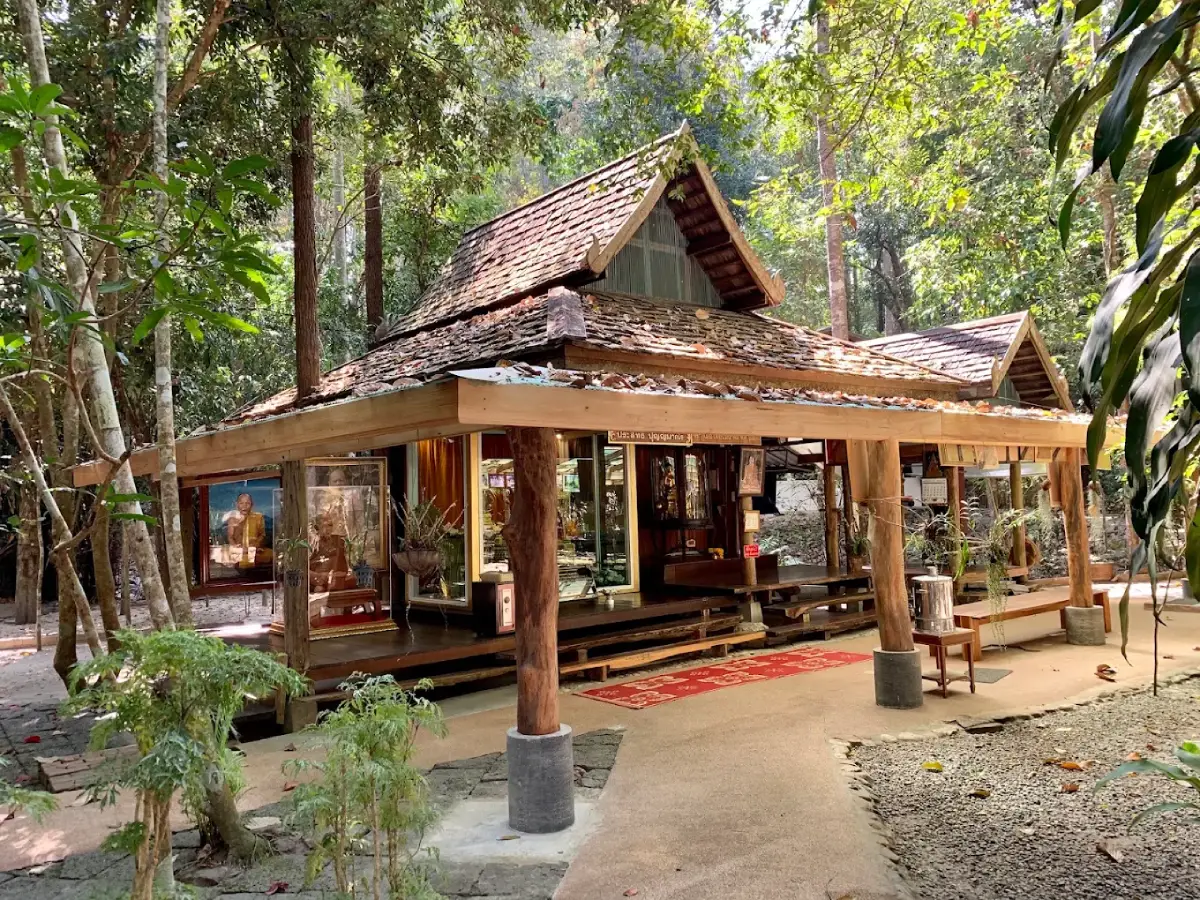
Open Days: Daily
Opening Hours: 08.00 - 17.00
Wat Pa Mu Mai in Ban Hua Pa Ha, Moo 2, Mae Taeng Subdistrict, Mae Taeng District, Chiang Mai Province, is a Dhammayut forest temple known for its peaceful atmosphere, deep shade, large trees, simple monastic lifestyle, and connection with Luang Pho Prasit Punyamakaro, a respected Thai forest monk. The temple is suitable for visitors who want to pay respect to the Buddha, experience a quiet meditation environment, learn about the Thai forest tradition, and understand a form of Lanna Buddhist culture rooted in simplicity, seclusion, and mindfulness.
Wat Pa Mu Mai is located in Mae Taeng Subdistrict, an old community area in Mae Taeng District. Ban Hua Pa Ha is Moo 2 of Mae Taeng Subdistrict, a village connected with local agriculture, the Mae Taeng River area, and the Chiang Mai-Fang route. The temple is not merely a tourist attraction. It is a living religious place rooted in local community life, monastic practice, and the faith of Buddhist devotees who come to experience quietness and inner reflection.
The name “Wat Pa Mu Mai” reflects the temple’s character. “Wat Pa” means a forest temple, while “Mu Mai” refers to the local village area. A forest temple is not defined only by having many trees. It is also defined by a way of practice that emphasizes simplicity, seclusion, discipline, and meditation. Visitors who enter Wat Pa Mu Mai will immediately feel a different atmosphere from urban temples or large sightseeing temples. The space is quiet, shaded, and designed to support contemplation rather than entertainment.
Wat Pa Mu Mai belongs to the Dhammayut monastic order and is located in Moo 2, Ban Hua Pa Ha, Mae Taeng Subdistrict, Mae Taeng District, Chiang Mai Province. Its Dhammayut identity is important because many forest temples in northern Thailand are connected with the meditation tradition of Luang Pu Mun Bhuridatto. This tradition emphasizes morality, concentration, wisdom, simplicity, and strict monastic discipline. Wat Pa Mu Mai therefore has cultural value as a forest meditation temple that preserves a quiet environment for practice.
The temple’s history is closely associated with Luang Pho Prasit Punyamakaro, a respected forest monk. Luang Pho Prasit was a disciple in the lineage of Luang Pu On Yanasiri and later practiced with Luang Pu Chob Thanasamo. He then traveled north and practiced with Luang Pu Waen Suchinno at Wat Doi Mae Pang in Chiang Mai Province. During his search for a secluded place, he found a quiet forest area behind the Mae Taeng irrigation office. He requested permission to establish a monastic residence there, and the place gradually developed into Wat Pa Mu Mai.
Luang Pho Prasit’s role gives Wat Pa Mu Mai deeper significance. He did not merely establish a temple. He shaped the temple around the values of forest practice. He preserved the original forest condition and continued planting more trees, creating a cool, shaded, and quiet environment. The monks’ wooden huts are spaced apart to support solitude and meditation. This layout reflects the purpose of a forest temple: to provide enough seclusion for monks and lay practitioners to cultivate mindfulness and concentration.
The forest-temple character of Wat Pa Mu Mai is also reflected in the way daily life was organized. In the past, electricity was used only in limited areas such as road lighting, the main hall, the ordination area, and the front restrooms. The monks’ huts were not connected to electricity, encouraging monks, novices, and lay practitioners to live simply with flashlights, candles, or lamps at night. This approach reduced worldly distractions and made the temple especially suitable for meditation practice.
The temple includes important structures typical of a forest meditation monastery. These include a 2-storey multipurpose hall, where the lower level is used for worship, chanting, Dhamma listening, and meals, while the upper level functions as the ordination hall. There is also a kitchen hall, monks’ huts, and accommodation huts for lay practitioners. The temple plan does not focus on grandeur. It emphasizes moderation, cleanliness, quietness, and practical use for meditation and monastic discipline.
One of the strongest features of Wat Pa Mu Mai is the relationship between the temple and the forest. The temple sits among large trees and preserved woodland. This gives the whole place a cool and calm atmosphere. Visitors should walk quietly because much of the temple is used for meditation practice. Unlike commercial tourist attractions, the temple’s value lies in its simplicity and silence. The natural surroundings help visitors slow down and experience the deeper meaning of a forest temple.
Wat Pa Mu Mai is also significant today because of the construction and worship of the Great Chedi of Luang Pho Prasit Punyamakaro. This chedi serves as a memorial to the respected forest monk and as a center of devotion for his followers. The Chiang Mai Provincial Office of Buddhism reported a ceremony for enshrining Buddha relics and raising the top umbrella finial of the Great Chedi at Wat Pa Mu Mai on March 5, 2026. This event confirms that the temple remains active and continues to be an important Buddhist site in Mae Taeng.
The Great Chedi of Luang Pho Prasit Punyamakaro is an important place to visit within the temple. It symbolizes gratitude to a revered teacher and functions as a sacred site for worship. The enshrinement of Buddha relics and the raising of the umbrella finial are important Buddhist ceremonies. They transform the chedi into a place where devotees can pay respect to the Buddha, the Dhamma, the Sangha, and the teacher who shaped the temple’s spiritual foundation.
Luang Pho Prasit Punyamakaro passed away on July 31, 2016, at the age of 75 with 55 rains retreats. His way of practice remains central to Wat Pa Mu Mai. His life story, from his birthplace in Udon Thani to his ordination, study with forest teachers, journeys through northern Thailand, and establishment of Wat Pa Mu Mai, makes the temple a meaningful place for those interested in Thai forest monks. Visitors can understand the temple not only as a religious site, but also as a place shaped by a specific lineage of practice.
Wat Pa Mu Mai plays several roles for Ban Hua Pa Ha and Mae Taeng Subdistrict. It is a place for Buddhist ceremonies, merit-making, Dhamma listening, meditation, and monastic support. It is also a green and peaceful space for the local community. By preserving its forest environment, the temple functions as a small cultural and ecological sanctuary. This relationship between community, Buddhism, and nature is an important part of northern Thai religious life.
Important Buddhist activities at Wat Pa Mu Mai include observances on Buddhist holy days, Dhamma practice, meditation, and the annual Kathin robe-offering ceremony. A 2022 Kathin listing recorded merit-making at Wat Pa Mu Mai to support the construction of the chedi of Luang Pho Prasit Punyamakaro. Kathin is not only a robe-offering ceremony after the rains retreat. At this temple, it also connects devotees with the care of a sacred memorial and the continuation of the forest temple tradition.
For cultural travelers, the most important things to see at Wat Pa Mu Mai are the shaded forest atmosphere, the multipurpose hall, the ordination space, the monks’ huts set within the forest, walking meditation areas, and the Great Chedi of Luang Pho Prasit Punyamakaro. The temple’s appeal is not based on decorative extravagance. Its value lies in restraint, simplicity, silence, and the spiritual quality of a place designed for practice.
The temple is especially suitable for visitors interested in forest monks, meditation, Thai Buddhist practice, and quiet cultural travel. It is not a place for loud tourism. Visitors should speak softly, avoid disturbing monks and practitioners, and not enter residential monastic areas without permission. Respect for silence is the most important rule when visiting Wat Pa Mu Mai.
Visitors should dress politely and choose comfortable shoes that can be removed easily. If planning to walk around the temple for a longer period, bring drinking water and avoid bringing unnecessary plastic or food waste into the temple grounds. The temple’s value comes from its cleanliness, simplicity, and forest environment. Visitors help preserve that atmosphere by behaving with care.
Traveling to Wat Pa Mu Mai is most convenient by private car, rental car, or hired driver. From Chiang Mai city, take the Chiang Mai-Fang route toward Mae Taeng District, pass the Mae Malai area, then continue into Mae Taeng Subdistrict and Ban Hua Pa Ha. The temple is located behind the Mae Taeng irrigation office area, about 1.5 km from the office according to visitor accounts. The route is suitable for a day trip from Chiang Mai city.
Travelers using public transportation should first reach Mae Taeng District or the Mae Malai area, then continue by local transport or hired vehicle to Ban Hua Pa Ha. Rural transport is less frequent than city transport, so planning ahead is recommended. Visitors who want to combine several destinations in one day will find a private vehicle more practical because Wat Pa Mu Mai can be combined with nearby temples, restaurants, and natural attractions in Mae Taeng.
A suitable route can begin at Wat Pa Mu Mai in the morning for worship and a quiet temple walk. Visitors can then continue to Wat Pa Na Bun or Wat Pa Huai Chomphu, which are also in Mae Taeng Subdistrict, before visiting Wat Den Sali Sri Muang Kaen for large-scale Lanna architecture. For a nature-focused extension, continue to Mae Ngat Somboon Chon Dam or Bua Tong Waterfall and Chet Si Spring. This route combines forest temples, local culture, and natural scenery in one day.
Overall, Wat Pa Mu Mai is a destination for travelers who seek quietness rather than crowds. It values simplicity more than luxury and meditation more than spectacle. The temple shows that Lanna Buddhist culture is not only about ornate architecture, but also about forest practice, respect for teachers, coexistence with nature, and training the mind. For those who want to understand Mae Taeng more deeply, Wat Pa Mu Mai is one of the most meaningful cultural stops in the district.
| Name | Wat Pa Mu Mai |
| Location | Ban Hua Pa Ha, Moo 2, Mae Taeng Subdistrict, Mae Taeng District, Chiang Mai Province |
| Address | Moo 2, Ban Hua Pa Ha, Mae Taeng Subdistrict, Mae Taeng District, Chiang Mai 50150, Thailand |
| Temple Type | Dhammayut forest meditation temple |
| Highlights | Quiet forest temple with large trees, meditation atmosphere, walking meditation areas, and the legacy of Luang Pho Prasit Punyamakaro |
| History | Luang Pho Prasit Punyamakaro found a secluded forest area behind the Mae Taeng irrigation office, requested permission to establish a monastic residence, and developed it into Wat Pa Mu Mai |
| Important Figure | Luang Pho Prasit Punyamakaro, the forest monk who founded and shaped the temple’s meditation tradition |
| Main Structures | 2-storey multipurpose hall, ordination space, kitchen hall, monks’ huts, lay practitioner huts, and the Great Chedi of Luang Pho Prasit Punyamakaro |
| Main Areas / Zones | Shaded forest area, meditation huts, walking meditation paths, Dhamma hall, and the Great Chedi area |
| Distinctive Features | Simple and peaceful forest temple atmosphere suitable for meditation, Dhamma practice, and quiet cultural travel |
| Open Days | Daily |
| Opening Hours | 08.00 - 17.00 |
| Travel Information | From Chiang Mai city, take the Chiang Mai-Fang route toward Mae Taeng District, pass Mae Malai, then continue into Mae Taeng Subdistrict and Ban Hua Pa Ha. Private car, rental car, or hired driver is recommended |
| Current Status | Open as a Dhammayut forest temple and cultural Buddhist attraction in Mae Taeng District, Chiang Mai Province |
| Important Traditions | Buddhist holy day observances, Dhamma practice, meditation, annual Kathin robe-offering ceremony, and ceremonies related to the Great Chedi of Luang Pho Prasit Punyamakaro |
| Visitor Etiquette | Dress respectfully, keep quiet, do not enter monks’ residences or meditation areas without permission, and help preserve the clean and peaceful forest environment |
| Nearby Tourist Attractions | 1. Wat Pa Na Bun, about 4 km 2. Wat Pa Huai Chomphu, about 5 km 3. Wat Phra That Siwichai, about 5 km 4. Wat Den Sali Sri Muang Kaen, about 14 km 5. Mae Ngat Somboon Chon Dam, about 17 km |
| Nearby Restaurants | 1. Moo Inter Mae Malai, about 6 km, Tel. 093-135-2929 2. Baan Suan Chomchan Mae Taeng, about 9 km, Tel. 053-047-111, 089-433-5819 3. Lae Phu Doona Cafe Mae Taeng, about 17 km, Tel. 093-275-3888 4. Doona Resort Restaurant, about 17 km, Tel. 093-275-3888 5. Restaurants in Mae Malai area, about 6 km |
| Nearby Accommodations | 1. Mae Malai Mansion, about 6 km, Tel. 053-842-620, 095-610-6489 2. Maetaeng Homestay & Resort, about 8 km, Tel. 086-399-9144 3. Mae Malai Hotel, about 6 km, Tel. 053-842-620 4. Phusanfah Resort, about 15 km, Tel. 053-106-437 5. Doona Resort, about 17 km, Tel. 093-275-3888 |
Frequently Asked Questions (FAQ)
Q: Where is Wat Pa Mu Mai located?
A: Wat Pa Mu Mai is located in Moo 2, Ban Hua Pa Ha, Mae Taeng Subdistrict, Mae Taeng District, Chiang Mai Province. It is a Dhammayut forest temple in Mae Taeng.
Q: What are the opening days and hours of Wat Pa Mu Mai?
A: Wat Pa Mu Mai is open daily from 08.00 to 17.00.
Q: Why is Wat Pa Mu Mai important?
A: The temple is important as a Dhammayut forest meditation temple associated with Luang Pho Prasit Punyamakaro, who established and shaped its forest practice tradition.
Q: What should visitors see inside Wat Pa Mu Mai?
A: Visitors should experience the shaded forest atmosphere, the multipurpose hall, the ordination space, meditation huts, walking meditation paths, and the Great Chedi of Luang Pho Prasit Punyamakaro.
Q: What type of travelers is Wat Pa Mu Mai suitable for?
A: It is suitable for travelers interested in forest temples, Thai meditation practice, quiet Buddhist sites, forest monks, and cultural travel in Mae Taeng.
Q: How can travelers get to Wat Pa Mu Mai?
A: From Chiang Mai city, take the Chiang Mai-Fang route toward Mae Taeng District, pass Mae Malai, then continue into Mae Taeng Subdistrict and Ban Hua Pa Ha. A private car or rental car is the most convenient option.
Q: What nearby places can be visited with Wat Pa Mu Mai?
A: Nearby places include Wat Pa Na Bun, Wat Pa Huai Chomphu, Wat Phra That Siwichai, Wat Den Sali Sri Muang Kaen, and Mae Ngat Somboon Chon Dam.
 Category: ●Places of Worship
 Group: ●Temple
Last Update : 3 DayAgo
 Last Update : 3 DayAgo
 Click to Access the Navigation Map GPS
Wat Pa Mu Mai Map
Recommend

 Muang Chiang Mai(121)Chom Thong(47)Mae Chaem(25)Chiang Dao(33)Doi Saket(68)Mae Taeng(85)Mae Rim(69)Samoeng(29)Fang(71)Mae Ai(62)Phrao(70)San Pa Tong(105)San Kamphaeng(66)San Sai(73)Hang Dong(74)Hot(32)Doi Tao(22)Omkoi(11)Saraphi(74)Wiang Haeng(15)Chai Prakan(28)Mae Wang(32)Mae On(22)Doi Lo(34)Galyani Vadhana(1)


