
lovethailand home >North Travel Attractions >Chiang Mai Travel Attractions >Mae Taeng >Mae Taeng > Wat Thara Thip Chai Pradit
TL;DR: Wat Thara Thip Chai Pradit is located at Ban Huai Chomphu, Moo 8, Mae Taeng Subdistrict, Mae Taeng District, Chiang Mai Province, open Daily, hours 08.00 - 17.00.

Wat Thara Thip Chai Pradit
Open Days: Daily
Opening Hours: 08.00 - 17.00
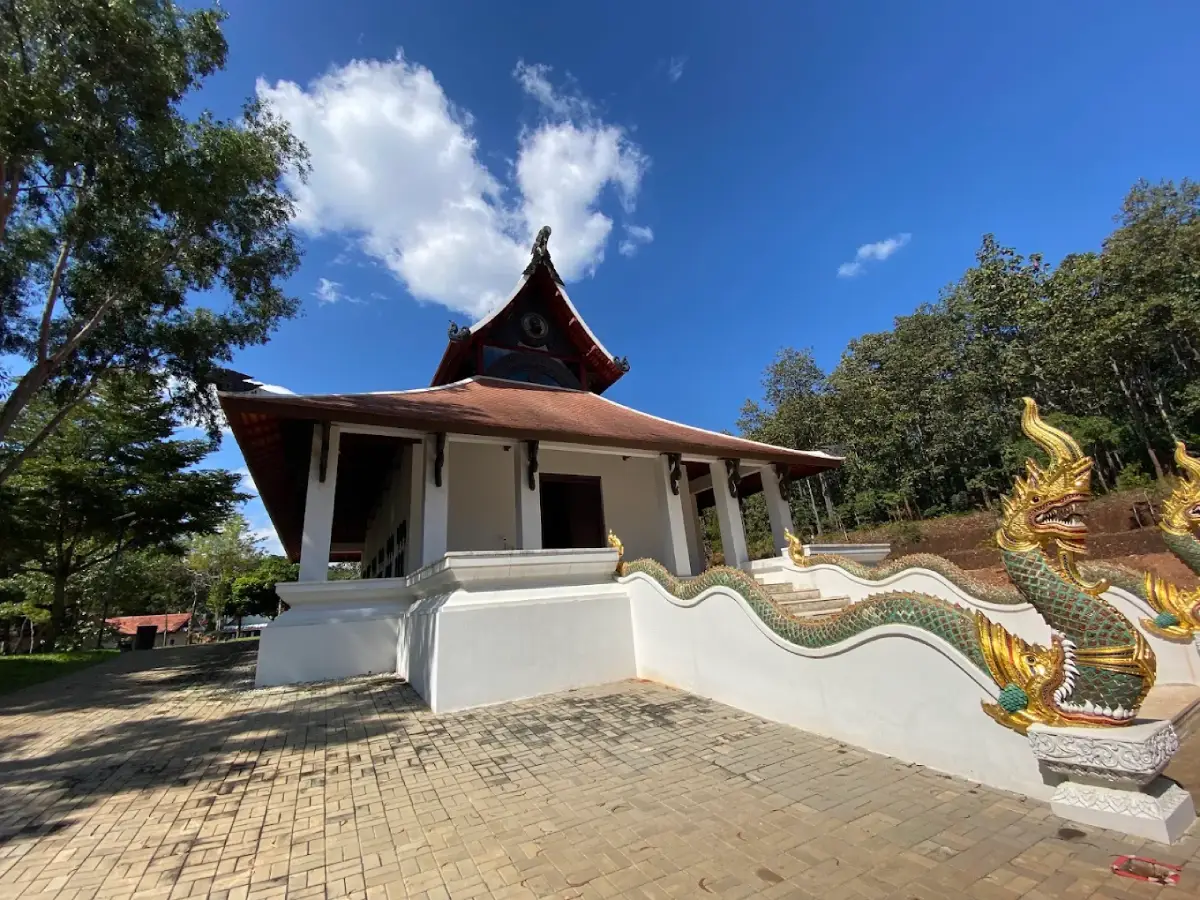
Wat Thara Thip Chai Pradit in Ban Huai Chomphu, Moo 8, Mae Taeng Subdistrict, Mae Taeng District, Chiang Mai Province, is an important cultural temple known for its Buddhist devotion, local history, contemporary sacred art, and royal-supported restoration work. The temple is suitable for travelers who want to make merit, admire mural paintings, learn about the restoration of a Lanna-style vihara, and experience a quiet community temple connected with the people of Ban Huai Chomphu. Its main highlights are the vihara, Phra Phuttha Patima Siriphaniramit, the Mahajanaka mural paintings, the sacred spring, and a temple landscape developed as a place for Buddhist and cultural learning.
Wat Thara Thip Chai Pradit is not a typical village temple. Its story combines the faith of Phra Khru Worawet Wisit, also known as Luang Pu Kruba Dhammachai Dhammachayo, the local belief in the sacred spring, and the restoration initiated by Her Royal Highness Princess Siribhachudhabhorn to preserve Buddhism and Thai art. The temple is therefore more than a place for worship. It is a cultural site that shows how local faith, Lanna artistic traditions, and the intention to conserve Buddhist heritage can meet in one sacred landscape.
For travelers planning a trip to Mae Taeng District, Wat Thara Thip Chai Pradit fits well into an itinerary that combines temples, local culture, restaurants, accommodations, and natural attractions. The temple is located in Ban Huai Chomphu, a calm rural community in Mae Taeng. Visitors can experience both the beauty of the temple and the atmosphere of a living northern Thai village. Unlike large tourist temples that focus mainly on sightseeing, this temple offers a quieter and more reflective cultural visit.
The history of Wat Thara Thip Chai Pradit began in 1979, when Phra Khru Worawet Wisit, or Luang Pu Kruba Dhammachai Dhammachayo, came to meditate near the sacred spring. He told his followers that this place had a spring associated with relief from illness and that a monastic residence would one day be established here. His disciples later contacted relevant authorities, acquired land, improved the area, built monks’ quarters, a pavilion, a road leading to the sacred spring and vihara, and a reservoir to collect water from the spring. This gradual development laid the foundation for the temple as a spiritual center for Ban Huai Chomphu.
Information from the Suthirat Yoovidhya Foundation states that Wat Thara Thip Chai Pradit was founded in 1980 by Phra Khru Worawet Wisit, Luang Pu Kruba Dhammachai Dhammachayo. This background shows the temple’s growth from a sacred spring and small monastic site into a community temple with lasting importance. The temple did not begin as a large tourist destination. It began from faith, local belief, and the need for a Buddhist place where villagers could gather, practice, and make merit.
Ban Huai Chomphu is closely tied to the temple’s history. The village was formerly under the administration of Moo 1, Ban Thung Luang, Mae Taeng Subdistrict, before becoming an officially separated village in March 1984. Most residents worked in agriculture, gardening, farming, and general labor. Wat Thara Thip Chai Pradit became the spiritual center of the village, a place for Buddhist ceremonies, emotional support, and community identity. The temple therefore reflects the growth of Ban Huai Chomphu as a village with Buddhism at its heart.
The sacred spring is one of the most important elements in the temple’s story. Local people believe that the spring is associated with Uchun Naga. Water seeps continuously from the hillside, and in the past villagers regarded it as sacred water. People who were ill or passing through the area would come to pray and take the water with faith. This belief reflects the relationship between nature, local spirituality, and Buddhism in Lanna society, where springs, hills, and sacred places often form part of community life.
The temple is now especially known for the restoration of its vihara and the art inside it. Her Royal Highness Princess Siribhachudhabhorn initiated the restoration after seeing the temple and vihara walls in a deteriorated condition. Drawing on her artistic education from Silpakorn University, she applied her knowledge to support Buddhist and cultural conservation. The vihara was restored with an architectural style that combines local Lanna artistic elements, while the temple plan was organized to serve religious, monastic, and meditation functions.
The mural paintings inside the vihara are among the temple’s most valuable features. Some of the murals draw inspiration from the royal literary work “Phra Mahajanaka” by His Majesty King Bhumibol Adulyadej The Great. The story of Mahajanaka emphasizes perseverance, wisdom, endurance, and public-minded leadership. These themes align closely with Buddhist teachings and make the murals an accessible learning tool for visitors and local communities.
The murals are not merely decorative. They form a visual narrative linking Buddhist teachings, royal literature, and contemporary Thai memory. The paintings include themes such as past Buddhas, the Buddhist cosmological universe, people compared with 7 types of water, and the royal oath “We shall reign with righteousness for the benefit and happiness of the Siamese people.” These themes help visitors understand the temple as a place where art teaches Dhamma and preserves the memory of King Rama IX’s moral vision.
The principal Buddha image inside the vihara is Phra Phuttha Patima Siriphaniramit. This sacred image received its name from His Majesty King Bhumibol Adulyadej The Great. The name refers to the Buddha image created by Her Royal Highness Princess Siribhachudhabhorn as an act of royal merit. The image is cast in bronze in the Mara Vichai posture, seated in the vajra posture, with a lotus-bud ushnisha. Its design draws inspiration from the Chiang Saen Singha I style and combines artistic influences from Gupta, Dvaravati, Srivijaya, and Hariphunchai traditions.
The base of the principal Buddha image contains details worth observing carefully. The lotus base symbolizes growth and spiritual awakening. At the center of the base is a sculpture of Mae Thorani wringing her hair, associated with the scene of the Buddha overcoming Mara. The royal monogram “ภปร” is placed in a significant position on the decorative cloth element. These details make Phra Phuttha Patima Siriphaniramit not only the main Buddha image of the vihara, but also a meaningful contemporary Buddhist artwork filled with symbolic and devotional value.
Phra Phuttha Patima Siriphaniramit is also important from an art-historical perspective. The sculptural work is associated with Professor Khemrat Kongsuk, a National Artist in visual art and sculpture. The combination of multiple Buddhist art traditions with a Lanna vihara setting makes the principal Buddha image valuable for those interested in Buddhist art. Visitors should take time to observe the image, the base, and the surrounding symbolic elements because each part carries both artistic and religious meaning.
The temple’s grounds have also been organized into functional zones, including the Buddhist sacred zone, the monastic zone, and a meditation area. This planning helps the temple serve as a proper religious space, a monks’ residence, and a meditation site for villagers and Buddhist visitors. The thoughtful organization of the temple area has helped raise Wat Thara Thip Chai Pradit from a small community religious site into a cultural learning destination with clearer spatial structure.
Wat Thara Thip Chai Pradit is under the patronage of Her Royal Highness Princess Siribhachudhabhorn and continues to host important Buddhist activities. In recent years, official news reports have mentioned the annual Kathin robe-offering ceremony at the temple. Public relations news from Chiang Mai also reported preparation for the 2025 Kathin ceremony, while Maejo University reported a 2026 committee meeting for Wat Thara Thip Chai Pradit under royal patronage to prepare for the annual Kathin ceremony. These reports confirm that the temple remains active and continues to play a role in Buddhist and community life.
The Kathin ceremony is one of the most important annual religious events connected with the temple. Kathin takes place after the Buddhist rains retreat and involves the offering of robes to monks who have completed the retreat. At Wat Thara Thip Chai Pradit, Kathin also supports temple maintenance, monks’ quarters, the kitchen, water and electricity expenses, and other temple needs. The ceremony therefore combines religious merit, community participation, and the practical care of the temple.
The latest abbot information found in a 2026 Maejo University report identifies Phra Ajarn Athiwat Ratanawanno as the abbot of Wat Thara Thip Chai Pradit. His presence in the report reflects the temple’s active administration and cooperation with committees and public institutions, especially for important Buddhist events under royal patronage. This helps confirm the temple’s current role as an active Buddhist site with clear religious leadership.
For travelers, the main experience at Wat Thara Thip Chai Pradit is the chance to see Buddhist art with both beauty and meaning. Visitors should begin by paying respect to Phra Phuttha Patima Siriphaniramit inside the vihara, then spend time viewing the murals and understanding the Mahajanaka story and the Dhamma lessons embedded in the paintings. Afterward, they can visit the sacred spring, which is the original source of local faith. This sequence helps visitors understand the temple through devotion, art, and community history.
The overall atmosphere of the temple is quiet and contemplative. It is best suited to cultural travelers, Buddhist visitors, art lovers, and anyone interested in Lanna temples beyond the usual tourist route. Visitors should dress respectfully, keep their voices low, and avoid disruptive photography in sacred or ceremonial areas. Because this is an active community temple, respectful conduct is essential.
Traveling to Wat Thara Thip Chai Pradit is most convenient by private car, rental car, or hired vehicle. From Chiang Mai city, take the Chiang Mai-Fang route toward Mae Taeng District, then continue into Mae Taeng Subdistrict and Ban Huai Chomphu. Travel time from Chiang Mai city to Mae Taeng is usually around 1 hour, depending on traffic. Once in Mae Taeng, visitors should use a navigation map to reach Ban Huai Chomphu because the temple is located inside a local community rather than directly on a major highway.
Travelers using public transportation should first reach Mae Taeng District or the Mae Malai area, then continue by local transport or hired vehicle to Ban Huai Chomphu. Because rural transport is less frequent than city transport, planning ahead is recommended. For visitors who want to combine multiple attractions in one day, a private car or hired driver is the most practical option, especially if the route includes Wat Den Sali Sri Muang Kaen, Mae Ngat Somboon Chon Dam, or Bua Tong Waterfall and Chet Si Spring.
A meaningful Mae Taeng itinerary can begin at Wat Thara Thip Chai Pradit in the morning, allowing time for worship, mural viewing, and learning about the sacred spring. Visitors can then continue to Wat Den Sali Sri Muang Kaen for large-scale Lanna architecture, followed by Mae Ngat Somboon Chon Dam or nearby natural attractions. For a more nature-focused route, continue to Bua Tong Waterfall and Chet Si Spring. This route combines temples, art, community history, and nature in one day.
Overall, Wat Thara Thip Chai Pradit deserves more attention as a cultural attraction in Mae Taeng. It has a clear founding history, a sacred spring connected with local belief, a vihara restored through royal initiative, a principal Buddha image of high artistic value, and mural paintings inspired by the Mahajanaka story. The temple is ideal for travelers who want more than a quick temple visit. It offers a deeper understanding of faith, art, community memory, and the cultural identity of Mae Taeng.
| Name | Wat Thara Thip Chai Pradit |
| Location | Ban Huai Chomphu, Moo 8, Mae Taeng Subdistrict, Mae Taeng District, Chiang Mai Province |
| Address | Moo 8, Ban Huai Chomphu, Mae Taeng Subdistrict, Mae Taeng District, Chiang Mai, Thailand |
| Coordinates | 19.167689, 98.930991 |
| Highlights | Restored vihara, Mahajanaka mural paintings, Phra Phuttha Patima Siriphaniramit, and the sacred spring of Ban Huai Chomphu |
| History | The temple began from Luang Pu Kruba Dhammachai Dhammachayo’s meditation near the sacred spring in 1979 and was founded in 1980 |
| Name Origin And Faith | The temple’s identity is closely linked with the sacred spring, which local villagers regard as an important source of faith |
| Distinctive Features | A Lanna temple combining local faith, contemporary Buddhist art, Mahajanaka murals, and royal-supported restoration work |
| Main Areas / Zones | Vihara, Buddhist sacred zone, monastic zone, meditation area, and sacred spring |
| Principal Buddha Image | Phra Phuttha Patima Siriphaniramit, a bronze Buddha image in the Mara Vichai posture inspired by Chiang Saen Singha I style and several Buddhist art traditions |
| Mural Paintings | Murals inside the vihara include the Mahajanaka story, past Buddhas, Buddhist cosmology, people compared with 7 types of water, and the royal oath of King Rama IX |
| Abbot / Caretaker | Phra Ajarn Athiwat Ratanawanno |
| Open Days | Daily |
| Opening Hours | 08.00 - 17.00 |
| Main Contact Number | 096-298-9554 |
| Travel Information | From Chiang Mai city, take the Chiang Mai-Fang route toward Mae Taeng District, then continue into Mae Taeng Subdistrict and Ban Huai Chomphu. Private car, rental car, or hired driver is recommended |
| Current Status | Open as a Buddhist temple and cultural attraction in Mae Taeng District, Chiang Mai Province |
| Important Tradition | Annual Kathin robe-offering ceremony and Buddhist merit-making activities |
| Nearby Tourist Attractions | 1. Wat Nong Bua Worawet Wisit, about 2 km 2. Wat Phra That Siwichai, about 3 km 3. Wat Den Sali Sri Muang Kaen, about 15 km 4. Mae Ngat Somboon Chon Dam, about 18 km 5. Bua Tong Waterfall and Chet Si Spring, about 28 km |
| Nearby Restaurants | 1. Moo Inter Mae Malai, about 7 km, Tel. 093-135-2929 2. Baan Suan Chomchan Mae Taeng, about 9 km, Tel. 053-047-111, 089-433-5819 3. Zab Nai Lueb at Tong Noi by Jacky, about 9 km 4. Sri Kaew Restaurant @ Mae Taeng, about 13 km, Tel. 082-574-7870 5. Doona Resort Restaurant, about 17 km, Tel. 093-275-3888 |
| Nearby Accommodations | 1. Mae Malai Mansion, about 8 km, Tel. 053-842620, 095-6106489 2. Maetaeng Homestay & Resort, about 9 km, Tel. 086-399-9144 3. OYO 1000 Maetang Hotel, about 8 km, Tel. 062-804-1040 4. Phusanfah Resort, about 15 km, Tel. 053-106437 5. Doona Resort, about 17 km, Tel. 093-275-3888 |
Frequently Asked Questions (FAQ)
Q: Where is Wat Thara Thip Chai Pradit located?
A: Wat Thara Thip Chai Pradit is located in Ban Huai Chomphu, Moo 8, Mae Taeng Subdistrict, Mae Taeng District, Chiang Mai Province. It is a cultural Buddhist temple known for its restored vihara, murals, and sacred spring.
Q: What days and hours is Wat Thara Thip Chai Pradit open?
A: The temple is open daily from 08.00 to 17.00.
Q: What is the main highlight of Wat Thara Thip Chai Pradit?
A: The main highlights are the restored vihara, the Mahajanaka mural paintings, Phra Phuttha Patima Siriphaniramit, and the sacred spring connected with local belief.
Q: How is the temple connected with Her Royal Highness Princess Siribhachudhabhorn?
A: Her Royal Highness Princess Siribhachudhabhorn initiated the restoration of the temple, vihara, and mural paintings as part of her dedication to preserving Buddhism and Thai cultural heritage.
Q: What is the principal Buddha image inside the vihara?
A: The principal Buddha image is Phra Phuttha Patima Siriphaniramit, a bronze Buddha image in the Mara Vichai posture inspired by Chiang Saen Singha I style and several Buddhist art traditions.
Q: How can travelers get to Wat Thara Thip Chai Pradit?
A: From Chiang Mai city, take the Chiang Mai-Fang route toward Mae Taeng District, then continue into Mae Taeng Subdistrict and Ban Huai Chomphu. A private car, rental car, or hired driver is the most convenient option.
Q: What important annual ceremony is held at the temple?
A: The temple is associated with the annual Kathin robe-offering ceremony, an important Buddhist event that supports temple maintenance and community participation.
 Category: ●Places of Worship
 Group: ●Temple
Last Update : 2 DayAgo
 Last Update : 2 DayAgo
 Click to Access the Navigation Map GPS
Wat Thara Thip Chai Pradit Map
Recommend

 Muang Chiang Mai(121)Chom Thong(47)Mae Chaem(25)Chiang Dao(33)Doi Saket(68)Mae Taeng(85)Mae Rim(69)Samoeng(29)Fang(71)Mae Ai(62)Phrao(70)San Pa Tong(105)San Kamphaeng(66)San Sai(73)Hang Dong(74)Hot(32)Doi Tao(22)Omkoi(11)Saraphi(74)Wiang Haeng(15)Chai Prakan(28)Mae Wang(32)Mae On(22)Doi Lo(34)Galyani Vadhana(1)


