

 Home
Home Chiang Mai(




Rating: 3.1/5 (7 votes)
 |
|  Map
Map 
 Have Map
  No Map
Phetchaburi attractions
Attractions in Thailand
Open Days: It is recommended to contact Pak Thale Subdistrict Administrative Organization (SAO) to make an appointment / confirm activity rounds before visiting
Opening Hours: Vary depending on the most suitable birdwatching time and local learning activities (please check in advance)
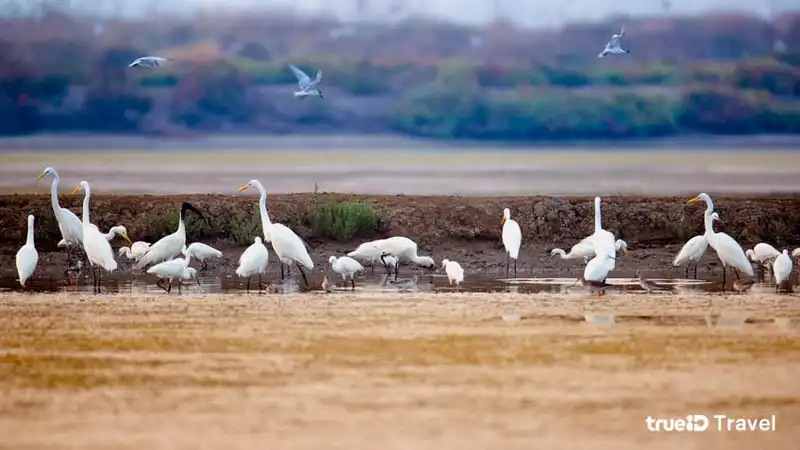
Pak Thale Bird & Ecosystem Learning Center is located in Moo 2, Pak Thale Subdistrict, Ban Laem District, Phetchaburi Province. It is a destination for anyone who wants to truly understand “shorebirds” and coastal ecosystems by seeing them in their real habitat—rather than simply viewing birds in photos or reading signboards. Here, you stand within the landscape where birds actually live: shallow ponds, mudflats, mangroves, and salt pans. Together, these connected habitats form a food web and living network for both migratory and resident birds along the Inner Gulf of Thailand.
“Ban Pak Thale” is a familiar name among Thai birdwatchers and nature-focused travelers because Pak Thale and the surrounding coastline provide ideal conditions for many shorebird species. This is especially true during migration season, when birds from northern regions travel south and use Thailand’s coast as a stopover to rest, feed, and rebuild energy before continuing their journey. Some species remain throughout the entire wintering period. As a result, visiting this learning center is not only about “seeing birds,” but also about understanding migration routes, habitat change, and the vital role of coastal wetlands in supporting biodiversity across the region.
One highlight that makes Pak Thale especially compelling is the possibility of encountering the Spoon-billed Sandpiper, a globally rare shorebird with extremely high conservation concern. Simply hearing its name often sharpens people’s image of Pak Thale, because it symbolizes that this coastline can still provide essential feeding and refuge habitat for internationally important migratory shorebirds. While sightings depend on season, local conditions, and the natural unpredictability of wildlife, learning why Thailand’s coast matters to the survival of long-distance migrants already makes the trip more meaningful than a typical photo stop.
When you look at the bigger picture of the “Pak Thale ecosystem,” its uniqueness does not come from any single element, but from several interconnected micro-habitats working together. Mangroves help trap sediment, reduce erosion, and provide nursery areas for young aquatic life. Mudflats are rich in benthic organisms—key food resources for shorebirds. Shallow water zones and salt pans offer water depths that are ideal for many species to forage. At different times, you might see birds pecking for tiny prey on the mud, flying in large flocks along the shoreline, or resting in groups along salt-pan embankments. These scenes reinforce a core lesson: nature is not separated into isolated pieces, but functions as a system in which each habitat supports the others.
This is why visiting Pak Thale suits people who want to “read the landscape” as part of the learning process. Rather than focusing only on birds as the goal, you begin to observe the environmental conditions that attract birds here—such as shallow versus deeper water, the quietness of feeding areas, continuity of wetland habitat, and changes over time like tides and wind direction. Once you start noticing these factors, you understand why birds may be distant on some days and closer on others, why flocks gather at specific times, and why some species prefer salt pans more than natural mudflats. These observations become real-time ecosystem science, and they naturally deepen the birdwatching experience.
Another reason Pak Thale is distinctive is the close connection between nature and community livelihoods. The Ban Laem coastline supports small-scale fishing, salt farming, wetland management, and seasonal resource use. Many local residents grow up learning how to read the sky and wind, understand tidal cycles, and recognize how mudflats and shallow-water habitats support aquatic life and food security. When the learning center connects this local knowledge with birdwatching, visitors can see clearly that “conservation” does not necessarily mean forbidding all human use. Instead, it means keeping nature functioning while ensuring the community can continue to live sustainably.
As a travel experience, Pak Thale is best for people who appreciate calm environments and the small details of nature. Its appeal is not the spectacle of a major tourist complex, but the quiet moments of listening to the wind, the waves, and bird calls while observing life along the coast. If you visit early in the morning or in the late afternoon, the weather is generally more comfortable and the light is beautiful—ideal for watching and photographing birds. Even so, responsible bird photography matters here: do not approach too closely, do not chase birds for flight shots, and avoid using sounds or behaviors that cause stress. Migratory birds in particular must conserve energy, and disturbance can have real costs.
One major factor for coastal birdwatching is “seasonality,” because bird species and numbers change throughout the year. In general, migration and wintering periods tend to bring higher diversity, but seeing particularly rare or signature species still depends on multiple conditions—weather along migration routes, the quality of local food resources, and the quietness of feeding grounds. For that reason, Pak Thale works well for both visitors hoping to “try their luck” with rare sightings and visitors who want to learn the ecosystem as a whole. Even if a target species does not appear, the ecological understanding you gain from coastal wetlands and shorebirds remains a worthwhile outcome.
For families, students, universities, or organizations seeking structured learning, Pak Thale can be developed into curriculum-based learning, environmental camps, and field trips. Activities can be designed for different ages and objectives. For younger learners, the focus can be on basic bird identification, using binoculars, observing simple feeding behaviors, and keeping short nature notes. For secondary and higher education levels, learning can expand to food webs, habitat reading, wetland suitability assessment, comparing how land-use changes affect birds, or citizen science activities that build standardized field data skills.
An environmental camp format that suits Pak Thale often uses multiple “learning stations” that connect into one storyline: Station 1 introduces coastal landscapes and wetland significance; Station 2 covers shorebirds and birdwatching tools; Station 3 focuses on behavioral observation and field-note methods; Station 4 explains how salt pans, mudflats, and mangroves support food resources; Station 5 explores community roles and sustainable coexistence. When participants complete the full sequence, they usually see the system clearly: birds do not exist in isolation, but depend on complex habitat mosaics—and those mosaics require thoughtful management as much as they require conservation.
Pak Thale also suits interdisciplinary field learning. In one trip, learners can connect environmental science, biology, geography, natural resource management, ecotourism, and even language/communication through field reports. The strength of this place is that it offers a complete “systems narrative” for real project work: biodiversity and rare-species conservation, community–coast relationships, and land-use practices such as salt farming and artisanal fisheries. This can be turned into practical student projects—seasonal bird surveys, feeding-behavior observations aligned with tides, or public communication projects for conservation awareness.
In practical terms, visitors should prepare for coastal birdwatching: a hat, long sleeves in neutral colors, comfortable walking shoes, drinking water, and—if possible—binoculars or a long-lens camera. Many birds keep distance for safety, and quiet movement helps you observe more naturally. Also be mindful of glare from shallow water and open skies, which can strain eyes. If visiting with children or seniors, plan rest points, shade breaks, and timing carefully so learning remains comfortable and continuous.
For travel directions, a commonly used route from Bangkok to Pak Thale follows the Khlong Khon corridor through Ban Laem District, then continues south for approximately 12 km (approximate) toward Pak Thale. From Phetchaburi city, travel east for approximately 8 km (approximate) to reach the Pak Thale area. In practice, exact routes may vary depending on the birdwatching point you want to visit that day—such as water-control points, shallow ponds, or salt-pan embankments. It is recommended to coordinate with Pak Thale SAO or a local contact so you can reach suitable viewing locations efficiently and avoid getting lost on small community roads.
Ultimately, the value of visiting the “Pak Thale Bird & Ecosystem Learning Center” is not just checking in, but gradually understanding the “logic of nature”: why shorebirds are drawn to this kind of coastline, why wetlands require ongoing care, and why good ecotourism should increase understanding and responsibility rather than add pressure to nature and the community. If you come with a genuine learning mindset, even a short visit can leave you with a deeper perspective on the sea, the coast, and the lives of birds that travel across continents and pause at Pak Thale.
| Place Summary | A coastal birdwatching site and ecosystem learning area in Pak Thale, Ban Laem, Phetchaburi, known for shorebirds and coastal wetland habitats. Suitable for ecotourism, field trips, and bird-focused learning activities. |
| Key Highlights | 1) A well-known shorebird viewing area in Phetchaburi and the Inner Gulf of Thailand 2) Learn a complete coastal ecosystem mosaic (mudflats – shallow ponds – mangroves – salt pans) 3) Well-suited for “curriculum-based learning / environmental camps / field trips” 4) Calm atmosphere, ideal for observing bird behavior and nature photography without rushing 5) Strong linkage between nature and coastal community livelihoods (fishing / salt farming), supporting place-based conservation learning |
| Address | Moo 2, Pak Thale Subdistrict, Ban Laem District, Phetchaburi 76110, Thailand |
| Getting There | From Bangkok: Use the Khlong Khon route, pass through Ban Laem District, then continue south to Pak Thale for ~12 km (approx.) From Phetchaburi City: Travel east toward the Pak Thale area for ~8 km (approx.) |
| Current Status | A community-based learning and birdwatching area; advance contact is recommended to access suitable viewing points and activity formats |
| Contact Numbers | Pak Thale SAO: 032-783-590 ext. 1 (or 032-783-591) Local Birdwatching Coordinator (P’Daeng): 082-223-5250 |
| Nearby Tourist Attractions | 1) Pak Thale Birdwatching Points / Wetland & Salt Pans ~1 km 2) Laem Phak Bia (Coastal Nature Area) ~12 km 3) Chao Samran Beach ~20 km 4) Bang Tabun (Community Lifestyle & Seafood Area) ~25 km 5) Phetchaburi City (Old Town / Major Temples Area) ~28 km |
| Nearby Restaurants | 1) Ran Pa Iad (Made-to-Order Thai Food) ~2 km Tel. 082-294-1265 2) Manora Restaurant (Ban Laem, Phetchaburi) ~3 km Tel. 063-578-8143, 092-613-6709 3) Coco&coff ~10 km Tel. 086-688-9701 4) Baan Talay Seafood (Laem Phak Bia Area) ~15 km Tel. 085-405-2856 5) Khrua Lung Yut (Bang Tabun Area) ~25 km Tel. 081-941-5260 |
| Nearby Accommodations | 1) Chom Talay Resort (Chao Samran Beach Area) ~20 km Tel. 032-478-488, 032-478-489, 099-097-7271 2) Keang Kluen Talay Resort (Chao Samran Beach Area) ~21 km Tel. 032-890-223 3) Seaman Resort (Chao Samran Beach Area) ~22 km Tel. 081-846-1327, 089-122-7968 4) Fisherman’s Resort (Chao Samran Beach Area) ~22 km Tel. 032-478-020, 086-300-4510 5) Sea Sky Beach Resort (Chao Samran Beach Area) ~22 km Tel. 032-478-431 |
Frequently Asked Questions (FAQ)
Q: Who is the Pak Thale Bird & Ecosystem Learning Center suitable for?
A: It is suitable for nature lovers, birdwatchers, families who want hands-on outdoor learning for children, students, and organizations seeking coastal ecosystem study visits.
Q: Do I need to make an appointment in advance?
A: Advance contact is recommended, especially for group visits or structured learning activities, so a suitable birdwatching point and format can be arranged for that day.
Q: What time should I visit for better birdwatching?
A: Early morning and late afternoon are often most comfortable, with good light and active feeding behavior. Sightings still depend on season and local conditions, so checking ahead is helpful.
Q: Can we organize an environmental camp or field trip here?
A: Yes. Activities can be designed as learning stations such as shorebird introduction, birdwatching tools, field-note skills, and the relationship between wetlands, salt pans, and community livelihoods. Coordinate in advance to match age level and group size.
Q: What should I prepare before coming?
A: Bring a hat, long sleeves, comfortable shoes, drinking water, and—if possible—binoculars or a long-lens camera to observe birds from a respectful distance without disturbing wildlife.
 Learning Center About Birds Map
 Category:
  Group:
  Last Update: 1 DayAgo
Comment
 Nearby Attractions
| Keyword (Advance) |
 Region
|
 Muang Phetchaburi(