

 Home
Home Chiang Mai(




Rating: 4.2/5 (5 votes)
 |
|  Map
Map 
 Have Map
  No Map
Phetchaburi attractions
Attractions in Thailand
Open Days: Open for visits (it is recommended to contact in advance for group visits)
Opening Hours: Generally around 09:00 – 17:00 (hours may vary depending on activities and onsite management)
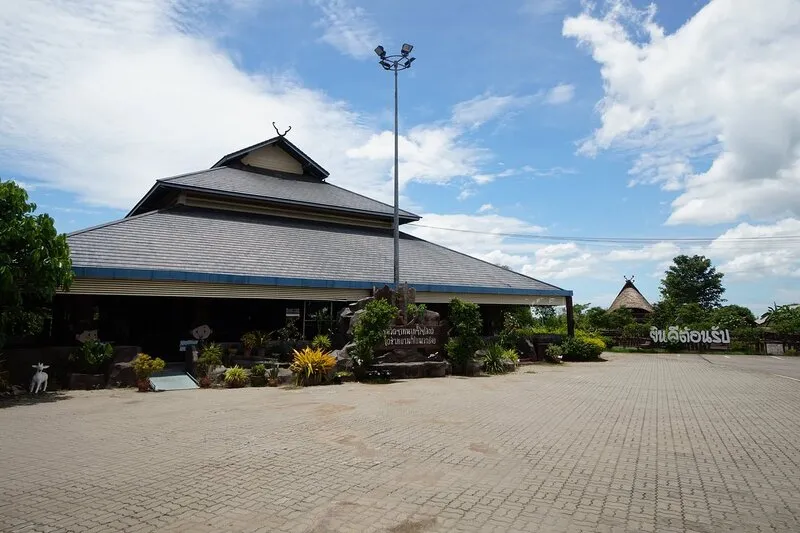
Thai Song Dam (Lao Song) Cultural Center, Khao Yoi, Phetchaburi is a distinctive cultural learning site in Phetchaburi Province. Located in Moo 5, Khao Yoi Subdistrict, Khao Yoi District, it was developed as a place to preserve and present “images of past ways of life” of the Thai Song Dam, or Lao Song, so that younger generations can continue learning. Through museum-style displays and living community activities, visitors can experience traditional textile weaving, basketry, dance practice, and khaen (mouth organ) lessons for children and youth on Saturdays and Sundays. These elements make the center more than a “storage of old objects”; it is a living cultural space where heritage still breathes and remains part of everyday community life.
For travelers looking for things to do in Khao Yoi beyond caves and mountains, the Thai Song Dam Cultural Center is an excellent choice. It helps explain Phetchaburi’s cultural diversity as a province where important ethnic communities have long settled. The Lao Song in Phetchaburi have preserved many clear identity markers, including spoken and written language, dress, beliefs, and skilled craftsmanship—especially their well-known weaving and basketry. A visit here feels like opening a window onto both the history of settlement and the continuity of living culture today.
Thai Song Dam, or Lao Song, are an ethnic group with narratives of ancestral homelands in mainland Southeast Asia and a strong cultural system with their own language and social symbols. Many families in Phetchaburi have inherited weaving and basketry knowledge as a vital form of cultural capital. What outsiders often recognize first is the signature black-toned clothing. Yet, with deeper learning, “black” is not simply a color preference; it is part of a broader meaning system that connects simplicity, craftsmanship, and the careful preservation of group forms across generations.
Upon entering the Thai Song Dam Cultural Center, visitors will immediately notice displays of everyday tools and household items, which help explain how self-reliant community life used to be. The exhibits include containers, kitchenware, farming tools, household equipment, and small details that reflect the community’s way of thinking and life order. There is also a model house that illustrates domestic space and family relationships, showing how “home” functions as a place of memory, warmth, and kinship gathering—the core of traditional community society.
Another notable section presents traditional scripts and language knowledge, which sit at the heart of identity transmission. Language is not only a communication tool but a cultural memory bank that carries the community’s worldview and values. For visitors unfamiliar with Thai Song Dam language, this part clarifies how having their own “written language” and “communication system” is a key marker of a community with historical continuity and a serious commitment to safeguarding its roots.
The center also offers weaving demonstrations, one of the highlights that many visitors come specifically to see. Thai Song Dam weaving is admired for both its aesthetic patterning and practical durability. Weaving is not merely production; it trains patience, precision, and the transfer of “tangible knowledge” from one generation to the next. This is why the souvenir area often features bags, clothing, and accessories that build on traditional craftsmanship, allowing travelers to support the community by purchasing products grounded in cultural heritage.
The center’s appeal goes beyond simply “walking through exhibitions.” It is especially meaningful to witness the space being used for real cultural learning by children and youth. On Saturdays and Sundays, the community often organizes training in traditional dance and khaen playing. This carries more significance than rehearsal for performance; it demonstrates that the community still values its roots and uses performing arts as a shared language for building collective pride. Dance and khaen become both skills and social media that help younger generations feel connected to their hometown identity.
In terms of especially lively periods, April each year draws attention because the Lao Song community celebrates Songkran as a joyful, social festival. The event rotates among villages, meaning Songkran is not structured simply as &ldquoorganizers and spectators” but as a community process that reaffirms kinship ties, mutual help, and shared ownership of cultural tradition. Visiting the center near the festival period, or asking about annual activities, adds context to the trip and highlights how traditions remain active in everyday life.
Beyond regular activities, the Thai Song Dam Cultural Center also welcomes group visitors who wish to request demonstrations or folk-tradition activities, such as the Sen Ruean ceremony (house-spirit offering), wedding rites, in-kon (traditional performance/chanting), luk chuang courtship games for young men and women, and khaen-accompanied dance. These activities typically require advance coordination and may involve fees depending on the format arranged for the group. Importantly, visitors should understand that a “ritual” is not merely a show; it belongs to the community’s belief world and relationship system. Respect should be shown to both the ritual practitioners and the place as a culturally meaningful space.
Regarding rituals, the “Sen Ruean” ceremony, or house-spirit offering, reflects ideas about the home and spiritual protection of the family. Such rituals often relate to affirming household stability, honoring protective forces, and providing reassurance to family members. While outsiders may view this as belief, socially it functions as a mechanism that brings the family together again, encourages communication, and helps reorder relationships within the home. It demonstrates that “belief” and “community life” are deeply intertwined.
Wedding rites in an ethnic-community context like Lao Song often follow sequences and symbols that differ from modern urban weddings. A key feature is the role of kinship networks and elders, who act as witnesses, coordinators, and social protectors for the couple. Understanding these wedding rites helps visitors see a social structure that emphasizes family recognition, long-term cohabitation, and the bonding of two households into an extended kin group—more than simply the story of two “lovers.”
Activities such as luk chuang games and khaen dance also reflect community society by providing a space for young people to meet and learn social etiquette within their cultural framework. Luk chuang is not only playful entertainment; it is a relationship system in which the community creates a safe space for introductions and getting to know one another. Khaen dance likewise is both performance and body language that communicates joy, harmony, and community unity. Seeing the Saturday–Sunday training makes it clear these arts are not preserved only to entertain tourists, but serve as “learning tools” that help the community continuously reproduce its identity each week.
For travelers who wish to stay overnight to study community life more closely, there is a simple community-based arrangement with a per-night fee according to the community’s structure. The key to this kind of learning stay is understanding that it is not “going to look” but “going to live alongside.” Therefore, etiquette such as dressing modestly, asking permission before photographing people or activities, respecting private spaces, and following the host family’s agreements will help ensure a smooth and mutually respectful experience.
Getting There If you drive, take Highway 4 (Phetkasem Road). After passing the Khao Yoi District intersection, continue toward Phetchaburi town for about 1 kilometer. Turn left at the entrance to Ban Wang School, then drive approximately 150 meters to reach the Thai Song Dam Cultural Center. Overall, the route follows a main road that is easy to drive, suitable for both a half-day Khao Yoi trip and travelers connecting onward to other attractions in Phetchaburi.
Overall, the Thai Song Dam (Lao Song) Cultural Center suits many types of travelers—families who want children to learn beyond the classroom, culture-focused visitors seeking deeper understanding of ethnic identity, and photography lovers drawn to the details of craftsmanship and community architecture. What you take away is not only photos, but also a richer understanding that “Phetchaburi” holds nuanced stories of people and culture, waiting to be discovered with genuine respect.
| Place Name | Thai Song Dam (Lao Song) Cultural Center, Khao Yoi |
| Location | Moo 5, Khao Yoi Subdistrict, Khao Yoi District, Phetchaburi Province |
| Key Highlights | A cultural learning center for Thai Song Dam/Lao Song heritage with displays of lifestyle artifacts, daily tools, a model house, traditional scripts, weaving demonstrations, souvenir products, and weekend dance–khaen training for younger generations |
| Open Days | Open for visits (recommended to contact in advance for group visits) |
| Opening Hours | Generally around 09:00 – 17:00 (hours may vary depending on activities and onsite management) |
| Admission Fee | Free admission |
| Contact | Tel. 032-561200, Email: thaisongdamkhaoyoi@gmail.com |
| GPS Coordinates | 13.228219, 99.828146 |
| Getting There | Highway 4: pass the Khao Yoi District intersection toward Phetchaburi town about 1 km, turn left at the Ban Wang School entrance, then continue about 150 m |
| Current Status | Open to visitors and may host educational group visits depending on arrangements |
| Nearby Tourist Attractions (With Distance) | 1) Tourist site/Chinese temple–shrine area (Khao Yoi) – approx. 1.2 km 2) Khao Yoi Arboretum – approx. 6.4 km 3) Khao Yoi Cave – approx. 0.4 km (very close) 4) Wat Khao Yoi – approx. 0.5 km (very close) 5) Hub Krapong Royal Development Study Center – (recommended to combine with a Khao Yoi–Cha-am route) |
| Nearby Restaurants (With Distance + Phone) | 1) Khao Kaeng Mae Luan – approx. 1.5 km – 032-562-384, 081-858-7946 2) Khao Kaeng Tamrab Mae Luan – approx. 1.5 km – 032-896941, 090-916-6659 3) Le Mae Cafe (Le Mae Cafe) – approx. 2.0 km – 095-251-9447 4) Kuay Teow Tom Yum Sathan Thung – approx. 2.0 km – 081-017-6586 5) Le Mae Cafe & Restaurant (front desk) – approx. 2.0 km – 095-251-9447 |
| Nearby Accommodations (With Distance + Phone) | 1) Le Mae Residence – approx. 1.0 km – 095-458-8836 2) NK Place – approx. 3.0 km – 086-314-4522 3) Sawang Resort & Golf Club – approx. 12.0 km – 081-192-4407 4) Pophouse Hotel – approx. 18.0 km – 032-706-796 5) A+ Hometel Phetchaburi – approx. 20.0 km – 097-978-5524 |
Frequently Asked Questions (FAQ)
Q: Where is the Thai Song Dam (Lao Song) Cultural Center located?
A: It is located in Moo 5, Khao Yoi Subdistrict, Khao Yoi District, Phetchaburi Province, near Phetkasem Road and the Khao Yoi area.
Q: Is there an admission fee?
A: Admission is generally free. However, for group visits requesting specific activities or performances, it is recommended to contact the center in advance to confirm any related costs.
Q: When is the best time to see cultural activities?
A: Saturdays and Sundays often include dance and khaen training for younger generations. April is also significant because the Lao Song community holds Songkran traditions that rotate among villages.
Q: How can a group request the Sen Ruean ceremony or folk activities?
A: Please contact the center in advance to coordinate the activity format and fees, as some programs require preparation of people and time to suit the group.
Q: Are there any visitor etiquette guidelines?
A: Dress modestly, respect onsite rules, ask permission before photographing individuals or ritual activities, and avoid disrupting children’s learning sessions.
Q: How can I contact the center?
A: You can call 032-561200 or email thaisongdamkhaoyoi@gmail.com.
 Lao Song (Thai Song Dam) Map
 Category:
  Group:
  Last Update: 1 DayAgo
Comment
 Nearby Attractions
| Keyword (Advance) |
 Facebook Fanpage
 Region
 Historical Sites and Monuments(
 Landmarks and Memorials(
 Royal Palace(
 Museums(
 Educational Places
 Educational Gardens, Farm(
 University
 Places of Worship
 Temple(
 Other religious and spiritural sites(
 Research and Development
 Royal Project(
 Suburban Living
 Village, Community(
 Floating Market(
 Nature and Wildlife
 National Parks and Marine Reserves(
 Mountain (Doi)(
 Dam, Reservoir, Lake(
 Waterfalls(
 Hot Springs(
 Caves(
 River, Canal(
 Bays and Beaches(
 Islands(
 Other natural attractions(
 Entertainment and Agricultural
 Zoos and Aquariums(
 Farm, Parks, Gardens and Ecotourism(
 Waterpark(
 Theater(
 Outdoor and Adventure Activities(
 Travel Articles, Recipes
 Travel Review, Food Review(