

 Home
Home Chiang Mai(




Rating: 3.8/5 (9 votes)
 |
|  Map
Map 
 Have Map
  No Map
Phetchaburi attractions
Attractions in Thailand
Open Days: Daily
Opening Hours: 08.00 – 17.00
Wat Khao Bandai It is located in Rai Som Subdistrict, Mueang Phetchaburi District, Phetchaburi Province. Locals have long known it as a “cave temple on a hill” with a vivid historical narrative, reflecting long-standing beliefs and the mountain-based monastic practice of earlier periods. The area was originally an ancient monastic retreat dating back to the Sukhothai era, before becoming a formal temple during the Ayutthaya period. Khao Bandai It is a modest hill, yet it contains many caves, giving the temple both the character of a religious sanctuary and a lived “sacred landscape” that visitors can physically experience through the uphill path, cave shrines with Buddha images, and layers of local stories passed down through generations.
The charm of Wat Khao Bandai It begins with the sense that this is not a typical lowland temple. As soon as you enter, you can clearly see how the lower temple grounds and the hillside zone exist together. The area below supports merit-making and community activities, while the upper area leads to caves and quiet spaces for meditation practice, offering a more secluded and contemplative atmosphere. This arrangement makes the temple suitable for families coming to pay respect and make merit, as well as for visitors who prefer to walk slowly and explore the site’s narrative layers, craftsmanship, and surrounding nature.
Historically, the temple is widely associated with a story set around B.E. 2171 (1628 CE) during the reign of King Songtham’s successors, when a figure known as “Phra Si Sin” (said to be related to King Songtham) was arrested and exiled from Ayutthaya to be imprisoned in a cave at Khao Bandai It. He was accused of plotting, gathering followers, and attempting to seize the throne. This story links the cave landscape to Ayutthaya-era politics in a striking way: the caves were not only natural spaces, but were also remembered as places of confinement, later becoming the dramatic setting for an escape tale retold for generations.
According to the legend, when Phra Si Sin was imprisoned, “Luang Mongkhon,” a maternal relative, brought servants to dig through other caves until they connected to the main cave where he was held. The original entrance was sealed with wooden boards, and guards lowered food and water in a basket. Over time, the food and water were left untouched, and no voice answered when the guards called out. Believing he had died, they reported back to Ayutthaya and received orders to seal the cave entrance with earth. The narrative then turns again, saying Phra Si Sin managed to slip out, hid himself, gathered supporters and troops, and staged a rebellion in Phetchaburi before being captured, sent back to Ayutthaya, and executed.
Even though the account carries the texture of oral tradition and should be read with care, its cultural value lies in how it changes the way visitors see the caves and the hillside route. The caves are not only places with Buddha images; they are also spaces tied to communal memory and local storytelling. This helps explain why Wat Khao Bandai It is often described as a temple where there is a “story” at every turn—from cave entrances and footpaths to the hush of stone chambers that invite people to imagine the past without effort.
Another powerful layer of tradition at Wat Khao Bandai It concerns “Ajarn Saeng,” a monk renowned for both Buddhist learning and esoteric arts, as well as Vipassana meditation practice. He is said to have been ordained at Wat Maheyong in Ayutthaya and later wandered as a forest monk before staying at Wat Khao Bandai It in the late Ayutthaya period (often placed around B.E. 2240–2249 during the reign of King Suea). The story emphasizes that this hill and its caves were quiet and secluded, making them ideal for serious practice. Ajarn Saeng is said to have remained here until his death, and his name became deeply tied to the landscape of the hill and caves.
These stories also connect Ajarn Saeng to “King Suea” (Khun Luang Sorasak), describing him as the king’s teacher in incantations and esoteric knowledge. The narrative suggests Ajarn Saeng came to Phetchaburi because he was disheartened after advising the king against harsh behavior toward women, advice that was not accepted. This kind of story reflects an old theme in Thai cultural memory: the relationship between political power and spiritual authority, and how moral counsel could shape the way later generations interpret rulers and religious figures. In this context, Wat Khao Bandai It is remembered not only as a quiet retreat, but also as a place where moral meanings and historical characters intersect.
When King Suea visited Phetchaburi to fish and capture elephants, the legend says he intended to persuade Ajarn Saeng to return to Ayutthaya, but failed. Accepting the monk’s decision, the king is said to have supported restorations and improvements at Wat Khao Bandai It. This is one reason many people view the temple as part of Phetchaburi’s tradition of respected masters and meditation lineages. Historically, temples associated with accomplished teachers of both spiritual practice and protective arts often became centers of devotion and places where close disciples received instruction.
The oral tradition continues into the early Rattanakosin period, mentioning a monk known as “Ajarn Luea,” remembered as highly revered for protective powers. It is said that local soldiers, before going to war, would come to seek talismans, sacred cords, yantra tattoos, and blessed water for morale and protection. While details remain in the realm of tradition, they illuminate how Thai devotion has long been intertwined with everyday life, especially in times of uncertainty. In that sense, Wat Khao Bandai It is also remembered as an important destination within Phetchaburi’s culture of protective faith.
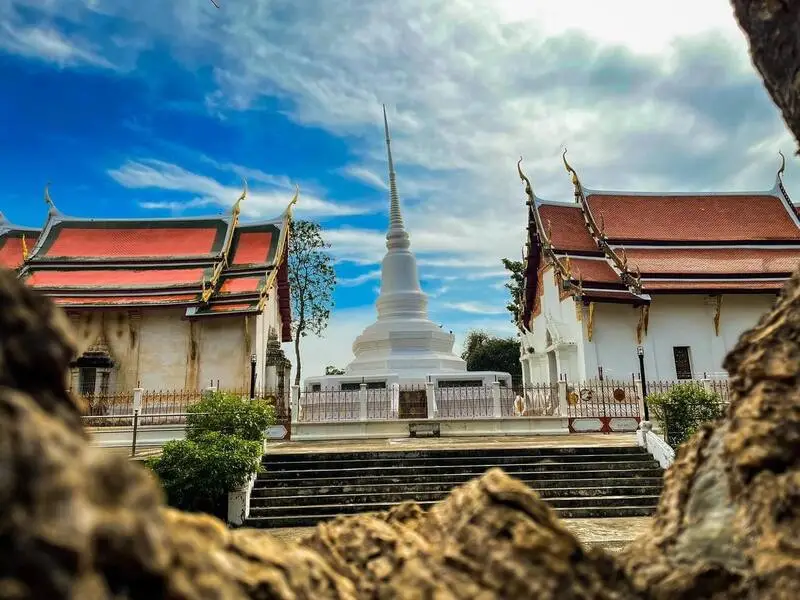
Beyond its stories, Wat Khao Bandai It appeals strongly to visitors who enjoy craftsmanship and temple art, especially the ordination hall (ubosot) with distinctive Phetchaburi-style stucco detailing. The ubosot is a five-bay brick-and-mortar structure with a gently curved base. Exterior pilasters decorate the walls, and the capitals feature lotus-like forms inlaid with colored glass. The front (east) wall has two door openings with ornate stucco frames. Above the door pediments appear naga-headed motifs and swirling kanok patterns blended with floral elements. The rear includes a small window opening, preserving the character of older regional temples that relied on largely solid walls with only necessary openings.
On the south side are two plain rectangular windows without decorative frames, while the north side has one window. There is also a side door at the second bay from the rear, again with a stucco-framed opening. Many visitors pause longest at the ubosot gables, which are celebrated as masterful examples of Phetchaburi stucco art. The eastern gable features elaborate swirling kanok forms combined with floral clusters and a Garuda motif at the center, framed by lively flowing lines. The western gable also incorporates Garuda imagery with bold flame-like kanok patterns and naga-headed scrollwork along the wing panels. The lines feel both fluid and weighty, reflecting the precision and confidence for which Phetchaburi artisans are famous.
The roof is a two-tiered reduction roof with wooden elements and decorative ridge ornaments. It is common to see evidence of traditional roofing techniques, including layers of protective plastering. The roof ornaments include lamyong boards, naga forms, chofa finials, bai raka, and hang hong, with glass inlay. Cantilever brackets support the eaves, and the roof structure is traditionally hardwood. Inside, many wooden components are painted with white patterns on a red ground, while the ceiling is decorated with star motifs and bat-like corner patterns framed by vine designs. If you enjoy studying details, Wat Khao Bandai It can turn a simple temple visit into the feeling of walking through a living craft museum, because so many surfaces reveal the intent and skill of the builders.
What truly makes Wat Khao Bandai It different from ordinary city temples, however, is the experience of walking up the hill to explore its caves. Several caves are considered key highlights, each with devotional elements and associated narratives. A commonly mentioned first stop is “Tham Pratun” (Pratun Cave), where Buddha images appear along both sides of the cave walls. The atmosphere can feel like a natural shrine hall, with the cave itself forming the walls and ceiling. Deeper in, visitors often reach “Tham Phra Chao Suea” (King Suea Cave), named after the story that King Suea came to see Ajarn Saeng and enshrined a standing Buddha image in the “Pacifying the Sea” posture here. Many people stop to pay respect and to connect their visit to the narratives that give this place its distinctive identity.
South of that area is “Tham Phra Phuttha Saiyat” (Reclining Buddha Cave), where a large reclining Buddha image is enshrined. A memorable detail often mentioned is a very old wooden boat canopy kept in a crevice of the cave wall, said in tradition to have been offered by King Suea to Ajarn Saeng. Such objects add a tangible layer to the story world of the caves, turning them into spaces where devotional practice and remembered narratives are linked through physical items, even as visitors may interpret them differently.
Beyond the best-known caves, Wat Khao Bandai It is also associated with other caves such as Tham Phra Athit (Sun Cave), Tham Phra Chan (Moon Cave), Tham Sawang Arom (Bright-Mind Cave), Tham Chang Phueak (White Elephant Cave), and Tham Duke. The name “Tham Duke” is locally said to be connected to Duke Johann Albrecht of Braunschweig (Germany), who reportedly visited Phetchaburi and explored the cave. Whether visitors engage with this detail as history or as local naming tradition, it adds another dimension: Wat Khao Bandai It is not only tied to Ayutthaya narratives and revered masters, but also carries traces of how outsiders once encountered and remembered Phetchaburi.
Another strand of shared memory comes from literature. It is often said that the poet Sunthorn Phu visited Wat Khao Bandai It and mentioned it in “Nirat Mueang Phet” (Journey Poem to Phetchaburi). When a place appears in classic literature, it naturally invites “following-the-trail” travel: some visitors come not only to pay respect, but also to sense the atmosphere that earlier writers described, imagining what the hill, caves, and quietness might have felt like in that era. Even though the modern world has changed, the cool air of caves and the shade of hillside trees can still bring visitors close to that contemplative mood.
For the fullest experience, it helps to allow at least 1–2 hours. If you want to explore multiple caves at a relaxed pace, 2–3 hours is comfortable. Many visitors begin with merit-making at the lower temple grounds to settle into a calmer frame of mind, then walk gradually upward. The route includes steps and sloped paths, so comfortable shoes with decent grip are recommended, especially during the rainy season when surfaces can be slippery. Inside the caves, the air often becomes cooler and more humid. Walk carefully and keep your voice low, because caves are both sacred spaces and places where sound carries easily.
Dress respectfully—avoid sleeveless tops and very short shorts or skirts—and consider bringing a shawl in case it is needed. Cave etiquette matters here because many chambers contain Buddha images that people genuinely come to venerate. Photography is possible in many areas, but it should be done discreetly, without flash, and without disturbing others. Avoid touching Buddha images or old objects, and do not climb on cave features such as rock formations. These practices support safety and help preserve both the sacred atmosphere and the natural environment.
In summary, Wat Khao Bandai It brings three elements together in one visit: devotion, story, and landscape. Devotion is expressed through the temple grounds and cave shrines; story appears through narratives of Phra Si Sin, Ajarn Saeng, and King Suea; and landscape shapes a physical experience through the uphill walk and the cool stillness of the caves that can make you feel removed from the city in just a few minutes. For this reason, the temple is an excellent centerpiece for a Phetchaburi cultural itinerary, especially for travelers who want more than a quick stop and prefer to spend time truly inhabiting a place.
Getting There If you are traveling by car, take Highway 4 (Phetkasem Road) toward Mueang Phetchaburi, then turn onto Highway 3171 heading toward Rai Som Subdistrict. The temple is not far from major attractions such as Khao Wang (Phra Nakhon Khiri), at an estimated route distance of about 2 km. If you arrive in Phetchaburi town by public transport, you can continue by local taxi or hired transport to the temple, as it lies on a well-known tourism route within the city area.
| Name | Wat Khao Bandai It (วัดเขาบันไดอิฐ) |
| Address | Rai Som Subdistrict, Mueang Phetchaburi District, Phetchaburi Province, Thailand |
| Place Summary | An ancient hilltop cave temple in Phetchaburi, known for multiple cave shrines, strong Ayutthaya-era narratives, and celebrated Phetchaburi-style stucco craftsmanship. |
| Highlights | Tham Pratun, Tham Phra Chao Suea, Tham Phra Phuttha Saiyat, stories of Phra Si Sin and Ajarn Saeng, master-level stucco gables with flowing kanok and Garuda motifs. |
| Nearby Tourist Attractions | 1) Phra Nakhon Khiri (Khao Wang) – 2 km 2) Wat Mahathat Worawihan – 4 km 3) Wat Yai Suwannaram Worawihan – 4 km 4) Wat Ko – 5 km 5) Phra Ram Ratchaniwet (Ban Puen Palace) – 6 km |
| Popular Restaurants Nearby | 1) Krua Boon Tang (Town Area) – 4 km Tel. 092-459-5263 2) Nuch Tod Man Khanom Jeen – 4 km Tel. 086-623-5748 3) Khanom Jeen Tod Man Thong Chiang (Jae Pui) – 4 km Tel. 086-032-3687 4) Owtung Nai Kee (Town Area) – 5 km Tel. 081-852-3350 5) Jae Ja Khao Tom Pla (Town Area) – 5 km Tel. 065-828-9379 |
| Popular Accommodations Nearby | 1) Royal Diamond Hotel – 5 km Tel. 032-411-061 2) Sun Hotel & Resort – 6 km Tel. 032-400-060 3) Chedi View Hostel & Rooftop Bar – 5 km Tel. 090-950-6529 4) Sweet Dreams Guest House – 7 km Tel. 085-121-9666 5) Alinda Resort – 9 km Tel. 086-318-4220 |
Frequently Asked Questions (FAQ)
Q: What makes Wat Khao Bandai It different from other temples in Phetchaburi?
A: It is a hilltop cave temple with multiple cave shrines, strong Ayutthaya-era legends, and outstanding Phetchaburi-style stucco work on the ubosot gables.
Q: Which caves are the most popular to visit?
A: Visitors commonly go to Tham Pratun, Tham Phra Chao Suea, and Tham Phra Phuttha Saiyat, each with enshrined Buddha images and associated local stories.
Q: How is the temple connected to King Suea?
A: Local tradition links King Suea to Ajarn Saeng and describes offerings of Buddha images and objects placed in certain caves, which influenced the naming of some chambers.
Q: How much time should I plan for a visit?
A: Allow at least 1–2 hours. If you want to explore several caves at an unhurried pace, 2–3 hours is ideal.
Q: Are there any safety tips for exploring the caves?
A: Wear comfortable shoes with good grip, be careful on slippery sections (especially in the rainy season), keep quiet inside caves, and avoid touching Buddha images or old objects to protect both safety and preservation.
 Wat Khao Bandai It Map
 Category:
  Group:
  Last Update: 1 DayAgo
Comment
 Nearby Attractions
| Keyword (Advance) |
 Facebook Fanpage
 Region
 Art, Culture and Heritage
 Historical Sites and Monuments(
 Landmarks and Memorials(
 Royal Palace(
 Art, Craft Centres, Tradition(
 Museums(
 Educational Places
 Educational Gardens, Farm(
 University
 Other religious and spiritural sites(
 Research and Development
 Royal Project(
 Suburban Living
 Village, Community(
 Floating Market(
 Nature and Wildlife
 National Parks and Marine Reserves(
 Mountain (Doi)(
 Dam, Reservoir, Lake(
 Waterfalls(
 Hot Springs(
 Caves(
 River, Canal(
 Bays and Beaches(
 Islands(
 Other natural attractions(
 Entertainment and Agricultural
 Zoos and Aquariums(
 Farm, Parks, Gardens and Ecotourism(
 Waterpark(
 Theater(
 Outdoor and Adventure Activities(
 Travel Articles, Recipes
 Travel Review, Food Review(