

 Home
Home Chiang Mai(




Rating: 3.7/5 (6 votes)
 |
|  Map
Map 
 Have Map
  No Map
Phetchaburi attractions
Attractions in Thailand
Open Days: Daily
Opening Hours: 08:00 – 17:00
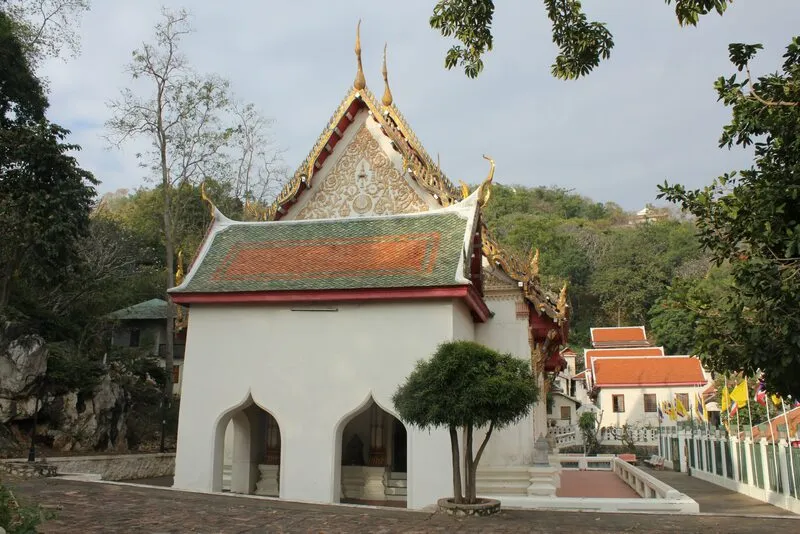
Wat Mahasamanaram Ratchaworawihan (Wat Khao Wang) Phetchaburi is a place worth pinning down before anything else if you want an in-town Phetchaburi day that delivers the calm of a practice-oriented temple, the hillside atmosphere beside Phra Nakhon Khiri (Khao Wang) — the province’s signature landmark — and high-level art that truly rewards slow looking. The temple’s appeal is not only its location right by the ascent to Khao Wang, but also the mural paintings inside the ubosot that portray Thai life and traditions in remarkable detail, from birth to life’s final passage. These murals do far more than decorate walls; they function like a visual encyclopedia of Thai ways of thinking, belief, aesthetics, and everyday culture, allowing later generations to see the past in tangible, human terms. And once you learn that this body of work is associated with Khrua In Khong together with several Phetchaburi painters, it becomes clear this is not a place for a quick stop. Visiting here is, in a very real sense, reading Phetchaburi through art made in the city and preserved in the exact place it was created to be seen.
The temple is located at 91 Khiri Ratthaya Road, Khlong Krachaeng Subdistrict, Mueang Phetchaburi District, Phetchaburi Province, and it belongs to the Dhammayut order. Even this basic fact helps define the temple’s character, because many Dhammayut temples are known for a restrained, quiet atmosphere and relatively orderly spatial organization. Combined with the Khao Wang foothill setting, the result is a charm that feels peaceful without being remote. You can come to pay respects, take time with the artwork, and then continue straight into the old-town area without detouring from the main route. For travelers aiming to make a one-day plan feel complete, this temple works as a natural connector between the Khao Wang zone and the historic urban quarter, keeping the whole day flowing smoothly without travel fatigue.
Historically, Wat Mahasamanaram was established in 1843 and later received official consecration of its ubosot boundary (wisungkhamsima), reflecting its recognized standing in the city’s religious landscape. Viewed through this lens, the temple was not formed as a small, isolated community site, but as part of the formal structure of Thai Buddhism and monastic administration at a time when Phetchaburi mattered in both geography and connectivity by land and water. This is why the temple functions not only as a center of faith but also as a place that preserves layered historical evidence, most vividly through the ubosot murals that act as a window through time. They show lived experience with a completeness that written records often cannot match, because images capture clothing, objects, gestures, and the social texture of ceremonies in a single glance.
As you enter the temple grounds, it helps to first take in the overall setting and how the temple relates to Khao Wang. One side of the temple area adjoins the route up to Phra Nakhon Khiri, another connects with the Khao Wang zone, and the front aligns with Khiri Ratthaya Road, making the temple feel like a cultural gateway for this district. Many visitors come primarily to go up Khao Wang, yet the temple’s proximity makes it easy to add a respectful stop for worship and art without needing to redesign your plan. This is what makes Wat Mahasamanaram ideal for cultural travel when time is limited, while still offering enough depth for those who want to stay and read details closely, because the ubosot, the viharn, and key elements of the site are all tied to the city’s history and the history of Thai art.
The ubosot is an essential building to look up at, walk around, and experience in full, because it holds the temple’s core in both religious and artistic terms. Its construction is commonly cited as spanning roughly 1843–1859, a period when Siam was undergoing significant transitions in external relations, social organization, and evolving attitudes toward cultural preservation within temples. Once you step inside, you immediately feel the deliberate atmosphere of composure: this is not a corridor to pass through, but a ceremonial space. Speaking softly, dressing modestly, and treating the setting with respect helps preserve the environment for both worshippers and those visiting to study the art.
What elevates Wat Mahasamanaram into one of Phetchaburi’s truly unmissable “temples for mural viewing” is the ubosot mural cycle that teaches about Thai life and traditions from birth to death. Put simply for anyone who is not approaching this as an academic, the murals unfold like the story of one life: a person opens their eyes to the world, moves through major life stages and rites, and finally reaches life’s end — but the story is told through densely detailed images that allow you to see clothing, household objects, procedural sequences of rituals, communal participation, and the underlying mindset of the period. You may recognize scenes related to childbirth customs, the topknot-cutting rite, ordination and study, marriage and family life, and eventually the final passages. If you stand long enough, you start to feel that the paintings do not merely record ceremonies; they reveal “society” itself through the way people relate, gather, and inhabit each scene.
To make viewing more rewarding, try asking yourself questions while you look: how are people dressed, how do they cluster and converse, what objects appear in the scene, and why did the painter place particular figures or buildings where they are? The answers draw you into details that many people walk past without noticing — the way people sit, the arrangement of tables, the placement of containers and offerings, or even small gestures that communicate emotion. As you follow the narrative continuously, you realize these are not simply “beautiful pictures” but cultural evidence, helping later generations see Thai heritage as something lived, not merely described.
Beyond depictions of everyday life and major rites, the murals also include scenes that express faith and worldview: images of pilgrimage to the Buddha’s footprint, portrayals of significant stupas, and the well-known scene of Phra Kosa Ajarn translating scriptures in Sri Lanka. Together they suggest that devotion in that era was not confined to Phetchaburi alone, but connected to a wider religious network — through pilgrim travel and through transregional scriptural learning. These images show that religion in Thai society was not only abstract doctrine; it was something people traveled for, studied, and recorded through art with great seriousness.
Another layer of significance comes from the painters themselves. The murals are often discussed in relation to Khrua In Khong, together with multiple Phetchaburi painters — a name familiar to many who follow Thai art history. Once you know this context, the refinement you see is not simply &ldquo prettiness” but the result of mature craft and visual storytelling expertise. The powdered pigments feel soft, yet the palette can appear vivid and luminous in the right sections, especially on columns or decorative areas designed to draw the eye. When you take in all four mural walls — commonly organized into upper and lower registers — you can sense an intentional system of narrative arrangement, allowing many scenes to coexist without confusion, like a carefully designed picture-book page where every element has a job.
After paying respects and spending time with the murals, it is worth giving adequate time to the viharn as well, often described as a Thai-style chaturamuk (four-gabled) structure that enshrines a Buddha image known as Luang Pho Khao Wang. The name itself highlights how closely the temple’s identity is tied to the surrounding landscape. The temple is not “beside” Khao Wang by coincidence; it belongs to this place so thoroughly that local usage naturally links it with Khao Wang. For visitors, this creates an easy continuity: worship at the temple and a Khao Wang visit can feel like one coherent journey rather than separate stops.
The temple is also associated with revered objects such as a replica Buddha footprint, and it is sometimes described as having a royal-historical memory connected to King Chulalongkorn (Rama V), including references to a resting bed linked with a period of novicehood. In cultural travel writing, the important approach is balance: treat such elements as traces of local memory attached to the site rather than overstating beyond what is supported, and let them serve as another reason to move through the temple with care. Each component carries meaning for the community and for historical understanding, so looking closely is part of traveling responsibly.
Within the ubosot, the principal Buddha image is described as being in the Maravijaya posture, accompanied by two foremost disciples, Phra Moggallana and Phra Sariputta. Experiencing these sacred images together with the murals creates a different kind of temple visit than a site where the focus is only the main Buddha image. Here, teachings are present both as the spiritual center at the altar and as a vivid visual world on the walls that shows how human life and tradition surround religion in everyday reality.
Overall, visiting Wat Mahasamanaram feels serene in the way many foothill temples do, and it becomes even calmer if you come in the morning or late afternoon, when many people are heading to Khao Wang or to food streets rather than lingering inside temples. Quieter hours make it possible to stand with the murals without rushing, which is exactly what this kind of art asks of you. The longer you look, the more you notice: subtle differences in clothing among groups, small props that hint at context, and tiny gestures that bring characters to life. The joy is often in discovering what is “hidden in plain sight” — details that only appear when you give the walls your time.
If you enjoy photography, remember that within the ubosot and sacred areas, photos should be taken with restraint and with respect for worshippers. The key point is to avoid flash unless it is explicitly appropriate, since flash can disturb people and is not friendly to art conservation. It is also best to avoid inappropriate behavior such as leaning on walls or getting too close to painted surfaces. If you want beautiful images, step back and compose the broader atmosphere: columns with vivid painted motifs, the relationship between light and interior calm, or angles that show the architecture’s quiet dignity alongside the contemplative mood.
Getting There Wat Mahasamanaram Ratchaworawihan is located at 91 Khiri Ratthaya Road, Khlong Krachaeng Subdistrict, Mueang Phetchaburi District. If you drive from Bangkok, the common route is Phetkasem Road (Highway 4) into Phetchaburi town, then head toward the Phra Nakhon Khiri (Khao Wang) area and take Khiri Ratthaya Road directly to the temple, as it is very close to the Khao Wang access route. If traveling by train, get off at Phetchaburi Railway Station and take a local taxi or in-town transport to the Khao Wang zone and Khiri Ratthaya Road. For a well-paced one-day itinerary, you can start at Wat Mahasamanaram for worship and mural viewing, continue up to Phra Nakhon Khiri for panoramic city views, and then move on to Wat Mahathat Worawihan or the old-town area to finish with Phetchaburi’s local food, all without crossing districts.
To make the visit most worthwhile, keep the pace unhurried. Begin by paying respects in the ubosot, then slowly follow the murals wall by wall, balancing the big picture with fine details, and afterwards visit the viharn to pay respect to Luang Pho Khao Wang and absorb the foothill atmosphere. If you have extra time, walk around the grounds to feel the temple’s relationship with Khao Wang and Khiri Ratthaya Road. Standing where you can see both the temple and the route up to Phra Nakhon Khiri at once makes it instantly clear why this is a cultural destination that works for first-time visitors to Phetchaburi and for return visitors who want to engage with the art at a deeper level.
In the end, if you treat Wat Mahasamanaram as a lesson in Phetchaburi itself, you will see that the province is not only beaches and cafés. Its artistic heritage is densely present right in the city center. The mural cycle that narrates Thai life makes this temple feel like a classroom without desks, where the learner is simply the person who stands and looks with intention. What you take away is not only a nice photo, but a deeper way of seeing “Thainess” through images, craftsmanship, and the rhythms of life that have been preserved on ubosot walls with extraordinary care.
| Place Name | Wat Mahasamanaram Ratchaworawihan (Wat Khao Wang) |
| Address | 91 Khiri Ratthaya Road, Khlong Krachaeng Subdistrict, Mueang Phetchaburi District, Phetchaburi |
| Place Summary | A Dhammayut temple at the foothills of Phra Nakhon Khiri (Khao Wang), renowned for ubosot murals that depict Thai life and traditions from birth to death, along with key sacred objects and a calm hillside atmosphere. Easy access and ideal for an in-town, one-day Phetchaburi cultural itinerary. |
| Highlights | Ubosot murals portraying a detailed “life cycle – Thai traditions” narrative, high-level craftsmanship associated with Khrua In Khong and Phetchaburi painters, location next to the Phra Nakhon Khiri (Khao Wang) route for seamless itinerary planning, a Thai-style chaturamuk viharn and Luang Pho Khao Wang, and a quiet foothill setting suited to slow, respectful viewing. |
| Abbot (Latest) | Phra Khru Piyathammaphiyut (Suep Piyadhammo) |
| Contact Number | 0-3242-5325 |
| Travel Summary | By Car: Enter Phetchaburi town and head to the Khao Wang area via Khiri Ratthaya Road / By Train: Get off at Phetchaburi Station, then take local transport to the Khao Wang zone |
| Nearby Attractions | 1) Phra Nakhon Khiri (Khao Wang) – approx. 0.8 km 2) Wat Phra Phuttha Saiyat (Wat Phra Non) – approx. 1.6 km 3) Wat Mahathat Worawihan, Phetchaburi – approx. 2.6 km 4) Wat Yai Suwannaram Worawihan – approx. 2.4 km 5) Wat Phlapphla Chai – approx. 2.2 km 6) Tham Khao Luang – approx. 4.8 km |
| Popular Restaurants Nearby | 1) Jek Meng Beef Noodles – approx. 1.8 km – Tel. 032-426-305 2) Rabiang Rim Nam Phetchaburi – approx. 2.7 km – Tel. 032-425-707 3) M Story Coffee and Tea Room – approx. 2.5 km – Tel. 098-826-9051 4) Khao Chae Mae Orn – approx. 2.4 km – Tel. 089-410-1969 5) Khanom Nok Noi – approx. 2.3 km – Tel. 081-434-9627 6) Jae Nok Beef Noodles – approx. 2.3 km – Tel. 032-410-162 |
| Popular Accommodations Nearby | 1) Royal Diamond Hotel Phetchaburi – approx. 2.9 km – Tel. 032-411-061 2) Sun Hotel Phetchaburi – approx. 3.0 km – Tel. 032-400-000 3) WIIN Phetchaburi Hotel – approx. 4.2 km – Tel. 082-926-9919 4) Sida Hostel Phetchaburi – approx. 2.6 km – Tel. 089-135-6432 5) Sweet Dreams Guest House – approx. 4.9 km – Tel. 085-121-9666 6) A+ Hometel Phetchaburi – approx. 3.3 km – Tel. 097-978-5524 |
Frequently Asked Questions (FAQ)
Q: Where is Wat Mahasamanaram Ratchaworawihan (Wat Khao Wang) located?
A: The temple is located at 91 Khiri Ratthaya Road, Khlong Krachaeng Subdistrict, Mueang Phetchaburi District, close to the access route up to Phra Nakhon Khiri (Khao Wang), so it is easy to reach within the city.
Q: What is the single most important highlight of Wat Mahasamanaram?
A: The main highlight is the ubosot mural paintings that depict Thai life and traditions from birth to death in great detail, along with scenes related to pilgrimage and religious history that carry high artistic value.
Q: How many hours should I plan for visiting the temple?
A: Plan at least 1–2 hours. If you want to read the murals carefully and also visit the viharn, allow 2–3 hours for an unhurried visit.
Q: Can I take photos inside the ubosot, and what etiquette should I follow?
A: By etiquette, take photos discreetly, keep your voice low, and avoid using flash so you do not disturb worshippers and so the artwork is treated appropriately. Also avoid standing too close to painted walls.
Q: What should I visit after Wat Mahasamanaram if I want nearby places?
A: You can continue to Phra Nakhon Khiri (Khao Wang), Wat Phra Phuttha Saiyat (Wat Phra Non), Wat Mahathat Worawihan, Wat Yai Suwannaram, or Tham Khao Luang, as they are in the same area and fit well into a one-day plan.
Q: What is the contact number for Wat Mahasamanaram?
A: For general inquiries, you can contact 0-3242-5325, based on the published contact information for the site.
 Wat Mahasamanaram Ratchaworawihan Map
 Category:
  Group:
  Last Update: 16 HourAgo
Comment
 Nearby Attractions
| Keyword (Advance) |
 Facebook Fanpage
 Region
 Art, Culture and Heritage
 Historical Sites and Monuments(
 Landmarks and Memorials(
 Royal Palace(
 Art, Craft Centres, Tradition(
 Museums(
 Educational Places
 Educational Gardens, Farm(
 University
 Other religious and spiritural sites(
 Research and Development
 Royal Project(
 Suburban Living
 Village, Community(
 Floating Market(
 Nature and Wildlife
 National Parks and Marine Reserves(
 Mountain (Doi)(
 Dam, Reservoir, Lake(
 Waterfalls(
 Hot Springs(
 Caves(
 River, Canal(
 Bays and Beaches(
 Islands(
 Other natural attractions(
 Entertainment and Agricultural
 Zoos and Aquariums(
 Farm, Parks, Gardens and Ecotourism(
 Waterpark(
 Theater(
 Outdoor and Adventure Activities(
 Travel Articles, Recipes
 Travel Review, Food Review(