

 Home
Home Chiang Mai(




Rating: 3.9/5 (9 votes)
 |
|  Map
Map 
 Have Map
  No Map
Phetchaburi attractions
Attractions in Thailand
Open Days: Daily
Opening Hours: 08:00 – 17:00
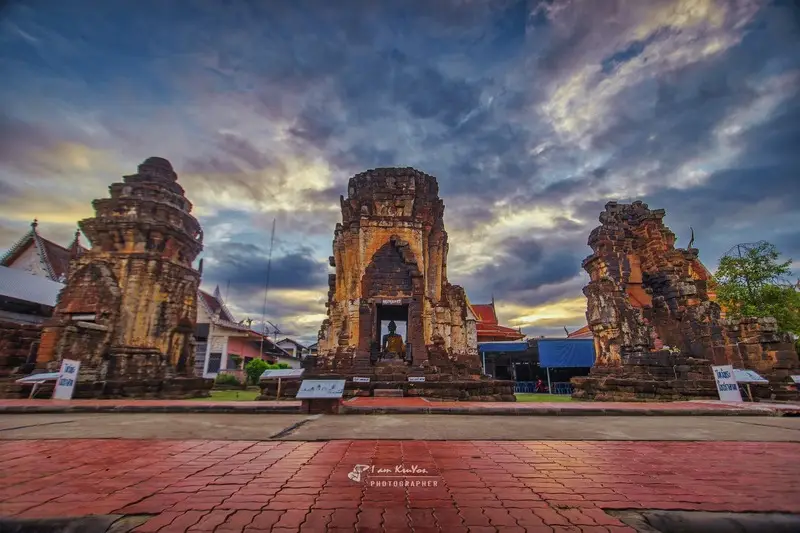
Wat Kamphaeng Laeng (Wat Thep Prasat Sila Laeng) Phetchaburi If you want to see a “Khmer ancient monument” right in Phetchaburi town—easy to reach and still very much part of a living, active temple—Wat Kamphaeng Laeng should be one of your first stops. The moment you approach the laterite perimeter walls, it feels as if you are stepping into a place where multiple layers of time overlap. The first layer is the present-day temple: monks reside here, and locals continue to make merit in a familiar rhythm of everyday life. The next layer is the ancient sanctuary that reflects religious beliefs, artistic traditions, and the political power of an era when Khmer influence extended into Thailand’s central region. The final layer is the local story of transition—from a once-abandoned site to a carefully maintained heritage space that still “breathes” alongside the community of Phetchaburi.
The heart of Wat Kamphaeng Laeng is its laterite sanctuary complex—the reason people have long called it “Kamphaeng Laeng” (literally, “laterite wall”). The defining feature is the laterite enclosure that frames the sacred area. This name is not merely a convenient label; it directly reflects how people relate to the place. Unlike grand temples glittering with mirror mosaics, this site offers a quieter, deeper beauty—one that rewards careful observation. You begin with the warm-toned stone surfaces weathered by sun and rain, then notice traces of plastering and surviving stucco motifs, and finally take in the proportions of the towers and the gateway that functions like a picture frame, helping visitors imagine the monument as it once looked in its complete form.
Historically, Wat Kamphaeng Laeng went through a long period as an abandoned temple. Later, a Chinese community moved in, leasing land from the Office of National Buddhism to cultivate orchards and gardens. Over time, when the site was re-established as an active temple and monks began residing here, the former residents relocated elsewhere. The monks then took on the role of caring for both the temple and the ancient structures within the same grounds. This shift mattered: the site was no longer left as a ruin at the mercy of time, but became a place under continuous stewardship. The Fine Arts Department later registered it as an ancient monument in the Royal Gazette (Volume 52, Part 75, page 3692, dated 7 March 1935), underscoring its status as cultural heritage that should be preserved.
In 1954, Wat Kamphaeng Laeng was established as a Vipassana meditation center and the name was changed to “Wat Thep Prasat Sila Laeng.” The new name clarifies the site’s identity. “Thep Prasat” evokes the older Khmer sacred architecture often associated with Brahmanical cosmology, while “Sila Laeng” emphasizes the laterite material that defines the monument. Today, as both an active temple and a meditation space, the atmosphere is notably calm. Visitors often sense that this is not a staged tourist attraction but a genuine place of faith, where the ancient sanctuary remains naturally woven into daily temple life.
From an archaeological perspective, Wat Kamphaeng Laeng is frequently described as one of the oldest Khmer-style monuments in Phetchaburi town and is often linked to the Bayon style associated with King Jayavarman VII, when Khmer influence reached into central Thailand. What makes it compelling is how the layout and architectural elements suggest a sacred structure that functioned as more than a building—it was a tangible “map of belief,” expressed through planning and proportion. The eastward orientation, the arrangement of the towers, and the presence of a formal gateway all relate to the ritual mindset of the builders.
You can read the monument’s overall structure through its laterite enclosure. The wall is not only a physical boundary; it also symbolically separates two worlds. Inside lies the sacred zone—once a focal point of community spirituality. Outside is the realm of everyday activity. As you walk along the wall or look back toward the entrance, you can feel that the act of “crossing over” from outside to inside was intentionally designed to shift one’s state of mind from ordinary life to a more contemplative, respectful mode.
A key feature to notice is the “gopura,” the gateway pavilion typical of Khmer sacred architecture. At Wat Kamphaeng Laeng, the gopura is built of laterite and stands on the eastern side of the sanctuary complex. Its presence suggests that access was historically organized and deliberate, rather than casual or random. Even though time has worn away many details, the structural form still tells the story of a once highly complete and sophisticated architectural composition.
One detail that distinguishes Wat Kamphaeng Laeng from many Khmer monuments in Thailand is the remaining evidence of stucco decoration. Laterite is durable but porous, making it less suited for fine carving like sandstone. In many cases, after the masonry structure was completed, builders applied plaster and created decorative motifs in stucco instead. This allows visitors to observe which parts are the stone core and which were later decorative layers added to fulfill the intended religious aesthetics. As stucco falls away over time, it reveals the building process itself—almost like reading successive layers of information from the exterior inward.
Another dimension many visitors may not know is that important artifacts associated with Wat Kamphaeng Laeng have been recorded as five key pieces. These finds help confirm the religious landscape of the era and turn a walk through the site into more than just viewing architecture—it becomes an encounter with evidence that once coexisted with the structures in meaningful ways. The artifacts reflect Mahayana and Vajrayana beliefs, as well as architectural elements like bridge components often seen in Bayon-period Khmer art.
The first piece is the “Radiant Avalokiteshvara (Lokeshvara).” It was found near the western tower. The sculpture is made of white sandstone and was discovered in a heavily damaged condition—with the head, arms, and legs broken—though the head was reportedly found nearby. A notable feature is the small seated Buddha figures arranged in rows across the upper torso. If complete, it would have had eight arms, and a seated Buddha would appear above the forehead panel. Other symbolic details include a ring whose head is a seated Buddha figure, and motifs on all ten toes suggesting a state of “supremacy over all Buddhas” within a complex, layered religious worldview. In this context, “radiant” is not simply descriptive—it represents the sacred power the makers intended to honor.
The second piece is a “Four-Armed Avalokiteshvara (Lokeshvara).” It was found in a damaged state, with only the torso and four arm sections remaining. The garment style and workmanship point to Bayon-period Khmer art. If complete, the four hands would hold key attributes: the front left holding a lotus, the front right holding a water vessel, the rear left holding prayer beads, and the rear right holding a scripture. Read as symbolic language, these objects convey an integrated ideal of compassion, purification, protection, and wisdom—central themes in Mahayana and Vajrayana traditions.
The third piece is a “Naga-Protected Vajrasattva.” This is a jeweled naga-protected Buddha image, found with only the face and upper torso remaining. Behind it is a carved stone panel forming the naga spreading its hood. If complete, it would depict the Buddha in meditation seated above the coiled naga base. What is especially significant is the identification of the figure as “Vajrasattva” within Cambodian Vajrayana tradition. In Khmer usage, “Vajrasattva” could refer to the Adi-Buddha or Mahavairocana, regarded as the sixth Buddha in Vajrayana Buddhism. The appearance of Vajrayana concepts in Phetchaburi through the familiar naga-protection iconography shows how religious ideas and artistic language were adapted to local tastes and shared visual understanding. For many people, the naga-protected image communicates protection and enlightenment amid adversity; overlaid with Vajrayana meaning, the symbolism becomes even more powerful within a multi-belief society.
The fourth piece is the head of “Prajnaparamita,” discovered as a head fragment only and currently held in private ownership. If complete, it would represent a female bodhisattva with two arms: the left holding a lotus containing the Prajnaparamita scripture, and the right in a gesture of granting blessings. Even the name “Prajnaparamita” signals the central Mahayana doctrine of “perfection of wisdom.” Together with evidence of Avalokiteshvara and Vajrasattva, this supports the view that the site once embodied layered religious dimensions—not limited to Theravada Buddhism and not purely Brahmanical as some first-time visitors might assume.
The fifth piece is a “Garuda Grasping a Naga Bridgehead.” This was not found inside Wat Kamphaeng Laeng itself, but has been recorded as stored at Wat Mahathat in Phetchaburi. It is a damaged stairhead or bridgehead sculpture of Garuda subduing a naga, with only parts of Garuda’s legs and three naga heads remaining. Such bridgehead motifs were popular in Bayon-period Khmer art and can be compared with examples at the National Museum in Bangkok. Knowing about this piece makes exploring Phetchaburi more engaging, because you can continue from Wat Kamphaeng Laeng to Wat Mahathat and look for how these fragments of evidence are distributed across the same city—like following a trail of history through real places.
When you walk through Wat Kamphaeng Laeng with the image of these five artifacts in mind, the experience shifts from simply “seeing an old tower” to “reading traces of a living belief world.” The sanctuary does not speak in words; it speaks through layout, orientation, spatial hierarchy, and the surviving fragments of sculpture that hint at past completeness. At the same time, the active temple environment functions as a guardian of the city’s memory without needing a museum-style presentation. This natural coexistence between present-day faith and ancient evidence is rare—and it is precisely what gives the site its distinctive charm.
Another point worth noting is the overall visiting atmosphere. Wat Kamphaeng Laeng is not bustling like a mass tourist spot throughout the day; instead, it has the quietness of a place where people come to walk slowly, observe carefully, and think deeply. If you visit in the morning or late afternoon, the light enhances the texture of laterite, and shadows on the enclosure wall and gateway create photographs that feel narrative with little effort. The key is to move carefully, respect the space, and avoid climbing on the ancient structures. Every brick and every tier of the base is heritage material far more fragile than it appears.
Because the temple also serves as a meditation space, visitors should maintain appropriate etiquette—dress modestly, keep voices low, and avoid disturbing any ongoing practice sessions. Photography should be done discreetly, without flash in areas where it may bother others. If you wish to photograph individuals, ask for permission clearly beforehand. These small considerations help tourism and the temple’s spiritual role coexist in a balanced and respectful way.
Getting There Wat Kamphaeng Laeng is located in Phetchaburi town, so travel is relatively easy and flexible. If you drive from Bangkok, the common route is via Phetkasem Road toward Phetchaburi, then continue on local town roads toward Tha Rap and the Phra Song Road area, which is not far from the town center. If you travel by train, you can get off at Phetchaburi Station and take a local taxi or city transport to the temple without difficulty. For a one-day itinerary, placing Wat Kamphaeng Laeng on a “Phetchaburi town highlights” route is especially convenient, because you can continue to Wat Mahathat, Phra Nakhon Khiri (Khao Wang), and the old town district within short distances, without losing time on long cross-district travel.
Once you arrive, it helps to begin by looking at the overall setting first—take in the laterite walls and the gateway position, then move inward to observe the sanctuary structures point by point. If you enjoy photography, try composing images that use the wall as leading lines, or shoot through the gateway frame to create depth. If you prefer interpretation, observe orientation and placement, then imagine how rituals may have begun by passing through the gopura and gradually moving toward the sacred core. Visiting with questions in mind allows the site to “tell its story” even without relying heavily on information signs.
What many people appreciate here is the sense of not being rushed. The site doesn’t force a checklist-style route like a museum; it lets you choose your own pace. You might spend just an hour for a general look and photographs, or take longer to walk a second loop and look for details you missed, such as small surviving stucco patches, subtle differences in base proportions, or laterite textures as the light shifts. This is a place for detail-lovers, and it suits anyone who wants to understand Phetchaburi more deeply than a quick, pass-through temple visit.
If you want to maximize the day, Wat Kamphaeng Laeng works very well as a starting point for a Phetchaburi town itinerary. Beginning with a Khmer monument gives you historical context, then you can move on to Wat Mahathat as a major center of Thai faith in the city, continue up to Phra Nakhon Khiri for panoramic city views, and finish with a walk through the old town for local sweets and food. In a single day, you can get scenery, stories, and flavors without shifting far across zones.
Finally, if you see Wat Kamphaeng Laeng as a “lesson of the city,” it becomes clear that Phetchaburi is not only about Cha-am beaches or modern cafes. The town itself holds a dense layering of history. Wat Kamphaeng Laeng is a window into how Phetchaburi once connected with larger worlds, what kinds of beliefs it absorbed, and how people across different eras helped preserve those traces. Walking among laterite blocks and stucco shadows is therefore more than a trip—it is a tactile encounter with the city’s memory in a real, living place.
| Name | Wat Kamphaeng Laeng (Wat Thep Prasat Sila Laeng) |
| Address | Tha Rap Subdistrict, Mueang Phetchaburi District, Phetchaburi Province |
| Quick Summary | An active temple in Phetchaburi town that contains a Khmer-style laterite sanctuary complex. Calm atmosphere, ideal for history-focused visits, photography, and an easy connection to other in-town attractions. |
| Highlights | Laterite enclosure wall and Khmer sanctuary towers, gopura gateway, surviving local stucco traces, the transition story from an abandoned site to a meditation-focused living temple, and recorded artifacts reflecting Mahayana–Vajrayana beliefs. |
| Current Abbot / Caretaker | Phra Athikan Sarawut Sutthasilo |
| Travel (Overview) | Located in Phetchaburi town. Easy by private car; or take the train to Phetchaburi Station and continue by local transport. Works well as the first stop on an in-town route before Wat Mahathat and Khao Wang. |
| Nearby Tourist Attractions (Approx. Distance) | 1) Wat Mahathat Worawihan, Phetchaburi – approx. 2 km 2) Phra Nakhon Khiri (Khao Wang) – approx. 4 km 3) Wat Yai Suwannaram – approx. 3 km 4) Phetchaburi Old Town / Phanit Charoen Road area – approx. 2 km 5) Tham Khao Luang – approx. 7 km |
| Popular Restaurants Nearby (Approx. Distance + Phone) | 1) Rabieng Rimnam – approx. 3 km – Tel. 032-425-707 2) Jekmeng Beef Noodles – approx. 3 km – Tel. 032-426-305 3) Tanote Restaurant – approx. 12 km – Tel. 082-252-4990 4) Krua Med Sai (Cha-am) – approx. 40 km – Tel. 089-800-2299 5) Je Daeng Bang Khwai – approx. 45 km – Tel. 032-470-455 |
| Popular Accommodations Nearby (Approx. Distance + Phone) | 1) Royal Diamond Hotel Phetchaburi – approx. 5 km – Tel. 032-411-061 2) Sun Hotel Phetchaburi – approx. 6 km – Tel. 032-400-000 3) Wiin Phetchaburi Hotel – approx. 7 km – Tel. 082-926-9919 4) KK Mansion Phetchaburi – approx. 6 km – Tel. 089-965-6296 5) R Resident Resort – approx. 9 km – Tel. 065-479-5995 |
Frequently Asked Questions (FAQ)
Q: Wat Kamphaeng Laeng in Phetchaburi?
A: It is an active temple in Phetchaburi town that contains a Khmer-style laterite sanctuary complex. The atmosphere is calm, and it’s suitable for making merit, exploring the ancient structures, and photography.
Q: What are the must-see highlights at Wat Kamphaeng Laeng?
A: The laterite enclosure wall, the Khmer sanctuary towers, the gopura gateway, and remaining stucco traces. The site is also notable for its history as an abandoned temple before being carefully maintained as a living temple and meditation space.
Q: How long should I plan to visit Wat Kamphaeng Laeng?
A: Generally 1–2 hours. If you want more time for photography and historical details, plan 2–3 hours for a slower walk-through.
Q: What should I wear and how should I behave when visiting?
A: Dress modestly, keep your voice low, respect temple and meditation areas, walk carefully, and avoid climbing on the ancient structures to help preserve the city’s cultural heritage.
Q: Where should I go after visiting Wat Kamphaeng Laeng in Phetchaburi town?
A: Good next stops are Wat Mahathat Worawihan, Phra Nakhon Khiri (Khao Wang), Wat Yai Suwannaram, and a walk through the Phetchaburi old town area—all nearby and easy to combine into a half-day or one-day itinerary.
 Wat Kamphaeng Laeng Map
 Category:
  Group:
  Last Update: 1 DayAgo
Comment
 Nearby Attractions
| Keyword (Advance) |
 Region
|
 Muang Phetchaburi(