

 Home
Home Chiang Mai(




Rating: 4.2/5 (12 votes)
 |
|  Map
Map 
 Have Map
  No Map
Phetchaburi attractions
Attractions in Thailand
Open Days: Held during the Buddhist Lent (Vassa) period (based on the lunar calendar: “the 1st waning day of the 8th lunar month”; the exact Gregorian date varies each year)
Opening Hours: Recommended visit time: 08:00 – 12:00 (depending on the temple and community schedule on the event day)
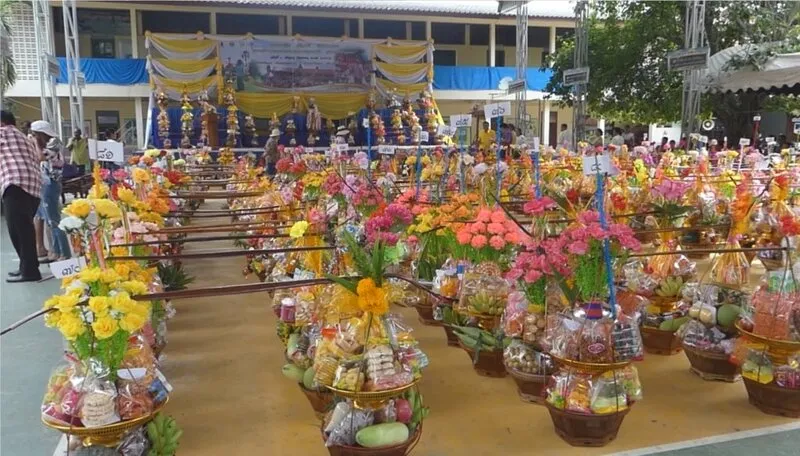
Chalaak Hab Tradition at Wat Jantararam, Moo 1, Ban Than Subdistrict, Ban Lat District, Phetchaburi Province, is a vivid example of a living “Vassa merit-making” tradition in a Thai community. It is not simply an individual act of placing offerings and leaving; rather, it is a collective movement of shared effort, unity, and faith, expressed through beautifully prepared shoulder poles (hab) filled with savory and sweet foods as well as essential items for monks during the rains retreat. The ritual of “drawing lots” (chalaak) adds another defining layer by creating fairness in the offering process, allowing merit to arise from pure intention without attachment to the idea that one’s offerings “must” go to a particular monk.
To outsiders, the phrase “chalaak hab” may sound like a colorful and festive activity. For local residents, however, it is a long-established form of merit-making during Vassa, when monks remain resident at the temple throughout the rainy season. Bringing necessary items to the temple is therefore not only giving according to one’s means, but also supporting monks so they can carry out religious duties and Dhamma study smoothly throughout the retreat. At the same time, this tradition serves as a “community classroom” that teaches gratitude, solidarity, and shared responsibility. A single hab does not appear by chance; it requires cooperation from selecting items, preparing food, arranging sets of supplies, to decorating the hab neatly and appropriately.
This tradition has two key layers. The first is the hab itself, a symbol of effort and devotion in Thai cultural life. Carrying a hab to the temple shows that making merit is not merely buying items and having someone else offer them; it is also about “doing it with one’s own hands”—preparing, carrying, and walking in procession with others in the community. The second layer is the “drawing of lots.” Monks draw numbers or lots to receive offerings from the habs in a designated order. This method brings structure, reduces bias, and helps donors avoid attachment to a specific recipient, because the essence of giving lies in intention and sincerity rather than selecting a receiver based on personal preference.
On the event day, the atmosphere usually begins early in the morning. Villagers dress especially well, often in modest and respectful attire, sometimes choosing colors that suit a merit-making occasion to honor the temple and the ritual. Each hab is arranged with care, containing savory foods, sweets, beverages, dry goods, and items useful for monks during Vassa, such as personal toiletries, soap, toothpaste, towels, rain-bathing cloths, basic medicines, or other suitable supplies based on the temple and community’s agreement (details may differ by locality). When the time comes, the hab procession moves toward the temple in an orderly manner. The beauty of the hab is not rooted in extravagance, but in the intention to present offerings that look appropriate, dignified, and clean.
Once the procession arrives at Wat Jantararam, the next phase is the monastic ceremony that brings sacredness and structure to the day. Villagers gather to listen to chanting, receive the precepts, and set their intentions before making offerings. Then the event enters its hallmark step: monks draw lots, and the hab owners (or their representatives) present offerings according to the number drawn. In some years, habs may be arranged in rows to ensure the ceremony runs smoothly. What many people feel in this moment is a powerful sense of collective merit-making—everyone shares the same rhythm, the same intention, and can directly witness the outcome of their shared effort.
The social value of chalaak hab lies in “distributed merit-making.” It does not overly emphasize any single host or household. Even if one hab is especially elaborate or contains more items, the central meaning remains the same: to collectively offer support for monks during Vassa and to strengthen community ties through shared participation. What the community takes pride in is not merely the number of habs, but the unity of the people and the successful transmission of the tradition so that younger generations can “do it for real,” not only “hear about it.”
Looking beyond the event day, chalaak hab is closely connected to learning within the family. Preparation often starts at home. Children and youth observe adults choosing items, cooking, arranging supplies, and discussing proper conduct at the temple, such as dressing modestly, placing offerings neatly, and speaking appropriately during a merit-making occasion. When children participate—even by carrying items or tying ribbons—they absorb that “tradition” is not simply beautiful words in a textbook, but something their own household actively does every year.
As for what goes into each hab, items may vary, but the core principle is suitability for monastic life and practical necessity during Vassa. Foods tend to be things that can genuinely be eaten and shared, prepared with cleanliness in mind. Supplies are typically items that can be used over time during the retreat. This makes the offering practically meaningful, not merely decorative. This is where the subtlety of Thai tradition shines: “beauty” is paired with “moderation,” and “faith” is paired with “usefulness.”
Wat Jantararam is an important temple for Ban Than Subdistrict. There is information indicating the temple was established around 1857 (B.E. 2400) and later received a royal grant of Wisungkhamsima according to temple registration documents. This shows the temple is not only a ceremonial space, but a long-standing center of community life. When the chalaak hab tradition is held at Wat Jantararam, the tradition stands on an appropriate foundation: religious continuity, local attachment, and a space capable of supporting communal activities in an organized manner.
For visitors who wish to join the chalaak hab event, it is important to observe basic etiquette for Thai merit-making occasions. Dress modestly (avoid overly short or tight clothing), speak in an appropriate tone within the monastic area, respect ritual spaces, and if you wish to take photos, avoid close-up shots of individuals without permission—especially elders and those actively participating in rituals. For the community, this is a meaningful merit-making day, not merely a backdrop for tourism.
Another reason the chalaak hab event can be so impressive is its “community-based orderliness.” While large events may seem chaotic at first glance, long-practiced merit traditions often carry their own internal systems: leaders, helpers, coordinators, site caretakers, and elders guiding children. This is an invisible form of cultural capital that you can feel while walking through the event—consideration for others, shared space, and cooperation to ensure everything proceeds smoothly.
Getting There Wat Jantararam is located in Moo 1, Ban Than Subdistrict, Ban Lat District, Phetchaburi Province. If you travel by private car, it is recommended to use the main route into Ban Lat District and set your map destination to “Wat Jantararam, Ban Than.” On the event day, you should allow extra time in the morning because many participants may arrive by car. Early morning is the best time to experience the atmosphere and join the full main ceremony.
In summary, the chalaak hab tradition at Wat Jantararam is not only about the beauty of decorated habs and festive clothing. It is also a lesson in “faith expressed through real action” and a window into how many Thai traditions continue to exist because communities collectively carry them forward year after year. Seeing it even once is not just sightseeing; it is a close look at the “culture of living together” among the people of Ban Lat, Phetchaburi.
| Place Name | Wat Jantararam (Moo 1, Ban Than Subdistrict, Ban Lat District, Phetchaburi Province) |
| Place Summary | A community temple in Ban Lat District that serves as a center for religious activities and the venue for the “Chalaak Hab” tradition during the Vassa period |
| Place History | There is information that the temple was established around 1857 (B.E. 2400) and later received a royal grant of Wisungkhamsima according to temple registration documents |
| Key Highlights | A strong community merit-making tradition—especially the “Chalaak Hab” event featuring hab processions and an organized lot-drawing ceremony for offering distribution |
| Monk In Charge / Abbot (Latest) | Phra Palad Suphot Phahuchakaro |
| Event Period | During Vassa (based on the lunar calendar: the 1st waning day of the 8th lunar month; the exact Gregorian date varies each year) |
| Admission Fee | No admission fee (donations are welcome as you wish) |
| Getting There | Drive into Ban Lat District and set your map to “Wat Jantararam, Ban Than.” It is recommended to allow extra time on the morning of the event |
| Current Status | An active community temple that continues to host local activities and has publicly available updates |
| Nearby Tourist Attractions (With Distance) | 1) Phra Nakhon Khiri Historical Park (Khao Wang) – approx. 22 km 2) Wat Mahathat Worawihan (Phetchaburi Town) – approx. 24 km 3) Khao Luang Cave – approx. 25 km 4) Chao Samran Beach – approx. 35 km 5) Phetchaburi Riverside Market / Phetchaburi Old Town Area – approx. 24 km |
| Nearby Restaurants (With Distance + Phone) | 1) Play Yuan (Ban Lat) – approx. 9 km – 089-081-2559 2) Khrua Tanot (Tham Rong/Ban Lat) – approx. 14 km – 082-252-4990 3) Suan Aharn Lan Aroi (Phetchaburi) – approx. 23 km – 088-594-9878 4) Lilyn Home Cafe (Ban Lat) – approx. 10 km – 086-610-2442 5) Ban Rai Phu Wan (Cafe in the Ban Lat area) – approx. 14 km – 098-497-8849 |
| Nearby Accommodations (With Distance + Phone) | 1) Super Highway Hotel (Ban Lat) – approx. 15 km – 097-189-9159 2) Super Resort (Ban Lat) – approx. 16 km – 080-009-8883 3) Na Wang Resort (Phetchaburi) – approx. 28 km – 093-986-8704 4) Sun Hotel Petchaburi (Phetchaburi Town) – approx. 24 km – 032-400-0000 5) OYO 390 Nana River (Kaeng Krachan) – approx. 60 km – 083-885-8866 |
Frequently Asked Questions (FAQ)
Q: What is the Chalaak Hab tradition?
A: It is a Vassa-period merit-making tradition in which villagers prepare a hab with savory foods, sweets, and essential supplies, bring it to the temple, and monks “draw lots” to receive offerings according to the assigned numbers, creating an organized and fair distribution.
Q: When is the Chalaak Hab event held each year?
A: It is held during the Vassa period based on the lunar calendar, often referenced as the 1st waning day of the 8th lunar month. The exact Gregorian date changes each year, so it is recommended to check announcements from the temple or community before traveling.
Q: What should be included in a hab?
A: Typically, it includes savory foods, sweets, dry goods, and essential supplies for monks during Vassa, prepared with cleanliness and arranged neatly. Specific items may vary depending on the temple’s guidelines each year.
Q: Can tourists or people from outside the community participate?
A: Yes. Visitors should dress modestly, respect the ceremony, avoid loud noise in the temple area, and ask permission before taking close-up photos of individuals or ritual moments.
Q: What is the meaning of “drawing lots” in this merit-making tradition?
A: It is a structured method for distributing offerings fairly, reducing bias and helping donors avoid attachment to specific recipients. It emphasizes the intention of giving, in line with Buddhist merit-making principles.
Q: What time should I arrive to catch the main ceremony?
A: It is recommended to arrive in the morning, when the procession gathers and the main rituals begin, and to help avoid heavier traffic on the event day.
 A Local Tradition Chalakhab Map
 Category:
  Group:
  Last Update: 23 HourAgo
Comment
 Nearby Attractions
| Keyword (Advance) |
 Region
|
 Muang Phetchaburi(