

 Home
Home Chiang Mai(




Rating: 3.2/5 (11 votes)
 |
|  Map
Map 
 Have Map
  No Map
Phetchaburi attractions
Attractions in Thailand
Open Days: Daily
Opening Hours: 08:00 – 17:00
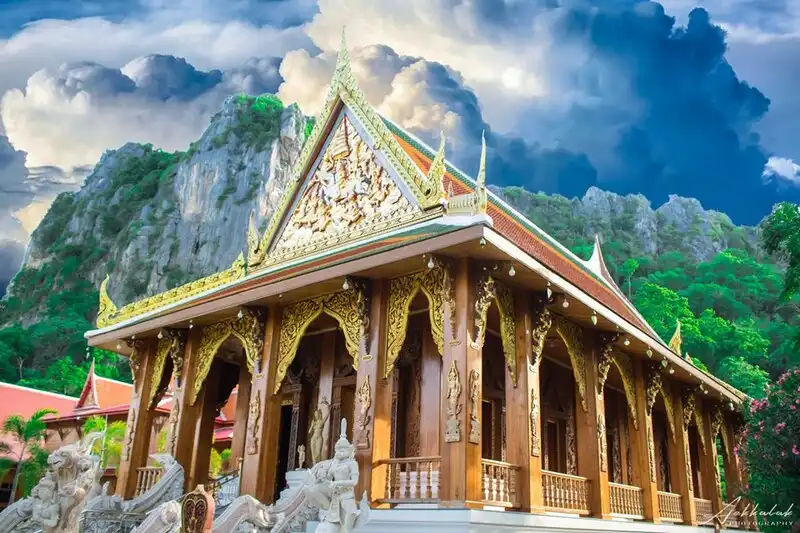
Wat Tham Khao Yoi is one of Phetchaburi’s cave temples that most clearly reflects the relationship between “landscape” and “faith.” The temple sits on a limestone hill along the main Phet Kasem Road, making it an easy stop for travelers who wish to pay respects and take a short break. What sets Wat Tham Khao Yoi apart from an ordinary roadside stop is the atmosphere inside the cave, which feels like a “natural vihara.” Nature has shaped a stone hall, cave chambers, and a ceiling of stalactites as if intentionally designed as a quiet space for contemplation. As visitors step from the bright outdoors into the cool interior, many sense a silence that is not emptiness, but a calm that helps the mind settle into the present with surprising ease.
The context of Wat Tham Khao Yoi is best understood alongside the “Phetchaburi limestone hills,” where many caves are found and have long been used as sacred spaces—as monastic shelters, meditation sites, places to venerate Buddha footprints, or as niches for Buddha images in accordance with the idea that “a cave is a secluded place.” Wat Tham Khao Yoi is therefore not only a natural attraction, but a place where religion and nature blend closely. The cave hall functions like a natural courtyard for worship, while the curved rock walls form a backdrop that reminds visitors of human smallness against time and the natural world. At the same time, the cave’s sanctity does not come only from darkness or mystery, but from generations who have “left their hopes” and “set down their burdens” here through lighting incense, praying, sitting in stillness, making vows, and giving merit according to their faith.
Inside the cave, many Buddha images in different postures are enshrined along various points of the cave walls, making visitors feel as though they are walking through “a prayer made visible,” because each step offers a Buddha image as an anchor for both eyes and mind. In the main chamber, a particularly revered focal point is the “Buddha footprint,” placed on a stone base and covered by a pavilion-like white mondop. This arrangement makes the footprint the clear center of the cave hall, as if it were the axis drawing attention and devotion into one shared space. Meanwhile, the cave ceiling—with stalactites hanging at varying heights—serves as a gentle reminder that the beauty of a sacred cave temple does not come from lavish decoration, but from “allowing nature to be the architect,” and then adding religious meaning with respect for the original setting.
One reason Wat Tham Khao Yoi is often mentioned in local historical narratives is its connection to the reign of King Rama IV. A long-told legend says that while King Mongkut (Rama IV) was ordained, he traveled on dhutanga pilgrimage to the Khao Yoi area, set up his forest umbrella (klod) to practice vipassana at the foot of Khao Yoi, and later moved up to meditate inside Khao Yoi Cave for several nights. Such a story is significant because it reflects the broader role of cave temples in an era when pilgrimage and seeking seclusion were central to spiritual practice. Caves in limestone mountains offered peace, safety from worldly disturbances, and a natural environment that helped practitioners contemplate impermanence.
Viewed through the lens of “cave temples in the era of King Rama IV,” caves were not merely places of concealment, but landscapes that expressed a form of Buddhism oriented toward “returning to the core,” at a time when Siam began to face pressure from the modern world. Rama IV, as a monk deeply interested in the Tipitaka and rational inquiry, emphasized discipline and serious practice. Cave landscapes aligned with the ideal of retreat and profound mindfulness. Therefore, the legend linking Wat Tham Khao Yoi to meditation in the cave is not simply “a tale to add mystique,” but a way of reaffirming that caves were genuinely used for contemplative practice and formed part of the region’s spiritual culture—especially in Phetchaburi, where many caves exist and have been continuously treated as sacred sites for a long time.
From a visitor’s perspective, Wat Tham Khao Yoi feels more “accessible” than many cave temples because the ascent is not very high and the stairs are not excessively steep. Many children and older visitors can climb up with only modest caution. The time that many find most comfortable is early morning to late morning, when the air is not too hot and the outdoor light is not so harsh that it makes adjusting to the cave interior difficult. One distinctive experience of visiting a cave temple is the “shift in temperature”—from the bright heat outside to the cool dimness within. This change often causes people to lower their voices automatically, as if the space itself quietly sets the rule that visitors should speak softly and walk slowly to respect both the place and those who come to worship.
Another layer of the experience is the sense that “a cave has its own rhythm.” Walking through a cave is not like moving straight down a building corridor; it involves gently turning around rock walls, passing through pockets of light, and gradually encountering Buddha images at different corners. This makes worship inside the cave feel like a kind of walking meditation. For those who intentionally move mindfully, each step can become a reminder to return to the breath. Standing before the Buddha footprint or looking up at the stalactites overhead can slow the mind, interrupt hurried thinking, and reveal a quiet, simple beauty that does not need to compete with anything.
When people speak of cave temples in Phetchaburi, many think of “Tham Khao Luang,” another significant site often compared with Wat Tham Khao Yoi. Both are limestone caves with strong spiritual meaning, yet their atmosphere and “cave character” differ clearly. Wat Tham Khao Yoi often feels like an easy-to-access cave, not so large that it becomes overwhelming, with the everyday quality of a community temple where people can stop to pay respects while traveling. Tham Khao Luang, meanwhile, is strongly associated with “light streaming down from a cave opening,” creating a sense of wonder and making many visitors feel as if they have entered a natural hall designed with its own spotlight. The experience of Tham Khao Luang therefore often leans more toward “the grandeur of nature.”
In terms of travel style, Wat Tham Khao Yoi is often ideal for those who want a short stop that still offers peace and a complete worship experience without taking too much time. Tham Khao Luang tends to suit those who plan the visit specifically, as it often requires more time for travel and for walking up and down, depending on one’s physical condition, and many people also consider the best time for beautiful light. In terms of “devotional value,” both carry weight in different ways. Wat Tham Khao Yoi holds value as a place where faith is intertwined with the everyday life of people along the main route—a place the community and passersby can return to repeatedly without major planning. Tham Khao Luang is a destination experience that many intentionally seek to witness its distinctive beauty, and it is often remembered for its large chamber and dramatic natural light.
This difference does not make one better than the other; it simply helps visitors “choose what matches their intention.” If you want a peaceful space, an easy walk, a convenient stop along the way, and the spiritual feeling of a sacred cave, Wat Tham Khao Yoi fits very well. If you want a cave experience defined by light and grandeur, Tham Khao Luang may be more suitable. For those with time, visiting both offers a view of the “spectrum of Phetchaburi cave temples,” from approachable simplicity to awe-inspiring natural spectacle.
As for visiting with respect, Wat Tham Khao Yoi is a place where appropriate footwear and careful walking are important, as certain sections can be slippery due to cave humidity. Visitors should also maintain quiet, avoid touching Buddha images or stalactites and stalagmites (fragile natural formations), and move carefully for personal safety and to help preserve the site. Some visitors may also encounter wildlife or animals living naturally in the hill area. Practicing caution and avoiding random feeding are part of responsible travel that helps the temple retain its calm and natural character over the long term.
Getting There By private car, you can take Phet Kasem Road (Highway 4) toward Phetchaburi. When you reach the Khao Yoi junction area, look for turns and signage, then turn onto local roads leading to the temple and parking area. From there, walk up the stairs to the cave entrance. Overall, it is a practical route for a stopover on the way south or back to Bangkok. It is recommended to allow a little extra time for walking up and down and for viewing the cave interior safely.
| Overview | A limestone-hill cave temple in Khao Yoi District, notable for its sacred cave atmosphere, multiple Buddha images, and a Buddha footprint. Ideal for worship and a restful stop along the route. |
| Address | Khao Yoi Subdistrict, Khao Yoi District, Phetchaburi Province |
| Highlights | A natural vihara inside a cool, peaceful cave with a gentle walking rhythm. Features multiple Buddha images and a Buddha footprint in the main chamber. Easy access for most ages (walk carefully). |
| Abbot / Temple Supervisor (Latest) | Phra Maha Nithikan Nitthivamso |
| Nearby Tourist Attractions | 1) Wat Khao Yoi – 1 km 2) Khao Yoi Viewpoint – 2 km 3) Tham Khao Luang (Mueang Phetchaburi District) – 30 km 4) Phra Nakhon Khiri Historical Park (Khao Wang) – 26 km 5) Cha-am (Beach / Resort Town) – 62 km |
| Nearby Restaurants | 1) Som Tam Rong Klueng (Aeb Saep) – 500 m, Tel. 087-124-2098 2) Khao Kaeng Tamrab Mae Luan – 600 m, Tel. 032-896-941, 090-916-6659 3) Tom Yum Noodles “Sathan Thung” – 700 m, Tel. 081-017-6586 4) Le Mae Cafe (Le Mae Cafe & Restaurant) – 900 m, Tel. 095-251-9447 5) Khao Kaeng Mae Luan – 900 m, Tel. 032-562-384, 081-858-7946 |
| Nearby Accommodations | 1) Le Mae Residence (Khao Yoi) – 1 km, Tel. 095-458-8836 2) SB.INN & SB.Camp – 3 km, Tel. 094-592-2625 3) Pop House Hotel (Khao Yoi) – 3 km, Tel. 032-706-796 4) V INN – 3 km, Tel. 084-005-8330 5) Wipula House / Relax House Branch 2 – 4 km, Tel. 088-794-4155 |
Frequently Asked Questions (FAQ)
Q: What time of day is best for visiting Wat Tham Khao Yoi?
A: Early morning to late morning or late afternoon is recommended, as the weather is less hot and walking up and down the stairs is more comfortable.
Q: What is the most important thing to worship inside the cave?
A: The cave enshrines many Buddha images, and the key highlight is the Buddha footprint in the main chamber, which serves as the central focus of devotion for many visitors.
Q: Is the climb difficult, and can older visitors go up safely?
A: In general, it is manageable and not overly steep, but visitors should walk slowly, use the handrails, and be careful of slippery surfaces, especially in humid sections of the cave.
Q: How is Wat Tham Khao Yoi different from Tham Khao Luang?
A: Wat Tham Khao Yoi is easier to access and suits a short, peaceful stop for worship along the route, while Tham Khao Luang is known for a large chamber and dramatic light streaming from a cave opening, creating a more grand atmosphere.
Q: What etiquette should visitors follow when visiting a cave temple?
A: Dress modestly, keep your voice low, maintain a calm atmosphere, do not touch stalactites, stalagmites, or Buddha images, and walk carefully to ensure safety and help preserve the site.
 Wat Khao Yoi Map
 Category:
  Group:
  Last Update: 4 HourAgo
Comment
 Nearby Attractions
| Keyword (Advance) |
 Region
|
 Muang Phetchaburi(