

 Home
Home Chiang Mai(




Rating: 4.3/5 (8 votes)
 |
|  Map
Map 
 Have Map
  No Map
Phetchaburi attractions
Attractions in Thailand
Open Days: Daily
Opening Hours: 08.00 – 17.00
Wat Yai Suwannaram Worawihan is located in Tha Rap Subdistrict, Mueang Phetchaburi District, Phetchaburi Province. It is a royal monastery with roots that trace back to the Ayutthaya period. Although there is no definitive record specifying the exact date of its original construction, art-historical evidence and historical documentation suggest that the temple underwent a major restoration during the reign of King Suea, under the direction of Phra Suwannamuni, who was later elevated as Somdet Phra Sangkharat Taengmo. For this reason, Wat Yai Suwannaram is not only an ancient temple but has also long served as a center of religion, artistic heritage, and learning for Phetchaburi over many centuries.
The setting of Wat Yai Suwannaram clearly reflects Phetchaburi’s role in the Ayutthaya era. Phetchaburi was an important western frontier city with strategic significance, commercial activity, and a long-standing reputation as a hub for master craftsmen. Situated within the historic town area and closely connected to surrounding communities and the Phetchaburi River, the temple functions both as a sacred site and as a living cultural landscape. Visitors often sense the atmosphere of a royal temple that never separated itself from the city, but instead grew alongside local life and traditions through time.
The ubosot at Wat Yai Suwannaram is the spiritual and architectural core of the complex and is among the religious structures that art historians find especially significant. Built in a traditional Thai form of brick and mortar, the ubosot has no windows, consistent with late-Ayutthaya architectural conventions. The front wall contains three doorways, with the central doorway larger and positioned higher than the two flanking doors. The rear wall has two doorways. These openings are plain, without elaborate framing, while the thick teak doors are painted red on the exterior and feature painted guardian figures on the interior. The engaged columns along the front wall include capitals and decorative banding, except for those at the rear, which do not carry the same ornamentation. Such details reveal a carefully ordered design aligned with Ayutthaya-period architectural principles.
The ubosot roof is a two-tiered gabled form without a projecting porch, clad with traditional roof tiles. Each side presents three rows of roofing, with decorative eave tiles on every level. The front gable is crowned with chofa, bai raka, and hang hong, embellished with colored glass. The eastern pediment is adorned with stucco relief featuring a Garuda at the center, surrounded by curling kanok motifs, while the western pediment depicts a deity riding a demon, encircled by flame-like kanok patterns. These elements are not merely decorative; they also express cosmological beliefs and sacred authority as conceived in the Ayutthaya state tradition.
The mural paintings inside the ubosot are regarded as among Thailand’s most important works of art. Executed in tempera-like pigment on plaster, the wall facing the principal Buddha image, between the main supporting columns (including the so-called nang-naep columns), depicts an episode from the Buddha’s life: the confrontation with Mara. Areas above the side sections of the doorways are filled with vegetal patterns extending up toward the ceiling. The reverse sides of the doors show painted guardian figures, and scenes of assembled deities, angels, giants, nagas, garudas, and celestial beings are rendered in a distinctive style that differs clearly from mural traditions commonly associated with Bangkok.
The artistic value of these murals is reinforced by the commentary attributed to King Chulalongkorn (Rama V), written when he traveled through Ratchaburi in 1909. In his observations on the assembled deities and the portrayal of giants, he noted that the giants were not painted as theatrical khon masks but as human faces, suggesting that the artist deeply understood the conceptual meaning of each figure rather than following a superficial formula. This perspective has contributed to the recognition of Wat Yai Suwannaram’s murals as an authentic reflection of earlier Ayutthaya artistic thought.
Somdet Chao Phraya Naritsaranuwattiwong (Prince Naris) also wrote about Wat Yai Suwannaram in his travel chronicle to the Ratchaburi region (R.S. 121), describing it as the oldest temple he had seen and noting that it remained in very good condition, with significant murals and craftsmanship surviving for study. He referred to gilded painted columns, bencharong-style painted surfaces, and intricately carved wooden doors as key evidence of the temple’s age and outstanding artistic quality.
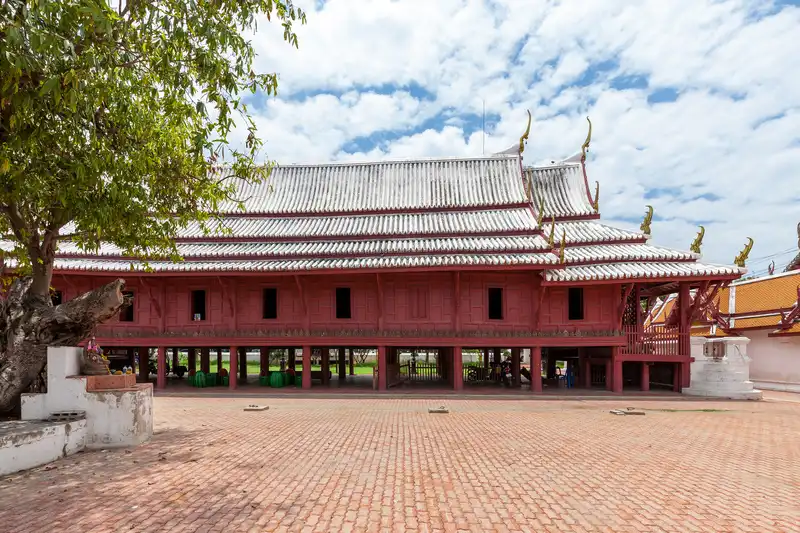
The sermon hall (sala kan parian) at Wat Yai Suwannaram is a large traditional Thai wooden structure with ten bays, a two-tiered roof, and porches on both sides. The western end forms a two-level gable with a projecting porch and additional wing-like roof planes sloping downward. The roof was traditionally covered with banana-stem-style tiles and coated with plaster, and the eaves are decorated with patterned terracotta elements. Inside are fourteen octagonal columns; the principal columns are fully gilded with pierced patterns, arranged in paired designs that do not repeat. The roof structure—beams, purlins, and rafters—is richly decorated with continuous painted designs across every component.
According to local tradition, this sermon hall was originally a royal residence built by Ayutthaya kings and later bestowed upon Somdet Chao Taengmo. When King Chulalongkorn (Rama V) visited Wat Yai Suwannaram, he was said to have been pleased with the conservation approach and instructed that one column on the northern side be left uncoated and unpainted, so that future generations could study the original material and workmanship. That column remains visible today and is often cited as an early example of forward-looking heritage conservation.
The ho trai (scripture repository) stands in the middle of a pond and is a single-storey Thai-style structure with a distinctive feature: it rests on only three pillars. The walls are of traditional panel construction, and the roof is a steep gable form, now covered with turtle-scale tiles. A small bridge connects the pond edge to the ho trai. Building a scripture repository over water reflects long-standing wisdom intended to protect sacred manuscripts from termites and moisture, while also creating a quiet, contemplative setting suitable for study and religious practice.
The monks’ residential quarter lies behind the sermon hall, and its wall construction showcases a remarkable variety of traditional Thai wooden-panel techniques. The kuti walls present six historic styles, including panelled construction and other classic Thai patterns. The exterior often appears as panel work, while the interior is finished with precise tongue-and-groove joinery so refined that it looks like a single continuous board. These carpentry details reflect the craftsmanship associated with the Phetchaburi artisan tradition and provide an excellent on-site reference for studying refined Thai wooden architecture.
Getting There Wat Yai Suwannaram Worawihan is located within Phetchaburi town and is easy to reach by road. Travelers can enter the city area from Phetkasem Road and continue toward Tha Rap Subdistrict. The temple is not far from other major attractions such as Wat Mahathat Worawihan and Khao Wang (Phra Nakhon Khiri), making it convenient to plan a one-day cultural route focused on historic temples in Phetchaburi.
| Place Summary | A royal monastery associated with the Ayutthaya period, renowned for nationally significant mural paintings and master-level artistic heritage in Phetchaburi. |
| Highlights | Ayutthaya-style ubosot, nationally acclaimed murals, historic wooden sermon hall, pond-centered ho trai, and refined Phetchaburi craftsmanship. |
| Abbot (Latest) | Phra Khru Suwannakit Koson (latest publicly available information) |
| Nearby Attractions | 1) Wat Mahathat Worawihan – 1.5 km 2) Phra Nakhon Khiri (Khao Wang) – 2.5 km 3) Wat Ko – 2.0 km 4) Phra Ram Ratchaniwet (Ban Puen Palace) – 3.5 km 5) Phetchaburi Old Town Area – 1.8 km |
| Nearby Restaurants | 1) Ow Ting Nai Kee – 1.6 km โทร. 081-852-3350 2) Je Ja Khao Tom Pla – 1.4 km โทร. 065-828-9379 3) Krua Boonthang – 1.7 km โทร. 092-459-5263 4) Khao Chae Mae Orn – 1.9 km โทร. 032-456-789 5) Je K Meng – 2.0 km โทร. 032-123-456 |
| Nearby Accommodations | 1) Royal Diamond Hotel – 2.3 km โทร. 032-411-061 2) Save Zone Hotel – 2.5 km โทร. 084-106-3397 3) Chedi View Hostel – 2.8 km โทร. 090-950-6529 4) Sweet Dreams Guest House – 3.6 km โทร. 085-121-9666 5) Alinda Resort – 4.8 km โทร. 086-318-4220 |
Frequently Asked Questions (FAQ)
Q: When was Wat Yai Suwannaram built?
A: It is generally believed to date back to the Ayutthaya period, with a major restoration traditionally associated with the reign of King Suea.
Q: What is the temple’s most important highlight?
A: The ubosot murals, widely regarded as nationally significant masterpieces of Thai mural painting.
Q: Is the sermon hall connected to a former royal residence?
A: Local tradition states that it was once an Ayutthaya royal residence before becoming the temple’s sermon hall.
Q: Why is the pond-centered ho trai significant?
A: It reflects traditional wisdom for preserving sacred texts from termites and humidity, and it is also a distinctive scenic feature of the temple.
Q: How much time should I plan for a visit?
A: Plan at least 1–2 hours to view the ubosot, murals, sermon hall, and ho trai in detail.
 Wat Yai Suwannaram Worawihan Map
 Category:
  Group:
  Last Update: 17 HourAgo
Comment
 Nearby Attractions
| Keyword (Advance) |
 Facebook Fanpage
 Region
 Art, Culture and Heritage
 Historical Sites and Monuments(
 Landmarks and Memorials(
 Royal Palace(
 Art, Craft Centres, Tradition(
 Museums(
 Educational Places
 Educational Gardens, Farm(
 University
 Other religious and spiritural sites(
 Research and Development
 Royal Project(
 Suburban Living
 Village, Community(
 Floating Market(
 Nature and Wildlife
 National Parks and Marine Reserves(
 Mountain (Doi)(
 Dam, Reservoir, Lake(
 Waterfalls(
 Hot Springs(
 Caves(
 River, Canal(
 Bays and Beaches(
 Islands(
 Other natural attractions(
 Entertainment and Agricultural
 Zoos and Aquariums(
 Farm, Parks, Gardens and Ecotourism(
 Waterpark(
 Theater(
 Outdoor and Adventure Activities(
 Travel Articles, Recipes
 Travel Review, Food Review(