

 Home
Home Chiang Mai(




Rating: 2.6/5 (18 votes)
 |
|  Map
Map 
 Have Map
  No Map
Phetchaburi attractions
Attractions in Thailand
Open Days: Daily
Opening Hours: 08.00 – 17.00
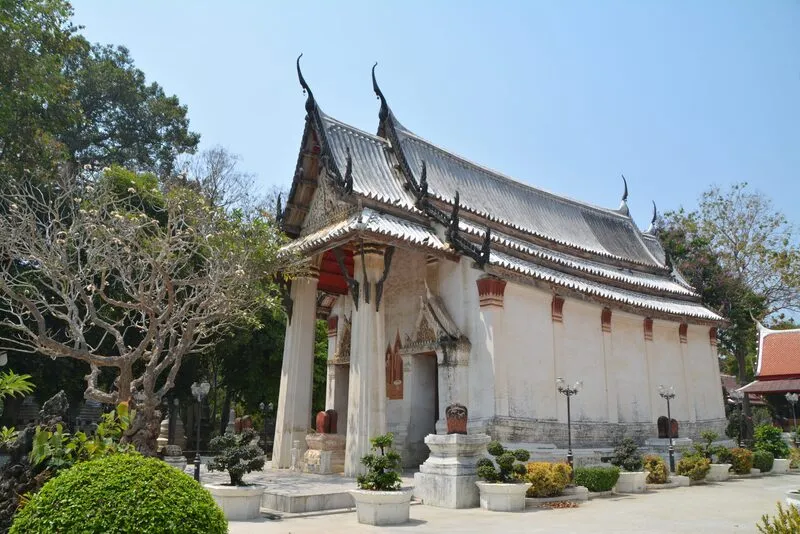
Wat Ko is located on the left bank of the Phetchaburi River in Tha Rap Subdistrict, Mueang Phetchaburi District, Phetchaburi Province. It is an ancient temple whose history dates back to the Ayutthaya period and is widely regarded as one of Phetchaburi’s most valuable sites in terms of art and historical significance. The temple stands out not only for its age, but also for its distinctive mural paintings inside the ordination hall, which carefully record both the Buddha’s life story and scenes of everyday society in Ayutthaya-era Phetchaburi. For this reason, Wat Ko has long been praised as a true masterpiece of Phetchaburi’s artistic heritage.
The riverside setting of Wat Ko reflects the Phetchaburi River’s long-standing role as the city’s main lifeline. Historically, the river was not only a transportation route and a channel for trade, but also the core around which settlements, religious sites, and cultural life developed. The placement of Wat Ko on this riverbank was therefore not accidental; it represents a deliberate choice of location aligned with the living patterns and urban structure of the Ayutthaya period. Over centuries, Wat Ko has served both as a spiritual center and as part of the cityscape that has continuously linked local communities to the river.
Key evidence confirming Wat Ko’s Ayutthaya-era origins can be found inside the ordination hall. The mural paintings contain a clear inscription stating that the temple was built in 1734 (B.E. 2277), during the reign of King Borommakot. This is an especially valuable historical record because the year is documented directly within the artwork itself. As a result, Wat Ko is not merely a temple that is “assumed” to date back to Ayutthaya; it is a site whose construction period can be identified with clarity, reinforcing Phetchaburi’s significance as an important city in the late Ayutthaya era.
The ordination hall of Wat Ko is a brick-and-mortar structure built according to late Ayutthaya architectural conventions. One distinctive feature is that it has no window openings, allowing the walls on both sides to serve as continuous surfaces for mural paintings. Inside, the murals were painted using powdered pigments mixed with adhesive, a traditional technique used by Thai artisans of that time. The primary narrative depicts the Buddha’s life story, arranged in an orderly sequence, with the year of painting recorded as 1734 (B.E. 2277). This mural set therefore holds dual importance as both high art and a form of historical documentation.
What makes Wat Ko’s murals especially different from those of other Ayutthaya-era temples is the presence of foreigners depicted among scenes of local society in Phetchaburi. These figures appear with clothing and features that clearly distinguish them from Thai people, reflecting the ethnic and cultural diversity of Phetchaburi during the Ayutthaya period. Their inclusion is not merely decorative; it serves as significant evidence that Phetchaburi functioned as a trading port city and a strategic frontier area with continuing contact with foreign communities. In this sense, Wat Ko acts like a visual archive of contemporary social life, something extremely rare to find today.
The importance of Wat Ko’s murals was also noted by Prince Narisara Nuvadtivongs (Somdejฯ Krom Phraya Naris), who wrote about the temple in his travel chronicle “Notes of a Journey to Ratchaburi Province.” He referred to an inscription at the base of the main stupa recording the year 1734 (B.E. 2277), as well as the dedication of the stupa for the lasting stability of Buddhism. This inscription further underlines Wat Ko’s value as a temple with clear historical evidence and as a long-standing spiritual center for its community.
Another remarkable feature of Wat Ko is its exceptionally beautiful preaching seat (thammat), built in 1921 (B.E. 2464) by craftsmen from the Wat Ko artisan group. This thammat has been recognized as a model for woodcarving styles seen in many other temples in Phetchaburi, particularly in elements such as brackets, kranok motifs, and decorative base patterns. Traditionally, a thammat is a raised seat used by monks when delivering sermons, often carved from wood and finished with lacquer and gold leaf. The Wat Ko thammat is therefore important not only for its function, but also as a refined work of art that clearly expresses the identity of Phetchaburi’s local craft tradition.
The viharn (assembly hall) of Wat Ko is located to the north of the ordination hall. It is a Thai-style brick-and-plaster building with four bays, constructed in a similar design tradition to the ordination hall, but with a more softly curved base. The viharn’s base includes chamfered corner pillars supporting projecting porches at both the front and the back, with decorative plasterwork at the pillar heads. At the rear porch stands a small stupa. The viharn has only one entrance door at the front; the rear wall is solid, while the side walls each have one window opening, believed to have been added later. The roof is covered with pointed earthenware tiles in a single-tier form, adorned with chofa, bai raka, and hong hang finials. The gable is plain without ornamentation, and inside the hall stands the principal Buddha image.
Between the ordination hall and the viharn stands the main stupa, commonly referred to as the “ornamented stupa.” In line with late Ayutthaya conventions for ordination hall layouts, a smaller stupa originally existed on this axis. Later, in 1925 (B.E. 2468), Phra Khru Phetcharopmakhun (Lueam Chanthachoto), the fourth abbot, built a larger stupa to encase the earlier structure in order to enshrine sacred relics. This ornamented stupa resembles the ornamented stupa at Wat Pom, suggesting that both may have been restored around the same period and possibly by the same group of craftsmen.
The bell-shaped body of the main stupa is decorated with garland-like chains and floral swags. Its base is encircled with kranok-style motifs, with a frieze band beneath, supported by lotus molding and vine-like garlands. The stupa platform is enclosed by a low “crystal wall,” and the staircase follows a style similar to the main stupa at Wat Yang. Above the base is a twelve-cornered pedestal, topped with niches and alternating pilasters. Higher sections include bead-like lotus moldings leading to the spire and dew-drop finial. The overall workmanship reflects refined craftsmanship and the distinctive beauty of Thai religious art.
To the north of the viharn are four satellite stupas arranged in descending sizes, reflecting a symbolic hierarchy. Their forms differ from many other stupas in Phetchaburi, and in overall silhouette they resemble the tall stupa shapes found at Khao Luang Cave. The size-graded arrangement conveys layered ideas of religious symbolism and artistic convention, adding further architectural depth to the Wat Ko complex.
The sermon hall (sala kan parian) of Wat Ko is located behind the ordination hall. It is a Thai-style open pavilion with two side wings, and an inscription on the gable records its construction year as 1914 (B.E. 2457). The hall underwent several restorations. In 1893 (B.E. 2436), Buddha-life paintings were added around the upper wall zone. Later, in 1924–1925 (B.E. 2467–2468), star motifs were installed on the ceiling and gold patterns were painted on the columns. In 1968 (B.E. 2511), minor repairs were made, including refreshing gold decoration and adding chofa, bai raka, and hong hang roof ornaments.
Inside, the sermon hall is a spacious open structure divided into three bays by column lines. On the northern side is a monastic seating zone, and Buddha images are placed on clustered lotus bases. The upper wall and ceiling areas feature tempera-style paintings on wood panels, depicting stories such as the Pathama Sambodhikatha, the Vessantara Jataka, mountain-and-forest scenes, and wildlife imagery, totaling 20 compartments. The ceiling is decorated with a “stars-around-the-moon” motif, with carved wooden panels and ornamental elements. The wing ceilings feature a red ground with pierced gold floral motifs, while the beams carry gold stencils of garlands and face motifs. The hall also preserves important antiques, including a preaching thammat, lacquered scripture cabinets, carved wooden screens, and a principal Buddha image in the Maravijaya posture.
The riverside pavilion, known as Sala Mahesuan, is located at the rear of the temple on the western side, adjacent to the Phetchaburi River and accessible by a concrete staircase from the riverbank. According to records by Phra Athikan Sian, the current abbot, this pavilion was built during the tenure of Phra Athikan Dit, the second abbot, as an offering to a royal figure titled Krom Muen Mahesuan. The pavilion was therefore named after the royal title. Sala Mahesuan is a raised pavilion with a two-tiered roof, decorated with chofa, bai raka, and hong hang finials. Its gable carvings feature repeated “khao bind” motifs executed with refined precision. The pavilion is surrounded by wooden backrests and turned balustrades in a distinctive style, with carved floral panels set into framed sections. Overall, Sala Mahesuan is considered a hallmark of the Phetchaburi artisan lineage and later became a model for riverside pavilions built in subsequent generations.
Wat Ko also maintains a temple museum, established in the area in front of the monks’ residential quarter. The museum has three floors. The first floor is used for teaching Dhamma to those interested and for monastic meetings. The second floor serves as a display zone for antiques, including Buddha images, porcelain ware, Benjarong ceramics, and funerary offering items. Some objects are recorded as royal donations by King Rama V during the funeral rites of Prince Urubongse Rajsombhoj. Examples include old lunch containers and foreign banknotes from earlier periods. The top floor is dedicated to preserving traditional manuscripts such as samut khoi folded books, palm-leaf scriptures, and Tripitaka texts, with storage cabinets and study equipment used by monks. This museum was established through community donations and temple merit funds, reflecting Wat Ko’s role as a custodian of local cultural heritage.
Getting There Wat Ko is located within the urban area of Phetchaburi and is convenient to reach from the city center. You can travel via local roads toward the Phetchaburi River, as the temple sits close to residential communities and several important landmarks. The location is well suited for planning a cultural route that combines visits to ancient temples and local heritage sites within a single day.
| Place Summary | An Ayutthaya-era temple built in 1734 (B.E. 2277), best known for its mural paintings and outstanding artistic heritage in Phetchaburi. |
| Key Highlights | Mural paintings of the Buddha’s life and foreign figures, a signature Phetchaburi-style preaching seat (thammat), Sala Mahesuan riverside pavilion, and the Wat Ko museum. |
| Abbot / Temple Head (Latest) | Phra Athikan Sian (พระอธิการเสี่ยน) |
| Nearby Tourist Attractions | 1) Wat Mahathat Worawihan – 1.5 km 2) Khao Nakhon Khiri (Khao Wang) – 2.0 km 3) Wat Yai Suwannaram – 2.5 km 4) Phra Ram Ratchaniwet (Ban Puen Palace) – 3.0 km 5) Phetchaburi Old Town Area – 1.8 km |
| Nearby Restaurants | 1) Jae Ja Khao Tom Pla – 1.2 km Tel. 065-828-9379 2) Krua Boonthang – 1.5 km Tel. 092-459-5263 3) Owtung Nai Kee – 1.6 km Tel. 081-852-3350 4) Khao Chae Mae On – 1.7 km Tel. 032-456-789 5) Jek Meng – 1.8 km Tel. 032-123-456 |
| Nearby Accommodations | 1) Royal Diamond Hotel – 2.0 km Tel. 032-411-061 2) Save Zone Hotel – 2.2 km Tel. 084-106-3397 3) Sweet Dreams Guest House – 3.5 km Tel. 085-121-9666 4) Chedi View Hostel – 2.8 km Tel. 090-950-6529 5) Alinda Resort – 4.5 km Tel. 086-318-4220 |
Frequently Asked Questions (FAQ)
Q: When was Wat Ko built?
A: Wat Ko was built in 1734 (B.E. 2277) during the reign of King Borommakot, as recorded in an inscription within the ordination hall murals.
Q: What is the most distinctive feature of Wat Ko?
A: Its mural paintings, which depict the Buddha’s life story and include rare scenes of foreigners within Ayutthaya-era Phetchaburi society.
Q: Why is the Wat Ko preaching seat (thammat) important?
A: It is considered a model work of Phetchaburi woodcarving craftsmanship and holds high artistic value.
Q: What is Sala Mahesuan?
A: It is a riverside pavilion built as an offering to a royal figure titled Krom Muen Mahesuan, and it is regarded as a classic example of the Phetchaburi artisan tradition.
Q: How much time should I plan for a visit?
A: It is best to allow at least 1–2 hours to explore the ordination hall, viharn, sermon hall, riverside pavilion, and the temple museum.
 Wat Ko Map
 Category:
  Group:
  Last Update: 17 HourAgo
Comment
 Nearby Attractions
| Keyword (Advance) |
 Facebook Fanpage
 Region
 Art, Culture and Heritage
 Historical Sites and Monuments(
 Landmarks and Memorials(
 Royal Palace(
 Art, Craft Centres, Tradition(
 Museums(
 Educational Places
 Educational Gardens, Farm(
 University
 Other religious and spiritural sites(
 Research and Development
 Royal Project(
 Suburban Living
 Village, Community(
 Floating Market(
 Nature and Wildlife
 National Parks and Marine Reserves(
 Mountain (Doi)(
 Dam, Reservoir, Lake(
 Waterfalls(
 Hot Springs(
 Caves(
 River, Canal(
 Bays and Beaches(
 Islands(
 Other natural attractions(
 Entertainment and Agricultural
 Zoos and Aquariums(
 Farm, Parks, Gardens and Ecotourism(
 Waterpark(
 Theater(
 Outdoor and Adventure Activities(
 Travel Articles, Recipes
 Travel Review, Food Review(