

 Home
Home Chiang Mai(




Rating: 4.5/5 (6 votes)
 |
|  Map
Map 
 Have Map
  No Map
Chachoengsao attractions
Attractions in Thailand
Open Days: Daily
Opening Hours: 06:00 – 18:00
Wat Pho Bang Khla, Chachoengsao is an old riverside temple on the Bang Pakong River in Bang Khla District. Visitors come here to pay respects to the Reclining Buddha housed inside a rare four-gabled pavilion (Wihan Chaturamuk), and to witness an Unseen highlight: large colonies of flying foxes (fruit bats) roosting in huge numbers on the temple’s trees. The atmosphere is shady and calm, the walk is easy, and a visit typically takes about 1–2 hours. You can comfortably continue your one-day route to Bang Khla Market, Bang Khla Floating Market, Wat Pak Nam Jolo, or drive back into Chachoengsao town within the same day.
Wat Pho Bang Khla, Chachoengsao is located about 23 kilometers from Chachoengsao town center. Locals know it as a spiritual hub for the riverside community, and travelers appreciate it as a place where heritage architecture and living nature exist together in the same real-world setting. The temple’s highlights do not feel staged: merit-making areas, worship spaces, and the large trees that have become a roosting habitat for flying foxes all function as part of everyday temple life. That is why many people choose to come here specifically to see the place with their own eyes.
If you enjoy the character of traditional Thai riverside towns, it becomes easy to understand why “temples” and “rivers” have always been inseparable in both past and present community life. The Bang Pakong River has long served as a lifeline for Chachoengsao and Bang Khla in terms of travel, trade, and settlement. Wat Pho Bang Khla is not hidden away in an isolated corner; it is part of a riverside landscape where people continue to live and move in real time. When you step into the temple, you will find the quiet calm typical of a Thai temple, while also sensing that this is not a place frozen in time. It still supports merit-making, ceremonies, and daily visits from local residents.
The temple grounds cover approximately 31 rai, which makes the visit feel open and uncramped, with enough space to take your time and absorb the details. On pleasant days, sunlight filters through the branches, leaf shadows fall across the courtyard, and nature sounds form the background. This mood is one reason Wat Pho Bang Khla suits travelers who want a destination near Bangkok without an overly curated atmosphere, because this is both a real, active temple and a real ecosystem where faith and nature co-exist in the same place.
Historically, Wat Pho Bang Khla is believed to have been established around 2310–2325 BE (1767–1782 CE), during the reign of King Taksin the Great. This estimated timeline matters in local historical terms because it suggests Bang Khla was not merely a pass-through area, but a community where people settled, founded religious institutions, and maintained faith traditions continuously into the present. Seen through this historical lens, the temple becomes more than a single building: it reads as a trace of settlement and a living continuity of riverside community life that can still be felt today.
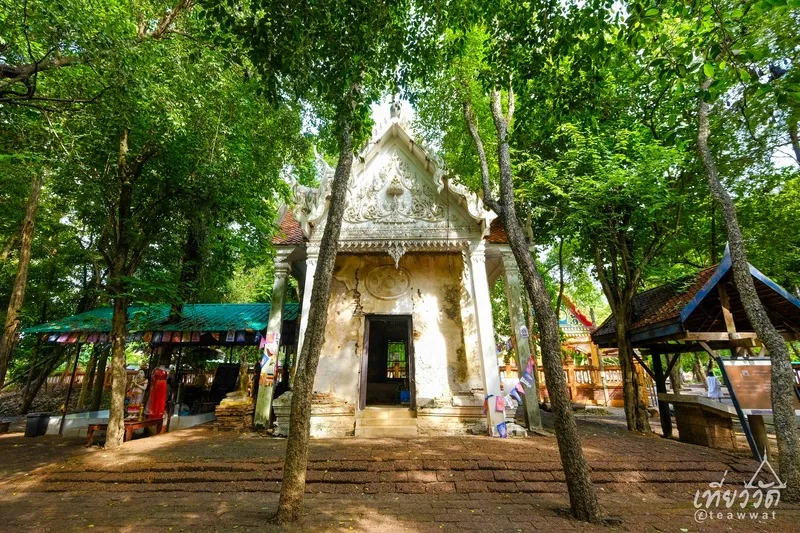
What makes Wat Pho Bang Khla especially compelling to those who appreciate craftsmanship is its architecture that bridges late Ayutthaya and early Rattanakosin influences in one place. The key structure is the Wihan Chaturamuk, built in brick and plaster, with a gabled roof clad in terracotta turtle-scale tiles. The four-gabled form gives the building dignity and depth, opening the view from multiple directions and conveying the presence of a purpose-built ceremonial hall. As you walk closer, you will notice that the beauty is not driven by heavy decoration, but by proportion, structure, and material details that make the entire composition feel “old with dignity.”
The terracotta turtle-scale roof tiles are another detail that stays in people’s memory because they carry a distinct texture and a sense of time. When light strikes the roof, the repeated rhythm of the tiles becomes a pattern in itself, with a handmade quality typical of traditional craftsmanship. Placed on the Wihan Chaturamuk, the roof contributes to an overall impression of stability, quiet, and an inviting calm that encourages visitors to step inside and pay respects without rushing. For cultural travelers, this is one reason Wat Pho Bang Khla feels different from many general attractions: you are not only taking photos, you are also “reading” craftsmanship and historical period through the space.
Inside the pavilion is a Reclining Buddha image, a focal point of devotion for visitors and local residents. The reclining posture is commonly associated with the Buddha’s final moments and the condition of deep peace. Paying respects to a Reclining Buddha within an old pavilion often feels more contemplative than a quick stop, because the interior atmosphere is calm and intimate rather than grandiose. When entering to worship, it is best to keep your voice low, remain composed, and give space to others who are praying, as this is a religious site used for daily merit-making and worship.
If the spiritual highlight is the Reclining Buddha, the natural highlight of Wat Pho Bang Khla is the colony of flying foxes (fruit bats) roosting in the temple trees. These fruit bats are large, with fox-like faces, big eyes, small noses and ears, brownish-reddish fur, and dark wings that can make them look like oversized birds in flight. Seeing so many bats hanging in clusters during the day is not something most people encounter in daily life, which is why Wat Pho Bang Khla is widely mentioned as an Unseen destination in Chachoengsao.
The bats’ behavior also makes the visit less dependent on luck. In the daytime, they typically remain roosting in large groups high in the trees. Toward dusk, they begin to fly out to forage naturally. Their diet includes fruit and tender leaves, such as bodhi leaves, mango leaves, and tamarind leaves. The temple’s many mature trees and its riverside ecosystem provide suitable conditions for the colony to thrive, which helps explain why visitors often describe Wat Pho Bang Khla as a place where faith and nature coexist in a balanced way.
Another reason the bat-viewing feels meaningful beyond the visual surprise is the ecological role of fruit bats. In general, these bats can help disperse seeds and contribute to plant reproduction in some species, supporting a living ecosystem. When you stand beneath the trees and look up at the roosting colony, it helps to see the scene as more than a photo opportunity. It is also a reminder that even within a community setting, wildlife can coexist when people respect the space and avoid unnecessary disturbance.
Bat viewing at Wat Pho Bang Khla should be done responsibly. Even though it is a visitor-friendly site, wildlife still needs quiet and stability. Appropriate behavior includes avoiding loud noise near roosting areas, not using flash at close range, not throwing food or trying to alter the bats’ natural movement, and not standing directly under heavily roosted branches for long periods. If you visit with children, keep them close and explain that we come to “observe,” not to “disturb,” because small behaviors repeated by many visitors can affect wildlife overall.
Wat Pho Bang Khla is also ideal for travelers who enjoy a slow, steady pace. You can begin with worship inside the pavilion, then step out to observe the Wihan Chaturamuk architecture, and finally walk toward the tree area to see the bat colony. This sequence provides faith, history, and nature in a single route without forcing you to rush or hop between multiple locations. If you have extra time, you can also enjoy the nearby Bang Pakong riverside atmosphere and complete the experience of Chachoengsao as a river town.
For travelers interested in river routes, Wat Pho Bang Khla can also be a natural stop. Boat trips along the Bang Pakong River may pass the temple area, and visitors can disembark at the temple pier to visit. Experiencing the area this way helps you understand the traditional river-based geography of the region, because you see distance and landscape from the same perspective people once used when the river was a primary route of everyday life.
As for timing, if you want clear daytime views of the roosting colony, late morning to afternoon works well because visibility is good. If you prefer the softer mood when the air cools and the light turns warmer, late afternoon is more comfortable for walking and can offer a chance to see the bats become more active before they fly out at dusk. In all cases, plan enough time and prioritize safety and respectful conduct, because wildlife viewing should never come at the expense of the temple environment or the animals’ wellbeing.
Getting There Wat Pho Bang Khla is in Bang Khla District, Chachoengsao. By private car, take Highway 304 (Chachoengsao–Kabin Buri) for about 17 kilometers, then turn left onto Highway 3121 for about 6 kilometers. When you reach Bang Khla town, pass the shrine and monument of King Taksin the Great, then turn left for about 500 meters to reach the temple. This route is straightforward and works well for a one-day trip, especially for travelers who want to leave in the morning and return the same day.
By public transport, start from the Chachoengsao Bus Terminal and take a local songthaew to Bang Khla District. From there, continue by local transport or a hired vehicle to the temple. This option is convenient if you prefer not to drive, but you should plan extra time for waiting and ensure your return schedule is not too tight, especially if you want to stay into the late afternoon.
A more charming alternative is traveling by boat. You can take a boat from the market area in Chachoengsao town; the pier is located behind Tawan-ok Plaza. From there, travel along the Bang Pakong River and disembark at the temple pier. This route suits travelers who want to experience Chachoengsao as a true riverside town, as the view and community life along the river feel very different from driving.
If you want a full but unhurried one-day plan, a strong approach is to start in the morning at Wat Pho Bang Khla and spend about 1–2 hours on the pavilion, the Reclining Buddha, and the bat-viewing area. Then head out for riverside food or a café in Chachoengsao town or around Bang Khla, and continue in the afternoon to nearby spots such as Bang Khla Market, Bang Khla Floating Market, or Wat Pak Nam Jolo. Ending the day with a return drive in the evening gives you a trip that combines merit-making, nature, and local culture without having to run across multiple districts.
| Place Name | Wat Pho Bang Khla (Flying Fox Viewing), Chachoengsao |
| Address | Bang Khla District, Chachoengsao Province |
| Place Summary | A historic riverside temple on the Bang Pakong River, known for a Wihan Chaturamuk housing a Reclining Buddha and an Unseen highlight: large colonies of flying foxes roosting in the temple trees. |
| Highlights | Wihan Chaturamuk with brick-and-plaster structure and terracotta turtle-scale roof tiles, Reclining Buddha inside the pavilion, Unseen flying fox colony, shady riverside temple atmosphere that is easy to walk around. |
| Period | Believed to date to around 2310–2325 BE (King Taksin period), with craftsmanship linking late Ayutthaya to early Rattanakosin influences. |
| Abbot (Latest) | Phra Khru Palat Wimon Pariyattiwat (Phra Maha Piyabutr Paññawaddhano) – Abbot of Wat Pho Bang Khla |
| Open Days | Daily |
| Opening Hours | 06:00 – 18:00 |
| Current Status | Open for worship and visits |
| Fees | No admission fee (donations welcome) |
| Contact Number | 084-783-0837, 038-541-027 |
| Nearby Tourist Attractions With Distance | 1) Bang Khla Market – 7 km 2) Bang Khla Floating Market – 10 km 3) Wat Pak Nam Jolo – 17 km 4) Bang Pakong Water Gate (Weir) – 28 km 5) Wat Saman Rattanaram (Wat Mai Khun Saman) – 33 km |
| Popular Restaurants Nearby With Distance And Phone | 1) Saey Tha Yai – 22 km – 081-586-1919 2) Sun Up Cafe – 22 km – 083-782-6656 3) The River Barn – 23 km – 038-515-892 4) Kung Nang – 24 km – 038-513-414 5) Kin Lom Chom Pla – 24 km – 085-328-6666 |
| Popular Accommodations Nearby With Distance And Phone | 1) Blue Ozone Resort & Spa – 11 km – 081-611-1144 2) Suntara Wellness Resort & Hotel – 26 km – 038-823-317 3) The Wish Hotel & Condo Chachoengsao – 27 km – 088-521-5234 4) JK Living Hotel & Service Apartment – 28 km – 092-742-9929 5) Heaven Hotel Chachoengsao – 28 km – 038-511-150 |
Frequently Asked Questions (FAQ)
Q: Is Wat Pho Bang Khla open every day?
A: Yes. The temple is open daily, and visitors can enter to worship during opening hours.
Q: What time does Wat Pho Bang Khla open?
A: The general opening hours are 06:00 – 18:00.
Q: What are the main highlights of Wat Pho Bang Khla?
A: The key highlights are the Wihan Chaturamuk with the Reclining Buddha, and the large flying fox colony roosting in the temple trees, which is considered an Unseen highlight of the area.
Q: When is the best time to see the flying foxes?
A: Daytime is best for clearly seeing the roosting colony in the trees. Late afternoon to early evening is suitable if you want to observe increased activity before they fly out to forage. Visitors should stay quiet and avoid disturbing the animals.
Q: How long should I plan to spend at Wat Pho Bang Khla?
A: Typically about 1–2 hours if you want to visit the pavilion, pay respects to the Reclining Buddha, and observe the bat-viewing area in detail.
Q: How do I get from Chachoengsao town to Wat Pho Bang Khla?
A: Drive along Highway 304, then turn onto Highway 3121 into Bang Khla. After passing the King Taksin shrine and monument, turn left for about 500 meters to reach the temple.
 Wat Pho Bang Khla Map
 Category:
  Group:
  Last Update: 1 WeekAgo
Comment
 Nearby Attractions
| Keyword (Advance) |
 Region
|
 Muang Chachoengsao(