

 Home
Home Chiang Mai(




Rating: 3.5/5 (4 votes)
 |
|  Map
Map 
 Have Map
  No Map
Chachoengsao attractions
Attractions in Thailand
Open Days: Held annually during the middle of the 9th lunar month
Opening Hours: Main ceremony in the morning 07.00 – 11.00 (Check annual schedule)
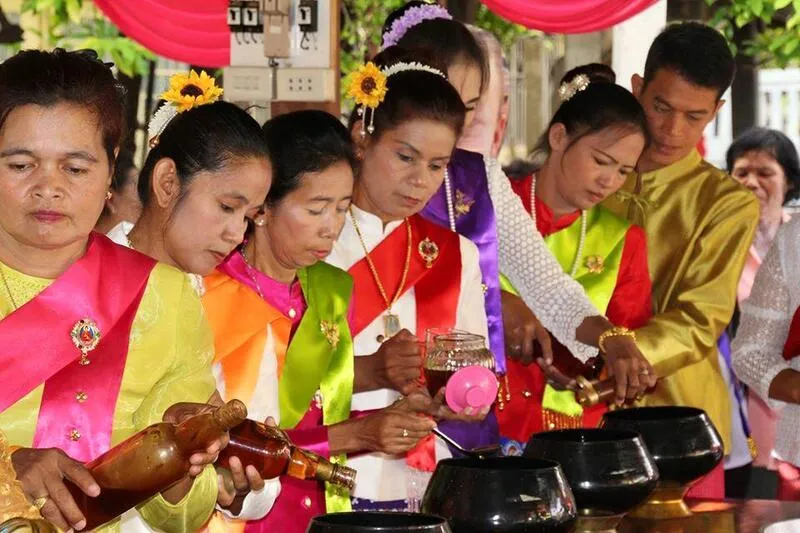
Honey Alms Giving Tradition at Wat Pimphawas (Tai), Bang Pakong District, Chachoengsao Province, is one of the most important traditions of the Thai-Mon (Raman) community that has been preserved for generations. It is held during the middle of the 9th lunar month each year. The ritual traces its origin to a Buddhist episode when the Lord Buddha resided in the Pa Lelai forest, where an elephant and a monkey attended to Him by offering sugarcane and honey. Later, the Buddha permitted monks and novices to consume honey and sugarcane juice as medicine.
The honey alms offering is therefore not merely a general merit-making activity. It is an act of reverence to the Blessed One and a remembrance of an important event in Buddhist history that reflects the relationship between humans, animals, and the Dhamma. The Mon community in Bang Pakong has preserved this ritual as a distinctive cultural identity, with Wat Pimphawas serving as the spiritual center.
Wat Pimphawas (Tai) is located in Pimpha Subdistrict, Bang Pakong District, Chachoengsao Province. Established in 1887 (B.E. 2430), it is a local temple under the Dhammayut order and plays a significant role as the spiritual heart of the Mon community in the area. The current abbot is Phra Khru Wichan Somanakhun.
The ceremony begins with monks chanting in the temple pavilion. While the chanting proceeds, villagers respectfully place honey into the monks’ alms bowls. Sugar is placed on a plate positioned beside each bowl. Savory and sweet foods are arranged separately. A special item that is always included is “Khao Tom Mat” (sticky rice wrapped in banana leaves), offered so that monks may eat it dipped in honey or sugar according to tradition.
After the offering, villagers gather to listen to a Dhamma sermon. This is considered the heart of the ceremony, as the purpose of offering requisites is not merely to provide food for monks but to enable lay Buddhists to hear the teachings and cultivate wisdom, which is the ultimate goal of merit-making.
From a cultural perspective, this tradition reflects the belief that “even animals recognize the value of the Dhamma.” In the Buddhist narrative, the elephant and monkey sought food to offer to the Buddha. Humans, endowed with wisdom, are therefore encouraged to recognize the value of religion and continue preserving such rituals.
Getting There Travel via Bang Na–Trat Road (Highway 34) toward Bang Pakong, then enter Pimpha Subdistrict. The temple is located near the Km 35 reference point and provides on-site parking. During the ceremony, visitors are advised to allow extra time due to increased attendance.
| Place Summary | Honey Alms Giving Tradition at Wat Pimphawas (Tai), Pimpha Subdistrict, Bang Pakong District, Chachoengsao Province |
| Highlights | Honey offering based on the Pa Lelai Buddhist episode, special offering of Khao Tom Mat, and Dhamma sermon listening |
| Abbot | Phra Khru Wichan Somanakhun |
| Temple Phone | 038-570-180 |
| Nearby Attractions | 1) Wat Sothon Wararam Worawihan – 25 km 2) Wat Saman Rattanaram – 35 km 3) Ban Mai 100-Year Market – 24 km 4) Khlong Suan 100-Year Market – 18 km 5) Bang Khla Floating Market – 30 km |
| Nearby Restaurants | 1) PIMPA food&drink – 4 km – 061-545-3889 2) Krua Phot – 6 km – 089-096-2826 3) Sathan Hom Pla Phao – 3 km – 093-446-6662 4) Pluem Coffee – 5 km – 084-141-9017 5) Jai Sang Ma – 6 km – 080-249-0290 |
| Nearby Accommodations | 1) Wellgrow Hotel – 8 km – 033-050-739 2) Goodnine Hotel – 10 km – 097-373-6363 3) PJ Place – 9 km – 099-004-6365 4) Bangpakong Boat Club – 12 km – 063-535-2521 5) Ratathara Resort – 15 km – 038-574-318 |
Frequently Asked Questions (FAQ)
Q: When is the Honey Alms Giving Tradition held?
A: It is held annually during the middle of the 9th lunar month. Visitors should confirm the exact lunar date with the temple before attending.
Q: Why is honey used in the ceremony?
A: It originates from the Buddhist episode at Pa Lelai forest, where an elephant and a monkey offered honey to the Buddha.
Q: What is the significance of Khao Tom Mat?
A: It is a special offering presented so that monks may eat it dipped in honey or sugar, following traditional practice.
Q: Can tourists participate?
A: Yes, visitors may participate. Modest dress and respectful conduct within temple regulations are expected.
Q: Is there an admission fee?
A: There is no admission fee. Visitors may make voluntary donations according to their faith.
 Honey Alms Giving Tradition Map
 Category:
  Group:
  Last Update: 1 WeekAgo
Comment
 Nearby Attractions
| Keyword (Advance) |
 Facebook Fanpage
 Region
 Historical Sites and Monuments(
 Landmarks and Memorials(
 Royal Palace(
 Museums(
 Historical Houses and The Ancient City(
 Educational Places
 Museum for Study(
 Library(
 Educational Gardens, Farm(
 University
 Places of Worship
 Temple(
 Mosque(
 Other religious and spiritural sites(
 Research and Development
 Royal Project(
 Suburban Living
 Village, Community(
 Local Market(
 Floating Market(
 Nature and Wildlife
 National Parks and Marine Reserves(
 Mountain (Doi)(
 Dam, Reservoir, Lake(
 Waterfalls(
 Caves(
 River, Canal(
 Bays and Beaches(
 Islands(
 Other natural attractions(
 Entertainment and Agricultural
 Zoos and Aquariums(
 Animal camps and shows(
 Farm, Parks, Gardens and Ecotourism(
 Spas and Wellness
 Spas and Wellness(
 Travel Articles, Recipes
 Travel Review, Food Review(