

 Home
Home Chiang Mai(




Rating: 3.6/5 (11 votes)
 |
|  Map
Map 
 Have Map
  No Map
Chachoengsao attractions
Attractions in Thailand
Event Date: As announced by Wat Phai Dam Charoen Suk (often scheduled in advance for a Buddhist holy day or a day when the community is ready to make merit together)
Time: Generally held in the morning–afternoon (please check the actual schedule from the temple’s announcement before traveling)
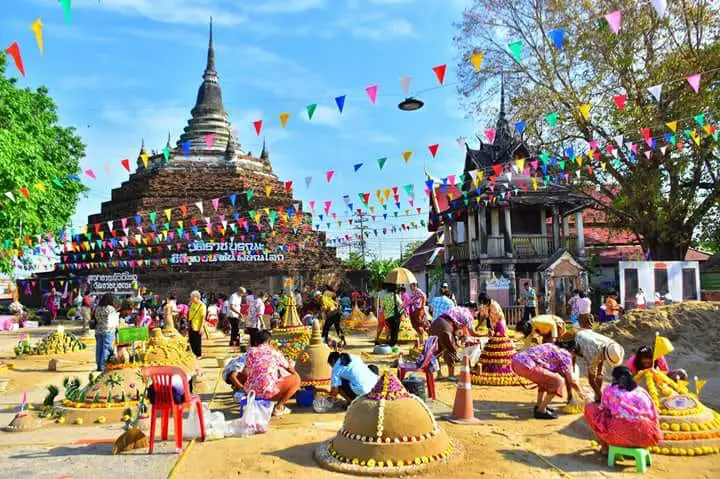
The Rice-Paddy Sand Pagoda Tradition (Phai Dam) in Bang Nam Priao District, Chachoengsao Province, is a vivid embodiment of “merit grown from the earth” and “faith that moves with the rice-growing seasons” in the Eastern river-basin communities. This tradition emerged from a simple yet profound intention: local people wanted to make merit and contribute to public benefit for the temple using what they truly had in everyday life—sand for temple repairs and, especially, unhusked rice, the principal product of local rice farmers. When these elements come together, the tradition becomes far more than building a mound into a pagoda shape; it tells the story of a community through a tangible ritual, helping later generations understand how temple and community once depended on each other in a world driven by agriculture and waterways.
In broader Thai society, the core idea of “sand pagoda building” is to bring sand into the temple for construction, renovation, or improving the temple grounds, while making merit collectively as a community. In Phai Dam, however, this meaning has been “adapted to local geography” in a practical way. The village sits in a floodplain area, so sand is not easy to obtain nearby. Over time, the community shifted from transporting naturally available sand to collectively “purchasing sand” as announced in advance by the temple, then gathering to build sand pagodas on the appointed date. The essence remains the same—“benefiting the temple”—but the method fits the real landscape and everyday life.
As the sand-pagoda tradition continued within an agricultural community, it naturally encouraged a way to “make merit with one’s own produce.” This is how the distinctive practice of “rice-paddy pagoda building” developed alongside sand pagoda building. Unhusked rice harvested from local fields is used to build a pagoda in place of sand. The process follows the same structure as sand pagoda building: a date is set in advance; on the day of the event, villagers bring unhusked rice in baskets or convenient containers to the temple and pour it into a designated area, forming a pagoda shape and decorating it beautifully while making merit according to their means. Afterward, the collected rice is sold to convert it into funds for maintaining and improving temple structures. In this way, “produce from the fields” becomes “the temple’s merit fund” in a concrete form, allowing people to participate directly—without needing to rely on cash donations alone to make merit.
Seen beyond the lens of a religious event, this tradition functions as a gentle mechanism of “social discipline.” The community must schedule, prepare, coordinate, and arrive together on the same day. This process brings different generations together without economic motives as the main driver. Children witness adults making merit; adults talk about temple affairs and rice-farming life; those who work outside the area can return and “become part of the same village” again if they come in time. The tradition naturally repairs community bonds and sustains “social capital,” which is vital in river-basin communities that must rely on each other during high water, floods, or peak agricultural workloads.
Another dimension that makes this tradition compelling is how it “turns ordinary things into symbols.” Sand and unhusked rice are familiar materials in rural life, yet once they are formed into a pagoda shape, the ordinary is elevated into a ritual object. In Buddhism, a pagoda symbolizes remembrance of the Triple Gem, stability, and the accumulation of merit. Building a pagoda by hand becomes a form of merit-making that is “visible” and “shaped”—something tangible—unlike donations that may end as a brief act of giving. The building process keeps people at the temple longer, deepens intention, and creates shared pride when the communal work takes a beautiful, completed form.
In many communities, sand pagoda building often expands into a “beauty contest,” and Phai Dam has a similar practice. Aesthetic competition motivates people to participate, help decorate, and think creatively about how to make their group’s pagoda look better. Yet the true value lies less in winning or losing and more in creating shared motivation, bringing a lively atmosphere to the temple, and turning religious activity into a space of happiness that still aligns with moral principles—enjoyable, but within the bounds of courtesy and respect for the sacred place.
Within the framework of “Eastern river-basin culture,” the Rice-Paddy Sand Pagoda Tradition is an example of how river-basin communities use local resources and produce to sustain their religious institutions. This relationship reflects a classic pattern in Eastern riparian agricultural society: both “rice fields” and “canals/rivers” form the foundational economic system. Religion is not separated from daily life; rather, the temple becomes the public center—a place for gathering news, arranging labor, helping one another, and indirectly shaping community norms. Building pagodas from sand or unhusked rice is therefore not merely ritual; it is part of community management with Buddhism as a central axis.
One especially noteworthy point is the choice of “unhusked rice” as a merit-making material. Unhusked rice is not ready-to-eat food; it requires milling, processing, and management in several steps. This implies that offering unhusked rice is an offering of “potential” and “future value,” not only finished goods. The temple’s practice of selling the rice to convert it into funds also reflects flexible, pragmatic management within a farming community: the temple receives what the community is best able to give, then transforms it into resources to care for the temple. This approach helps the temple and community move forward together without making merit feel like an excessive burden.
For visitors who want to understand this tradition “in a vivid way,” it helps to observe three key phases. The first is preparation and gathering—where you can see how the community divides responsibilities: who sets up space, who manages cleanliness, who coordinates deliveries. The second is shaping the pagoda, the heart of the event, requiring both strength and precision; here you can witness organic cooperation between those with physical energy and those with experience in shaping forms. The final phase is decoration and merit-making, often warmly communal because everyone can see the shared outcome, followed by conversation and local exchange in the temple atmosphere.
From a cultural tourism perspective, this tradition has strong potential because it connects “agriculture–religion–community” in a single scene. Visitors interested in local life can witness real local produce (unhusked rice), the community’s approach to merit-making, and the collaborative organization of temple events. The key is respectful participation: dress modestly, speak politely, avoid blocking work areas, do not handle ritual items without permission, and if you wish to take photos, ask the organizers first—especially when people or religious activities are involved.
Getting There Phai Dam Village is located in Bang Nam Priao District, Chachoengsao Province. From Bangkok, you can travel via Suwinthawong Road (Highway 304) toward Chachoengsao, then continue to Bang Nam Priao using the district’s main routes. On event days, allow extra time as traffic may be heavier near the temple and community area. It is also advisable to bring drinking water and wear comfortable walking shoes, as the activity typically involves walking within the temple grounds and the event area.
| Tradition Name | Rice-Paddy Sand Pagoda Tradition (Phai Dam) |
| Activity Center | Wat Phai Dam Charoen Suk, Sala Daeng Subdistrict, Bang Nam Priao District, Chachoengsao |
| Place/Activity Summary | Phai Dam community members make merit by building pagodas using “sand” for temple benefit, with a distinctive practice of building a “rice-paddy pagoda” using unhusked rice from local farming. The rice is later sold by the temple to generate funds for maintaining and improving temple structures. |
| Highlights | Merit-making using real community resources (sand/unhusked rice), strong communal cooperation in shaping and decorating pagodas, and in some years a beauty contest to create a lively temple atmosphere. |
| Temple Abbot/Caretaker | Phra Khru Welu Thammastit |
| Temple Contact | 089-016-5402 |
| Nearby Tourist Attractions | 1) Phai Dam Folk Culture Center (Wat Phai Dam School) – approx. 1 km 2) Bang Nam Priao Floating Market – approx. 10 km 3) Wat Sothon Wararam Worawihan – approx. 25 km 4) Ban Mai 100-Year Market – approx. 26 km 5) Wat Jeen Prachasamoson (Leng Hok Yi) – approx. 27 km |
| Nearby Restaurants | 1) All-In (Restaurant & Cafe) – approx. 12 km – 038-581789 ext. 108 / 061-5504486 2) Hawao Phochana (Halal Food) – approx. 12 km – 096-218-5646 3) Khrua Rong Si (Bang Nam Priao) – approx. 12 km – 061-516-5665 4) Luk Thung Restaurant (Bang Nam Priao) – approx. 12 km – 095-936-6641 5) Nanthawan Park 888 – approx. 12 km – 064-789-7893 / 099-246-6629 |
| Nearby Accommodations | 1) TT Residence – approx. 12 km – 092-428-8624 2) The Power In Resort – approx. 12 km – 038-581-087 3) Tubtim Resort – approx. 12 km – 098-280-7099 / 098-280-7100 4) Sappaya Hotel (Lotus Valley) – approx. 20 km – 038-835-555 5) The Power In Resort (Accommodation Page) – approx. 12 km – 038-582-087 |
Frequently Asked Questions (FAQ)
Q: What is the Rice-Paddy Sand Pagoda Tradition (Phai Dam)?
A: It is a community merit-making tradition in Phai Dam where people build pagodas using sand to benefit the temple, with a distinctive practice of building a pagoda using unhusked rice so the temple can sell it and use the proceeds to maintain temple structures.
Q: Why does Phai Dam have “rice-paddy pagoda building” alongside sand pagoda building?
A: Because the community is agricultural and located on a floodplain where sand is not easily sourced nearby, the tradition evolved to include merit-making with the community’s main produce—unhusked rice—so every household can participate according to their capacity.
Q: What happens to the unhusked rice donated by villagers?
A: The temple sells the collected unhusked rice (or converts it into funds) and uses the proceeds for temple maintenance and public-benefit works.
Q: On which day of the year is this tradition held?
A: The date is generally set by the temple’s announcement and the community’s readiness, often scheduled in advance for a Buddhist holy day or a mutually agreed date. It is best to check the temple’s announcement before traveling.
Q: How should visitors prepare if they want to experience the atmosphere?
A: Dress modestly, wear comfortable walking shoes, and bring drinking water. If you wish to make merit, prepare a donation according to your faith, and be respectful of the ritual space—do not disturb community work or religious activities.
 The Rice-Paddy Sand Pagoda Tradition (Phai Dam) Map
 Category:
  Group:
  Last Update: 1 WeekAgo
Comment
 Nearby Attractions
| Keyword (Advance) |
 Region
|
 Muang Chachoengsao(