

 Home
Home Chiang Mai(




Rating: 2.8/5 (12 votes)
 |
|  Map
Map 
 Have Map
  No Map
Chachoengsao attractions
Attractions in Thailand
Open Days: Open daily
Opening Hours: Open all day – prayer times follow the daily salah schedule
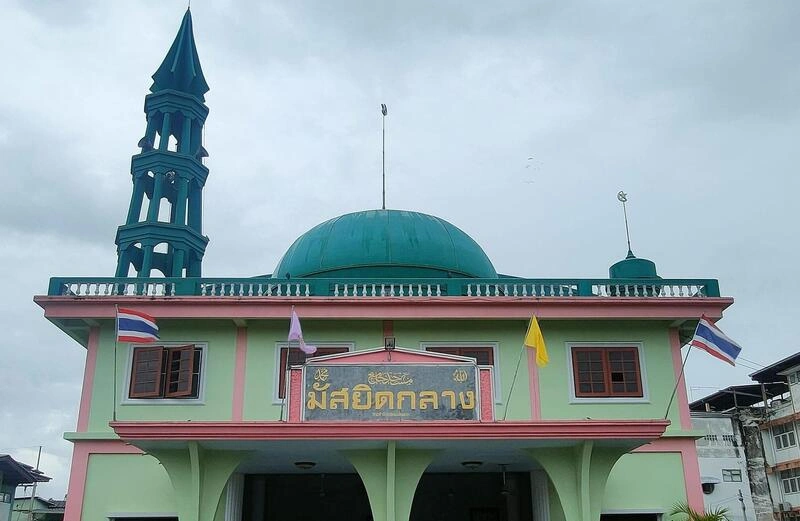
Chachoengsao Central Mosque If there is one place in Paed Riew’s city center that quickly reveals the image of “Chachoengsao as a multicultural town,” it is oftenChachoengsao Provincial Central Mosque. This is not only a place of worship for Muslims, but also a community anchor, a reflection of faith growing alongside the city’s expansion, and a cultural destination that helps visitors understand the “identity of Paed Riew” more deeply than a trip focused only on temples or old markets.
The mosque is located on Mahachakkraphat Road, Na Mueang Subdistrict, Mueang Chachoengsao District, Chachoengsao Province — a convenient area in a key urban community zone. It is registered as No. 38. What gives this central mosque historical weight in a modern context is its “verifiable story” through three successive building phases across different periods. These were not driven solely by architectural preferences, but by real community needs: structural strength, suitability for use, and an increasing number of worshippers as the city’s population expanded.
Looking back to the post–World War II period, Chachoengsao was in a stage of recovery and gradual growth powered by commerce, transportation, and life along the Bang Pakong River. Communities in the Na Mueang area were diverse in ethnicity and religion, including Thai Buddhists, Thai–Chinese, and Thai Muslims who settled here for work and trade. As the Muslim community became strong enough, they came together to build a mosque as an official place for religious practices and as a spiritual refuge for the community.
The first mosque building was constructed in 2490 B.E. (1947), marking the beginning of a concrete Islamic center in Chachoengsao Province. The earliest structure prioritized function, using materials and techniques of its time. It was simple, yet it served fully for daily prayers, community gatherings, and religious activities when needed. The highlight was not the building’s size, but the community’s “shared determination” to establish a stable spiritual space in the city center.
Later, in 2496 B.E. (1953), the mosque was renovated into its second phase. This renovation reflected two realities at once. First, the original building had begun to deteriorate with time and environment. Second, usage had become heavier as attendance steadily increased. When a mosque truly becomes a community center, maintenance and improvement are essential. That renovation was a reaffirmation that “the central mosque would remain with this city for a long time,” not just as a temporary structure built for a moment.
Then, in 2537 B.E. (1994), the mosque underwent its most significant transformation: the construction of the third building, which is the current structure in use. The reasons were clear and practical. The mosque committee concluded that the previous building, whose upper floor was wooden, might continue to deteriorate and would not remain durable long-term. At the same time, the number of worshippers had increased noticeably, creating cramped conditions and inconvenience for religious practices — especially for gatherings with large attendance. The committee therefore met and resolved to build a new structure that would be stable, strong, and suitable for long-term community use.
From a cultural-travel perspective, the three building phases are more than just “B.E. years.” They form a narrative that helps visitors understand the steady growth of the Muslim community in Chachoengsao and its capacity to manage community needs through committee governance and collective cooperation. The 2537 B.E. (1994) decision was both an engineering solution and a space-management upgrade, laying a foundation for the mosque to fully serve the community during a period of rapid urban expansion.
Architecturally, the current mosque presents a neat, dignified presence and clearly communicates its Islamic identity through key elements such as the dome and the minaret. The stronger structure allows the interior to accommodate more worshippers, and the space is organized for practical use, emphasizing cleanliness, calm, and order — essential qualities of a religious place, whether on ordinary days or during important religious occasions.
Another aspect that makes Chachoengsao Provincial Central Mosque feel “alive” is its community role beyond prayer. It functions as a meeting place, a learning space, and a venue for passing religious values to the younger generation. Activities such as Qur’an lessons, youth programs, and committee meetings make the mosque a social institution that strengthens community bonds. At the same time, it helps visitors see the “quiet beauty of everyday life” in a city where multiple religions coexist.
For visitors interested in a cultural visit, it is important to remember that a mosque is a sacred religious space, so dress and etiquette should be respected. In general, dressing modestly, keeping appropriate coverage, speaking softly, and avoiding disruption during prayer times will help ensure a smooth and respectful visit. Many visitors choose to appreciate the architecture and understand the community’s history by observing the atmosphere, which can be enough to experience a sense of “calm” and gain a fresh perspective on Paed Riew.
Getting There From Bangkok, you can take the main routes into Chachoengsao and continue into the city center, then head to Mahachakkraphat Road within the municipal area. Driving is convenient because it is an urban zone with clear landmarks and easy navigation via map apps. If traveling by train, get off at Chachoengsao Railway Station and take a taxi or local songthaew to the Na Mueang area. It is a short trip because the mosque is in the central city area with good connectivity.
The advantage of visiting the central mosque as a cultural traveler is that you can plan a well-balanced “one-day trip in Paed Riew.” The Na Mueang area is close to a major temple, old markets, and riverside walking spots along the Bang Pakong River. Linking routes between places of different faiths within short distances makes it easy to see how people of diverse beliefs coexist naturally. It also adds depth to a Chachoengsao trip beyond only worship visits or good food, revealing a richer “layer of meaning” in the city.
If you think of Chachoengsao as a book, Chachoengsao Provincial Central Mosque is an important chapter that completes the story. A city becomes truly beautiful not only because it has famous attractions, but because it has communities with roots, faith, shared management, and mutual respect across differences. This is a value visitors can feel even by simply passing by or pausing briefly to notice the order and calm of the place.
When you return from Paed Riew, you may remember the flavors of riverside food and the sight of temples along the Bang Pakong — and you may also remember the quiet calm of the central mosque. Sacred places often leave a subtle feeling behind, one that helps us understand people more, understand a city more, and realize that diversity is not distant. It is a lived reality in many parts of Thailand, including Chachoengsao.
| Place Name | Chachoengsao Provincial Central Mosque |
| Address | Mahachakkraphat Road, Na Mueang Subdistrict, Mueang Chachoengsao District, Chachoengsao 24000 |
| Summary | The province’s Islamic center with three construction phases (2490, 2496, 2537 B.E.), located in the city center and easy to reach. |
| Highlights | A three-era development history reflecting the growth of the Muslim community in Paed Riew; a contemporary dome and minaret; a calm, orderly atmosphere. |
| Brief History | First built in 2490 B.E. (1947), renovated in 2496 B.E. (1953), and the current building constructed in 2537 B.E. (1994) for long-term durability and to accommodate more worshippers. |
| Travel | Drive into Chachoengsao city center and head to Mahachakkraphat Road / Take the train to Chachoengsao Station, then a taxi or songthaew to Na Mueang. |
| Current Status | Open for regular religious activities. |
| Contact Number | 089-611-5989 |
| Nearby Tourist Attractions | 1) Wat Sothon Wararam Worawihan – approx. 2 km 2) Ban Mai 100-Year Market – approx. 3 km 3) Somdet Phra Srinagarindra Park (Chachoengsao) – approx. 5 km 4) Nakhon Nueng Khet Old Market – approx. 12 km 5) Bang Khla Floating Market – approx. 16 km |
| Popular Restaurants Nearby | 1) Ban Mai Rim Nam (Paed Riew) – approx. 3 km. Tel: 038-512-064 2) Ruen Romsai – approx. 3 km. Tel: 090-407-4007 3) Mathuros Ruean Pae – approx. 4 km. Tel: 038-511-958, 081-864-2929 4) Ruean Nam Thip Restaurant – approx. 7 km. Tel: 088-209-7330 5) Chai Krub Restaurant – approx. 4 km. Tel: 087-143-2444 |
| Popular Accommodations Nearby | 1) JK Living Hotel & Service Apartment – approx. 3 km. Tel: 092-742-9929 2) Suntara Wellness Resort & Hotel – approx. 10 km. Tel: 033-590-250 3) V-Verve Service Apartment – approx. 5 km. Tel: 081-762-9151 4) The Brown House Chachoengsao – approx. 4 km. Tel: 083-011-4212 5) Malone Maranatha – approx. 7 km. Tel: 084-008-0004 |
Frequently Asked Questions (FAQ)
Q: When was Chachoengsao Provincial Central Mosque first built?
A: The first building was constructed in 2490 B.E. (1947), renovated in 2496 B.E. (1953), and the current building was built in 2537 B.E. (1994).
Q: Can tourists visit the mosque?
A: Yes. Visitors are welcome, but should dress modestly and respect the prayer times and the sacred nature of the space.
Q: Is it open every day, and when is the best time to go?
A: It is open daily. You can visit anytime, but please be mindful that prayer times are the main periods of activity.
Q: Is it convenient to get there from Chachoengsao Railway Station?
A: Yes. It is located in the city center, and you can take a taxi or a local songthaew to Na Mueang in a short time.
Q: What is the direct contact number for the mosque?
A: 089-611-5989
 Chachoengsao Central Mosque Map
 Category:
  Group:
  Last Update: 4 DayAgo
Comment
 Nearby Attractions
| Keyword (Advance) |
 Region
|
 Muang Chachoengsao(