

 Home
Home Chiang Mai(




Rating: 2.4/5 (29 votes)
 |
|  Map
Map 
 Have Map
  No Map
Chachoengsao attractions
Attractions in Thailand
Open Days: Daily
Opening Hours: 08.00 – 17.00
Wat Thao Uthai in Tha Kradan Subdistrict, Sanam Chai Khet District, Chachoengsao is a community (Mahanikaya) temple that tells the area’s past through both the local legend of “Thao Uthai” and traces of old construction materials such as bricks and laterite. It is therefore well-suited for visitors who want a calm, unhurried temple visit while also picking up meaningful local historical context.
If you have limited time, about 1–2 hours is enough to walk through key corners of the temple, notice foundations and structural details, and enjoy the shaded atmosphere under the trees. A highlight is understanding the name “Nong It” (Brick Pond), which is linked to the story of building with fired-clay bricks in local tradition, as well as seeing the temple as a community center that still plays an active role on major Buddhist holy days. Getting here is convenient for travelers with a private car; from Sanam Chai Khet you can drive into Tha Kradan Subdistrict where signposts are generally clear, then continue to the temple along the main community roads.
Wat Thao Uthai is a community temple under the Mahanikaya order, located in Tha Kradan Subdistrict, Sanam Chai Khet District, Chachoengsao. Overall, the temple feels peaceful and simple, closely connected to the surrounding local way of life. Once you step inside, the pace naturally slows down: traffic noise fades, and you are left with space to notice small details—from shaded tree lines and the open courtyard to structures that reflect layers of renovation over time. This type of local temple is not always a single “landmark-style” photo stop; instead, it invites you to walk slowly and read the meaning of the place through what is in front of you.
From a cultural travel perspective, Wat Thao Uthai stands out because it holds both a “local historical core” and a “living faith core” in the same place. Local accounts suggest the temple or the nearby settlement is connected to the Dvaravati era, with physical evidence found in the area such as brick fragments and laterite, materials often associated with ancient sites and older construction traces across Thailand. When archaeological signals overlap with community memory, the result is a “story that gives the place an identity”—not merely a stop to pay respects, but a site that prompts further questions: why people chose to settle here, why the village or pond name is tied to “bricks,” and what role the temple played for people when roads and travel were far less convenient than today.
The story that the community uses to pass on the meaning of this area is the legend of “Thao Uthai.” It is told that Thao Uthai was a royal son on his mother’s side, while his father was “Thao Saen Pom,” a name describing a body marked with lumps. Thao Uthai is said to have traveled by Chinese junk with followers and local people, then built Buddhist structures here. The construction used fired-clay bricks, which led to the place being called “Nong It” (Brick Pond), a name still remembered locally today. For travelers, this legend works like a “key to reading the landscape”: as you walk through the temple grounds, your attention naturally shifts beyond worship alone, toward observing brick-related traces, construction details, and remnants that may still remain in certain corners of the site.
At the same time, Wat Thao Uthai also has a clear administrative development within Thailand’s monastic system. The temple was officially established on 27 June 1973 and later received its consecrated boundary (Wisungkhamsima) on 29 February 2012. These dates are important for understanding that while the area may carry older stories and a sense of antiquity, the temple’s formal status within the monastic administration came later—a pattern common to many Thai local temples, where long-standing community faith and use of the site existed before official recognition.
Regarding historical periods and renovations, local references also connect the temple’s restoration to the reign of King Nangklao (Rama III), noting that “Luang Pho Bua” renovated the site and built a stupa, an ordination hall, and other monastic structures. Physical traces are said to remain, such as stupa bases, the ordination hall, Buddha images, and other objects. As a visitor, it is best to approach this part with respect for evidence: recognize that the area shows multiple construction layers, and that early Rattanakosin-era renovations were often a key moment when many local temples took on the recognizable temple form we see today, rather than remaining only simple sacred grounds or a modest monastic retreat.
What makes visiting Wat Thao Uthai worthwhile is walking in a way that “reads details” rather than simply “checking in.” Spend time with the temple’s basic elements: the courtyard where the community gathers during merit-making events, the shaded tree lines that soften the heat, and the walkways that lead to key points. Then observe construction work carefully—which parts look older or newer, where foundations appear original, and where later additions were made. You do not need to be an archaeologist to do this; it is simply training your eyes to distinguish the “layers of time” in a place. Once you begin to notice those layers, you will see that a temple is never static: it is built, expanded, repaired, and adjusted according to the real needs of the community over time.
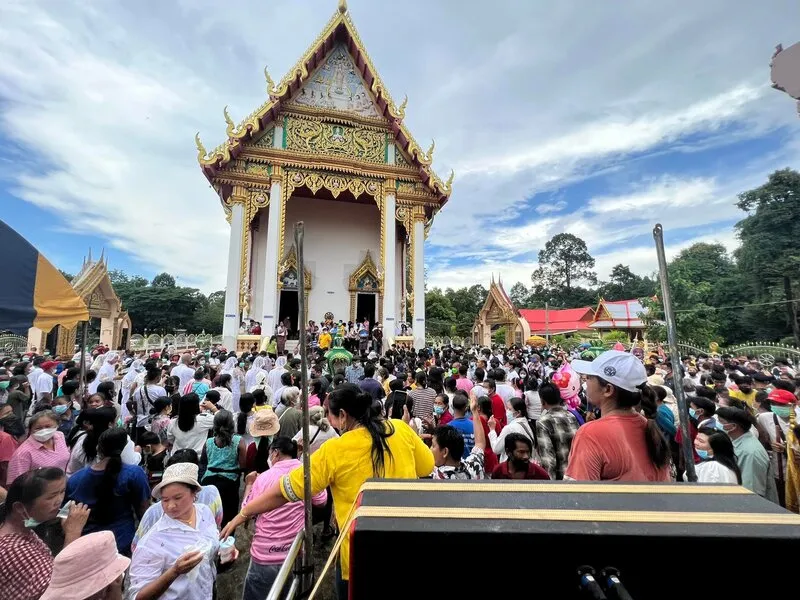
In terms of community life, Wat Thao Uthai serves as a center for Buddhist ceremonies and local activities, especially on important days such as Visakha Bucha and the beginning of Buddhist Lent (Khao Phansa). These are times when people gather to make merit, listen to teachings, join candlelit processions, and take part in activities that strengthen community bonds. The temple therefore functions as more than a “religious venue”; it is a space where people care for one another, share, and pass on local identity through collective events. On an ordinary day, you experience calm; on major holy days, you see the “community energy” that keeps the temple truly alive.
To visit Wat Thao Uthai with both peace of mind and a meaningful experience, the essentials are simple: dress respectfully, speak softly, avoid loud noise, and be mindful of areas used for monastic life or ceremonies. If you want to take photos, do so with restraint and avoid disturbing anyone practicing meditation or participating in rites. On ceremony days, respect the rhythm of the event—do not walk across the front of proceedings or block others’ views. These practices do not make the trip “strict”; they simply make the visit smoother, more comfortable, and more welcomed by the local community.
Getting There To reach Wat Thao Uthai by private car, start from Sanam Chai Khet District and head toward Tha Kradan Subdistrict. Signposts leading to the temple are generally visible along the main routes. Once you enter the village area, drive at an appropriate speed, as there are smaller intersections and local traffic. Along the way, you will notice a more rural side of Chachoengsao compared with the city area: greener scenery, lighter traffic, and a calmer travel rhythm.
If you start from Chachoengsao city, consider planning a “culture-and-nature” half-day trip, because routes into Sanam Chai Khet can connect well to reservoir viewpoints or other local temples. Bring drinking water, especially in the hot season, and allow extra time in the rainy season when roads can be slippery or have standing water. Visiting in the morning is more comfortable for walking, while late afternoon offers softer light for photographing the temple atmosphere and tree shade. If you are unfamiliar with rural roads, plan to head back before nightfall.
If you have about 1–2 hours at the temple, begin by paying respects at the ordination hall or the main sacred area to set the intention of your visit. Then walk around the grounds without rushing. Notice any construction materials you see—such as bricks along foundation lines or preserved fragments—and connect those observations to the “Nong It” story. The visit tends to leave you with a “story” to take home, not only photos. If you enjoy local history, coming here can feel like reading a slim book written through both evidence and community memory.
For a half-day plan, you can visit Wat Thao Uthai in the morning and continue to nearby nature spots or cafés in Sanam Chai Khet. If you travel with family or elderly visitors, spending more time at the temple is also suitable because you do not need extensive walking to enjoy the peaceful ambience. The key is not to treat the temple as merely a “pass-through” stop—its charm lies in simplicity and in seeing the community as it truly is.
In a broader sense, Wat Thao Uthai reflects a grassroots relationship between people and religion. The temple is not here only for tourism; it is a place where the community manages life—from merit-making events and traditions to mutual support in many everyday ways. When you visit with respect, you can feel the “right balance” of a local temple: a balance in daily rhythm, a balance in faith, and a balance in stories that continue to make the place worth exploring.
| Name | Wat Thao Uthai |
| Place Summary | A local Mahanikaya community temple in Tha Kradan, connected to the “Thao Uthai” legend and traces of older construction materials such as brick and laterite, linking to the place name “Nong It” (Brick Pond). |
| Highlights | Peaceful local temple atmosphere, the “Nong It” story and Thao Uthai legend, a strong sense of community history, suitable for cultural temple visits in Sanam Chai Khet. |
| Address | Moo 3, Tha Kradan Subdistrict, Sanam Chai Khet District, Chachoengsao 24160 |
| Type | Community Temple, Mahanikaya Order |
| Period | Local tradition links the area to the Dvaravati era; officially established on 27 June 1973; received Wisungkhamsima on 29 February 2012. |
| Key Evidence | Bricks and laterite found in the area (older construction materials), traces of stupa bases and monastic structures reflecting multiple renovation layers. |
| Name Origin | The temple name is tied to the “Thao Uthai” legend; “Nong It” (Brick Pond) is linked to fired-clay bricks used for construction in local tradition. |
| Open Days | Daily |
| Opening Hours | 08.00 – 17.00 |
| Abbot (Latest) | Phra Athikan Narong Thanawaro |
| Contact Number (Verified) | 063-186-6049 |
| Travel | Drive from Sanam Chai Khet into Tha Kradan Subdistrict and follow the main community routes with signposts to the temple (morning or late afternoon is recommended; allow extra time in the rainy season). |
| Current Status | Open for worship and visits during stated open days and hours. |
| Facilities | Courtyard and shaded resting areas; parking space within the temple area (subject to on-site conditions). |
| Nearby Tourist Attractions (Approx. Distance) | 1) Wat Cham Pa Ngam (approx. 6 km) 2) Lat Krathing Reservoir (approx. 18 km) 3) Khlong Si Yat Reservoir (approx. 35 km) 4) Khao Hin Son (approx. 35 km) 5) Sanam Chai Khet Market (approx. 15 km) |
| Nearby Restaurants (Approx. Distance + Phone) | 1) Tem Kham Cafe (approx. 15 km) Tel. 091-801-6390, 099-293-9090 2) Pak Mor Je Pen (approx. 15 km) Tel. 080-093-9031 3) Jungle Cafe (Sanam Chai Khet Branch) (approx. 20 km) Tel. 094-546-9922 4) Meet Café (approx. 18 km) Tel. 061-469-1465 5) So Khao Tom & Made-to-Order Dishes (approx. 15 km) Tel. 085-085-8115 |
| Nearby Accommodations (Approx. Distance + Phone) | 1) Two Resort (Sanam Chai Khet) (approx. 15 km) Tel. 085-085-1199, 085-130-7056 2) The Bed Resort (Sanam Chai Khet Market) (approx. 15 km) Tel. 091-009-7598, 090-097-598 3) Rim Mueang Resort (Sanam Chai Khet) (approx. 15 km) Tel. 098-545-4688 4) Ban Yai Homestay Na Yao (approx. 20 km) Tel. 081-003-1329 5) Ban Nam Lan (approx. 25 km) Tel. 093-617-1819 |
Frequently Asked Questions (FAQ)
Q: Where is Wat Thao Uthai located?
A: The temple is in Moo 3, Tha Kradan Subdistrict, Sanam Chai Khet District, Chachoengsao, and it is a good stop for a calm cultural temple visit in the Sanam Chai Khet area.
Q: What are the open days and opening hours for Wat Thao Uthai?
A: It is open daily from 08.00 – 17.00. Morning visits are recommended for cooler weather and a more comfortable walk around the grounds.
Q: What are the highlights of Wat Thao Uthai?
A: Highlights include the local “Thao Uthai” legend linked to the place name “Nong It” (Brick Pond), and a peaceful community-temple atmosphere ideal for an unhurried visit.
Q: Which phone number should I use to contact Wat Thao Uthai?
A: A contact number stated as the abbot’s phone is 063-186-6049.
Q: How much time should I plan for visiting Wat Thao Uthai?
A: About 1–2 hours is sufficient for worship and a relaxed walk around. If you enjoy observing historical layers and local context, consider allowing 2–3 hours for a slower pace.
 Wat Thao Uthai Map
 Category:
  Group:
  Last Update: 1 WeekAgo
Comment
 Nearby Attractions
| Keyword (Advance) |
 Facebook Fanpage
 Region
 Art, Culture and Heritage
 Historical Sites and Monuments(
 Landmarks and Memorials(
 Royal Palace(
 Art, Craft Centres, Tradition(
 Museums(
 Historical Houses and The Ancient City(
 Educational Places
 Museum for Study(
 Library(
 Educational Gardens, Farm(
 University
 Mosque(
 Other religious and spiritural sites(
 Research and Development
 Royal Project(
 Suburban Living
 Village, Community(
 Local Market(
 Floating Market(
 Nature and Wildlife
 National Parks and Marine Reserves(
 Mountain (Doi)(
 Dam, Reservoir, Lake(
 Waterfalls(
 Caves(
 River, Canal(
 Bays and Beaches(
 Islands(
 Other natural attractions(
 Entertainment and Agricultural
 Zoos and Aquariums(
 Animal camps and shows(
 Farm, Parks, Gardens and Ecotourism(
 Spas and Wellness
 Spas and Wellness(
 Travel Articles, Recipes
 Travel Review, Food Review(