

 Home
Home Chiang Mai(




Rating: 4.3/5 (4 votes)
 |
|  Map
Map 
 Have Map
  No Map
Chachoengsao attractions
Attractions in Thailand
Open Days: Daily
Opening Hours: Mon – Fri 07:00 – 16:30; Sat – Sun 07:00 – 17:00
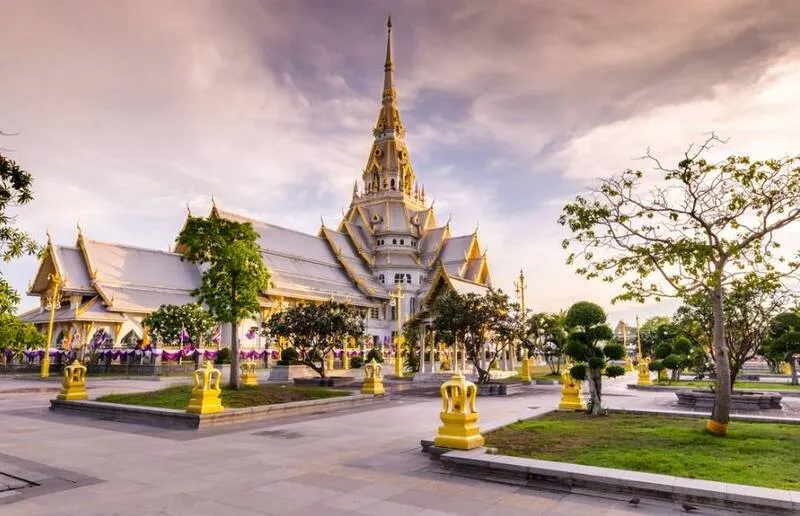
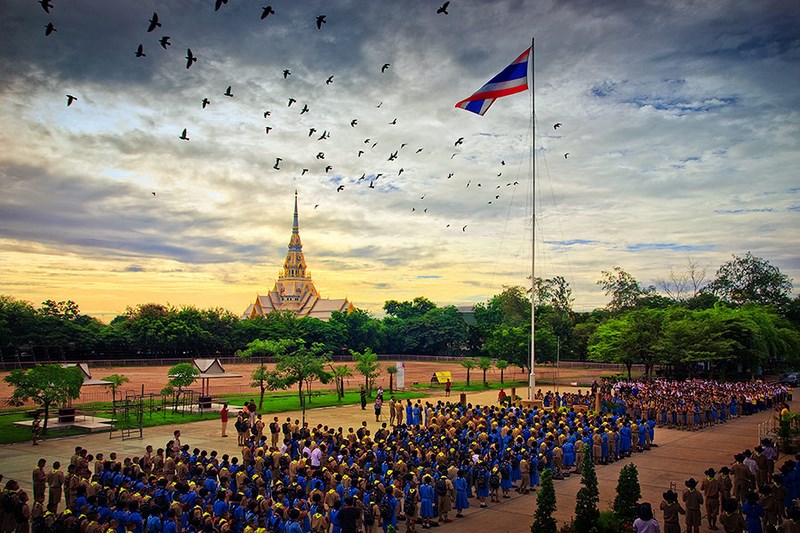
Wat Sothon Wararam Worawihan stands on the banks of the Bang Pakong River in Chachoengsao municipality. Officially a first-class royal monastery (Worawihan), it enshrines “Luang Pho Phuttha Sothon” (Luang Pho Sothon), the province’s most revered Buddha image. The temple’s story reaches back to the late Ayutthaya period, when it was known as “Wat Hong” before being continuously restored and expanded into one of eastern Thailand’s most important centers of faith. For visitors who want to pay respects, take in the architecture, and absorb the atmosphere properly, plan around 2 – 3 hours.
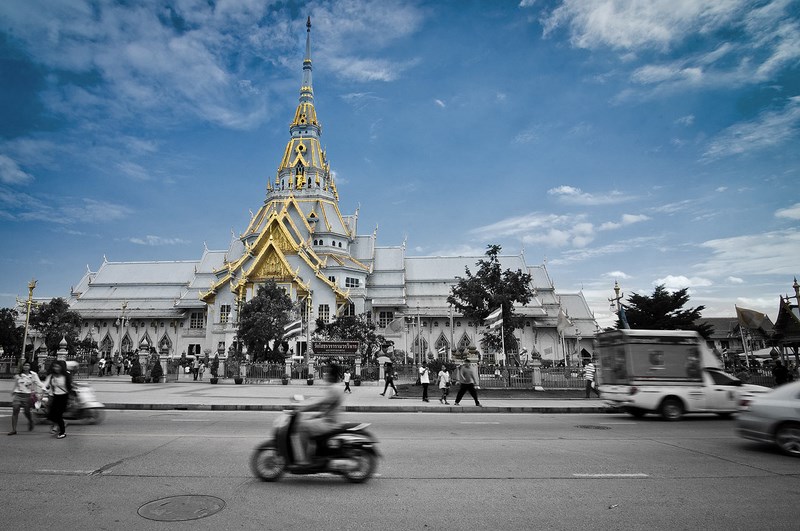
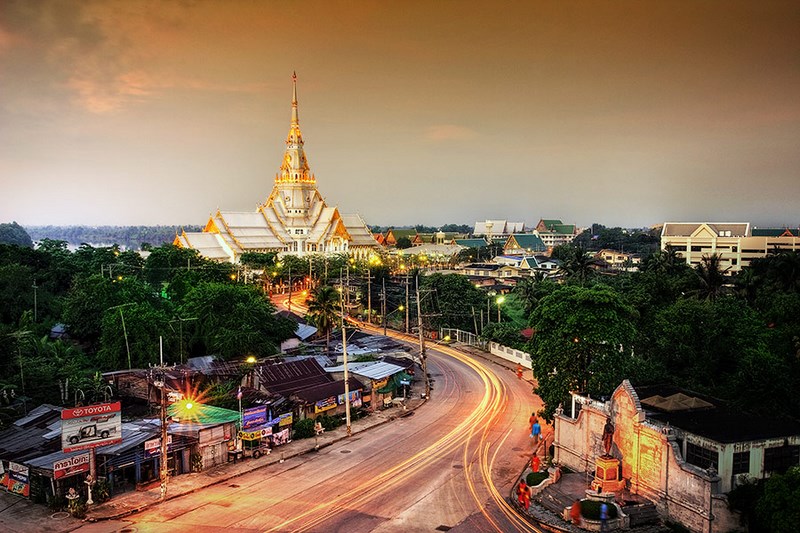
Wat Sothon Wararam Worawihan is the defining landmark of Chachoengsao. Its vast mandapa-style ordination hall and the living devotion around Luang Pho Sothon give the temple a presence that goes far beyond “just another place to visit.” The moment people mention Chachoengsao, Luang Pho Sothon is usually the first name that follows. In that sense, the temple functions as both a spiritual emblem and a historical anchor for the city of Paet Riew.
In earlier times, the temple was called “Wat Hong,” and it is commonly understood to have been founded in the late Ayutthaya period, when riverside communities along the Bang Pakong were expanding and trade routes were shaping the rhythm of everyday life. A temple established beside the river reflected a way of living where water was not only an economic lifeline but also a channel of faith. Through the Rattanakosin era, the temple underwent ongoing restoration and, in time, was elevated to royal monastery status.
The heart of Wat Sothon is Luang Pho Phuttha Sothon, a seated Buddha image in meditation posture. The present outer form is a stucco-covered image, with the lap width recorded at 1.65 meters and the height at 1.48 meters, associated with Lan Xang artistic influence: a gentle expression, a calm stillness, and proportions that feel balanced rather than ornate. Local tradition says the original was a bronze-cast Buddha image that drifted along the Bang Pakong River before villagers invited it ashore and enshrined it here.
The “floating Buddha” story is one of the most enduring narratives tied to Luang Pho Sothon. It is often told alongside a belief that three Buddha images drifted by water and came to rest at different places: one in Chachoengsao, another in Bang Phli, and another in Samut Songkhram. Whether approached as faith, folklore, or cultural memory, the tale expresses how communities along waterways understood sacred protection and auspicious arrival through the movement of water itself.
Another layer of the story concerns preservation. The image was said to have once been smaller, and because the community feared theft, monks covered the original with stucco, creating the larger outer form seen today. In this reading, the temple did not “change” the sacred image to reinvent it, but to protect it. The protective covering became part of the identity of Luang Pho Sothon and, over time, part of what devotees recognize as familiar and deeply personal.
Daily devotion here is continuous. Visitors come to pay respects, apply gold leaf, and make vows for work, fortune, business, and major life goals. Offerings of boiled eggs are especially common, and some devotees fulfill vows with traditional performances. This blend of ancient reverence and present-day practice is precisely what gives Wat Sothon its unmistakable energy: it is not a museum-like temple, but a living religious space where belief is visible at every hour.
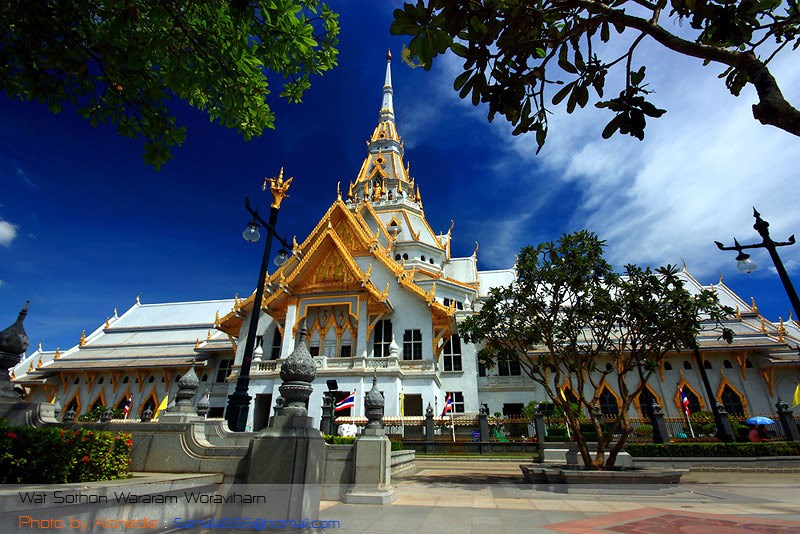
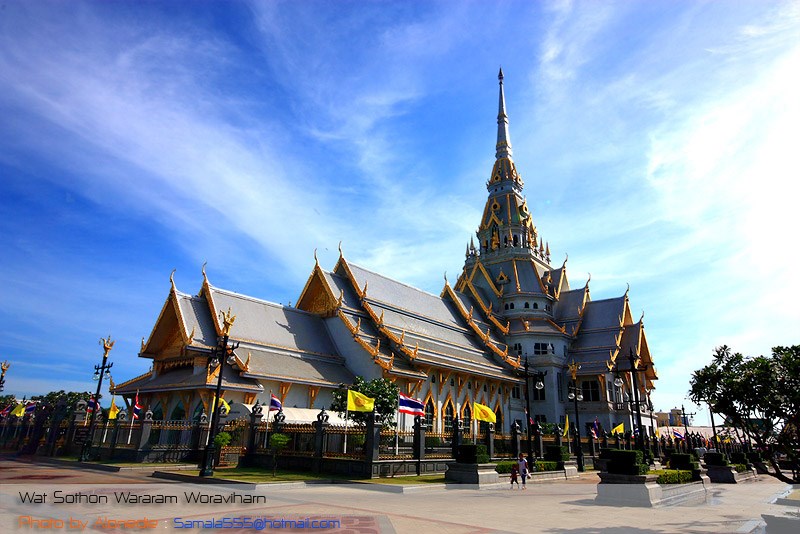
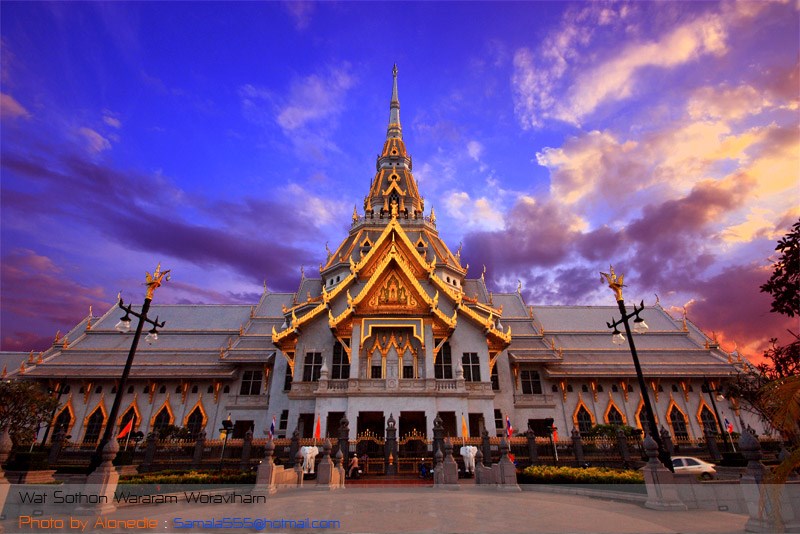
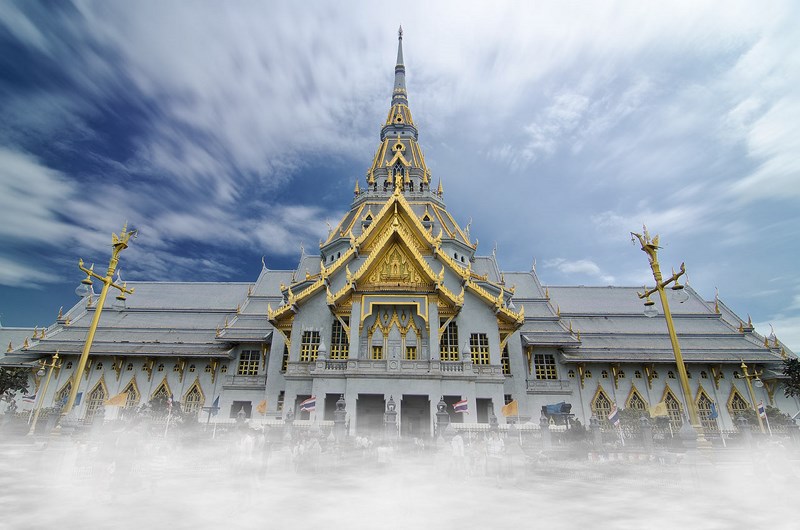
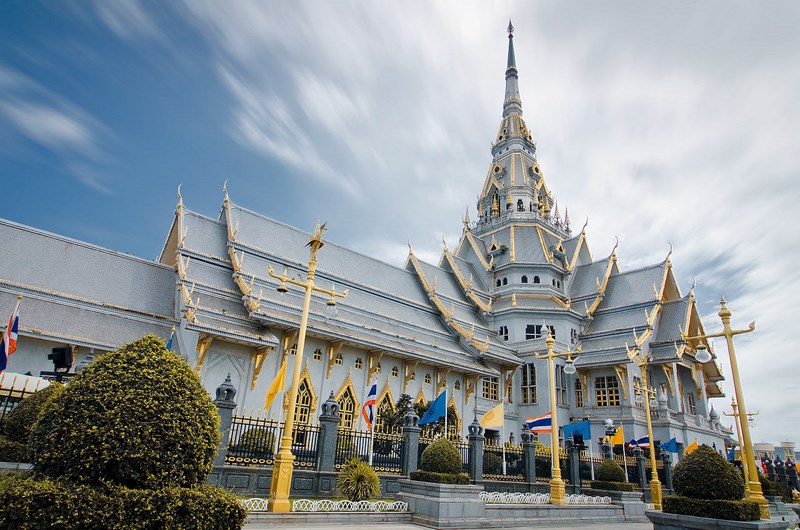
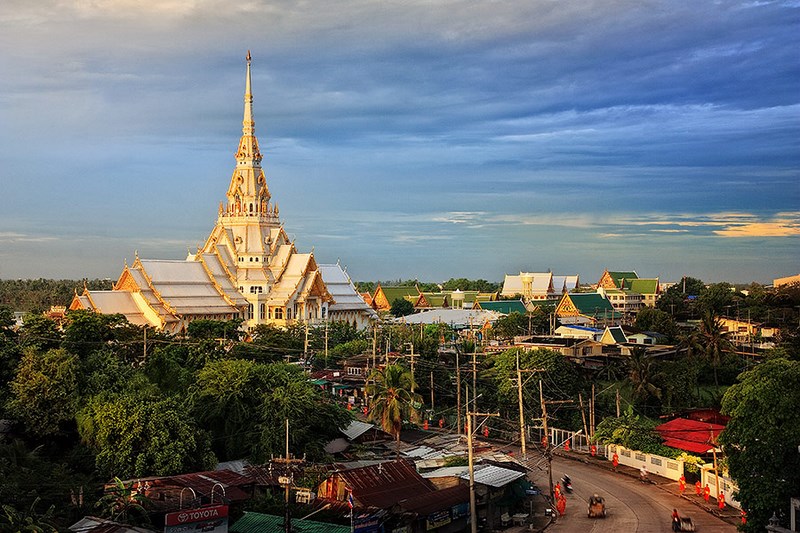
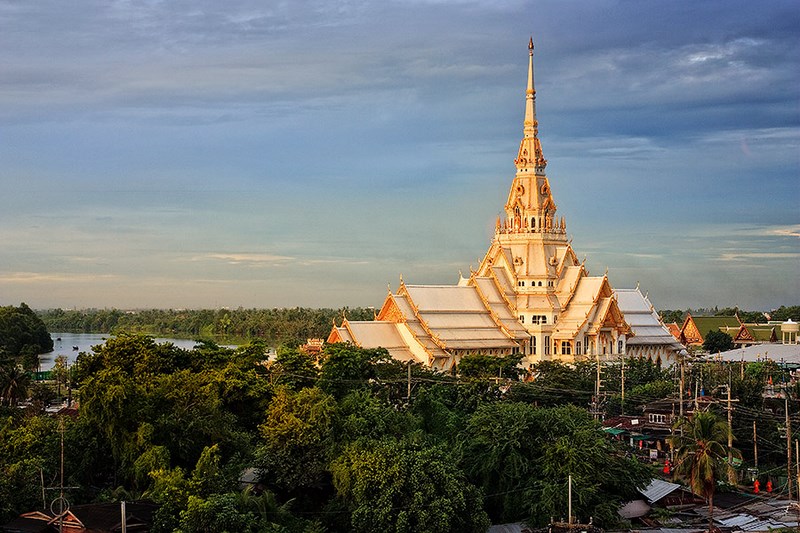
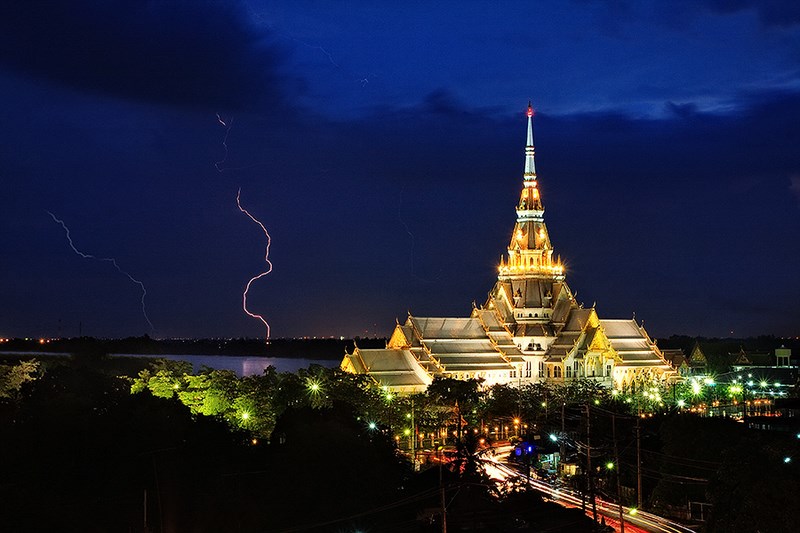
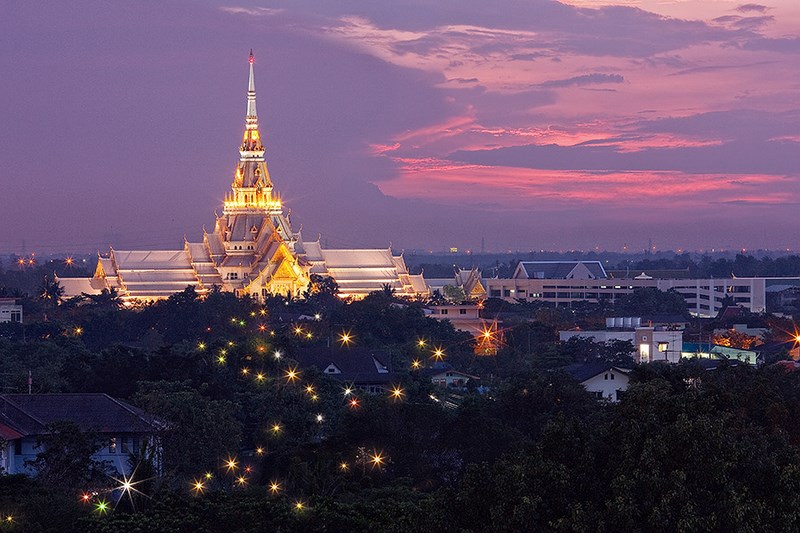
The current ubosot (ordination hall) is a monumental piece of Thai-inspired architecture built in a mandapa style, conceived as a special design for its era. It replaced an older hall that had become deteriorated and too small for the scale of worship. The building presents a grand, Thai-palace-like composition with a multi-gabled plan, recorded at about 44.5 meters wide and 123.50 meters long, designed to accommodate both ceremony and continuous public visitation.
At the center rises the main mandapa spire to about 85 meters. Its finial is a five-tiered umbrella (chatra), about 4.90 meters high, with a gold finial historically described as weighing 77 kilograms. These details are frequently cited as symbols of collective faith and the temple’s modern prominence, translating devotion into physical scale and visible craftsmanship.
Outside, the ubosot is clad in marble associated with Carrara, Italy, which adds a distinctive brightness and weight to the structure. Inside, murals by a National Artist visualize a Buddhist cosmological universe, turning the hall into a narrative environment rather than simply a devotional room. The imagery moves through the ideas of the cosmic ocean, guardian deities, heavenly realms, Brahma worlds, stars, and a mapped universe that blends religious worldview with a structured sense of celestial order.
A particularly striking detail often highlighted by visitors is the ceiling: the placement of stars is described as aligned with an astronomical configuration connected to 5 September 1996, the date associated with the ceremony of raising the golden finial above the mandapa. Whether one focuses on devotion, art, or the sheer ambition of the interior program, the result is a hall that feels immersive and deliberately monumental.
To visit respectfully, dress modestly and keep a calm manner inside the ubosot area. Early morning is generally easier for unhurried worship, while weekends and public holidays draw heavy crowds, especially around the central worship zone of Luang Pho Sothon. Because the temple sits in the municipal area beside the river, it is also easy to combine with nearby riverside walks and old-town stops in a single day.
Getting There Wat Sothon Wararam Worawihan is on Thep Khunakon Road, Na Mueang Subdistrict, Mueang Chachoengsao District. From Bangkok, the distance is commonly considered around 80 km, with driving time about 1.5 hours depending on traffic. You can also travel by the Eastern railway line or by vans/buses into Chachoengsao town, then continue locally to the temple. Parking areas around the temple support a high volume of visitors, though peak days can still feel crowded.
| Name | Wat Sothon Wararam Worawihan |
| Address | 134 Thep Khunakon Rd, Na Mueang, Mueang Chachoengsao District, Chachoengsao 24000, Thailand |
| Place Summary | A major royal temple on the Bang Pakong River, rooted in the late Ayutthaya period (formerly “Wat Hong”), and home to Luang Pho Phuttha Sothon, Chachoengsao’s most revered Buddha image. |
| Highlights | Luang Pho Sothon (Lan Xang influence) with the famous river-drifting legend, a monumental mandapa-style ubosot, a central spire about 85 m high, a five-tier chatra with a gold finial historically described at 77 kg, and immersive Buddhist cosmology murals. |
| Period | Late Ayutthaya Period (with major modern restorations and expansion) |
| Abbot (Latest) | Phra Ratchaphawanaphithan |
| Open Days | Daily |
| Opening Hours | Mon – Fri 07:00 – 16:30; Sat – Sun 07:00 – 17:00 |
| Current Status | Open to visitors for worship and sightseeing during opening hours |
| Fees | No admission fee (donations welcome) |
| Facilities | Large parking areas, restrooms, souvenir shops, main worship zones and walking areas inside the temple complex |
| Nearby Tourist Attractions With Distance | 1) Baan Mai 100-Year Market – 3 km 2) Wat Mueang (Wat Pitulathiratcharangsarit) – 4 km 3) Chachoengsao City Pillar Shrine – 3 km 4) Bang Pakong Riverwalk (Clock Tower Area) – 2 km 5) Wat Jeen Prachasamosorn (Wat Leng Hok Yee) – 3 km |
| Popular Restaurants Nearby With Distance And Phone Number | 1) Kung Nang Restaurant – 3 km – 038-513-414 2) The River Barn (Chachoengsao) – 3 km – 038-515-892 3) Kin Lom Chom Pla – 5 km – 085-328-6666 4) Sun Up Café – 2 km – 083-782-6656 5) Seiy Tha Yai – 3 km – 081-586-1919 |
| Popular Accommodations Nearby With Distance And Phone Number | 1) JK Living Hotel & Service Apartment – 4 km – 092-742-9929 2) Tree House Chachoengsao – 4 km – 098-253-7460 3) Yenjit Resort – 6 km – 038-511-200 4) Suntara Wellness Resort & Hotel – 10 km – 038-823-317 5) Heaven Hotel Chachoengsao – 5 km – 038-511-150 |
Frequently Asked Questions (FAQ)
Q: What are the opening hours of Wat Sothon Wararam Worawihan?
A: The temple is generally open daily. Commonly listed hours are Mon – Fri 07:00 – 16:30 and Sat – Sun 07:00 – 17:00.
Q: What is Luang Pho Phuttha Sothon best known for?
A: Devotees widely come to pray for work, fortune, business, success, and stability in life, and many apply gold leaf as an act of reverence.
Q: How old is the temple?
A: The temple’s origins are commonly associated with the late Ayutthaya period, when it was known as “Wat Hong,” before later restorations and expansions.
Q: How tall is the central spire of the main ubosot?
A: The central mandapa spire is commonly described at about 85 meters.
Q: How long should I plan for a visit?
A: A comfortable visit is typically 2 – 3 hours if you want to worship, walk around, and appreciate the architecture and murals.
Q: How do I get to the temple from Bangkok?
A: Driving is the most direct option (often considered around 80 km, about 1.5 hours depending on traffic). You can also take trains on the Eastern line or travel by vans/buses into Chachoengsao town and continue locally.
 Wat Sothonwararam Worawihan Map
 Category:
  Group:
  Last Update: 1 WeekAgo
Comment

Photo Gellery(12) 
 Thank you photo(3) from: Alonedie
|
|
|
 | ● Photographer: Samala555@hotmail.com ● Link: pixpros.net/forums/showthread.php ● Ref: pixpros.net |
Thank you photo(3) from: Nupino
|
|
|
 | ● Photographer: Nupino ● Link: fotobug.net/forum/thread-2342-1-1 ● Ref: fotobug.net |
Thank you photo(6) from: Hgvw
|
|
|
|
|
|
 | ● Photographer: Hgvw ● Link: pixpros.net/forums/showthread.php ● Ref: pixpros.net |
● Copyright Photography. (800*500)
● View full size images from the photographer.
● View full size images from the photographer.
 Nearby Attractions
| Keyword (Advance) |
 Region
|
 Muang Chachoengsao(