

 Home
Home Chiang Mai(




Rating: 3.8/5 (4 votes)
 |
|  Map
Map 
 Have Map
  No Map
Chachoengsao attractions
Attractions in Thailand
Open Days: Daily
Opening Hours: 08.00 – 17.00
King Taksin the Great Shrine — which many locals also refer to as the “Memorial Stupa of King Taksin the Great” — is an important landmark in Bang Khla District, Chachoengsao. Visiting here takes you back to a pivotal chapter in Thai history after the fall of Ayutthaya, when King Taksin’s campaign to restore independence moved through the Bang Pakong River basin, leaving behind the enduring story of the “victory at Pak Nam Jo Lo” that has been passed down for generations.
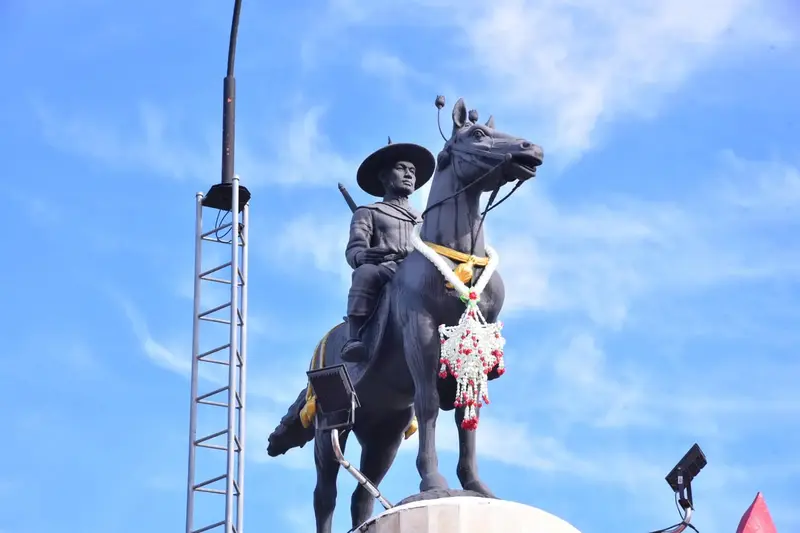
The charm of this place is not only that it is a photogenic landmark or a spot to stop and pay respects, but that it genuinely functions as an “open-air history classroom.” Visitors can see key elements of the memorial: the stupa, a royal statue of King Taksin the Great, and accompanying sculptures that complete the scene. Combined with the riverside atmosphere along the Bang Pakong River—where a cool breeze is felt for most of the day—the site suits both those who want to learn in depth and those who simply want a quiet, restorative visit.
If you think of it as a “worthwhile one-hour visit,” it does not take long, yet it feels meaningful. Start by walking around the stupa to take in details, then pay respects at the statue of King Taksin the Great as your faith guides you. After that, stroll to the river-viewpoint to enjoy the breeze and take photos. Morning and late afternoon are especially nice; the softer light makes the golden tones of the structures stand out and gives photos a gentle, pleasing look.
Historically, Pak Nam Jo Lo is remembered as an area connected to King Taksin’s troop movements during the time he was gathering forces to head east, with Chanthaburi as a key destination in preparation for reclaiming national independence. Local narratives say this area was where he achieved victory over Burmese forces, and that a victory memorial stupa once stood here as a symbol for later generations to remember an important national event.
Although details of the “original memorial stupa” are preserved more in community memory than in uniform nationwide documentation, the core message remains consistent: the Bang Pakong River basin was not merely a transportation corridor, but a strategic landscape that supported troop movements, temporary encampments, and the gathering of forces at a time when the country was at its most fragile.
In the modern era, the shrine and a new memorial statue of King Taksin the Great were built in 1988 (B.E. 2531) to give the site a clear, dedicated structure suitable for public veneration. This also reinforced Pak Nam Jo Lo’s identity as a tangible historical destination. Looking across art and tourism references, the site’s key components today include the stupa, the royal statue, and animal sculptures such as horses and elephants that add symbolic intensity to the overall setting.
What many visitors find most impressive is the “riverside calm” that invites you to slow down and listen to the wind rather than the noise of the city. The Bang Pakong River has long been a lifeline for local communities, and Pak Nam Jo Lo still feels like a riverside town with its own rhythm. Standing by the water in the context of the independence-restoration narrative makes history feel less like words in a book and more like something you can “touch” through the real landscape.
For those who come specifically to pay respects, worship at King Taksin the Great Shrine is usually done simply, with an emphasis on composure and respect for the place. You may bring flowers, incense, and candles as appropriate, or simply focus your mind on the king’s virtues and state your wishes clearly. Many people pray for decisiveness, professional success, stability, and the strength to overcome obstacles with calm awareness, because King Taksin is often associated in Thai society with determination, endurance, and putting the nation’s interests first.
Good etiquette matters. Dress respectfully, avoid loud noise, do not climb on the statue base or architectural elements, and help keep the area clean—especially by the riverbank, which is part of the community’s ecosystem. If visiting with family or small children, supervise closely near the edge of the riverbank for safety.
Getting There The easiest way to reach King Taksin the Great Shrine (Pak Nam Jo Lo) is by private car, since it allows you to connect several Bang Khla attractions in a single day. From Chachoengsao city, head toward Bang Khla District, then continue to Pak Nam Subdistrict in the Pak Nam Jo Lo area. As you approach the Bang Pakong River, you will find the memorial complex, which is easy to recognize once you are nearby.
If traveling from Bangkok, you can drive into Chachoengsao and continue on to Bang Khla conveniently. Travel time is typically about 1.5–2.5 hours depending on traffic. For public transport, travel to Chachoengsao city first, then use local songthaews (shared pickup trucks) or hired transport to Bang Khla and onward to Pak Nam Jo Lo. This option works well if you do not plan to drive, but it is wise to plan your return time clearly, especially in the evening.
To make the most of a “Bang Khla 1-day trip,” many visitors plan it like this: start in the morning by paying respects at King Taksin the Great Shrine to begin the day, then visit Wat Pak Nam Jo Lo to see its golden ordination hall, followed by Wat Pho Bang Khla to watch the famous bat colony and enjoy its shaded atmosphere. Next, head to Bang Khla Floating Market or the Wat Bang Krachet floating market area for lunch, and end the day at a riverside café or a riverside restaurant in the evening. This route gives you history, nature, and local life all in one day.
For photography lovers, the best time is early morning or late afternoon. The golden elements and surface textures of the stupa catch the light beautifully, while the Bang Pakong River behind creates depth in photos. If you like documentary-style images, you can also capture architectural details, the layout of the worship area, and the simple, sincere way people come to pay respects—all of which reflect the character of a place shaped by shared memory.
In summary, King Taksin the Great Shrine (Pak Nam Jo Lo) is ideal for those who want to see Chachoengsao in a deeper way than simply “visiting Wat Sothon and going home.” It shows that the Bang Pakong riverside landscape once served both as a strategic route and as a long-standing lifeline for communities. Visiting here becomes travel, worship, and a reflection on the meaning of “independence” through a real place in a province close to Bangkok that is easy to reach.
| Name | King Taksin the Great Shrine (Pak Nam Jo Lo) / Memorial Stupa of King Taksin the Great |
| Address | Pak Nam Jo Lo, Pak Nam Subdistrict, Bang Khla District, Chachoengsao |
| Place Summary | A memorial honoring King Taksin the Great, linked to the Pak Nam Jo Lo victory narrative and the independence-restoration route after the fall of Ayutthaya, set by the Bang Pakong River in a peaceful atmosphere. |
| Highlights | Memorial stupa, royal statue of King Taksin the Great, Bang Pakong River viewpoint, suitable for historical learning and worship. |
| Period | Linked to the post-Ayutthaya period (B.E. 2310 / 1767) and modern memorial construction (shrine/statue built in B.E. 2531 / 1988). |
| Key Evidence / Elements | Memorial stupa, royal statue, a pair of horse sculptures and a pair of elephant sculptures (elements present on-site today). |
| Name Origin / Area | Pak Nam Jo Lo (Khlong Tha Lat) is the local riverside area name along the Bang Pakong River, remembered in community narratives as connected to historical troop movements and victory accounts. |
| Travel (Summary) | Drive from Chachoengsao city to Bang Khla, then continue to Pak Nam Subdistrict (Pak Nam Jo Lo). Public transport: reach Chachoengsao city, then take songthaews or hired transport to Bang Khla and onward to Pak Nam Jo Lo. |
| Current Status | Open for visits and worship. |
| Fees | No confirmed fee information available (check on-site notices if posted). |
| Nearby Tourist Attractions | 1) Wat Pak Nam Jo Lo (Golden Ubosot) – approx. 2 km – Tel. 085-398-4555 2) Wat Pho Bang Khla (Bat Colony) – approx. 5 km – Tel. 038-541-027 3) Bang Khla Floating Market – approx. 8 km – Tel. 081-928-8216 4) Wat Bang Krachet Floating Market – approx. 12 km – Tel. 081-826-1279 5) Wat Sothon Wararam Worawihan – approx. 30 km – Tel. 038-511-048 6) Wat Saman Rattanaram – approx. 35 km – Tel. 081-983-0400 7) Viharn Sien (Sa Wang Sathadhammasathan) – approx. 32 km – Tel. 083-558-3364 |
| Popular Restaurants Nearby | 1) Rommaisaitarn – approx. 1 km – Tel. 086-155-7111 2) Past Tale’s Cafe – approx. 6 km – Tel. 086-332-9099 3) Greenville FarmCafé – approx. 12 km – Tel. 061-828-8880 4) Baan Mai Rim Nam (Chachoengsao City) – approx. 30 km – Tel. 038-512-064 5) The River Barn – approx. 30 km – Tel. 038-515-892 |
| Popular Accommodations Nearby | 1) Bang Khla Resort – approx. 9 km – Tel. 092-770-9899 2) Tamarindee Stay & Cafe (Bang Khla Riverside) – approx. 10 km – Tel. 061-425-3716 3) Blue Ozone Resort & Spa (Bang Khla) – approx. 12 km – Tel. 081-611-1144 4) JK Living Hotel & Service Apartment (Chachoengsao City) – approx. 30 km – Tel. 092-742-9929 5) The Wish Hotel & Condo (Chachoengsao City) – approx. 30 km – Tel. 088-521-5234 |
| Facilities | No officially confirmed facilities information available (generally includes a walking area and riverside resting spots). |
Frequently Asked Questions (FAQ)
Q: Where is King Taksin the Great Shrine (Pak Nam Jo Lo) located?
A: It is located in Pak Nam Jo Lo, Pak Nam Subdistrict, Bang Khla District, Chachoengsao, along the Bang Pakong River.
Q: What days is it open and what are the opening hours?
A: It is open daily from 08.00 – 17.00.
Q: Why is this place significant in Thai history?
A: It is a memorial connected to local narratives of troop movements and victory during the post-Ayutthaya period, and it is linked to King Taksin the Great’s route to restore national independence.
Q: How long should I plan to spend here?
A: Most visitors spend about 30–60 minutes for walking, photos, and worship.
Q: What do people commonly pray for here?
A: Many pray for career success, decisiveness, stability, and the strength to overcome obstacles with calm awareness, while keeping their worship respectful and composed.
Q: If I plan a one-day trip in Bang Khla, where should I go next?
A: Recommended nearby stops include Wat Pak Nam Jo Lo, Wat Pho Bang Khla, Bang Khla Floating Market, or the Wat Bang Krachet floating market area for a full day of history, nature, and local community life.
 King Taksin the Great Shrine Map
 Category:
  Group:
  Last Update: 4 DayAgo
Comment
 Nearby Attractions
| Keyword (Advance) |
 Region
|
 Muang Chachoengsao(