

 Home
Home Chiang Mai(




Rating: 3.2/5 (5 votes)
 |
|  Map
Map 
 Have Map
  No Map
Chachoengsao attractions
Attractions in Thailand
Open Days: Daily
Opening Hours: 06:00 – 18:00
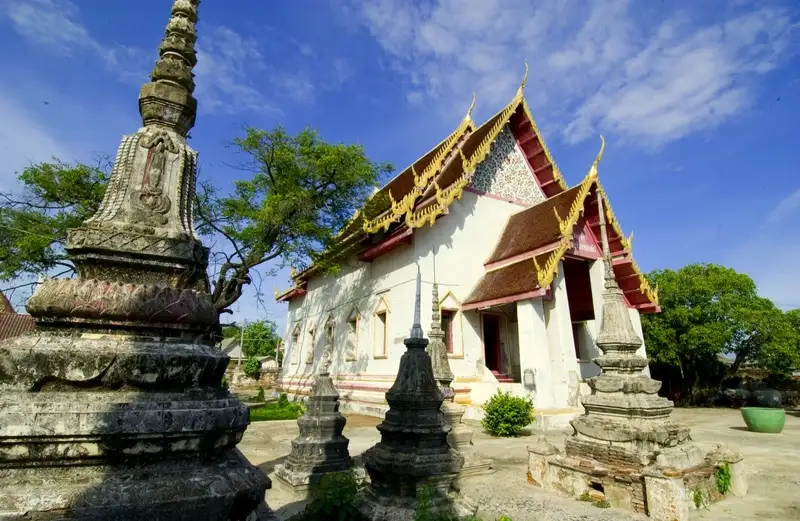
Wat Mueang (Wat Pitulathiratcharangsarit) in Na Mueang Subdistrict, Chachoengsao Province, is a historic city-center temple established during the reign of King Rama III in 1834 (B.E. 2377), alongside the construction of the city’s fort and walls. It stands out for architectural forms that evoke the prang silhouettes associated with Bangkok’s royal-era temple aesthetics, making it well suited to travelers who enjoy both temple visits and urban history. Plan about 1–1.5 hours for an unrushed walk, and it is easy to connect this stop with other highlights in Chachoengsao (Paet Riw).
Wat Mueang (Wat Pitulathiratcharangsarit) is often overlooked because it sits quietly within the city zone and looks calm and simple at first glance. But if you like “old temples within an urban context” where the experience goes beyond a quick prayer, this is one of the places that immediately gives Chachoengsao more weight. The temple was built in the same moment as the city’s fort and walls under King Rama III, reflecting how this area once served as a central node for city organization, administration, and riverside security along the Bang Pakong River.
What makes Wat Mueang compelling is not the bustle of a major tourist site, but a quiet intensity with a story underneath. If you start your city day here, the pace naturally slows and your attention becomes more precise, because this type of temple invites observation rather than a quick camera stop. Worshipping in a place tied to city-building adds a reflective dimension: you are not only here to make wishes, but also to touch traces of the period when Paet Riw was shaped through deliberate urban structure.
In the larger picture, Chachoengsao grew from its relationship with water and trade. The Bang Pakong River has been the city’s lifeline for generations. As Chachoengsao’s role expanded, urban planning and defensive elements such as forts and walls became necessary in that period, and Wat Mueang emerged within the same timeframe. Temples like this become a bridge between “faith” and “the order of the city,” so entering to pray is not only a religious activity but also an encounter with how earlier communities believed a stable city needed both governance and a spiritual center.
One reason the temple is rewarding to walk is that you can feel the builders’ intention in the details. Even without modern grandeur, the dignity of craftsmanship allows the place to “stand on its own” without excessive decoration. For travelers who like to read places, Wat Mueang is a clear example of architecture as narrative language: you can sense a composed rhythm, an ordered layout, and a restrained solemnity typical of a city temple designed to serve more people than a small neighborhood shrine.
Another point that gives Wat Mueang its distinct character is the idea of “craftsmen from the capital,” which influences the overall architectural tone. In this context, capital craftsmanship does not simply mean luxury; it means accurate proportions, controlled forms, and the ability to make structures look dignified without relying on heavy ornamentation. When you look at the main elements, you begin to notice that the beauty here comes from “getting the form right” rather than using vivid colors—a quality that resonates strongly with people who truly enjoy old temples.
Historically, the temple was known plainly as “Wat Mueang,” referring to its location and role within the city. Later, in 1908 (B.E. 2451), during King Chulalongkorn (Rama V)’s visit to Chachoengsao, the temple received its royal name: “Wat Pitulathiratcharangsarit”, meaning “the temple built by the King’s uncle.” This meaning turns the name into a compact historical record. Once you know it, the name carries more weight—as if you are not only naming a place, but also calling up a story of era, city, and royal connection at the same time.
For walking and viewing, the best approach is gradual and attentive. Start by taking in the overall composition of the temple, then move closer to examine details. The pleasure of well-crafted temples is that “the closer you look, the more you see”: fine lines, sectional rhythms, and small decisions in form become visible, and the overall feeling becomes calmer and more ordered.
One of the most commonly mentioned features is an architectural resemblance to prang-form traditions associated with Bangkok’s royal temple language. The point of “resemblance” is not to compare in a fault-finding way, but to use it as a viewing frame: it helps you understand how Wat Mueang shares a vocabulary with royal-era craftsmanship. You can begin by observing the overall silhouette, height and slenderness, the relationship between the base and the upper structure, and the rhythm of elements that creates an upright, dignified impression. From there, the smaller details reveal what makes Wat Mueang distinctly itself.
A difference that many visitors sense is the atmosphere of craftsmanship shaped by a provincial city context. The elements may not pursue perfection at every millimeter like works in the capital, but the intention and structural discipline remain clear. This is the charm of something “in-between” royal style and local context: the main form retains dignity, while certain details reflect place and period. Reading the temple this way makes the visit more engaging, because you are effectively seeing a conversation between the city and the capital through real architecture.
As you continue walking, you will notice that the architectural language does not work in isolation—it works with the overall atmosphere. Because the space is calm and not crowded, observing details becomes easier. You do not need to dodge people; you can stand quietly and study proportions fully. This is a key advantage of Wat Mueang as a cultural travel stop: it gives visitors “space for time.” In temples like this, time feels slower without effort.
If you enjoy urban history, Wat Mueang helps you connect multiple storylines in one visit: the temple’s establishment under King Rama III, the city’s fort and walls, and the royal naming under King Rama V. With these narratives in mind, walking the temple becomes more than viewing buildings—it becomes walking through at least two major periods of Siam. You begin to understand why Wat Mueang matters to Paet Riw more than it first appears, and why the simple old name and the meaning-rich royal name can coexist naturally.
Another layer that makes a story about Wat Mueang engaging is the meaning of being a “city temple” in local life. City temples often function as shared spaces for everyday merit-making, not only for major festivals. You may see people stop by briefly but intentionally, entering quietly and leaving in peace. This shows that Wat Mueang remains a lived, working temple—not only a preserved historical site—and that everyday sincerity is part of what makes the place feel worthy of respect.
If you want to worship in a simple but meaningful way, it does not take much. Begin by settling your mind and reducing haste, then pay respects with calm focus. Make wishes grounded in inner qualities you want to strengthen—mindfulness, perseverance, compassion, gratitude—because a quiet temple like this naturally supports “stability and clarity” more than urgent outward requests. When your mind becomes still, the later architectural walk tends to become more attentive on its own.
For photography, Wat Mueang suits architectural images focused on lines and proportion rather than fashion-style portraits. A common strong angle is where the main structure cuts against the sky. Morning light is softer and makes shadows and form readable without harshness; late afternoon creates warmer tones and an even calmer mood. Regardless of timing, the key is respectful shooting: keep quiet, avoid blocking entrances, and give worshippers space. The temple’s calm is part of what makes its images truly beautiful.
Beyond architectural value, Wat Mueang works as a practical connector that helps Chachoengsao feel like one coherent city story. Its location makes route planning easy. You can design a day as “start with calm, then move toward livelier places”: begin with worship and craftsmanship, then walk to an old market or the riverside promenade to feel city life, enjoy lunch at a well-loved local restaurant, and later visit a larger, busier temple in the afternoon. This approach keeps the day efficient without exhausting long drives outside town.
If you like learning through real places, Wat Mueang feels like a walkable classroom of city history. You see traces of time through tangible structures—a different experience from reading, because you are standing in a space built with real intention in its era. Being in front of old architecture often makes people feel unexpectedly calm: you sense both the patience of time and the effort of craftsmanship. This is why Wat Mueang suits travelers who want a peaceful visit that offers both substance and merit.
When you walk out and look back one more time, you may feel that the temple’s charm comes from not trying to attract attention. It draws you in through the dignity of form and the weight of story. People who love old temples often understand immediately: a place like this does not need a lot. Time, order, and an atmosphere that supports calm are enough to make you want to return—especially on days when you want travel to mean more than just taking photos.
Getting There Wat Mueang (Wat Pitulathiratcharangsarit) is in Na Mueang Subdistrict, Mueang Chachoengsao District. Pin the temple name on your map and travel into the city zone. Driving is the most convenient option because it allows flexible timing for worship and easy continuation to other city stops. If you arrive by train or minivan into central Chachoengsao, you can connect by local transport or taxi as convenient. Allow extra time on weekends and public holidays, when traffic in the city center can be heavier.
If you want a well-balanced one-day plan, a practical route is to begin the morning at Wat Mueang for its calm atmosphere and royal-style craftsmanship, then walk through Baan Mai 100-Year Market late morning for food and riverside old-town life, and continue to Wat Sothon Wararam Worawihan in the afternoon. This route combines history, old-town culture, local food, and major religious heritage without needing to drive across multiple districts.
Ultimately, Wat Mueang is the kind of temple where the more you look, the more you notice, and the more you understand its history, the more valuable it feels. It is not only a religious place, but also a trace of city-building in one era of Siam. If you want your Chachoengsao trip to feel more meaningful than a simple temple stop, Wat Mueang is a place that helps you “read the city” through architecture and a name with a clear historical story.
| Place Name | Wat Mueang (Wat Pitulathiratcharangsarit) |
| Address | 156 Maruphong Road, Na Mueang Subdistrict, Mueang Chachoengsao District, Chachoengsao 24000, Thailand |
| Summary | A historic city-center temple in Paet Riw, established in 1834 (King Rama III) alongside the city fort and walls, known for an architectural mood reminiscent of royal-era craftsmanship and ideal for temple-and-history city travel. |
| Highlights | Early Rattanakosin-era architectural character, a temple aligned with city-building (forts and walls), a central location connecting easily to Baan Mai 100-Year Market and Wat Sothon, and a calm setting for architectural photography. |
| Period | Established in the reign of King Rama III (1834); received a royal name in the reign of King Rama V (1908). |
| Open Days | Daily |
| Opening Hours | 06:00 – 18:00 |
| Current Status | Open for worship and visits during operating hours. |
| Fees | No admission fee (donations are voluntary). |
| Facilities | On-site parking area, restrooms, and worship/viewing areas within the temple grounds. |
| Nearby Tourist Attractions With Distance | 1) Baan Mai 100-Year Market – 2 km 2) Wat Chin Prachasamoson (Wat Leng Hok Yi) – 2 km 3) Chachoengsao City Pillar Shrine (San Chao Pho Lak Mueang) – 2 km 4) Bang Pakong Riverside Promenade (Clock Tower zone) – 3 km 5) Wat Sothon Wararam Worawihan (Luang Pho Sothon) – 5 km |
| Popular Restaurants Nearby With Distance And Phone Number | 1) Kung Nang Restaurant – 3 km – 038-513-414 2) The River Barn – 3 km – 038-515-892 3) Kin Lom Chom Pla – 5 km 4) Sun Up Cafe – 3 km 5) Seiy Tha Yai – 3 km |
| Popular Accommodations Nearby With Distance And Phone Number | 1) JK Living Hotel – 4 km 2) Tree House Chachoengsao – 4 km 3) Yenjit Resort – 6 km 4) Suntara Wellness Resort & Hotel – 10 km 5) M2 Hotel Waterside – 6 km |
Frequently Asked Questions (FAQ)
Q: Is Wat Mueang (Wat Pitulathiratcharangsarit) open every day?
A: Yes. It is open daily, and visitors can worship and walk around the temple grounds during operating hours.
Q: What time does Wat Mueang open?
A: The opening hours are 06:00 – 18:00.
Q: When was Wat Mueang established?
A: It was established in 1834 during the reign of King Rama III, alongside the construction of the city fort and walls in Chachoengsao.
Q: Why is it called Wat Pitulathiratcharangsarit?
A: In 1908, King Rama V visited Chachoengsao and granted the royal name “Wat Pitulathiratcharangsarit,” meaning “the temple built by the King’s uncle.”
Q: What is the main highlight of Wat Mueang?
A: Its highlight is an architectural character associated with capital-style craftsmanship, paired with a calm city-temple atmosphere connected to the historical era of city-building in Paet Riw.
Q: How long should I plan for a visit?
A: Most visitors spend about 1 – 1.5 hours, depending on how much time is spent worshipping, observing architectural details, or taking photos.
 Wat Mueang (Wat Pitulathiratcharangsarit) Map
 Category:
  Group:
  Last Update: 1 WeekAgo
Comment
 Nearby Attractions
| Keyword (Advance) |
 Region
|
 Muang Chachoengsao(