

 Home
Home Chiang Mai(




Rating: 3.5/5 (6 votes)
 |
|  Map
Map 
 Have Map
  No Map
Chachoengsao attractions
Attractions in Thailand
Open Days: Daily
Opening Hours: 08.00 – 17.00
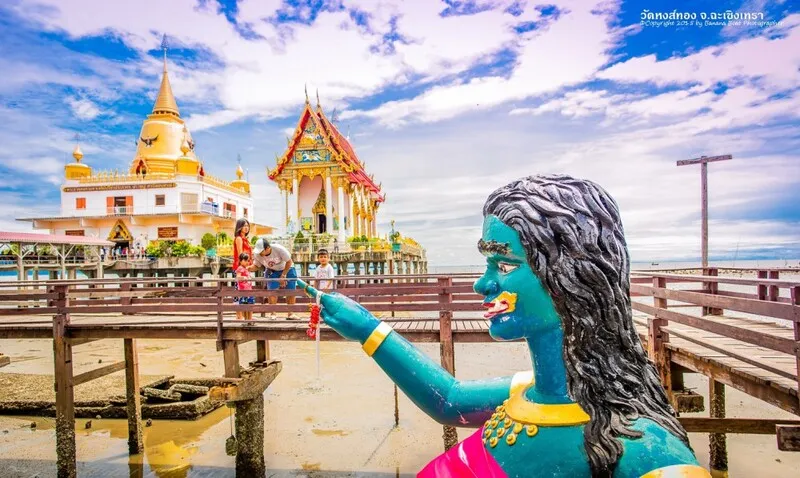
Wat Hong Thong (Wat Klang Nam), Bang Pakong, is a seaside temple best known for its “sea-based ordination hall” and the “Phra That Khongkha Maha Chedi” as its main highlights. It is ideal for a day trip focused on temple visits and photography, with sweeping views of the Gulf of Thailand. The must-do experience is walking along the causeway that stretches out over the sea to pay respects to the relic stupa and enjoy mangrove scenery, then continuing the route with nearby seafood and cafés in the same trip.
Wat Hong Thong is located in Moo 9, Song Khlong Subdistrict, Bang Pakong District, Chachoengsao Province. Many Thais recognize it instantly from its iconic identity as a “temple in the sea” with architecture that extends over the water. What makes this temple different from a typical community temple is that the space of faith does not end on land; it expands outward into the sea, mangroves, and the horizon itself. As a result, visiting here naturally blends merit-making, paying respect, mindfulness, and landscape-based travel in one continuous experience.
Wat Hong Thong’s signature character comes from constructing several key religious structures “in the sea,” connected by a continuous walkway from the shore to the sea-based sacred zone. The structure most often discussed is the “Phra That Khongkha Maha Chedi,” a grand golden stupa standing prominently offshore. It is designed as a space for devotees to pay respects to relics, while also moving through murals and important Buddha images on each level in a clear sequence. From a distance, the stupa’s gold silhouette against the sky and water creates an image that feels both serene and majestic at the same time.
Wat Hong Thong is a local temple under the Mahanikaya order. The temple’s establishment date is recorded as 13 September 1983, and it received the royal grant of Wisungkhamsima on 12 September 1986, with the boundary measuring 20 meters wide and 32 meters long. This is a significant milestone for Thai temples because Wisungkhamsima formally defines the ordination boundary, enabling key monastic rites to be performed in full accordance with the Vinaya. Beyond its Buddhist status, Wat Hong Thong also serves as a spiritual center for coastal communities in Bang Pakong and for visitors from nearby provinces who come specifically to pay respects to the temple’s revered sacred sites.
As you enter the onshore section of the temple, what stands out is the atmosphere of a coastal temple intertwined with mangrove landscapes. The surroundings combine open sea breezes with the humidity of a shoreline ecosystem. On clear days, you can see sunlight shimmering on the water and hear the wind as a soft backdrop. This naturally slows your pace, which is why many visitors feel that Wat Hong Thong is equally suited for “resting the mind” as it is for “making merit.”
The highlight behind the nickname “Wat Klang Nam” is the “sea-based ordination hall,” a sacred structure built out over the water. Inside, there is a golden principal Buddha image, along with wall paintings depicting episodes from the Buddha’s life. The experience feels different from an ordinary ordination hall because when you turn back, you see the long walkway leading toward the shore, while turning the other way reveals an open expanse of sea. This places your act of worship against a backdrop of vast, quiet nature.
Another highly visited point is behind the ordination hall, where there is a statue of Admiral Prince Abhakara Kiartivongse (Krom Luang Chumphon Khet Udomsak), widely revered in Thailand. Devotion to the Admiral Prince is commonly associated with protection, safe journeys, and guardianship. As a result, this spot receives steady offerings and prayers, especially from people connected to travel, commerce, or those seeking a strong beginning for something new.
The “Phra That Khongkha Maha Chedi” is where many visitors spend the most time. Inside, the chedi is arranged across multiple floors so that the visit unfolds step-by-step as you move upward. The lower level enshrines a replica of Luang Pho Sothon and other important Buddha images for close-up worship. The second level features a lifelike wax figure of Phra Mongkol Thep Muni (Sod Candasaro) of Wat Paknam Phasi Charoen, along with a replica of the Emerald Buddha, allowing visitors to pay respects to several major revered figures in a single trip. The top level is dedicated to enshrining arahant relics within a gleaming golden stupa. Across the floors, murals accompany the experience, including scenes from the Buddha’s life, portraits of Thai monarchs, and artworks reflecting a contemporary Thai temple perspective on faith and nation.
Wat Hong Thong’s uniqueness is not only its grandeur, but also the way it creates a tangible “path of faith” that you can truly walk from shore to sea. Visitors do not merely view the structures from afar; they physically move into the place itself. Reaching the far end, you can feel the intent behind the spatial design: the journey gradually carries you from the liveliness of the onshore area to the openness of the walkway, and finally into the quiet, focused atmosphere inside the worship spaces within the chedi.
Another activity that draws interest is Dharma practice in a coastal setting. Wat Hong Thong is known for offering opportunities to undertake nekkhamma practice (white-robed lay observance) during early April each year. The defining advantage of practice here is an environment that supports mindfulness: the sound of wind and the openness of the seascape help reduce mental noise. Those who come with serious intent often feel as if they have truly stepped away from the city, even though the journey from Bangkok is not especially far.
From a travel perspective, Wat Hong Thong fits multiple styles: a focused merit-making and prayer trip, a family visit for both elders and children to enjoy sea views, or a photography outing that pairs golden architecture with a coastal horizon. Visiting in the morning offers softer light, cooler air, and fewer crowds, making it comfortable for walking and taking photos. Late afternoon into early evening provides the most atmospheric sea mood and near-sunset light, which many visitors prefer because the scenery gains depth and a distinctly calming tone.
For those who want a structured worship flow, a smooth sequence is to begin with prayers in the onshore section, then walk to the sea-based ordination hall, and finally continue to the Phra That Khongkha Maha Chedi. Following this order helps your mood gradually transition from the community area to the sea-based sacred zone. It also helps with time management, because the chedi has multiple floors; if you plan to reach the top level and enjoy the sea view from higher vantage points, it is best to allow enough time so the visit remains unhurried and complete.
Two things matter most for a comfortable visit: safety and temple etiquette. Because the temple includes a walkway extending into the sea, some days can be windy, especially during monsoon season or when weather shifts quickly. If you bring children or older family members, walk carefully, use handrails, and avoid lingering in crowded photo spots. Dress modestly, avoid overly short or inappropriate clothing, and keep your voice low inside the ordination hall and at worship points.
Wat Hong Thong also includes several sacred points that many Thai visitors choose to pay respects to, such as Ai Khai (the temple boy spirit), Phra Mae Khongkha (the water goddess), Luang Pho To, and the shrine of Doctor Jivaka Komarabhacca. These reflect contemporary Thai beliefs that coexist naturally within Buddhist temple spaces. Visitors may pay respects according to personal faith, while keeping the overall atmosphere orderly and respectful.
Getting There Wat Hong Thong is in the coastal Bang Pakong area. The most convenient option is to drive or rent a car, since it allows flexible timing and makes it easy to continue to nearby seafood restaurants or cafés. From Bangkok, people commonly use Bang Na–Trat Road (Highway 34) or other routes connecting to Bang Pakong, then head into Song Khlong Subdistrict and follow signage to Wat Hong Thong. A clear landmark is the coastal setting and the sea-based walkway that extends out over the water. Parking is available near the temple area.
If you do not have a private vehicle, a practical approach is to travel to the Bang Pakong area first, then use a local taxi or ride-hailing service to reach the temple. It helps to confirm the destination name clearly as “Wat Hong Thong (Wat Klang Nam), Song Khlong Subdistrict, Bang Pakong District.” Allowing extra travel time is recommended, because some segments are local roads and traffic can be heavier on weekends and holidays.
For trip planning, Wat Hong Thong works very well as a “one-day, all-in-one” route. You can start in the morning with worship and a walk through the sea-based structures, then continue to seafood or cafés in Bang Pakong. If time allows, you can extend the day to other Chachoengsao highlights, including Wat Sothon Wararam Worawihan. This creates a day that combines faith, scenery, and food without an exhausting long-distance drive.
| Place Name | Wat Hong Thong (Wat Klang Nam) |
| Address | Moo 9, Song Khlong Subdistrict, Bang Pakong District, Chachoengsao Province |
| Summary | A seaside temple in Bang Pakong featuring a sea-based ordination hall and the Phra That Khongkha Maha Chedi as signature landmarks, offering a full route of worship, sea views, and multiple sacred points in one visit. |
| Key Highlights | Sea-based ordination hall, 3-level golden Phra That Khongkha Maha Chedi, Gulf of Thailand viewpoints, mangrove scenery, easy day-trip route for worship and photography. |
| History (Verifiable) | Established on 13 September 1983; granted Wisungkhamsima on 12 September 1986; a local temple under the Mahanikaya order, developed sea-based sacred structures and became a major Bang Pakong landmark. |
| Temple Phone Number | 038-528-367, 093-951-7717, 087-823-3339 |
| Current Abbot / Overseer | Phra Khru Palad Watchara Panyawachiro |
| Current Status | Open for worship and visits during operating days and hours. |
| Nearby Attractions (Approx. Distance) | 1) Wat Sothon Wararam Worawihan (Approx. 38 km) 2) Ban Mai 100-Year Market (Approx. 45 km) 3) Wat Saman Rattanaram (Approx. 55 km) 4) Bang Khla Floating Market (Approx. 60 km) 5) Ganesha Park, Khlong Khuean (Approx. 70 km) |
| Nearby Restaurants (Approx. Road Distance + Phone) | 1) Boonchana Wild Food (Approx. 3 km) – 099-353-1976 2) Hoi Kha Noodles Rim Wang (Approx. 2 km) – 087-388-3758 3) Golden Swan Cafe (Approx. 1 km) – 096-294-4456 4) Phai Thale (Approx. 6 km) – 061-589-2081 5) Krua Ban Thawee (Approx. 8 km) – 086-906-1978 6) Long Sang Boeng (Approx. 9 km) – 084-705-6051 |
| Nearby Accommodations (Approx. Road Distance + Phone) | 1) Boonchana Resort (Approx. 6 km) – 099-353-1976 2) Ban Bang Wua Resort (Approx. 13.2 km) – 086-599-9779 3) Rattara Resort (Approx. 18.95 km) – 038-574-318, 038-573-644 4) PJ Place (Approx. 20 km) – 099-004-6365 5) Suan Maithara Resort (Approx. 22 km) – 095-356-6621 6) Yenjit Bungalow & Resort (Approx. 30 km) – 038-511-200 |
Frequently Asked Questions (FAQ)
Q: Where is Wat Hong Thong located?
A: It is in Moo 9, Song Khlong Subdistrict, Bang Pakong District, Chachoengsao Province. It is a seaside temple with a sacred zone that extends out over the sea.
Q: Is Wat Hong Thong open every day, and what are the opening hours?
A: Yes. It is open daily from 08.00 – 17.00.
Q: What is the most outstanding highlight of Wat Hong Thong?
A: The sea-based ordination hall and the golden Phra That Khongkha Maha Chedi, which you can walk to and pay respects to directly, with Gulf of Thailand and mangrove views.
Q: What is the best order for worship and walking around Wat Hong Thong?
A: Start with worship in the onshore area, then walk to the sea-based ordination hall, and then continue to the Phra That Khongkha Maha Chedi, moving floor by floor for a smooth and complete visit.
Q: What should visitors wear when visiting Wat Hong Thong?
A: Dress modestly, avoid overly short or inappropriate clothing, and keep your voice low, especially inside the ordination hall and at worship points.
Q: Which phone number should I use to contact Wat Hong Thong?
A: You can contact the temple at 038-528-367, 093-951-7717, or 087-823-3339.
 Website: www.wathongthong.com
 Wat Hongthong Map
 Category:
  Group:
  Last Update: 1 WeekAgo
Comment
 Nearby Attractions
| Keyword (Advance) |
 Region
|
 Muang Chachoengsao(