

 Home
Home Chiang Mai(




Rating: 3.4/5 (5 votes)
 |
|  Map
Map 
 Have Map
  No Map
Ang Thong attractions
Attractions in Thailand
Open Days: Daily
Opening Hours: 08:00 a.m. – 05:00 p.m.
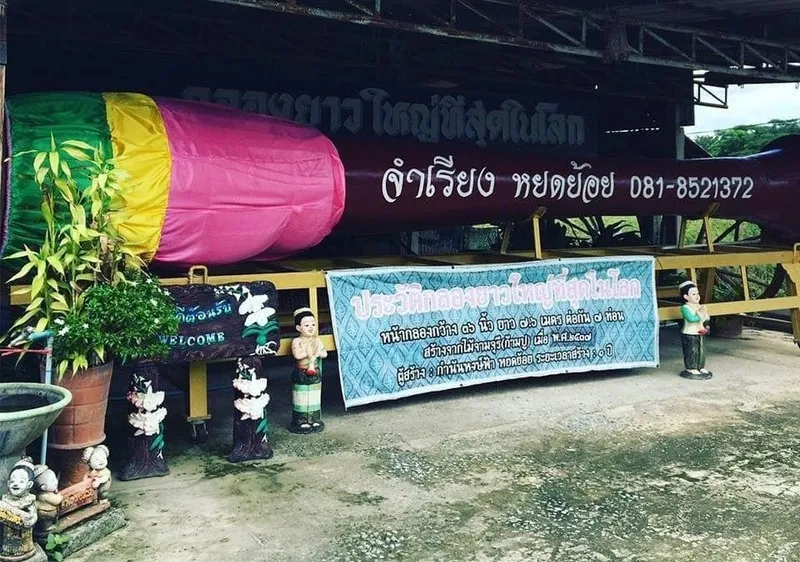
The World’s Longest Long Drum (Ban Ekkarat Drum-Making Village), Ang Thong If you are looking for an Ang Thong attraction that offers more than a quick photo stop, Ban Ekkarat Drum-Making Village (Ban Bang Pae) is one of the clearest cultural answers. This is not a quiet museum with objects placed behind glass; it is a living craft community where “sound” and “the hands of artisans” remain the heart of the place. Here, you will see that a traditional long drum is not simply a prop in a festive parade, but a piece of craftsmanship that demands precision, patience, and a refined sense of shape and tone passed down over generations, until it becomes the village’s true identity.
The charm begins with the village atmosphere itself, set in the rural landscape of Pa Mok District. The moment you step into the area, you feel the simplicity of a working community—not a staged tourist set. That very simplicity makes the experience feel more “real” than many destinations, because you are witnessing Thai culture in a form that still breathes. You can sense the smell of wood and paint, hear sanding and trimming, catch the sound of test taps, and notice the steady rhythm of craftsmen who are thoroughly familiar with fine, detailed work. Seen in this light, Ban Ekkarat is not just a place to visit; it is a cultural classroom that teaches without needing to be arranged like one.
The highlight that has made Ban Ekkarat widely talked about is “the world’s longest long drum,” created specially to emphasize the village’s uniqueness and to present its artisan identity with pride. What makes it special is not only the word “long,” but the cultural meaning behind that length. Building a drum on this scale is a declaration that the long drum’s sound and rhythm are the village’s language—something the community is proud of and wants younger generations to remember as a clear cultural root. Publicly shared information states that this special long drum is about 38 meters long with an approximate diameter of 1.30 meters, making it an eye-catching symbol that naturally invites people to come and see it in person.
To experience the world’s longest long drum with real depth, it helps not to treat it as a simple backdrop for a photo and then walk away. Give yourself time to observe details and ask basic questions: the long drums you see in merit-making parades and community processions—what do they go through before becoming a finished instrument? And for a drum that is exceptionally long like this, how does a craftsman think about balance, strength, and presentation so it remains a “long drum” in cultural terms, not merely a large object built for spectacle? Once you start asking these questions, the same destination shifts from a check-in spot into a learning space. That is the core difference between cultural travel and ordinary sightseeing.
Ban Ekkarat Drum-Making Village also carries an interesting dimension in terms of community history and development. It is often described as a long-established drum-making community with skills passed down over time and known since around B.E. 2470, reflecting that its expertise did not come from a short-lived tourism trend, but from continuity across artisan families and the ongoing demand of Thai society that remains closely tied to music and ritual throughout the community calendar. There is also information that the area was selected as one of the “10 Creative Cities” in B.E. 2554, reinforcing that drum making here is recognized as cultural capital and part of the creative economy, not simply a local trade for survival. Through this lens, Ban Ekkarat becomes a strong example of how local wisdom can endure in the modern world because of the genuine value of the craft itself.
The heart of this story is helping readers see that a long drum is “craftsmanship,” not just a single folk instrument. Good craft begins with materials and a deep understanding of their nature. Drum makers must know which types of wood provide strength and the right form for shaping, understand the rhythm of sanding and finishing, and recognize how the thickness of the drum body relates to the character of its sound. They must also know how even a small mistake in hollowing or shaping can affect weight balance and resonance. Drum making, therefore, is as much about “conversing with the material” as it is about physical labor. No matter how strong a craftsman is, if they cannot read the wood, the drum will not produce the sound it should.
After the body is shaped, the step that many visitors find most fascinating is the drumhead and the tensioning, because this is the moment a “thing” becomes “sound.” That sound is exactly why the long drum has remained close to Thai culture for so long. A drumhead that is too tight creates a hard, harsh tone without warmth, while a drumhead that is too loose produces a dull sound with weak projection and unclear rhythm. The right tension is not accidental; it is the result of experience, attentive listening, and confident hands. When you visit Ban Ekkarat and hear the test rhythms within the village, you begin to understand why this expertise is a source of pride: it is built through repetition, learning from errors, and continuously raising one’s own standard.
Beyond the drum body and the sound, the long drum also carries a strong visual dimension. Unlike some instruments used quietly indoors, the long drum is played in public processions surrounded by crowds. Because of that, appearance matters as much as tone. The neatness of the paintwork, decorative patterns, coating, joint finishing, and overall balance of shape all contribute to the “dignity” of a procession and the pride of the drum’s owner. In this sense, long-drum making is comparable to high-quality handicraft: it must be durable and truly usable, yet also look impressive in front of many people at once. When you start seeing it this way, you realize the long drum is culture that can be heard and seen at the same time.
In cultural meaning, the long drum is one of the clearest symbols of joy and collective energy in community life. Its rhythm helps people step in unison, helps spectators feel the celebration, and gives ceremonies and festivals a shared pulse. The long drum is not merely an accompaniment; it shapes the emotional atmosphere of merit-making events at the community level. You do not need deep musical knowledge to feel how long-drum rhythms can move people “together,” and that is why the craft of long-drum making still has a place in Thai society. As long as merit-making, parades, and local traditions remain part of community life, the long drum’s sound will remain a familiar and meaningful sound for Thai people.
That is why Ban Ekkarat works well for many types of travelers on the same trip. Content creators gain strong visuals and clear storytelling because there is both a major symbol—the world’s longest long drum—and real craft work as the backdrop. Families and students can learn about skill, patience, and pride in workmanship without formal instruction. Cultural travelers get what they want because the village connects “objects used in rituals” directly to “real community life” in a tangible way. And for those who prefer simplicity, walking through a working craft village in rural Ang Thong offers the calm charm of a secondary province that does not rush visitors through the experience.
In terms of making the most of your visit, Ban Ekkarat is ideal for a half-day stop or a one-day route that connects multiple places. It does not take long to walk and explore, but it provides dense cultural value. You can start in the morning to see the highlight and capture photos, then continue to other cultural destinations in Ang Thong that are not far away, and finish the day with local food around Ang Thong town or nearby districts. Planning your day this way turns a one-day trip into more than just long driving between check-in points; it becomes a connected journey with a consistent story from beginning to end.
Getting There The most convenient way to reach Ban Ekkarat Drum-Making Village is by private car, as it is a rural community within Pa Mok District. Driving allows you to manage your time and easily connect your route to other nearby attractions. Use Ekkarat Subdistrict, Pa Mok District, Ang Thong Province as your primary destination, then follow local roads into the village area. For travelers using public transport, the most practical approach is to reach Ang Thong town first, then continue by local transport to Pa Mok District and Ekkarat Subdistrict as appropriate. It is best to plan your round trip clearly to avoid long waits, especially if you want to arrive in the morning for comfortable walking and photography.
Before closing, it is worth seeing Ban Ekkarat as a “living representation” of Thai culture rather than culture stored in a display cabinet. In a world that changes quickly, handicrafts survive when they carry both real quality and real meaning. Ban Ekkarat has both: craftsmanship you can witness and cultural significance that Thai people recognize through traditions, festivals, and merit-making events. When you see “the world’s longest long drum,” you are not only seeing length; you are seeing a community’s intention to affirm its identity with pride. And when you observe real drum making, you understand that Thai local wisdom can continue, as long as we continue to value the people who keep culture sounding alive.
| Name | The World’s Longest Long Drum (Ban Ekkarat Drum-Making Village) |
| Address | Ekkarat Subdistrict, Pa Mok District, Ang Thong Province |
| Open Days | Daily |
| Opening Hours | 08:00 a.m. – 05:00 p.m. |
| Fees | Free Admission |
| Contact Number | 035-661914, 086-379-9186 |
| Place Summary | A drum-making handicraft community in Ang Thong that preserves local wisdom and created the “world’s longest long drum” as a cultural symbol of the village. Ideal for cultural travel, learning craftsmanship, and photography. |
| Highlights | See the world’s longest long drum as the village’s signature symbol, observe traditional long-drum craftsmanship, enjoy a calm yet content-rich cultural visit, suitable for a half-day trip or as part of an Ang Thong route. |
| Period | The community is often described as known for drum making since around B.E. 2470, and it has developed into a cultural tourism destination in Ang Thong. |
| Key Evidence | Publicly shared information about the special long drum (approx. 38 meters long and approx. 1.30 meters in diameter) and the continuing drum-making handicraft tradition in the community. |
| Name Origin | Named after Ekkarat Subdistrict, a community known for its long-drum-making identity. |
| Travel | Most convenient by private car: set your destination to Ekkarat Subdistrict, Pa Mok District, then enter the village via local roads; public transport: reach Ang Thong town first, then continue by local transport to Pa Mok and Ekkarat as appropriate. |
| Current Status | Open To Visitors |
| Facilities | Parking Available; bring drinking water if you plan to walk around multiple points in the village. |
| Nearby Tourist Attractions (Approx. Distance) | 1) Wat Champa Lo – 5.8 km 2) Ang Thong Paradise Park (Nong Chet Sen) – 7.4 km 3) Krung Siam Art Gallery – 8.3 km 4) Maharat Buddha Park (Giant Luang Pu Thuat Image) – 8.2 km 5) Wat Sanam Chai, Ang Thong – 9.9 km |
| Popular Restaurants Nearby (Approx. Distance + Phone) | 1) Khong Aroi By Lung Lung – 0.3 km – Tel. 080-932-2331, 095-210-7108 2) Hoi Kratha Sap Nara Sing – 1.0 km – Tel. 089-935-6798 3) Lom Chao Kha Cafe – 1.5 km – Tel. 092-795-6987 4) Aqua Cafe&Restaurant – 0.7 km – Tel. 095-725-2878 5) Khanom Chin Khun Ya & Fresh Coffee – 0.6 km – Tel. 089-803-0262, 084-554-5303 |
| Popular Accommodations Nearby (Approx. Distance + Phone) | 1) Bua Luang Boutique Resort, Ang Thong – 7.1 km – Tel. 081-495-8884 2) Bua Luang Hotel – 9.2 km – Tel. 035-611-116, 080-922-4040 3) Suphorn Grand Hotel – 9.6 km – Tel. 081-551-2828 4) Wiset Sabai Resort – 14 km – Tel. 081-587-5993 5) Ruen Rab Khwan – 6.6 km – Tel. 061-997-8987 |
Frequently Asked Questions (FAQ)
Q: Where is the world’s longest long drum located?
A: It is at Ban Ekkarat Drum-Making Village (Ban Bang Pae) in Ekkarat Subdistrict, Pa Mok District, Ang Thong Province, a well-known long-drum handicraft community in the province.
Q: What are the opening days and hours?
A: It is open daily from 08:00 a.m. to 05:00 p.m.
Q: Is there an admission fee?
A: No. Admission is free.
Q: What is the main highlight once you arrive?
A: The main highlight is the world’s longest long drum created as a special symbol of the community, along with the atmosphere of a living handicraft village where long drums are still made through local wisdom passed down to the present.
Q: When is the best time to visit?
A: Morning is ideal because the weather is more comfortable for walking. If you want photos, allow extra time to observe craftsmanship details and find angles around the highlight area.
Q: Can I visit without a private car?
A: Yes. Travel to Ang Thong town first, then continue by local transport to Pa Mok District and Ekkarat Subdistrict. Plan your round trip clearly to avoid long waiting times for local transport.
 The World is Longest Long Drum Map
 Category:
  Group:
  Last Update: 3 DayAgo
Comment
 Nearby Attractions
| Keyword (Advance) |
 Region
|
 Muang Ang Thong(