

 Home
Home Chiang Mai(




Rating: 3.6/5 (5 votes)
 |
|  Map
Map 
 Have Map
  No Map
Ang Thong attractions
Attractions in Thailand
Open Days: Daily
Opening Hours: Open all day
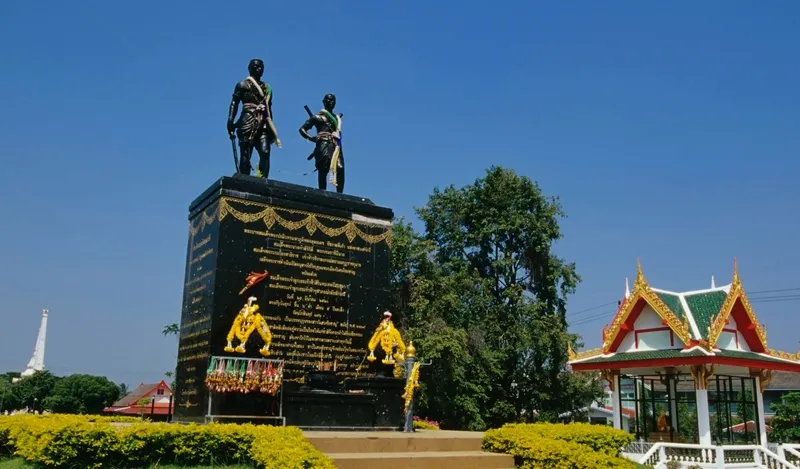
Nai Dok & Nai Thong Kaew Monument If you are looking for an “Ang Thong attraction” that takes you back to the late Ayutthaya period in a way you can truly feel, Nai Dok & Nai Thong Kaew Monument is an excellent choice. This is not simply a symbolic statue; it is a shared site of memory created by the people of Wiset Chai Chan and Ang Thong to remind visitors that “courage” and “unity” once enabled ordinary people to rise and defend their homeland in Thai history. The monument is enshrined in front of Wiset Chai Chan Witthayakhom School, Phai Chamsin Subdistrict, Wiset Chai Chan District, Ang Thong Province. Travel along the Ang Thong–Wiset Chai Chan route, then turn into Soi Pu Dok–Pu Thong Kaew 16 and continue for about 1.5 kilometers. The surrounding area remains a simple local community, suitable for a half-day historical stop or as a starting point before connecting your trip to important temples and markets in the Wiset Chai Chan area.
As a place to visit in the spirit of “read first, then see it for real,” the story here is clear from the very first glance. The monument communicates the idea of heroism without relying on a large exhibition. Most visitors spend about 20–45 minutes walking around, taking photos, and reading the accompanying information. If you want to absorb the story more deeply and connect it to the broader historical context of Bang Rachan, allow about 60 minutes so you can slowly “read the site” in both overview and detail. What makes this stop different from an ordinary check-in is that you may walk away asking yourself: if you lived in that era, would you have been brave enough to stand on the front line like the people in the story? That is the value of a strong memorial—it does not only show you something; it makes you think.
The heart of Nai Dok & Nai Thong Kaew Monument is tied to a major moment in the late Ayutthaya era, before the second fall of Ayutthaya. As war intensified, cities and communities across the region faced growing pressure from the Burmese invasion. The story widely known as the “Bang Rachan Camp” is not merely a dramatic tale passed along for entertainment; it reflects how ordinary villagers had to make a decisive choice to protect their home. In this sense, honoring the Bang Rachan heroes is not only about celebrating individuals, but also about honoring the “power of community”—the belief that unity could still create a path to resistance, even when the enemy was stronger.
Information from the community-based tourism source of DASTA notes that Nai Dok & Nai Thong Kaew Monument was built by the people of Wiset Chai Chan and Ang Thong to commemorate the virtue and bravery of the local heroes from Ban Pho Thale, Wiset Chai Chan—known respectfully as “Pu Dok” and “Pu Thong Kaew.” Both are remembered for sacrificing their lives in the fight against the Burmese at Bang Rachan Camp before Ayutthaya fell in B.E. 2309. They are also recognized as key figures among the “11 Heroes of Bang Rachan,” who have long been honored in Thai collective memory.
When we place the Bang Rachan story onto the map of central Thailand’s shared memory, Wiset Chai Chan and nearby areas can be seen as connected to routes of troop movement, forced relocation, and the fear experienced by people during the late Ayutthaya war period. One narrative often discussed is that Burmese forces advanced into this region, pushing residents to decide whether to submit to capture or to unite and resist. Bang Rachan, as a “villagers’ camp,” became both a refuge and a defensive base. From this perspective, Nai Dok and Nai Thong Kaew are not only two fighters; they represent local people who chose to “stand firm” rather than retreat, understanding that surrender in that moment could mean losing everything that defined “home” in the days ahead.
What adds greater historical weight to this monument is the detail of its creation and official opening. DASTA notes that the people of Ang Thong jointly built this monument as a memorial to Nai Dok and Nai Thong Kaew, and that the opening ceremony was presided over by the Crown Prince (acting on behalf of the King) on March 25, 1977 (B.E. 2520). On the same date each year, Ang Thong residents hold a wreath-laying ceremony to honor and remember the virtue and heroism of both men.
Once you know that a wreath-laying remembrance ceremony takes place every year on March 25, the monument shifts in meaning from a simple “photo stop” to a “civic ritual space” where the community reconnects with its past. Having an annual remembrance day ensures that the story does not end in textbooks; it is brought back to life repeatedly through visible actions such as wreath-laying, spoken tributes, and local gatherings. This is one reason historical sites matter for cultural tourism: travel does not only take us to see old objects, but also to witness how “people today use memory” to connect community identity to meanings larger than everyday life.
Another aspect worth understanding is the “name” and the “status” of Nai Dok and Nai Thong Kaew in local perception. The respectful titles “Pu Dok” and “Pu Thong Kaew” reflect community reverence, elevating them as elders and moral anchors of the locality. This signals that the story is not only about bravery; it also emphasizes virtues that the community wishes to uphold. In Thai culture, the term “pu” (grandfather/elder) often evokes the image of a protector, a giver of blessings, and a root of the community. Honoring heroes as “pu” therefore places them in a position that people can always return to when they want to reflect on what “home” truly means.
Visiting Nai Dok & Nai Thong Kaew Monument is therefore a chance to “read meaning through place.” You begin by looking at the statue standing prominently on a high base. The overall impression is solemn and dignified, encouraging visitors to “look up” and encounter a heroic narrative in the global tradition of memorial monuments. What is especially distinctive here is its location in front of a school, which naturally ties the site to “learning.” Local children and youth therefore see the symbol of heroism throughout their education years, and the story can be passed on continuously through both schooling and annual commemorations.
For travel experience, if you want photos that feel truly like a memorial site, choose an angle that includes both the monument base and the sky to emphasize scale, or use a slightly lower angle to give the statue a more commanding presence. Morning and late afternoon usually provide softer light, adding depth to the sky and shadows on the statue. Midday light makes lines and forms sharper, suitable for documentary-style images, but it is wise to bring water and a hat on hot days, as memorial areas like this are often open and exposed.
If you are the kind of traveler who enjoys “understanding a place through story,” it helps to briefly recall the sequence of late Ayutthaya events in your mind, then look at the monument again. You may begin to see that its meaning is not about “winning” or “losing” a battle, but about affirming that even in national crisis, ordinary people still had the dignity to choose their actions. The Bang Rachan story is remembered because villagers resisted multiple attacks and it has been celebrated as a courageous episode in Thai history. When connected back to Nai Dok and Nai Thong Kaew, it becomes clear why the people of Ang Thong chose to build this monument as a “proof of the heart” that their homeland is part of a larger national memory.
Getting There Nai Dok & Nai Thong Kaew Monument is located in Wiset Chai Chan District, Ang Thong Province. Traveling by private car is convenient. From Ang Thong town, head toward Wiset Chai Chan along the Ang Thong–Wiset Chai Chan road. Around kilometer markers 26–27, look for the entrance to Soi Pu Dok–Pu Thong Kaew 16, then drive in about 1.5 kilometers to reach the area in front of Wiset Chai Chan Witthayakhom School where the monument stands. If traveling from Bangkok, you can route through the Ayutthaya area and connect into Ang Thong, then continue toward Wiset Chai Chan on the province’s main roads. For public transport, it is practical to reach Ang Thong town or the Wiset Chai Chan area first, then use a local hired vehicle to reach the school frontage. Planning around bus/van schedules and real pickup-dropoff points on your travel day is recommended.
Once you arrive, the best way to make the visit worthwhile is to treat the monument as a “starting point for the story,” then expand your trip to important sites around Wiset Chai Chan. This area includes well-known temples, community spaces, and local markets, allowing you to combine history, art, and present-day lifestyle in a single day. You can begin with the monument to understand the story of Nai Dok and Nai Thong Kaew, then continue to significant temples or stop by a market for local atmosphere, before returning to Ang Thong town or connecting onward to Ayutthaya without major backtracking.
One important point for visitors is respect for the surrounding area. Because the monument is located in front of a school, the environment is actively used for education and daily community life. Photography is generally fine, but visitors should behave politely, avoid disturbing school activities, and park carefully so as not to disrupt local traffic—especially in the morning and afternoon when students are being dropped off and picked up. These small considerations help cultural tourism remain community-friendly and more sustainable.
| Place Name | Nai Dok & Nai Thong Kaew Monument |
| Address | In front of Wiset Chai Chan Witthayakhom School, Moo 2, Phai Chamsin Subdistrict, Wiset Chai Chan District, Ang Thong 14110, Thailand |
| Place Summary | A historical memorial built by local communities to honor the heroism of “Nai Dok” and “Nai Thong Kaew,” connected to the Bang Rachan narrative. |
| Highlights | A clearly legible hero memorial linked to the Bang Rachan story, located in front of a school and thus naturally framed as a learning space, suitable for a half-day stop and easy to connect with nearby temples and markets in Wiset Chai Chan. |
| Period | Referenced events: late Ayutthaya period (before the second fall of Ayutthaya); official opening ceremony: March 25, 1977 (B.E. 2520) |
| Key Evidence | Local sources state it was jointly built by the people of Wiset Chai Chan and Ang Thong, linked to the 11 Heroes of Bang Rachan, opened on March 25, 1977, and commemorated annually with a wreath-laying ceremony. |
| Name Origin | Named after “Nai Dok” and “Nai Thong Kaew,” local heroes from Ban Pho Thale (Wiset Chai Chan) associated with the Bang Rachan hero narrative. |
| Travel | Easy by private car via the Ang Thong–Wiset Chai Chan route, then enter Soi Pu Dok–Pu Thong Kaew 16 for about 1.5 km; by public transport, reach Wiset Chai Chan first and continue by local transport as appropriate. |
| Current Status | Open to visitors |
| Nearby Tourist Attractions (Approx. Distance) | 1) Wat Wiset Chai Chan – approx. 2 km 2) Rong Thong Shrine Market – approx. 1 km 3) Wat Nang Nai Thammikararam – approx. 3 km 4) Wat Muang (Big Buddha) – approx. 3 km 5) Big C Market, Wiset Chai Chan (local food/community area) – approx. 2 km |
| Popular Restaurants Nearby (Approx. Distance + Phone) | 1) Wiset Pochana (Wiset Chai Chan Market) – approx. 3 km – 035-631090, 081-9427289 2) Ruean Rub Kwan – approx. 6 km – 061-997-8987 3) Krua Ban Rai – approx. 7 km – 080-289-4130, 097-187-2568 4) Krua Khun Yai Ban Hua Taphan – approx. 8 km – 063-932-9410 5) (Reserve item) Add 1 more restaurant near Wiset Chai Chan Market – approx. 3–5 km |
| Popular Accommodations Nearby (Approx. Distance + Phone) | 1) Smile Resort – approx. 1.34 km 2) Jumbo Villa Homestay & Resort – approx. 1.6 km – 035-631564 3) Meedee Resort – approx. 8 km – 081-559-3877 4) Hor Nok Hook Resort – approx. 4 km – 086-321-2070 5) Ok Resort – approx. 5 km – 035-632-195 |
Frequently Asked Questions (FAQ)
Q: Where is Nai Dok & Nai Thong Kaew Monument located?
A: It is located in front of Wiset Chai Chan Witthayakhom School in Phai Chamsin Subdistrict, Wiset Chai Chan District, Ang Thong. From the Ang Thong–Wiset Chai Chan road, enter Soi Pu Dok–Pu Thong Kaew 16 and continue about 1.5 kilometers.
Q: How is this monument connected to Bang Rachan?
A: The monument was built to honor Nai Dok and Nai Thong Kaew, local heroes remembered as key figures in the Bang Rachan hero narrative, a famous episode of resistance before the second fall of Ayutthaya.
Q: Which days and hours is it open?
A: As a public monument site, it can be visited daily and viewed from outside throughout the day. Morning and late afternoon are recommended for more comfortable weather and better light for photos.
Q: How much time should I plan for the visit?
A: For photos and a short walk-around visit, allow about 20–45 minutes. If you want to read the story carefully and connect nearby sites, plan about 60 minutes.
Q: Is there an annual remembrance ceremony?
A: Yes. Information indicates that a wreath-laying ceremony is held every year on March 25 to commemorate Nai Dok and Nai Thong Kaew.
Q: If I plan a one-day trip, where should I go next nearby?
A: You can connect your trip to Rong Thong Shrine Market, Wat Nang Nai Thammikararam, and Wat Muang in the same area, then return to Ang Thong town or continue onward to Ayutthaya.
 Nai Dok Nai Thongkaeo Monument Map
 Category:
  Group:
  Last Update: 3 DayAgo
Comment
 Nearby Attractions
| Keyword (Advance) |
 Facebook Fanpage
 Region
 Royal Palace(
 Art, Craft Centres, Tradition(
 Museums(
 Historical Houses and The Ancient City(
 Educational Places
 Educational Gardens, Farm(
 Places of Worship
 Temple(
 Other religious and spiritural sites(
 Research and Development
 Royal Project(
 Suburban Living
 Village, Community(
 Local Market(
 Floating Market(
 Nature and Wildlife
 River, Canal(
 Other natural attractions(
 Entertainment and Agricultural
 Farm, Parks, Gardens and Ecotourism(
 Outdoor and Adventure Activities(
 Shopping
 Shopping and Night Market(
 Travel Articles, Recipes
 Travel Review, Food Review(
 Central Thai Cuisine, Central Thai food recipes(