

 Home
Home Chiang Mai(




Rating: 3.3/5 (9 votes)
 |
|  Map
Map 
 Have Map
  No Map
Ang Thong attractions
Attractions in Thailand
Open Days: Daily
Opening Hours: 09:00 – 16:00
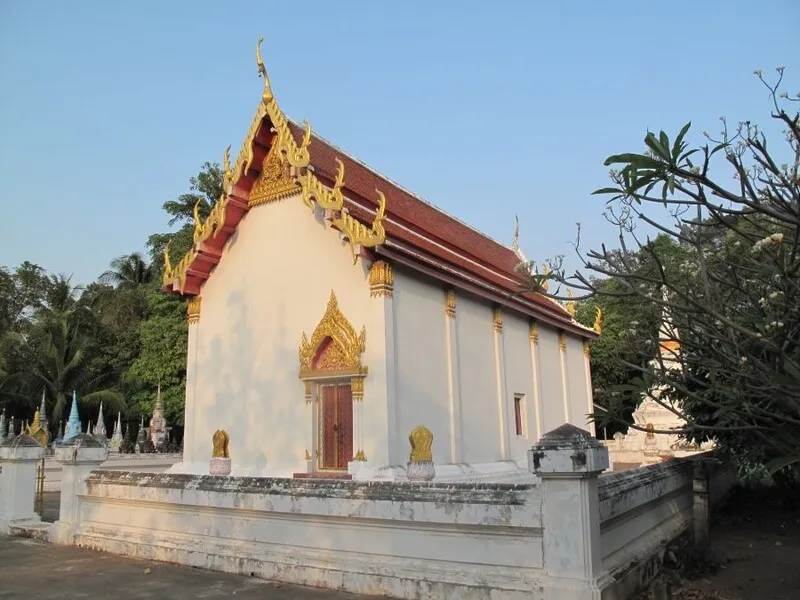
Wat Mathurotsatiyaram (Wat Kuti) is an old temple along the Asian Highway in Ang Thong Province. Many people drive past it, but few realize that this quiet compound preserves masterful late-Ayutthaya craftsmanship in a remarkably complete setting — with an overall temple layout, a crystal wall (kamphaeng kaeo), a viharn, a chedi, and a rare type of ubosot that stands out from the ordinary. The temple’s most distinctive highlight is its ubosot, designed as an “ubosot-chedi” with a curved silhouette reminiscent of a traditional sampan boat. Built of brick and mortar and roofed with fired clay tiles, it is further distinguished by exquisitely carved wooden gables on both the front and rear. These features have made Wat Mathurotsatiyaram an important destination for visitors interested in Thai temple architecture, especially those who want to see late-Ayutthaya beauty expressed through form and craftsmanship, even without extensive written historical records.
The temple’s charm begins with its former local name, “Wat Kuti,” which evokes the image of a traditional community temple in Thailand’s central plains — a place where people were deeply connected to faith, learning, and everyday merit-making. In the context of Thai temples, the word “kuti” also suggests the presence of monastic dwellings and an orderly sangha community. Over time, the temple came to be known as “Wat Mathurotsatiyaram,” a name that feels gentle and refined, carrying a sense of beautiful remembrance through Thai vocabulary influenced by Pali and Sanskrit. A changed name does not mean the original identity disappears. On the contrary, this temple continues to preserve its long-standing character through a well-composed group of historic structures within the same precinct, inviting visitors to read its story simply by walking through the grounds once.
When viewed as a cross-section of late-Ayutthaya history, it becomes clear why the statement “believed to date from the late Ayutthaya period” carries weight in terms of art and architecture, even without definitive written documentation. Late Ayutthaya temple craftsmanship in the central region often emphasized compact yet sturdy proportions, durable brick-and-mortar construction, and refined decorative elements — especially intricate wood carving. As you step into the temple, you will find key components such as the viharn, crystal wall, ubosot, and chedi arranged together like an intentional “architectural ensemble,” designed to relate to one another both for ritual use and for the overall harmony of the site plan.
The ubosot of Wat Mathurotsatiyaram is the heart of the visiting experience because its form is more unusual than what most temples present. You can quickly see that it is not a simple rectangular structure. Instead, its overall mass curves like a sampan, creating a sense of “movement” even though the building stands still. This aligns with Thai temple traditions that often use symbolic forms to communicate deeper meaning, especially the idea of crossing from the worldly realm toward the spiritual. The brick-and-mortar construction and fired clay roof tiles reinforce an authentic, traditional character — understated rather than overly embellished, yet filled with fine craftsmanship typical of the Ayutthaya era.
Based on the physical details commonly described, this ubosot-chedi is approximately 4 meters wide and 8 meters long, with a roof height of about 6 meters. These proportions create a compact elegance: not so large that it overwhelms the delicate ornamentation, yet not so small that it lacks the solemnity expected of a sacred ritual space. Standing a short distance away and looking back, you can feel how the curvature naturally guides the eye along the building’s length. For architecture-focused photography, this is a particularly rewarding angle, especially in the morning or late afternoon when sunlight casts gentle shadows that reveal the building’s volume and contours without requiring elaborate techniques.
Even so, what truly makes Wat Mathurotsatiyaram stand out among Ang Thong’s art-historic temples is not only the boat-shaped ubosot-chedi, but the wooden gables on both the front and rear of the ubosot, regarded as outstanding works of art. These gables are carved with extraordinary intricacy, and their composition creates visual rhythm characteristic of master craftsmen. The primary motifs include a lotus at the center, scrolling vines, and distinctive endings described as “hong tao” (tail-like openings). Seen up close, it becomes clear that the carving is not merely repetitive pattern work. Instead, it creates a distinct identity that belongs specifically to this temple.
The most striking feature — and the one that gives these gables their rare individuality — is the carved lotus motif that resembles a “thep phanom” (a praying celestial figure) placed upon the lotus crown. This is not commonly found in Thai decorative art. Symbolically, the lotus often represents purity and the arising of wisdom, while the thep phanom posture conveys devotion and reverence. When combined into a single visual language of carved wood, the motif gains layered meaning, both spiritual and aesthetic. It is a compelling example of how traditional artistry can merge with fresh imagination while remaining grounded in religious faith, reflecting a confident “craftsman’s taste” that dares to be different without departing from sacred sensibilities.
To appreciate the gables fully, it is worth spending time with both the front and rear sides. Even when they share the same visual vocabulary, the rhythm of lines and the way shadows fall under different angles of light create a different feeling on each side. The most rewarding approach is to begin at a distance to take in the overall composition, then move closer to study the scrolling lines, the small elements that act as a “visual beat,” and the signature hong tao endings. Observing this way can feel like reading craftsmanship line by line, and it helps explain how a single carved gable can elevate an entire temple into a destination for lovers of Thai art and architecture.
Beyond the ubosot and gables, the temple grounds include a viharn, a crystal wall, and a chedi that have been well preserved. Having these elements together in one precinct allows visitors to experience an overall temple plan that many older sites have gradually lost over time. The crystal wall serves both as a sacred boundary and as a spatial organizer, giving the walking route a clear sense of sequence without confusion. It also creates an atmosphere of calm that feels surprisingly separate from the noise of the Asian Highway, even though the temple is very close to the main road.
From the perspective of local history, Wat Mathurotsatiyaram represents Ang Thong as a central-region center of craftsmanship, with many significant temples across the province. Ang Thong lies not far from Ayutthaya, and it inherited influences in artisan networks, religious culture, and community connections through major travel routes and waterways. As a result, many temples in the province preserve refined craftsmanship, and Wat Mathurotsatiyaram is one of the clearest examples — combining historic brick-and-mortar construction with wooden carving that remains visually legible despite the long passage of time.
If you want to visit in a way that emphasizes understanding rather than a quick photo stop, start by looking at the overall temple layout first, then move in toward the ubosot-chedi to observe its sampan-like curve. Next, shift your attention to the front and rear gables to see how light and shadow create differences in perception. As you walk, notice the crystal wall and how the buildings are grouped, because the harmony of the layout is a “hidden value” that many visitors overlook. When you collect both the big picture and the fine details, the experience becomes clearly different from a rushed temple visit.
Getting There is very convenient because the temple is located on Highway 32 (the Asian Highway). After passing the Ang Thong entrance intersection toward Nakhon Sawan for about 500 meters, turn right into the PTT gas station, then drive straight for about 30 meters to reach the temple. This landmark-based route is easy to follow even on a first visit. From Bangkok, you can connect via Phahonyothin Road to the Asian Highway and continue on Highway 32 through Ayutthaya into Ang Thong. For public transport, it is practical to reach Ang Thong town first, then take a local taxi or hired vehicle to the temple, since Ban It area is not far from the town zone and the route follows major roads.
Once inside, the atmosphere often feels clearly different from the busy highway outside. The interior precinct is calm and open, with a walking rhythm that does not feel pressured — suitable both for visitors who wish to study architectural details and for those seeking a short, peaceful pause. When visiting a Thai temple that preserves historic structures, it is best to act with respect: dress modestly, keep voices low, and take photos without disturbing worshippers. If you want to observe the gables closely, keep a comfortable distance, avoid touching any surfaces, and refrain from using flash at close range to help preserve the woodwork.
For architecture-focused travelers, Wat Mathurotsatiyaram feels like an open-air museum that demonstrates how Thai temple beauty is not only about grand scale, but also about structural balance, thoughtful planning, and the details artisans intentionally embedded in small elements like carved gables. Lotus motifs, scrolling vines, and hong tao endings may appear to be decoration at first glance, yet they function as a visual language expressing devotion, beauty, and local identity. If you have time, stand in front of the gable for a while without rushing, and you may begin to sense the “living” quality of its lines — a gentle pathway into the imagination of craftsmen from long ago.
Another strength of this temple is that it works as an easy stop for a day trip to Ang Thong or a multi-temple route, because it sits on the Asian Highway corridor that connects smoothly to other important sites in the province. You can plan a sequence that begins at Wat Mathurotsatiyaram to appreciate late-Ayutthaya craftsmanship, then continue to Ang Thong’s larger temples or community attractions with minimal travel time. This kind of itinerary gives you both an old-world atmosphere and a broader picture of Ang Thong within a single day, efficiently and enjoyably.
In religious life, Wat Mathurotsatiyaram continues to function as an active community temple today, with resident monks and an abbot overseeing temple affairs. When an ancient temple remains alive within contemporary community practice, its value becomes even stronger: the historic structures are not frozen as mere display objects, but remain part of a living space where people come to pay respect, make merit, and stay connected to collective memory. This is what makes a visit here different from many purely archaeological sites — you can feel both the “past” and the “present” within the same place.
If you want the visit to feel complete, plan at least 30–60 minutes at Wat Mathurotsatiyaram so you can walk through the ensemble, study the ubosot-chedi form, and see both gables in full. Afterward, it is easy to continue to other major Ang Thong temples or stop for food around Ban It and the town area, because this zone is highly accessible. The temple’s advantage is therefore not only its beauty, but also the fact that it is genuinely easy to reach — ideal for travelers who want to see something exceptional without complicated planning.
| Name | Wat Mathurotsatiyaram (Wat Kuti) |
| Address | Moo 5, Ban It Subdistrict, Mueang Ang Thong District, Ang Thong 14000, Thailand |
| Location (Overview) | Along the Asian Highway (Highway 32), near the Ang Thong entrance intersection; access via the PTT gas station |
| Place Summary | A historic temple believed to date to the late Ayutthaya period, notable for its boat-shaped ubosot-chedi and rare carved wooden gables |
| Key Highlights | Boat-shaped ubosot-chedi; carved wooden gables featuring lotus, scrolling vines, hong tao endings, and a rare lotus motif resembling a thep phanom figure |
| Period / History | Believed to have been established in the late Ayutthaya period; formerly known as “Wat Kuti” |
| Key Evidence | Crystal wall, viharn, ubosot, chedi, and carved wooden gables |
| Name Origin | Previously called “Wat Kuti” (local community name); later known as “Wat Mathurotsatiyaram” |
| Travel | On Highway 32: about 500 m past the Ang Thong entrance intersection toward Nakhon Sawan; turn into the PTT gas station and drive straight about 30 m to the temple |
| Facilities | On-site parking; walkable historic structures (other facilities depend on day-to-day management) |
| Fees | No admission fee stated (temple visits are typically free) |
| Current Status | Active community temple; maintained and inhabited by monks |
| Abbot / Current Caretaker | Phra Khru Phisan Khunaphinan Abhinanto |
| Nearby Tourist Attractions (Approx. Distance) | 1) Wat Ang Thong Worawihan – approx. 8 km 2) Wat Chaiyo Worawihan – approx. 20 km 3) Wat Pamok Worawihan – approx. 25 km 4) Wat Muang (Luang Pho Yai) – approx. 18 km 5) Talat San Chao Rong Thong (Wisetchai Chan area) – approx. 30 km |
| Popular Restaurants Nearby (Approx. Distance + Phone) | 1) This Zaeb Ver (Made-to-Order Thai Dishes) – approx. 2 km – tel. 098-578-9771 2) Ploen Aroi (Ban It) – approx. 3 km – tel. 095-213-0984 3) Ruammit Japanese Curry (Ban It) – approx. 2 km – tel. 094-479-1397 4) Samrap Kub Khao Ang Thong (Wat Chan Rangsi area) – approx. 4 km – tel. 094-326-5965 5) Wife’s House Cafe & Bar – approx. 10 km – tel. 064-963-5650 |
| Popular Accommodations Nearby (Approx. Distance + Phone) | 1) Suphorn Grand Hotel (Ang Thong) – approx. 3 km – tel. 081-551-2828 2) Bualuang Hotel Ang Thong – approx. 12 km – tel. 035-611-116 / 080-922-4040 3) Bualuang Boutique Resort Ang Thong – approx. 12 km – tel. 081-495-8884 4) IKKYU2 Angthong – approx. 12 km – tel. 086-559-6642 / 086-506-9503 5) Jumbo Villa Resort (Wisetchai Chan) – approx. 28 km – tel. 085-944-1244 |
Frequently Asked Questions (FAQ)
Q: Where is Wat Mathurotsatiyaram, and what is the easiest way to get there?
A: The temple is along the Asian Highway (Highway 32). Drive about 500 meters past the Ang Thong entrance intersection toward Nakhon Sawan, turn right into the PTT gas station, then continue straight about 30 meters to reach the temple.
Q: What should I not miss when visiting Wat Mathurotsatiyaram?
A: Don’t miss the boat-shaped ubosot-chedi and the carved wooden gables on both the front and rear, featuring lotus and scrolling motifs with hong tao endings — especially the rare lotus carving that resembles a thep phanom figure.
Q: How much time should I plan for the visit?
A: If you want to see the overall layout, the ubosot-chedi, and both gables carefully, plan about 30–60 minutes.
Q: When is the best time to photograph the gables and architecture?
A: Morning or late afternoon is ideal, because angled sunlight creates shadows that reveal the depth and details of the carvings and building form.
Q: What should I wear and how should I behave when viewing the historic structures?
A: Dress modestly, keep noise low, avoid touching historic surfaces or the wooden gables, and take photos respectfully without disturbing worshippers.
 Wat Mathurotsatiyaram (Wat Kuti) Map
 Category:
  Group:
  Last Update: 23 HourAgo
Comment
 Nearby Attractions
| Keyword (Advance) |
 Facebook Fanpage
 Region
 Art, Culture and Heritage
 Landmarks and Memorials(
 Royal Palace(
 Art, Craft Centres, Tradition(
 Museums(
 Historical Houses and The Ancient City(
 Educational Places
 Educational Gardens, Farm(
 Other religious and spiritural sites(
 Research and Development
 Royal Project(
 Suburban Living
 Village, Community(
 Local Market(
 Floating Market(
 Nature and Wildlife
 River, Canal(
 Other natural attractions(
 Entertainment and Agricultural
 Farm, Parks, Gardens and Ecotourism(
 Outdoor and Adventure Activities(
 Shopping
 Shopping and Night Market(
 Travel Articles, Recipes
 Travel Review, Food Review(
 Central Thai Cuisine, Central Thai food recipes(