

 Home
Home Chiang Mai(




Rating: 3.5/5 (4 votes)
 |
|  Map
Map 
 Have Map
  No Map
Ang Thong attractions
Attractions in Thailand
Open Days: Daily
Opening Hours: 08:00 – 20:00
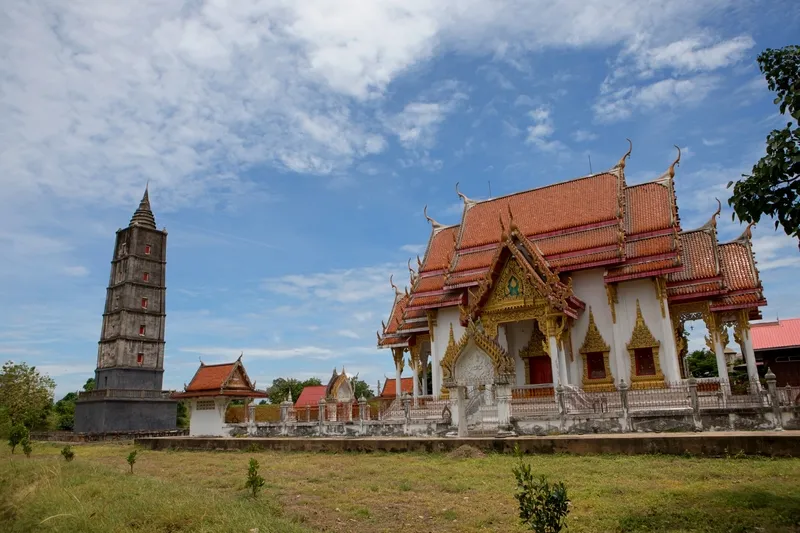
Wat Plotsat If you are looking for a cultural stop in Ang Thong that feels “just a short drive from town, yet like stepping into a world of faith and sacred architecture,” Wat Plot Sat, Ang Thong deserves real time and attention. The temple is located in Village No. 4, Ban Hae Subdistrict, Mueang Ang Thong District, and many visitors remember it instantly for its striking “tall pagoda-like stupa” that rises as the temple’s landmark, visible from afar like a quiet signal that serenity is waiting ahead. Wat Plot Sat is therefore not only a place to pay respect, but also a place that can tell stories—of an old riverside community, of a meaningful local renaming, and of architecture designed to communicate devotion through form.
The charm of Wat Plot Sat begins with its very name. It was not chosen simply because it sounds auspicious; it is tied directly to local life in Ban Hae in a way you can picture. A “hae” is a traditional fishing net used by riverside communities, and it represents a livelihood closely connected to the river. When the village itself is called Ban Hae, the phrase “releasing animals from the net” is not merely a metaphor—it is a lived image the community shares. Historically, this temple was originally known as “Wat Sakae,” and at one point it was left abandoned for a long time. It later revived during the reign of King Mongkut (Rama IV), when Khun Thammakan (Thongkham) carried out restoration work around 1857 (B.E. 2400) and renamed it “Wat Damrong Tham” to bring the monastery back into full religious use for that era.
Later, a key moment cemented the name “Wat Plot Sat” as the official name used to this day. Somdet Phra Maha Samana Chao Krom Phraya Vajirananavarorasa—who later became the 10th Supreme Patriarch of the Rattanakosin era—visited to inspect the monastic administration and local residences. He remarked that “Wat Damrong Tham” did not fit the context of its location in Ban Hae, and therefore proposed the name “Wat Plot Sat,” meaning the act of releasing animals from a fishing net. The new name simultaneously anchors the temple to the community’s identity and carries a compassionate symbolic meaning. From that point onward, Wat Plot Sat was not merely a temple “in Ban Hae,” but a temple that clearly “speaks the language of Ban Hae” through its name.
In terms of ecclesiastical status, Wat Plot Sat is regarded as an important Dhammayut Nikaya temple in Ang Thong Province. Records note that it received Wisungkham Sima on 20 February 1884 (B.E. 2427), formally establishing its consecrated boundary for ordination rites. This detail matters for anyone interested in Thai monastic history because it indicates that Wat Plot Sat is more than an ordinary community temple—it has an official role within the monastic structure and reflects continuity of institutional stewardship from the past to the present.
With that historical framework in mind, what most clearly sets Wat Plot Sat apart from other temples within a short drive of town is its tall, iconic stupa structure. It is often described as resembling a “Bodh Gaya style” stupa, which makes many visitors feel as though they are seeing an architectural form intentionally inspired by one of Buddhism’s most significant places. That association carries power: Bodh Gaya is widely recognized as the site of Enlightenment, so when the temple’s silhouette evokes that memory, the idea of spiritual searching and calm begins to arise even before you step close.
The beauty of this stupa is not only that it is “tall and visible from afar,” but also that its form becomes a language of meaning. Local telling sometimes explains its tiers in symbolic terms associated with religious cosmology—such as relating levels to heavens and invoking the imagery of Chulamani Chedi (Ket Kaew Chulamani) in interpretive thought. Part of the stupa’s appeal is that it invites visitors to “read meaning” for themselves. Even without being an art historian, you can sense that the form is trying to communicate something beyond aesthetics. By placing the stupa as the dominant visual anchor of the temple, the site effectively declares that “mindfulness of the Dhamma is the center here,” and that this remembrance does not need words—it can be expressed through proportion, height, and silhouette.
Another layer of the experience is seeing the stupa as a “landscape” of the temple. In the morning, light often clarifies edges and corners, making the structure look quietly dignified. In late afternoon, warmer light softens the tones and adds depth. This is ideal for those who enjoy architectural photography, because capturing a convincing sense of height without distortion depends on choosing a viewpoint that works with leading lines and perspective. From the right distance and angle, your photo can make viewers truly “feel the height,” not merely register that there is a stupa in the frame.
Wat Plot Sat is also visited by many for a specific thread of belief, especially those born in the Year of the Dog or the Year of the Snake. Local tradition often says that paying respect at the temple’s stupa brings auspicious blessings to life. Beliefs of this kind appear in many Thai cultural settings and often function as a meaningful “reason to return to the temple”—to make merit, reset one’s mind, and clarify one’s hopes within a sacred space. In that sense, visiting to pray is not only about asking for blessings; it can also be a pause to reflect on where you want to go and what “a better life” truly means for you. Seen through this lens, the Year of the Dog/Year of the Snake belief becomes part of a living faith culture that supports both community cohesion and personal meaning.
If you want your visit to Wat Plot Sat to feel “complete,” give the place time and do not rush. Start by walking through the site to catch the overall rhythm first. A temple with such a strong landmark can make people hurry straight to the stupa and miss the surrounding details. Try walking slowly around the grounds to notice why the stupa is positioned as the primary focal point, how the approach lines naturally guide your gaze from far away, and what kind of atmosphere the whole space creates. Once you begin to “read” the place, your act of paying respect becomes more meaningful—because you are not only arriving, you are arriving to understand.
As for its relationship with the community, Wat Plot Sat is intertwined with Ban Hae in the way many Central Thai community temples are: it serves as a spiritual anchor, a ceremonial space, a gathering place on important days, and a site that sustains cultural continuity at the local level. Even as the outside world changes quickly, a temple like this helps prevent “community identity” from fragmenting, because it preserves a shared place of meaning. Wat Plot Sat therefore does not stand alone; it stands within Ban Hae’s network of memory, made visible most clearly through a name that reflects real geography and real lives.
When visiting as a cultural traveler, etiquette is essential. Wat Plot Sat remains an active religious site, so dressing modestly, speaking softly, and respecting worship areas helps preserve calm for everyone. Photography is fine as long as you do not disturb others or block pathways for people who are praying. Above all, respect monks’ areas and any spaces used for ceremonies. The beauty of Thai temples is not only in form, but also in the atmosphere of quiet reverence created by mutual consideration.
Getting There is straightforward for a half-day or one-day outing because the temple is about 7 kilometers from Ang Thong town. The common route is via Highway 3501, then continue into Ban Hae Subdistrict. As you approach, the tall stupa serves as a clear visual guide. Driving is the most convenient option because it makes it easy to combine your visit with other temples or restaurants in town. If you are using public transport, travel into Ang Thong town first, then take a local taxi or in-town transport onward to Ban Hae; it usually takes little time compared with traveling to farther districts.
Once you truly spend time at Wat Plot Sat, you will realize it carries more “story” than you might expect—from late Ayutthaya roots, to a major revival during Rama IV, to a renaming that precisely reflects Ban Hae’s identity, to Wisungkham Sima status that anchors the temple within formal monastic structure. And above all, the tall Bodh Gaya–inspired stupa makes the temple instantly recognizable. If you like temples with distinctive architecture, enjoy reading meaning through form, and want a near-town trip that offers both calm and context, Wat Plot Sat is one of Ang Thong’s cultural stops you should not overlook.
| Name | Wat Plot Sat (Wat Plot Sat) |
| Address | Village No. 4, Ban Hae Subdistrict, Mueang Ang Thong District, Ang Thong 14000, Thailand |
| Place Summary | A key community temple in Ban Hae (about 7 km from Ang Thong town), best known for its tall Bodh Gaya–inspired stupa. The temple traces back to late Ayutthaya, was revived during Rama IV, and is a Dhammayut Nikaya temple in Ang Thong. |
| Highlights | 1) A tall, landmark stupa visible from afar 2) A name story tied directly to Ban Hae’s fishing-net culture 3) Dhammayut Nikaya temple with recorded Wisungkham Sima |
| Period / History | Late Ayutthaya roots (original name: Wat Sakae). Revived around 1857 (B.E. 2400) during Rama IV (once called “Wat Damrong Tham”), and later renamed “Wat Plot Sat.” |
| Key Evidence | A tall Bodh Gaya–style stupa, Dhammayut status, and Wisungkham Sima record (20 Feb 1884 / B.E. 2427). |
| Name Origin | Renamed to match the local context of “Ban Hae”; “Plot Sat” refers to releasing animals from a fishing net (hae). |
| Sect | Dhammayut Nikaya |
| Wisungkham Sima | Granted on 20 February 1884 (B.E. 2427) |
| Abbot (Latest) | Phra Khru Thawon Winaiwong (Thawaro) |
| Travel | By car: From Ang Thong town to Ban Hae (about 7 km), commonly via Highway 3501, then enter the temple area Public transport: Reach Ang Thong town first, then take a local taxi or in-town transport to Ban Hae |
| Current Status | Open for worship and visits |
| Contact Number | 035-625-076, 086-511-7234 |
| Nearby Attractions (Approx. Distance) | 1) Wat Ton Son – 3.8 km 2) Ang Thong City Pillar Shrine – 4 km 3) Wat Sangkratai – 4 km 4) Ban Hun Lek – 8.7 km 5) Wat Muang (Wiset Chai Chan) – 16 km |
| Nearby Restaurants (Approx. Distance + Phone) | 1) Phad Thai Wat Thong Khung – 1.2 km – 082-233-3887 2) Lek Ban Ro – 3.8 km – 035-612-070 3) Niramit – 7 km – 035-631-052 4) Ruean Rap Khwan – 6 km – 061-997-8987 5) Bohk Toh Restaurant – 4 km – 065-275-1898 |
| Nearby Accommodations (Approx. Distance + Phone) | 1) Bualuang Hotel (Ang Thong) – 9 km – 035-611-116 2) Suphorn Grand Hotel – 9 km – 081-551-2828 3) MOR MOR Resort (Ang Thong) – 12 km – 085-698-3681 4) Rimchon Resort (Ang Thong) – 12 km – 035-611-527 5) Bualuang Boutique Resort – 13 km – 035-949-850 |
Frequently Asked Questions (FAQ)
Q: What is Wat Plot Sat in Ang Thong best known for?
A: It is best known for its tall landmark stupa that can be seen from far away and serves as the temple’s signature worship point.
Q: Why is it called “Wat Plot Sat”?
A: The name relates to “Ban Hae” (a fishing-net community). “Plot Sat” means releasing animals from a fishing net, and the name was proposed to better match the temple’s location and local identity.
Q: How far back does Wat Plot Sat’s history go?
A: It is described as having late Ayutthaya roots (originally called Wat Sakae) and was significantly revived around 1857 (B.E. 2400) during the reign of Rama IV.
Q: Is Wat Plot Sat far from Ang Thong town?
A: No. It is about 7 kilometers from Ang Thong town, convenient for driving and easy to include in a one-day itinerary.
Q: Why do people born in the Year of the Dog or Year of the Snake visit?
A: Local belief says that paying respect at the temple’s stupa can enhance auspicious fortune, which is why many people in those zodiac years visit specifically for worship.
Q: How much time should I plan for a visit?
A: Planning about 1–2 hours is usually ideal for worship, walking around the architecture, taking photos, and enjoying the atmosphere without rushing.
 Wat Plotsat Map
 Category:
  Group:
  Last Update: 1 DayAgo
Comment
 Nearby Attractions
| Keyword (Advance) |
 Facebook Fanpage
 Region
 Art, Culture and Heritage
 Landmarks and Memorials(
 Royal Palace(
 Art, Craft Centres, Tradition(
 Museums(
 Historical Houses and The Ancient City(
 Educational Places
 Educational Gardens, Farm(
 Other religious and spiritural sites(
 Research and Development
 Royal Project(
 Suburban Living
 Village, Community(
 Local Market(
 Floating Market(
 Nature and Wildlife
 River, Canal(
 Other natural attractions(
 Entertainment and Agricultural
 Farm, Parks, Gardens and Ecotourism(
 Outdoor and Adventure Activities(
 Shopping
 Shopping and Night Market(
 Travel Articles, Recipes
 Travel Review, Food Review(
 Central Thai Cuisine, Central Thai food recipes(