

 Home
Home Chiang Mai(




Rating: 4.5/5 (4 votes)
 |
|  Map
Map 
 Have Map
  No Map
Ang Thong attractions
Attractions in Thailand
Open Days: daily
Opening Hours: 06:00 – 17:00
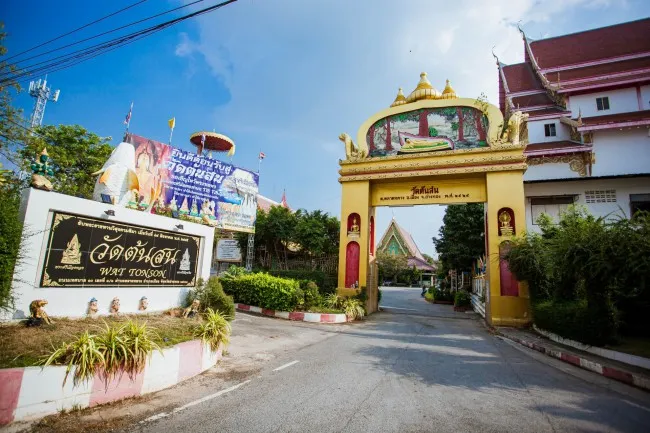
Wat Ton Son is one of the most rewarding temples to visit in Ang Thong town if you want a place that gives you “everything in one trip”: faith, history, art, and a riverside atmosphere. This temple is not only valued for its long-standing roots that are often linked to the late Ayutthaya period, but it is also renowned as the home of a monumental Buddha image in the subduing Mara posture—a defining symbol of Ang Thong in the modern era and a major reason why so many devotees travel here with clear intention and deep respect.
For many visitors, the strongest first impression begins with the “giant Buddha” that stands out even before you reach the inner grounds. The Buddha image bears the full name “Somdet Phra Phuttha Nawalo Kuttara Thammadibodi Sri Mueang Thong” and is widely known in everyday speech as “Somdet Phra Sri Mueang Thong.” Its grand scale, dignified presence, and confident craftsmanship convey a sense of solidity and calm, making arrival feel like encountering a true “spiritual anchor” of Ang Thong. At the same time, the temple offers far more than a photo moment with a landmark statue. It invites you to walk through the living story of a town temple that has grown, adapted, and remained closely connected to the Chao Phraya riverside community over time.
Wat Ton Son is located in Mueang Ang Thong District, Ang Thong Province, in an area that is easy to access and practical for a one-day itinerary. Town temples often carry a special character: they serve as religious centers, public spaces, and cultural venues that welcome visitors across generations. Wat Ton Son fits that role clearly. Beyond merit-making, worship, and practice, it remains a gathering point for local people on important days, with an environment that is maintained to be visitor-friendly. The nearby riverside setting also creates moments of genuine quiet, proving that a temple visit in town can feel “truly peaceful”—not only in rural destinations.
In historical terms, Wat Ton Son is often described as having origins that may trace back to the late Ayutthaya period, around 1767 (B.E. 2310). This assumption is commonly linked to architectural features of the older ordination hall, which reflect stylistic elements associated with that era. However, early details of the temple’s beginnings are not supported by an official archival chronicle that can be cited with certainty. Much of what is known has been passed down through local elders and community memory rather than formal documentation. Understanding the temple’s history therefore involves reading both what is visible in the built environment and what is remembered through the long emotional ties between the temple and its people.
Over time, Wat Ton Son also experienced a period of decline and disrepair, to the point where it was said to have nearly become abandoned—a story that echoes many older temples in Thailand’s central region, especially where community structures and economic routes shifted across generations. A major turning point came in 1945 (B.E. 2488), when “Phra Ratcha Suwan Moli,” a former ecclesiastical leader of Ang Thong, began significant restoration and construction of permanent buildings within the temple. These works supported religious activities, strengthened community use, and returned the temple to a lively and meaningful role. The revival of Wat Ton Son was therefore more than structural repair; it was the rebuilding of a temple’s place as a true “center of faith” for Ang Thong town.
With stronger foundations in place, the most defining development that elevated Wat Ton Son to a province-level landmark was the creation of “Somdet Phra Sri Mueang Thong”—a monumental Buddha image in the subduing Mara posture, cast entirely in metal and finished with lacquer and gold leaf. Construction is described as having begun in 1973 (B.E. 2516), a period when Thailand was expanding urban infrastructure and public spaces. Building a giant Buddha image in a town temple thus functioned both as a powerful expression of collective devotion and as the creation of a cultural symbol—a shared destination that people across Ang Thong could point to with pride.
The full name “Somdet Phra Phuttha Nawalo Kuttara Thammadibodi Sri Mueang Thong” carries weighty auspicious meaning connected to Dhamma and the prosperity of the city. The shorter name “Somdet Phra Sri Mueang Thong” is easy to remember and has become embedded in local conversation whenever Ang Thong is mentioned. Another unforgettable milestone is the ceremony on 7 March 1985 (B.E. 2528), when Her Royal Highness Princess Maha Chakri Sirindhorn presided over the rite of placing the finial (ket) for the image. This moment further confirmed the statue’s status as a principal sacred object of the temple and the province, and it remains a key reason why pilgrims from across Thailand come here to pay homage with the highest respect.
Standing before the giant Buddha is an experience where “size” immediately transforms into “inner strength.” The monumental scale is not meant for spectacle alone; it helps worshippers feel that they can place their hearts upon something steadier than the urgency of everyday life. The subduing Mara posture symbolizes overcoming obstacles through mindfulness and perseverance. Many visitors therefore interpret worship at Somdet Phra Sri Mueang Thong as a moment to recommit to a new beginning, to seek success in their work, or to ask for clarity and resilience through difficult times. Merit-making here is not only ritual; it becomes a way to bring one’s hopes into focus through a sacred setting.
Beyond the giant Buddha, Wat Ton Son offers several areas that deserve time and attention. The temple houses relics of the Buddha and arahants, enshrined in an elegant busabok (a sacred throne-like reliquary structure). This adds a deeper layer to the visit by reconnecting the experience to the roots of Buddhism itself. Paying respect to relics extends the journey beyond devotion to a single landmark statue and invites reflection on the Buddha and the arahants as models of discipline, mindfulness, and the path of practice. Walking to this spot can feel like returning to the heart of the tradition.
Another revered image is “Luang Pho Dam,” an important Buddha image whose features are described as resembling Somdet Phra Sri Mueang Thong. It is enshrined upon a raised base with the chief disciples on the left and right, accompanied by golden ceremonial umbrellas that heighten the dignified atmosphere. This setting carries the calm solemnity typical of well-kept town temples that still prioritize ritual order and respectful space. For many visitors, Luang Pho Dam is a fitting place to pause, make a quiet wish, and spend a few unhurried minutes with their own thoughts.
Inside the ordination hall, visitors can also find beautiful mural paintings—an element that many overlook because attention is naturally drawn to the giant Buddha. Yet if you want a visit that is truly “rich in knowledge,” the murals offer a valuable cultural layer. In Thai temples, mural painting is not created for decoration alone; it is a visual medium for teaching, allowing people of all ages to access Buddhist stories and moral lessons without needing texts. If you stand and observe carefully—watching the colors, lines, and storytelling rhythm—the ordination hall becomes like a picture book that reveals the care of the artists and the commitment of the temple’s caretakers to preserving cultural heritage in a sacred space.
Wat Ton Son also includes various shrines and revered figures that reflect the diversity of belief within contemporary Thai society. Visitors may find places of respect associated with Phra Phuttha Chinnarat, Guan Yin, Phra Phuttha Sothon, as well as a shrine of the golden takhian spirit known locally as Chao Mae Takhian Thong Sroi Suwan, which is said in local telling to have great age. There are also shrines linked to Luang Pu Thuat and references connected with Indra and the Chulamani Chedi. These features show how a modern Thai temple can serve many emotional needs: some people come to make merit, some come to ask for blessings, some seek quiet and grounding, and others arrive with cultural curiosity. The coexistence of these layers is part of what makes Wat Ton Son a true living community temple.
Another dimension that makes Wat Ton Son feel different from a typical town-temple visit is the nearby riverside embankment along the Chao Phraya, where many visitors enjoy walking to the “Wang Matcha” area to feed fish. The movement of water and the synchronized flow of fish can calm the mind naturally, providing a gentle pause before returning to everyday routines. It also helps reconnect urban visitors with nature without requiring long-distance travel. To preserve this peaceful environment, visitors should keep the area clean, avoid littering, and choose appropriate fish food rather than throwing unsuitable items into the water. Such places remain beautiful through shared responsibility.
If you want to experience Wat Ton Son “in every dimension,” it helps to follow an unhurried walking rhythm. Begin by paying respect to Somdet Phra Sri Mueang Thong in silence, then move toward key areas within the temple such as the ordination hall and its murals. After that, visit the reliquary busabok and Luang Pho Dam, and finish with a gentle walk along the embankment and the Wang Matcha area by the river. This route allows you to absorb devotion, history, and nature in one visit without the pressure to rush through “everything” quickly. A good temple visit is often defined less by how many points you collect and more by how well you can remain present.
Temple etiquette matters, especially in a town temple where people come to make merit throughout the day. Dressing modestly, speaking softly, and respecting worship spaces help preserve the calm atmosphere for everyone. Photography is usually fine when it does not disturb others. Avoid flash inside the ordination hall or near people who are praying, and be mindful of where you stand and walk—do not block those who are worshipping, do not climb onto bases or restricted areas, and do not touch sacred objects without necessity. Respect for sacred space is an essential part of meaningful cultural travel.
Getting There is easy because Wat Ton Son is located in Mueang Ang Thong (the town district). If you drive from Bangkok, a common route passes through Ayutthaya and continues into Ang Thong. Once you enter town, head toward the Talat Luang area and the Thesaban roads near the temple. Traveling by private car also makes it convenient to extend the day to other well-known temples in Ang Thong or to local restaurants in town. If you travel by public transport, reach Ang Thong town first and then take a local taxi or town transport to the temple, as it is located in the urban zone and is straightforward to access.
Wat Ton Son suits both visitors who want a serious merit-making trip and those who want cultural travel. The temple’s elements support multiple purposes in one place: you can come to calm your mind, come to make merit, come to appreciate art inside the ordination hall, or come to enjoy the Chao Phraya riverside atmosphere of Ang Thong. The temple’s continued care and development make it a strong example of a town temple that preserves “sacredness” while also welcoming visitors appropriately—and that is precisely why Wat Ton Son remains one of the places in Ang Thong that deserves real time and attention.
| Place Name | Wat Ton Son |
| Address | Thesaban 10 Road, Talat Luang Subdistrict, Mueang Ang Thong District, Ang Thong 14000, Thailand |
| Place Summary | A historic town temple in Ang Thong with roots commonly linked to the late Ayutthaya period. Best known for “Somdet Phra Sri Mueang Thong,” a monumental metal Buddha in the subduing Mara posture, along with an ordination hall with murals, multiple revered shrines, and a Chao Phraya riverside atmosphere near a fish-feeding area (Wang Matcha). |
| Key Highlights | 1) Somdet Phra Sri Mueang Thong, a monumental metal Buddha image in the subduing Mara posture 2) A long town-temple history with major restoration from 1945 (B.E. 2488) onward 3) Ordination hall murals and multiple important worship points within the temple 4) Near the Chao Phraya embankment with a fish-feeding area for a calm riverside moment |
| Period / History | Commonly believed to date to the late Ayutthaya period (around 1767 / B.E. 2310), with major restoration and development from 1945 (B.E. 2488). |
| Key Evidence / Notable Features | Somdet Phra Phuttha Nawalo Kuttara Thammadibodi Sri Mueang Thong (Somdet Phra Sri Mueang Thong), a monumental metal Buddha image; Buddha and arahant relics enshrined in a decorative busabok; Luang Pho Dam; ordination hall murals; and the riverside Wang Matcha area. |
| Abbot / Current Caretaker | Phra Thep Suwan Muni (Phra Khru Anusas Sophon) |
| Travel | By car: from Bangkok via Ayutthaya into Ang Thong town, heading toward Talat Luang and Thesaban 10 Road. By public transport: travel to Ang Thong town first, then take a local taxi or town transport to the temple. |
| Current Status | Open for worship and visits during opening hours. |
| Contact Numbers | 035-611-198, 086-122-5888 |
| Nearby Attractions (Approx. Distance) | 1) Ang Thong City Pillar Shrine – 2 km 2) Ang Thong City Legend Museum – 2 km 3) Baan Hoon Lek (Ang Thong) – 3 km 4) Wat Sang Kratai – 6 km 5) Wat Muang – 15 km |
| Popular Restaurants Nearby (Approx. Distance + Phone) | 1) Tiao Nuea Bang Yup – 2 km – 065-694-6616 2) Sri Uma Pochana – 3 km – 086-010-6659 3) Bok Tor (Bohk Toh Restaurant) – 4 km – 065-275-1898 4) Lek Ban Ro – 12 km – 035-612-070 5) Niramit – 22 km – 035-631-052, 081-852-4777 |
| Popular Accommodations Nearby (Approx. Distance + Phone) | 1) Bualuang Hotel (Ang Thong) – 2 km – 035-611-116, 080-922-4040 2) Suphorn Grand Hotel – 2 km – 081-551-2828 3) MOR MOR Resort (Ang Thong) – 5 km – 085-698-3681 4) Rimchon Resort (Ang Thong) – 6 km – 035-611-527 5) Bualuang Boutique Resort – 4 km – 081-495-8884 |
Frequently Asked Questions (FAQ)
Q: What is Wat Ton Son in Ang Thong best known for?
A: It is best known for “Somdet Phra Sri Mueang Thong,” a monumental metal Buddha image in the subduing Mara posture that serves as a major spiritual landmark of Ang Thong town.
Q: What is the full name of Somdet Phra Sri Mueang Thong?
A: The full name is “Somdet Phra Phuttha Nawalo Kuttara Thammadibodi Sri Mueang Thong,” commonly shortened in local use to “Somdet Phra Sri Mueang Thong.”
Q: How far back does the history of Wat Ton Son go?
A: It is commonly described as having origins linked to the late Ayutthaya period, with major restoration and development from 1945 (B.E. 2488) onward that revived the temple as a key religious center in Ang Thong town.
Q: What can I see at Wat Ton Son besides the giant Buddha image?
A: You can visit the ordination hall with murals, the reliquary busabok enshrining Buddha and arahant relics, Luang Pho Dam, other important worship points, and the Chao Phraya riverside atmosphere near the Wang Matcha fish-feeding area.
Q: Where is the Wang Matcha area at Wat Ton Son, and what can visitors do there?
A: It is near the Chao Phraya embankment close to the temple. Visitors can walk there to feed fish and enjoy the riverside scenery. Please keep the area clean and avoid throwing unsuitable items into the water.
Q: How can I get to Wat Ton Son without a private car?
A: Travel to Ang Thong town first, then take a local taxi or town transport to the temple. Because the temple is in the urban zone, access is straightforward.
Q: What time of day is best for visiting and taking photos?
A: Morning or late afternoon is usually best, as the weather is less intense and the light is softer, creating a calm atmosphere and pleasing photo tones.
 Wat Tonson Map
 Category:
  Group:
  Last Update: 1 DayAgo
Comment
 Nearby Attractions
| Keyword (Advance) |
 Region
|
 Muang Ang Thong(