

 Home
Home Chiang Mai(










Rating: 3.1/5 (11 votes)
 |
|  Map
Map 
 Have Map
  No Map
Chiang Mai attractions
Attractions in Thailand
Open Days: Daily (recommended to contact and make an appointment in advance if you want a live demonstration or to speak with local weavers)
Opening Hours: Recommended 09.00–16.30 (late morning to afternoon is best for seeing weaving in action and choosing products)
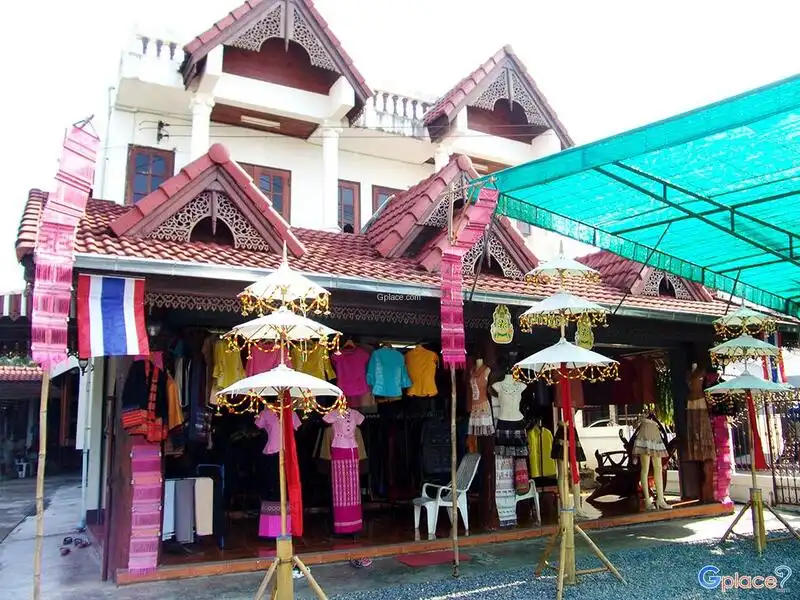
Teen Jok Sinh Weaving Village (Tha Pha Subdistrict, Mae Chaem District) is a cultural stop in Chiang Mai that makes the phrase “local textiles” feel heavier than a typical souvenir. This isn’t just a storefront area—it’s a living community where people are still “making cloth for real” as part of everyday life. In Tha Pha, weaving teen jok sinh is especially widespread, with around 150 families involved, and many homes still keep their looms under the raised house, a familiar image of handcraft work deeply tied to the household and family structure.
Today, this local textile is highly popular because it is beautiful, distinctive, and recognizably unique in its patterns. Prices are generally approachable, making it suitable as a keepsake or a meaningful gift with a story and lasting emotional value beyond seasonal fashion. If you would like a guided visit with a local speaker, it is recommended to contact the Mae Chaem District Office in advance at 0 5348 5111 (ask for the District Administration section).
A truly rewarding visit often begins with “seeing the real thing” first, then circling back to the meanings. The teen jok is not simply a pretty band at the hem of a sinh; it is the space where the weaver declares skill, patience, and the community’s aesthetic through highly detailed pattern structures. In technical terms, jok is formed by using fingers or small tools to insert, lift, and hook supplementary weft threads point by point to create motifs on the cloth. This differs from patterns formed by ordinary weaving, because teen jok “takes time” and demands sharp visual accuracy—to the point that many say the work naturally guides the mind into calm concentration.
The heart of its beauty lies in the way patterns are organized into “layers.” Many pieces are built in bands, moving from a base motif that acts like a frame, to a main motif that takes the lead, and finally to secondary motifs that soften the overall look. If you look closely, many teen jok hems are not flashy, but disciplined—balanced spacing, harmonious color weight, and repeated rhythm that makes the pattern feel poised and dignified. This aligns with a Lanna South taste that values neatness and appropriateness to time and occasion.
When people talk about “pattern types,” it doesn’t mean a single set of names used across all of Northern Thailand. Names can vary by village and weaving lineage. Broadly, however, you will often find geometric groups emphasizing order (such as diamonds, fishbone/chevrons, or zigzags), botanical groups suggesting growth and abundance (flowers, clusters, vines, pikul), and animal/sacred-symbol groups reflecting Buddhist beliefs blended with local traditions (such as naga, hongsa/hadsadilink, elephants). When combined within the same teen jok hem, these motifs function like a “long sentence” that can tell both beauty and meaning at once.
If you want to read teen jok more deeply, try looking at three things together: 1) the structure—what base supports the main motif, and how the band ends or is framed; 2) the density of the jok—whether the silk/cotton alignment is consistent or shows subtle shifts in tightness; 3) the color choices—controlled tones often feel elegant, while bold palettes feel energetic and playful. These choices frequently relate to the occasion of wearing and the wearer’s age within the local social world.
An ethnographic lens helps us see that a “sinh” is not only clothing, but another language used to communicate status and relationships. In Lanna South communities, many women grow up with lessons in appropriateness—going to a temple, a merit-making event, a relative’s home, a celebratory ceremony, or a mourning context. The choice of sinh, color, and the fineness of teen jok reflects both timing and respect for place and people. Wearing a neatly chosen sinh is therefore not only about beauty, but about “carrying oneself” correctly in the world.
In ritual contexts, teen jok also relates to ideas of auspiciousness, completeness, and “preparing the body” to enter a sacred or formal space—such as temple merit-making, paying respect to teachers, community traditions, or even weddings and housewarming ceremonies in some areas. A finely woven teen jok hem may be read as a sign that one has “put intention into it”—intention toward the rite, toward elders, and toward the family’s image. For many, women’s dress is the face of the household, the pride of a mother, the memory of children, and a quiet proof that one can still stand gracefully on the community’s original roots.
Through the lens of a Lanna South family structure, weaving is not a hobby; it is an economic skill that gives women real bargaining power in daily life. Income from weaving can support children’s education, help steady seasons when agriculture is uncertain, and protect household dignity without requiring long-distance labor migration. Many homes therefore have a “kinship-based learning system”: as children, they watch mothers and grandmothers work; as they grow, they take on more difficult steps; and eventually they pass it forward as a living heritage that does not need to be announced—because it happens every day.
If you want a trip that feels “short but deep,” come to see the real weaving process, choose textiles with an understanding of pattern and material differences, and then continue to nearby Mae Chaem stops to complete the picture of Lanna South culture—important local temples, viewpoints/waterfalls, or a small cafe to rest before returning to Chiang Mai city. Mae Chaem’s charm is not in bustle, but in calmness, detail, and the feeling of a living “craft town” that is still breathing.
Getting There From Mae Chaem town, the Teen Jok Sinh weaving area in Tha Pha is about 3 kilometers away. You can drive your own car or use local transport. If you want a guided visit or plan to visit several households in one day, it is recommended to coordinate with the Mae Chaem District Office in advance so the community can prepare and welcome visitors appropriately.
Summary Table
| Place Name | Teen Jok Sinh Weaving Village (Tha Pha Subdistrict, Mae Chaem District, Chiang Mai) |
| Location | Tha Pha Subdistrict, Mae Chaem District, Chiang Mai |
| Key Characteristics | A living weaving community with many households still weaving; looms commonly set under raised houses; you can purchase directly from makers |
| Significance Overview | Reflects Lanna South culture through handcraft and women’s roles in family structure; weaving functions as both community economy and heritage transmission |
| Travel | About 3 km from Mae Chaem town to Tha Pha (recommended to arrange in advance if you want a guide/demonstration) |
| Current Status | An active community producing and selling teen jok sinh continuously; ideal for cultural tourism and buying directly from local makers |
| Contact (for arranging a guided visit) | 0 5348 5111 (Mae Chaem District Office; District Administration section) |
Reference Table: “Teen Jok Pattern Types + Meanings”
| Common Pattern Types | Overall Meaning / Cultural Nuance |
| Geometric motifs (e.g., diamonds / fishbone / zigzags) | Associated with order, steadiness, refinement, and a weaver’s discipline; often serves as the structural base so main motifs can “stand” gracefully |
| Botanical motifs (flowers / clusters / vines / pikul) | Linked to growth, abundance, auspiciousness, and the continuity of life and kinship lines |
| Auspicious animal motifs (e.g., hongsa / elephants) | Connected with honor, elegance, stability, and protection; often chosen for important occasions |
| Belief-based motifs (e.g., naga / protective-symbol-like motifs) | Reflects Buddhist beliefs blended with local traditions; textiles are seen as helping the body “pass through ceremonies” appropriately and auspiciously |
| Multi-layer compositions (base – main motif – secondary motifs) | Signals mastery; the better the control of repetition rhythm, spacing, and color tone, the more clearly it reflects the community’s aesthetic |
Table: Nearby Attractions (with Approx. Distance and Phone Number)
| Nearby Attraction | Approx. Distance | Phone Number |
| Wat Phut-EN (Chang Khuang Subdistrict) | Approx. 6–10 km (depending on your start point in Tha Pha / town area) | 053 485358 |
| Wat Kong Kan (Mae Suek Subdistrict) | Approx. 25–35 km | 053 248604, 053 248607 |
| Mae Pan Waterfall (Doi Inthanon National Park) | Approx. 35–55 km | 053 286729 |
| Doi Inthanon National Park (service/contact) | Approx. 40–70 km (depending on the destination inside the park) | 0 5328 6729 |
| Mae Chaem District Office (for travel info / arranging guides) | Approx. 3 km (from the weaving area to Mae Chaem town) | 0 5348 5111 |
Table: Nearby Restaurants (with Approx. Distance and Phone Number)
| Restaurant / Cafe | Approx. Distance | Phone Number |
| Mae Chaem Gate Restaurant | Approx. 0–5 km (Tha Pha area / along the main route) | 085 671 3061 |
| Jaem A-rom: Classic Tom Yum Noodles | Approx. 3–6 km (Mae Chaem town area) | 081 167 5992 |
| Pema Cafe | Approx. 4–8 km | 088 229 5692 |
| Twin Sisters: Khanom Jeen Buffet | Approx. 3–7 km | 080 191 3514 |
| Sukjai Cafe & Restaurant | Approx. 3–7 km | 084 804 4698 |
Table: Nearby Accommodations (with Approx. Distance and Phone Number)
| Accommodation | Approx. Distance | Phone Number |
| Mon Mueang Jaem | Approx. 9.5 km (based on the referenced route) | 089 852 4797 |
| Ban Rai Jai Jaem – Spa Cafe & Homestay | Approx. 8–15 km | 086 192 3241 |
| Kowit Maechaem Farmstay | Approx. 0–10 km (Tha Pha / near the weaving area) | 091 858 4546 |
| Mae Chaem Resort | Approx. 3–8 km | 053 287 581 |
| Ban Phak Nong Namphu (Pa Bong Piang / Mae Chaem area) | Approx. 25–45 km (depends on route and mountain roads) | 093 220 6128 |
Frequently Asked Questions (FAQ)
Q: How far is the Teen Jok Sinh weaving village in Tha Pha from Mae Chaem town?
A: It is generally about 3 kilometers from Mae Chaem town. You can reach it easily by private car or local transport.
Q: How do I arrange a guided visit with a local speaker?
A: It is recommended to contact the Mae Chaem District Office in advance to coordinate a guide and a visit route. Phone: 0 5348 5111 (District Administration section).
Q: How is “teen jok” different from regular woven patterns?
A: Teen jok is created by inserting and hooking supplementary weft threads point by point to form highly detailed motifs. It requires more time and accuracy than patterns made by standard weaving.
Q: Do teen jok patterns have fixed meanings?
A: Not necessarily. Names and interpretations can vary by community and weaving lineage. In general, botanical motifs often connect to abundance, animal/belief motifs to auspiciousness and protection, and geometric motifs to order and discipline.
Q: What should I look for when buying a teen jok sinh?
A: Check the consistency of spacing and density, the neatness on the back side of the cloth, the overall color harmony, and ask about fiber/material and care instructions for long-term use.
Q: How does teen jok relate to rituals and social appropriateness?
A: In Lanna South culture, a sinh is a social language used to show appropriateness for place and ceremony. A finely made teen jok often signals intention, respect, and auspiciousness for important occasions.
Q: Why is weaving often linked to women’s roles in the family?
A: Because weaving is both a skill passed down through kinship and a household economy. Income from weaving supports the family, education, and gives women tangible economic roles in everyday life.
Q: When is the best time to visit to see weaving clearly?
A: Late morning to afternoon is usually best for meeting weavers and seeing demonstrations. For a fuller look at the process, it’s best to arrange in advance so the community can prepare.
 Tel: 053485111 ต่อ ปกครองอำเภอ
 Traditional Cotton Woven Village Map
 Category:
  Group:
  Last Update: 16 HourAgo
Comment
 Nearby Attractions
| Keyword (Advance) |
 Region
|
 Muang Chiang Mai(