

 Home
Home Chiang Mai(




Rating: 4.5/5 (4 votes)
 |
|  Map
Map 
 Have Map
  No Map
Prachuap Khiri Khan attractions
Attractions in Thailand
Open Days: The community can be visited every day, but it is advisable to contact the community in advance if you would like to join learning activities.
Opening Hours: Daytime is the most suitable period, approximately 08:00 – 17:00.
Pa La-U Village is another destination in Hua Hin District, Prachuap Khiri Khan Province, ideal for travelers who want to experience the charm of an indigenous ethnic community alongside the natural beauty of the Kaeng Krachan forest. The village is located in Moo 3, Huai Sat Yai Subdistrict, on the Hua Hin–Pa La-U route, surrounded by mountains, forests, and streams that still preserve a distinctly peaceful and simple atmosphere. The appeal of Pa La-U is not limited to being a gateway to Pa La-U Waterfall. It is also significant as a community of Pga K’nyau Karen people who have admirably preserved their way of life, beliefs, wisdom, and close relationship with nature. This makes it an ideal destination for cultural travelers, those interested in ethnic communities, and visitors who wish to see a quieter and deeper side of Hua Hin beyond the familiar image of a seaside town.
The charm of Pa La-U lies in the fact that it is a living community, not a tourist site artificially arranged merely to accommodate visitors. Those who come here will find houses scattered among foothill landscapes, forests surrounding the village, and agricultural plots that clearly reflect the villagers’ self-reliant way of thinking. Upon arrival, visitors can immediately feel a rhythm of life that differs greatly from that of Hua Hin town. Pa La-U does not urge people to rush through their visit. Instead, it invites them to look slowly, listen carefully, and gradually understand that this seemingly simple place is in fact filled with local history, shared memory, and wisdom passed down through many generations.
Historically, Pa La-U holds importance as a settlement of the Pga K’nyau Karen, also known as Sgaw Karen, some of whom refer to themselves as “Karang.” The community is located on foothill plains along the Thai–Myanmar border zone. In the past, the area was dense forest, rich in natural resources, and well suited to traditional upland farming. Oral accounts in the village mention a Karen man named “Nai U,” who was both a farmer and a hunter. He came across a stream and a tract of land thick with bamboo and believed the area was suitable for upland rice cultivation and for gathering food from nature. He therefore brought his family to settle there as the first household. Later, other families gradually joined, and over time the settlement developed into a stable village with a clear identity in the Huai Sat Yai area.
The name “Pa La-U” itself clearly reflects the geography of the community. According to community records, the word “La-U” in Karen means “bamboo,” because the area was once rich in bamboo groves. It also had streams flowing throughout the year, making it suitable for settlement and nature-based agriculture. The name of the village therefore serves not only as an administrative label, but also as linguistic evidence and a memory of the original environment of the area. This gives Pa La-U a cultural dimension beyond that of an ordinary rural settlement, because even the village name is closely tied to language, livelihood, and the natural environment.
The history of Pa La-U also includes another layer preserved in the memories of villagers regarding the upper and lower Satu watershed areas, which the Karen call “Ka Tue Lor.” These areas were important to the community’s rotational farming system. Villagers would go up into these zones to cultivate rice and a variety of crops, living there temporarily during the farming season before returning to Pa La-U, which served as the main settlement. This pattern of land use shows a refined ecological understanding. Rather than practicing permanent agriculture that exhausts resources, the community rotates fields and leaves land fallow so that nature can recover. The system therefore reflects both wisdom and an ethic of living sustainably with the forest.
In terms of everyday life, Pa La-U is a place where nature remains the main foundation of survival. The Karen in this community primarily engage in rotational farming and mixed agriculture in their rice fields. They do not grow only rice, but also sesame, upland crops, tobacco, taro, cassava, sugarcane, bananas, beans, gourds, winter melon, sponge gourd, pumpkin, and many kinds of local vegetables. This diversity means that the rice field is not merely a source of staple food, but a small food ecosystem that enables households to feed themselves year-round, reduces dependence on outside markets, and helps spread risks from uncertain weather or fluctuating yields in any given year.
The rotational farming practiced by the people of Pa La-U is often misunderstood by outsiders as a form of deforestation. However, when examined carefully, it becomes clear that the community’s approach is entirely different from clearing forests for commercial exploitation. The choice of cultivation areas, the practice of letting the soil rest, and the return to previously used fields only at the appropriate time are all parts of knowledge accumulated over generations. The goal is not to maximize production in the short term, but to maintain the land’s ability to sustain people over the long term. This very idea makes Pa La-U an important example of the relationship between an ethnic community and the forest, showing that both can coexist in balance when society understands them correctly.
Beyond farming, some villagers also possess skills in forest gathering, hunting for subsistence in earlier times, and collecting honey from high trees. The honey gathered from the natural forest was used within the household or exchanged with nearby communities. These skills were not based on courage alone, but on close learning from the forest—knowing the seasons, understanding animal behavior, and knowing how to use natural resources without degrading the forest. Such abilities are highly valuable forms of local knowledge, demonstrating how natural resources can be used in moderation, without excess, and within an ethical framework that the community has long upheld.
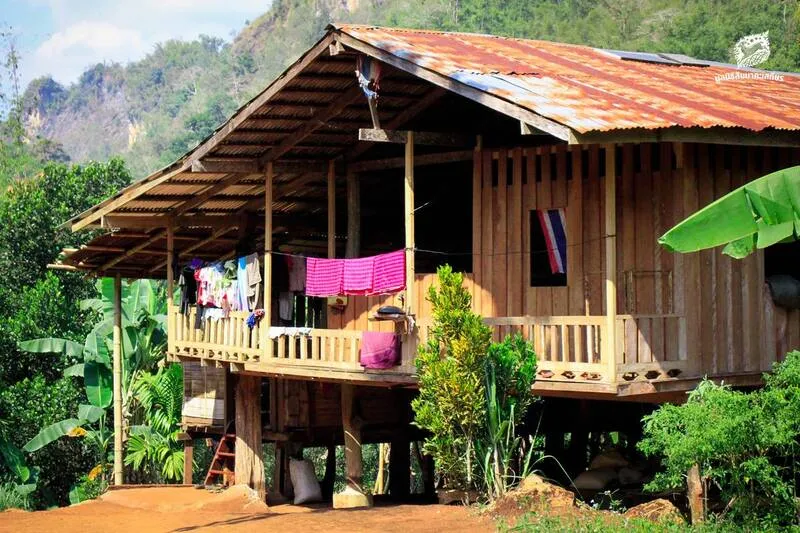
The houses of the Karen in Pa La-U also clearly reflect the identity of the community. Traditional homes are usually built primarily from bamboo, with roofs thatched with grass, and there are also field huts used for temporary residence during the farming season. Although some households today have adapted their building materials for comfort or durability, the simplicity of the architecture and the relationship between the house and the landscape remain very visible. Homes here are not built to separate people from nature, but rather to exist in harmony with the climate, mountains, forest, and agricultural way of life of the family. This is why the overall image of the village still retains its beauty as a cultural community.
Another aspect that makes Pa La-U more meaningful than a typical tourist village is its stories and memory spaces within the community. Villagers still speak of the old betel nut orchard “Phue Mu Sae,” which belonged to Grandpa Mu, where a large jackfruit tree still stands near Pa La-U Waterfall. They also speak of the abandoned field of Grandpa Na Ku, or “Phue Na Ku Si,” which remains in the memory and stories of later generations. Although these places have not been developed as commercial tourist attractions, they carry profound local historical meaning. They connect people in the community to their ancestors and to the landscape in which those ancestors once lived, proving that a place holds value not only because of its natural beauty, but also because of the memories and meanings given to it by the people who live there.
In terms of belief, Pa La-U is an example of a community where Buddhism and traditional Karen beliefs are harmoniously blended. Many villagers are Buddhist and participate in religious activities at local temples, yet at the same time rituals and beliefs concerning land, forest, and cultivation inherited from their ancestors still exert strong influence over daily life. These beliefs are not isolated supernatural ideas detached from reality. Rather, they are a framework that guides the relationship between people and nature, between families and their farmland, and between the present and the ancestors who once lived on the same land.
Some rituals are connected with offering items or making dedications before the start of the planting season, caring for cultivated land with respect, and preserving customs believed to ensure peace and prosperity for the family and their crops. Although outsiders might see such practices as mere folk beliefs, within the community these rituals play an important role in creating responsibility toward resources, structuring communal life, and reminding people that land, forest, water, and food are not merely resources to exploit, but things that must be cared for and respected in return.
Pa La-U is also a community with strong ties to the monarchy and important figures in local development history. Community narratives refer to assistance and patronage from members of the royal family and from monks who played important roles in improving the villagers’ quality of life. These include His Highness Prince Bhanubandhu Yugala, whom the community remembers as having supported local development and well-being, as well as His Majesty the King, who showed concern for Karen children in the area. There are also monks such as Luang Pho Chan of Wat Maruekhathaiyawan and Luang Pho Kaeo of Wat Na Huai, whom villagers recall with respect as people who supported education, welfare, and opportunities for the community.
In terms of local wisdom, Pa La-U still has much to be studied. One of the most notable examples is backstrap-loom weaving, a handicraft that vividly reflects the skill, patience, and identity of the Karen people. Cloth woven on a backstrap loom is not merely clothing, but also a symbol of group identity. Its patterns, colors, and weaving techniques can communicate stories about the community, gender, age, and the role of the wearer in many cases. Alongside this is beadwork and handicrafts made from local materials, which serve both practical and artistic functions and are deeply connected to the everyday life of the people.
Language is another element of identity that makes Pa La-U especially interesting. Most villagers still use the Karang language, or Sgaw Karen, for communication within the community. This language is not only a tool for conversation, but also a storehouse of knowledge containing the names of plants, animals, landscape features, farming methods, and the worldview of the community. When a language still has an active place in daily life, it reflects the fact that the community has successfully preserved its cultural core. Pa La-U therefore serves both as a cultural tourism destination and as a place to learn about language, identity, and the continued existence of an ethnic community in contemporary Thai society.
The natural surroundings of Pa La-U are another major reason why visiting here feels different from a typical trip to Hua Hin. The village is situated within a forest zone connected to Kaeng Krachan National Park, with streams, dry evergreen forest, moist forest, and the Tanawsri mountain range forming a beautiful valley landscape. Along the route from Hua Hin town into Huai Sat Yai, travelers can clearly feel the transition from a coastal tourist town into another world filled with trees, cool breezes, and quietness. If you visit in the morning or after rain, the freshness of the area becomes even more striking, with light mist along the hills and lush greenery adding greatly to the atmosphere.
The most famous nearby attraction is “Pa La-U Waterfall,” located within Kaeng Krachan National Park. This large multi-tiered waterfall is also one of the key butterfly-watching areas in the Huai Sat Yai region. For travelers planning a visit to Pa La-U Village, combining the trip with Pa La-U Waterfall is highly recommended, as it offers both a natural and a cultural experience in a single day. In the same subdistrict, there is also a wild elephant observation tower and wildlife viewing points, reflecting the high ecological value of the Huai Sat Yai area and showing that nature remains truly central to the way of life here, rather than merely serving as a backdrop for tourism.
A visit to Pa La-U should therefore not be seen as just a quick stop through a village. It deserves time and attention in order to understand the subtlety of the place. Travelers interested in culture should pay attention to proper etiquette when visiting the community, such as respecting villagers’ privacy, avoiding intrusive photography without permission, dressing appropriately, and listening to local stories with care and respect. This kind of travel not only gives visitors a deeper experience, but also helps ensure that tourism does not overshadow the community’s ownership of its own space.
From a tourism perspective, Pa La-U is highly suitable for those who want to experience “another side of Hua Hin”—a side that is not only about the sea, cafés, or resorts, but a Hua Hin deeply connected to forest, mountains, and ethnic community life. Travelers will come to see that Prachuap Khiri Khan is not only rich in coastal landscapes, but also possesses equally rich mountain scenery and cultural depth. Pa La-U therefore has strong potential as a cultural and learning destination, meeting the needs of modern travelers who want more than photographs—they want to understand people, understand place, and leave with a new perspective on sustainable living with nature.
For those interested in sustainability, Pa La-U is a particularly compelling case study. The community’s way of life clearly shows that sustainability does not always have to begin with complex theories or expensive technologies. Sometimes sustainability begins with understanding the rhythm of the seasons, planting a variety of crops in the same field, using local materials to build homes, knowing when to use land and when to let it rest, and viewing natural resources from the standpoint of a caretaker rather than merely a user. This is precisely what gives Pa La-U relevance in contemporary society, because it helps open conversations about forest conservation, respect for cultural diversity, and forms of development that do not overlook local people.
Another reason Pa La-U is so fascinating is that it is a place where the past has not been severed from the present. When villagers continue to speak of the old betel nut orchard, the fields of their ancestors, the Satu watershed, traditional rituals, language, and rotational farming practices, it becomes clear that the history of this place does not survive only in documents or museums. It remains in the landscape, in the language spoken, in the food eaten, and in daily life itself. This is a defining quality of a living cultural destination. Unlike places where stories exist mainly for display, in Pa La-U those stories are still part of real life in the community.
Getting There Reaching Pa La-U Village is quite convenient from Hua Hin town. Travelers can take Highway 3219 toward Huai Sat Yai and the Pa La-U Waterfall route. The distance from Hua Hin is around 60 kilometers. Along the way, you will pass agricultural areas, mountains, and rural communities, making the transition from town to forest very clear. Once you enter the Huai Sat Yai area, road signs to Pa La-U are fairly easy to follow. Visitors traveling by private car can reach the village comfortably throughout the year. Those without their own vehicle may use hired transport, taxis, or rental cars from Hua Hin. If you want a deeper community experience, arranging a local guide or coordinating with people in the area in advance will make the journey smoother and more meaningful.
In summary, Pa La-U Village is not merely an ordinary community-based tourism destination. It is a place that brings together nature, local history, ethnicity, language, belief, and wisdom for living with the forest in a remarkably complete way. Visitors do not come away with only beautiful scenery or peaceful surroundings, but also with an understanding of another side of Prachuap Khiri Khan that is profound, layered, and full of value. Pa La-U is therefore especially suitable for travelers who want to understand Thailand’s diversity through a small community that still firmly preserves its roots. For anyone seeking a destination near Hua Hin that leads away from familiar routes and toward genuine learning, Pa La-U is a place worth experiencing at least once.
| Place Name | Pa La-U Village |
| Location | Moo 3, Huai Sat Yai Subdistrict, Hua Hin District, Prachuap Khiri Khan Province 77110 |
| Address | Pa La-U Community, along the Hua Hin–Pa La-U route in a foothill area near Kaeng Krachan National Park |
| Place Summary | An old Pga K’nyau Karen community that has preserved its traditional way of life, language, beliefs, and rotational farming wisdom with remarkable clarity |
| Highlights | Traditional Karen culture, forested mountain landscapes near Pa La-U Waterfall, local historical narratives, backstrap-loom weaving, and an agricultural way of life in harmony with nature |
| Name Origin | “La-U” is a Karen word meaning “bamboo,” reflecting the abundance of bamboo forest in the area, and the name “Pa La-U” is therefore closely linked to the original landscape of the community |
| Community Character | A rural foothill ethnic community of the Pga K’nyau Karen, with a simple lifestyle, reliance on nature, and strong preservation of language, culture, and belief |
| Suitable Activities | Learning about community culture, nature-based travel, visiting Pa La-U Waterfall, exploring Karen agricultural wisdom, and photographing mountains, streams, and rural scenery |
| Getting There | From Hua Hin town, take Highway 3219 toward Huai Sat Yai and Pa La-U. The distance is about 60 km. The village can be reached conveniently by private car, rental car, or hired transport |
| Current Status | A living community with continuing cultural life, suitable for learning-oriented travel and visits conducted with respect for local ways of life |
| Coordinates | Approximately 12.5086, 99.5201 |
| Nearby Attractions | 1. Pa La-U Waterfall – approximately 4 km 2. Pa La-U Wild Elephant Observation Tower – approximately 10 km 3. Huai Sat Yai Wild Elephant Viewing Point – approximately 10 km 4. Wat Huay Mongkol – approximately 42 km 5. Hua Hin Night Market – approximately 60 km |
| Nearby Restaurants | 1. Dusita Restaurant and Coffee Point – approximately 8 km – Tel. 089-011-6043, 032-826758 2. Rai Thip Ocha Kiri – approximately 6 km – Tel. 081-113-5835 3. Pa La-U Restaurant Branch 2 – approximately 58 km – Tel. 096-953-1415 4. Restaurants at Hilton Hua Hin Resort & Spa – approximately 60 km – Tel. 032-538999 5. Restaurants at Hua Hin Marriott Resort & Spa – approximately 61 km – Tel. 032-904666 |
| Nearby Accommodations | 1. The Sea-Cret Garden Hua Hin – approximately 47 km – Tel. 032-900565, 097-080-0672 2. Hilton Hua Hin Resort & Spa – approximately 60 km – Tel. 032-538999 3. Hua Hin Marriott Resort & Spa – approximately 61 km – Tel. 032-904666 4. G Hua Hin Resort & Mall – approximately 61 km – Tel. 032-515199 5. Centara Grand Beach Resort & Villas Hua Hin – approximately 60 km – Tel. 032-512021 |
Frequently Asked Questions (FAQ)
Q: Where is Pa La-U Village located?
A: Pa La-U Village is located in Moo 3, Huai Sat Yai Subdistrict, Hua Hin District, Prachuap Khiri Khan Province, along the Hua Hin–Pa La-U route near Kaeng Krachan National Park.
Q: Which ethnic group lives in Pa La-U Village?
A: Pa La-U Village is home to the Pga K’nyau Karen, or Sgaw Karen, some of whom refer to themselves as “Karang.” They have preserved their language, culture, and traditional way of life very clearly.
Q: Is Pa La-U Village close to Pa La-U Waterfall?
A: Yes, it is very close. Visitors can easily combine a trip to Pa La-U Village with Pa La-U Waterfall in the same day, enjoying both cultural and natural experiences together.
Q: When is the best time to visit Pa La-U Village?
A: The village can be visited year-round, but the late rainy season through the cool season offers especially fresh mountain scenery. During the rainy season, it is advisable to check road conditions and prepare suitable rain gear.
Q: How should visitors prepare for a trip to Pa La-U Village?
A: Visitors should dress respectfully, wear comfortable walking shoes, bring drinking water, and prepare sun or rain protection depending on the season. It is also important to respect the privacy of the community when taking photos or speaking with villagers.
Q: What type of traveler is Pa La-U Village suitable for?
A: It is ideal for travelers interested in ethnic culture, nature, forests, educational travel, and those who want to experience a quieter and deeper side of Hua Hin beyond the sea and town center.
 Pa La-U Village Map
 Category:
  Group:
  Last Update: 14 HourAgo
Comment
 Nearby Attractions
| Keyword (Advance) |
 Facebook Fanpage
 Region
 Art, Culture and Heritage
 Historical Sites and Monuments(
 Landmarks and Memorials(
 Royal Palace(
 Art, Craft Centres, Tradition(
 Art Gallery(
 Educational Places
 Museum for Study(
 Educational Gardens, Farm(
 University
 Places of Worship
 Temple(
 Other religious and spiritural sites(
 Research and Development
 Royal Project(
 Local Market(
 Floating Market(
 Nature and Wildlife
 National Parks and Marine Reserves(
 Mountain (Doi)(
 Dam, Reservoir, Lake(
 Waterfalls(
 Caves(
 River, Canal(
 Bays and Beaches(
 Islands(
 Other natural attractions(
 Entertainment and Agricultural
 Animal camps and shows(
 Farm, Parks, Gardens and Ecotourism(
 Waterpark(
 Outdoor and Adventure Activities(
 Shopping
 Shopping and Night Market(
 Travel Articles, Recipes
 Travel Review, Food Review(