

 Home
Home Chiang Mai(




Rating: 3.8/5 (4 votes)
 |
|  Map
Map 
 Have Map
  No Map
Prachuap Khiri Khan attractions
Attractions in Thailand
Open Days: Visitors should contact the research station in advance before visiting
Opening Hours: The museum house is open during official working hours, and advance arrangements are generally recommended
Bang Berd Farm in Bang Saphan Noi District, Prachuap Khiri Khan Province, is one of the most important landmarks in the history of Thai agriculture. It was here that Prince Sithiporn Kritakara experimented with integrated farming concepts, upland cultivation, cover crops, crop rotation, and the adaptation of foreign plant varieties, eventually leading to the success of the famous “Bang Berd watermelon.” The original farm area later developed into the Sithiporn Kritakara Research Station and the museum house, which gives this place value not only as an attraction in Prachuap Khiri Khan but also as a learning site that clearly explains the foundations of modern agriculture in Thailand.
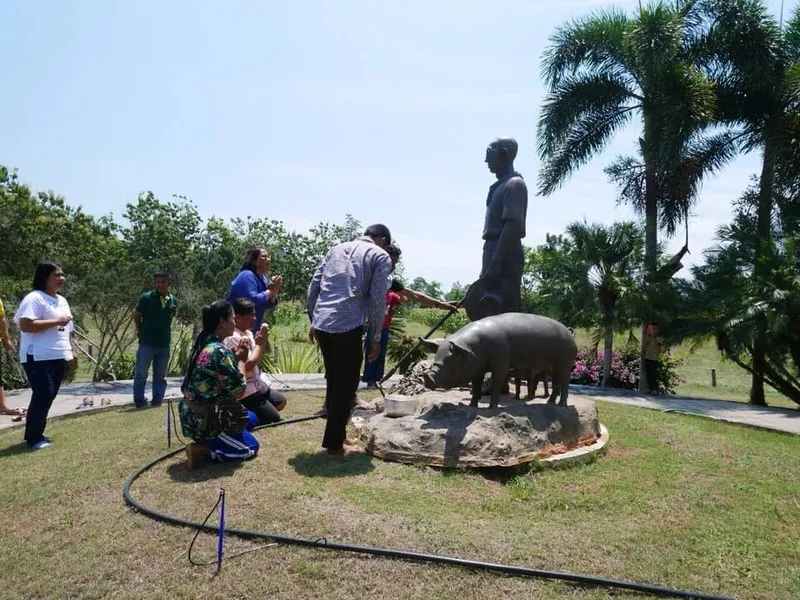
Bang Berd Farm is a historical and agricultural attraction of great importance in Prachuap Khiri Khan Province. It is located in Bang Saphan Noi District, in the area now associated with the Sithiporn Kritakara Research Station and the museum house of H.S.H. Prince Sithiporn Kritakara. From a general tourism perspective, this place may seem quiet and less visually prominent than beaches or seaside resorts. However, in the history of Thai agriculture, Bang Berd Farm is legendary, because it was where highly advanced ideas for modern agriculture were first tested, including integrated farming, agricultural technology, plant breeding, and systematic land management.
What makes Bang Berd Farm so interesting is not simply that it is an old farm, but that it represents a new way of thinking about agriculture in Thailand. At a time when Thai agricultural society was still accustomed to monocropping and traditional methods, Prince Sithiporn Kritakara looked far beyond those limits. He sought to prove that Thai land could support more diverse and efficient agricultural approaches if study, experimentation, record-keeping, and practical adaptation to real environmental conditions were applied with sound judgment. Bang Berd Farm was therefore not just farmland, but an “outdoor laboratory” that influenced the development of agricultural thinking in Thailand in the years that followed.
The Background and History of Bang Berd Farm Bang Berd Farm was founded in 1920 by Prince Sithiporn Kritakara. He began life at the farm with his wife and two young children, with the intention of creating a genuine model of new-style agriculture in Thailand. Choosing Bang Berd as the experimental site was not accidental. It came from recognizing the potential of this coastal and upland area, which could support a wider variety of agricultural systems than most people of that era were used to.
At that time, Thai agriculture was still largely centered on rice or a single crop grown over broad areas. Upland land use was not yet highly efficient, and the idea of combining multiple crops in one system had not attracted much attention. Prince Sithiporn Kritakara saw that if farmers understood how to use land in harmony with nature, how to match crops to soil and climate, and how to use knowledge gained from actual experimentation, Thai agriculture could gain both more options and greater sustainability. This was the core concept on which Bang Berd Farm was built from the very beginning.
Once Bang Berd Farm was established, it was not operated simply to produce crops. Instead, it became a true practical agricultural study site. Every planting, every livestock experiment, and every management decision within the farm was used as data for comparison and learning, not merely for harvesting products in a single season. This approach made Bang Berd Farm clearly different from ordinary farming and turned it into a model with long-term influence.
Prince Sithiporn Kritakara and His Role as a Pioneer of Modern Thai Agriculture It would be impossible to tell the story of Bang Berd Farm without speaking of Prince Sithiporn Kritakara, because he was the heart of the place. He has been widely recognized as a pioneer of modern agriculture in Thailand and, in another sense, as a thinker, experimenter, and communicator who understood agriculture far more deeply than simple farming in its most basic sense.
Prince Sithiporn’s distinction did not lie merely in generating new ideas, but in putting them into practice and recording the results systematically. He experimented with many crops and livestock breeds, using observation, comparison, and production records to identify the strengths and weaknesses of each method. This reflected a clearly scientific mindset and gave his approach far more weight than ordinary advice unsupported by evidence.
More importantly, he did not keep this knowledge confined to the farm. He shared it through articles and public communication so that farmers and decision-makers in the country could see that Thai agriculture was capable of developing far beyond its current condition. This way of thinking made Prince Sithiporn Kritakara important not only as the founder of Bang Berd Farm, but as a figure who laid a new intellectual foundation for Thai agriculture as a whole.
The Integrated Farming Concept at Bang Berd Farm The heart of Bang Berd Farm was integrated farming, an idea that was highly advanced for its time. At a time when many farmers still depended on only one crop, Prince Sithiporn experimented with cultivating multiple crops together and combining commercial livestock raising within the same system. This approach allowed the land to be used more efficiently, reduced the risks of depending on a single product, and created more balance than separated forms of agriculture.
Bang Berd Farm was therefore not just a place for growing crops, but a small economic system that carefully connected soil, water, crops, animal feed, and markets. Some plants were grown for sale, while others were cultivated to be used as green manure or animal feed. Livestock raising was not separated from crop production, but formed part of the same cycle. This is what made Bang Berd Farm a prototype of what today would be called sustainable agriculture or holistic farming.
Agricultural Innovations and Technology Ahead of Their Time Bang Berd Farm has often been mentioned as one of the first places in Thailand to adopt new agricultural technologies and methods. One of the most important examples was the use of cover crops and crop rotation, which helped preserve soil fertility, reduce land degradation, and improve long-term resource efficiency. These methods were highly significant because they offered an alternative to shifting cultivation or wasteful land use that could still be found in parts of Thailand at that time.
Beyond crops, Bang Berd Farm also seriously experimented with commercial livestock, including White Leghorn chickens, Yorkshire pigs, and dairy cattle. These animals were not raised simply for household consumption, but as part of a systematic production model for eggs, meat, and related products for sale. This shows that Bang Berd Farm viewed agriculture as an economic system requiring planning, rather than merely subsistence production.
Bang Berd Watermelon: A Legend Still Remembered If there is one farm product from Bang Berd Farm that remains well known to this day, it is undoubtedly the “Bang Berd watermelon.” This watermelon originated from imported American varieties such as Tom Watson and Klondike, which were tested in Thailand and then adapted to Bang Berd’s local conditions. The result was a high-quality product that was in strong demand and became one of the enduring symbols of Bang Berd Farm.
The success of Bang Berd watermelon was not only a matter of taste or fruit size, but also proof that foreign plant varieties could be grown successfully in Thailand if properly studied and adapted. This is one of the reasons Bang Berd Farm became known as a pioneering experimental site. It did not cling only to familiar practices, but welcomed knowledge from abroad and carefully selected what was suitable for real local application.
Other Crops and Products Experimented with at Bang Berd Farm In addition to watermelon, Bang Berd Farm also played an important role in testing a number of economic crops and useful plants, including Virginia tobacco cured with heat for improved quality, as well as imported peanuts and maize used both for production and as green manure or animal feed. These examples show that Bang Berd Farm was never focused on only one crop, but instead viewed the entire system and asked how each plant could strengthen the farm as a whole.
Some products from Bang Berd Farm were not sold only locally, but were sent to larger markets such as Bangkok and Penang. This indicates that the farm was not merely a closed experimental area, but had real economic potential and could connect effectively with external markets. Seen in the context of its era, this makes it even clearer that Bang Berd Farm was far more progressive than ordinary farming operations of the time.
Bang Berd Farm and the Spread of Agricultural Knowledge in Thai Society What made the contribution of Bang Berd Farm greater than its physical area was that Prince Sithiporn Kritakara did not keep the results of his experiments for himself alone. He recorded information and shared it through newspaper articles and printed media so that farmers and the broader public could learn from real experience. He explained his findings through data and statistics, not simply through personal opinion, which helped raise agricultural discussion in Thailand to a more evidence-based and practical level.
This kind of communication had a significant influence on how people thought, because it helped farmers see that experimentation and the use of data mattered to production and income. Agriculture no longer needed to rely only on habit or inherited methods, but could be improved through learning and continuous adjustment. This was a deeper and more lasting impact than the farm’s own products alone.
From Bang Berd Farm to the Sithiporn Kritakara Research Station After Prince Sithiporn sold Bang Berd Farm to the state, the area was further developed into the Sithiporn Kritakara Research Station, connected to the agricultural research and learning work of Kasetsart University. The role of the land therefore changed from a private model farm into a study and memorial site that helps preserve Prince Sithiporn’s legacy of agricultural thought for future generations.
Today, visitors to the area no longer see Bang Berd Farm exactly as it existed in its original period. Even so, they can still experience the historical traces, agricultural value, and meaning of the site through the museum house, memorial spaces, and the area’s management as a learning center. This means that Bang Berd Farm has not disappeared from history, but has been carried forward in a form suited to the modern era.
The Atmosphere of Visiting Bang Berd Farm Today Although visitors today will not encounter the large farm exactly as it once was, what can still be felt is the atmosphere of a place filled with history in every dimension. The quietness of Bang Saphan Noi, the closeness to Bang Berd Beach, and the story of modern agricultural ideas born on this land make a visit here more than just seeing a place. It is a chance to come into contact with the roots of a major transformation in Thai agriculture.
For travelers who enjoy places with a story, Bang Berd Farm has greater charm than attractions that can only be appreciated on the surface. The more one knows about its history and context, the clearer its value becomes. Visiting Bang Berd Farm is therefore especially suitable for people interested in local history, Thai agricultural history, or anyone curious about how one relatively small place could influence the thinking of an entire country.
Getting to Bang Berd Farm If traveling by private car, visitors can take Phetkasem Road south into Bang Saphan Noi District, then continue toward Sai Thong Subdistrict and the Bang Berd area. The route is fairly convenient for those planning a combined trip around Bang Saphan Noi and Bang Berd Beach, whether for a half-day or full-day itinerary with nearby attractions.
Those staying in Bang Saphan Noi or near Bang Berd Beach can travel to the Sithiporn Kritakara Research Station by local transport or private vehicle with relative ease. Visitors wishing to see the museum house or learning areas should contact the station in advance in order to arrange a suitable schedule and ensure that staff or a coordinator will be available to provide information on the day of the visit.
Bang Berd Farm is therefore not only a tourist attraction in Prachuap Khiri Khan in the sense of a place to visit, but also a destination of learning that helps us understand that Thai agriculture did not develop by chance. It evolved because of people who dared to think, dare to experiment, and dare to share knowledge with society in a serious way. When visitors come to this place, they are not only seeing the past, but also seeing ideas that still hold value for the future of Thai agriculture.
| Place Name | Bang Berd Farm / Sithiporn Kritakara Research Station / H.S.H. Prince Sithiporn Kritakara Museum House |
| Address | 60/1 Moo 5, Ban Bang Berd, Sai Thong Subdistrict, Bang Saphan Noi District, Prachuap Khiri Khan Province 77170 |
| Summary | A historic agricultural site of Thailand that once served as Prince Sithiporn Kritakara’s model farm before being developed into a research station and museum house for learning about agriculture and local history |
| Highlights | The birthplace of Thailand’s integrated farming concept, the story of Bang Berd watermelon, cover crops, crop rotation, and the systematic testing of foreign plant varieties |
| Background and History | Founded in 1920 by Prince Sithiporn Kritakara as a model farm for modern agriculture, the original area was later developed into the Sithiporn Kritakara Research Station and museum house |
| Key Historical Figure | Prince Sithiporn Kritakara, pioneer of modern Thai agriculture |
| Agricultural Importance | An important starting point of integrated farming, agricultural technology adoption, foreign crop experimentation, and the spread of agricultural knowledge to Thai farmers |
| Main Learning Points | H.S.H. Prince Sithiporn Kritakara Museum House, memorial area, research station grounds, and the story of Bang Berd watermelon |
| Current Status | Managed by the Sithiporn Kritakara Research Station and used as a learning site and memorial area related to agricultural history |
| Visiting Days and Hours | Visitors should contact the station in advance. Information on the museum house indicates that it opens on official working days and there is no admission fee. |
| Contact Numbers | 081-868-2022, 090-237-9160 |
| Getting There | Travel by private car into Bang Saphan Noi District, then continue to Sai Thong Subdistrict and Ban Bang Berd. Visitors interested in educational visits should contact the station in advance. |
| Nearby Tourist Attractions | 1. Bang Berd Beach, approximately 2 km 2. Khao Bang Berd, approximately 3 km 3. H.S.H. Prince Sithiporn Kritakara Museum House, approximately 0.2 km, Tel. 081-868-2022 4. Wat Bang Berd, approximately 2 km 5. Bang Berd Coastal Viewpoint, approximately 3 km |
| Nearby Restaurants | 1. Krua Khanthong, Bang Berd Beach, approximately 2 km, Tel. 083-449-5678, 096-242-2456 2. Krua Ton Tang, approximately 12 km, Tel. 086-170-5262 3. Lan Rueang Lao by Je Saeng, approximately 13 km, Tel. 092-333-0062, 081-773-9881 4. Krua O-Nan, approximately 14 km, Tel. 092-830-5687 5. Nang Baan Phuean, Bang Saphan Noi, approximately 15 km, Tel. 098-375-4269 |
| Nearby Accommodations | 1. Bang Berd Resort, approximately 2 km, Tel. 089-223-9894, 086-075-7521, 032-817-234 2. Baan Sai Thong Beach Resort, approximately 3 km, Tel. 081-894-0410 3. Bang Saphan Resort, approximately 12 km, Tel. 092-562-7899, 032-691-152 4. VSN House, approximately 14 km, Tel. 062-991-2954 5. Kasalong Resort Bang Saphan Noi, approximately 15 km, Tel. 093-017-8053 |
Frequently Asked Questions (FAQ)
Q: Where is Bang Berd Farm located?
A: The original Bang Berd Farm was located in the Ban Bang Berd area, Sai Thong Subdistrict, Bang Saphan Noi District, Prachuap Khiri Khan Province. Today, the area is associated with the Sithiporn Kritakara Research Station and the H.S.H. Prince Sithiporn Kritakara Museum House.
Q: Why is Bang Berd Farm important?
A: It was a model site for integrated farming and modern agricultural experimentation in Thailand, pioneered by Prince Sithiporn Kritakara.
Q: Who founded Bang Berd Farm?
A: It was founded by Prince Sithiporn Kritakara in 1920, and he played a highly important role in developing new agricultural ideas in Thailand.
Q: What is Bang Berd watermelon?
A: Bang Berd watermelon is a famous product developed from foreign watermelon varieties experimentally grown at Bang Berd Farm until they succeeded and became widely remembered.
Q: Does Bang Berd Farm still exist today?
A: The original farm area has been preserved in the form of the Sithiporn Kritakara Research Station and museum house, which now serve as a learning center and agricultural memorial site.
Q: What else can I visit near Bang Berd Farm?
A: Visitors can continue on to Bang Berd Beach, Khao Bang Berd, Wat Bang Berd, or the Bang Saphan Noi community, which has seafood restaurants and several seaside accommodations.
Q: How is Bang Berd Farm connected to Thai agriculture?
A: Bang Berd Farm is one of the important roots of integrated farming concepts, the use of real experimental data, and the spread of modern agricultural knowledge in Thai society.
 Bang Berd Farm Map
 Category:
  Group:
  Last Update: 5 HourAgo
Comment
 Nearby Attractions
| Keyword (Advance) |
 Region
|
 Muang Prachuap Khiri Khan(