

 Home
Home Chiang Mai(




Rating: 2.6/5 (10 votes)
 |
|  Map
Map 
 Have Map
  No Map
Prachuap Khiri Khan attractions
Attractions in Thailand
Open Days: Open Daily
Opening Hours: 08:00 – 17:00
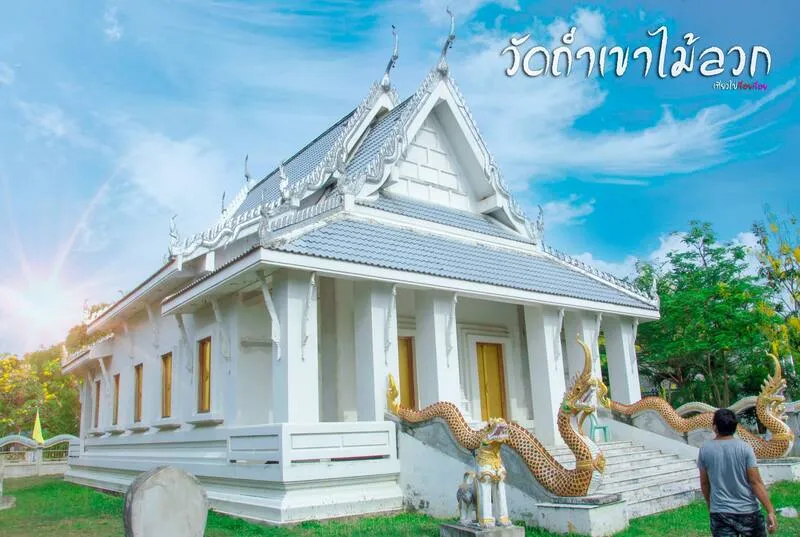
Wat Tham Khao Mai Ruak is a royal temple under the Mahanikaya sect, located at 80/9 Moo 9, Ang Thong Subdistrict, Thap Sakae District, Prachuap Khiri Khan Province. This temple is not only a religious site for the local community, but also one of the distinctive temples of Thap Sakae District. It features a peaceful natural atmosphere, hillside terrain, and caves that are well suited to meditation, along with a clear role in Buddhist practice and Buddhist education. For this reason, it is regarded as one of the temples that those interested in religious and cultural tourism in Prachuap Khiri Khan should seriously get to know.
The charm of Wat Tham Khao Mai Ruak lies in the combination of a community temple and the calm atmosphere of a meditation center. Upon arrival, visitors can immediately feel the shady, simple, and unhurried setting, unlike the bustling seaside tourist attractions that are more commonly associated with Prachuap Khiri Khan. This peaceful quality gives the temple a distinct identity, making it suitable both for those who come to make merit, pay respect to Buddha images, and practice meditation, and for those who simply want to rest their minds in a place that still retains the spirit of nature and local community life.
In historical terms, Wat Tham Khao Mai Ruak was officially established as a temple on June 7, 2007. This marked an important beginning, transforming the site from a place of local faith into a fully recognized temple within the Thai Sangha system. Later, on March 31, 2009, the temple received its royal boundary charter for the ordination hall. This officially confirmed the temple’s status as a religious site capable of conducting major Buddhist ceremonies in full accordance with monastic discipline. Receiving this charter was therefore not merely an administrative matter, but a major step showing that Wat Tham Khao Mai Ruak had become fully established both as a Buddhist institution and as an important center for the community.
The location of the temple is another factor that makes it particularly appealing. The grounds are surrounded by the natural landscape of Ang Thong Subdistrict, Thap Sakae District, and include both flat land and a small hill within the same area. This terrain gives the temple a deeper, quieter, and more private atmosphere than temples built entirely on flat land. When combined with the presence of caves within the temple grounds, Wat Tham Khao Mai Ruak becomes a place where religious value, natural beauty, and travel experience come together in one setting.
The temple has also been appointed as the 24th official meditation center of Prachuap Khiri Khan Province, which is a highly significant role. This means the temple does not serve only as a site for religious ceremonies or merit-making on holy days, but also as a place for mindfulness training, meditation practice, and ongoing Dhamma learning. This is especially evident during weekends and holidays, when students, young people, and members of the public come to practice meditation on a regular basis. The continuity of these activities gives Wat Tham Khao Mai Ruak a living presence. It is not simply a place to stop by and look around, but a spiritual space that is actively used by people in the community.
In addition to its role as a meditation center, the temple also has a Sunday Buddhist Study Center, which adds an important educational dimension to its identity. A center of this kind is especially valuable in rural communities, because it provides a space where children and young people can learn Buddhist teachings, moral values, and proper conduct in daily life. With this dual role as both a meditation center and a source of Buddhist education for the younger generation, Wat Tham Khao Mai Ruak can truly be seen as a place that connects people of different ages through the practical teachings of Buddhism.
At present, Wat Tham Khao Mai Ruak is led by Phra Khru Wisit Sathukan, also known as Den Duang Thananako, who serves as abbot and also holds the position of ecclesiastical head of Ang Thong Subdistrict, Zone 1. Having a monastic leader who serves in both a temple-level and subdistrict-level role strengthens the temple’s significance within the religious structure of the area. The abbot’s responsibilities extend beyond overseeing ceremonies and monastic routines; they also include promoting meditation programs, improving necessary temple facilities, and connecting the faith of local people with the long-term development of the temple.
If there is one story that most clearly sets Wat Tham Khao Mai Ruak apart from other temples, it is the story of the bat cave and the use of bat guano to support the construction of the ordination hall. This story is both an important part of the temple’s history and an example of how natural resources can be used wisely. Within the temple grounds there is a cave inhabited by a large number of bats, which naturally produces a significant amount of bat guano. During the period when the temple needed to raise funds for the construction of its ordination hall and faced financial limitations, the abbot came up with the idea of selling the bat guano to generate income for the project.
This idea was particularly remarkable because it did not rely solely on general donations. Instead, it reflected the ability to recognize the value of what was already available within the temple grounds and to use it appropriately for the benefit of the temple. The income from the sale of bat guano contributed substantially to the construction of the ordination hall and became one of the most memorable stories associated with Wat Tham Khao Mai Ruak. It also demonstrates a simple but effective approach to development: using available natural resources carefully and turning them into something valuable for both religion and community.
The bat cave is therefore not just a natural feature of the temple grounds, but an integral part of the temple’s identity. On one hand, it enhances the natural atmosphere of the temple, giving it the peaceful and distinctive character of a hillside temple. On the other hand, it is closely linked to the temple’s development during an important period, allowing visitors to see not only a completed religious site, but also the deeper story of how its beauty came from cooperation, faith, and thoughtful resource management.
As the number of meditation practitioners increased, the temple gradually developed over time. Necessary buildings and facilities were added according to need, in order to accommodate monks, meditation practitioners, and local people coming to make merit. The landscape of the temple, which combines both flat land and hillside terrain, also allows for a variety of functional areas. In particular, the four monk residences built on the hill strengthen the temple’s image as a true meditation center, because such a setting creates quiet, privacy, and a suitable environment for mindfulness practice.
From an architectural perspective, although Wat Tham Khao Mai Ruak is not an ancient temple or a historical monument, its strength lies in the fact that it has grown through a meaningful and well-remembered process. The beautifully constructed ordination hall has become an important symbol of the temple’s development. This religious building reflects not only aesthetic beauty, but also the perseverance, cooperation, and faith of the monks and the local community who worked together to make it a reality.
The role of the temple within Ang Thong Subdistrict and nearby areas is highly significant, because it serves as both a religious center and a social center. At the family level, villagers come to make merit, listen to sermons, and join activities on important Buddhist holy days. At the community level, the temple helps preserve traditions and public activities, giving local people a shared point of connection through merit-making, Dhamma events, and moral activities.
On Buddhist observance days, major religious festivals, and during the Buddhist Lent season, Wat Tham Khao Mai Ruak becomes even more active. Activities may include almsgiving, listening to sermons, meditation practice, and events that allow people in the community to participate closely. All of this shows that the temple continues to function as a true center of community relationships. It is not merely a place used for occasional rituals, but a place where local people continue to live out their religious lives on a regular basis.
For travelers or visitors from outside the area, Wat Tham Khao Mai Ruak offers a kind of charm quite different from the seaside tourist spots of Prachuap Khiri Khan. This is not a place focused on excitement or entertainment, but rather on peace, learning, and simplicity. Anyone interested in temples with a unique story, a natural setting, memorable development history, and an atmosphere suitable for quiet reflection will find that this temple offers much more than a brief stop for merit-making.
Walking slowly around the temple grounds, visitors can sense the character of a meditation-oriented temple that has not been overly embellished. The quiet of the hillside setting, the sounds of nature, and the simple arrangement of buildings all create a relaxing atmosphere. This stands in contrast to larger temples that are crowded throughout the day. The true charm of Wat Tham Khao Mai Ruak lies in the fact that it still preserves a genuine space for silence and calm.
In terms of educational value, Wat Tham Khao Mai Ruak is also an excellent example of temple development through cooperation between monks and local people. The story of raising funds from bat guano to build the ordination hall shows that the development of a religious place does not always depend on large capital alone. It can also begin with creative thinking, the ability to see the value of available resources, and sound management. This is one of the reasons the temple has value not only as a travel destination, but also as an inspiring case study for those interested in community and religious development.
Another point of interest is how the temple has maintained a balance between development and the preservation of its natural atmosphere. Even though an ordination hall and other necessary buildings have been added, the overall feeling of the temple remains calm, uncluttered, and still closely connected to its original landscape. Its identity as a temple with hills, caves, and meditation areas helps visitors feel linked to nature while also engaging with Buddhism.
From a tourism perspective, Wat Tham Khao Mai Ruak fits well into travel plans that include other attractions in Thap Sakae District and nearby areas. Whether the itinerary includes beaches, waterfalls, or other important temples around Ban Krut and Thap Sakae, this temple adds a valuable religious and cultural dimension to the trip. Its flexibility as part of a wider route means it is not merely a stand-alone destination, but one of the key stops that enrich the overall experience.
For those especially interested in meditation-oriented temples, Wat Tham Khao Mai Ruak is well worth visiting in person. It combines all the essential qualities: peace, simplicity, natural surroundings, and a clearly defined role as an official provincial meditation center. The experience of coming here is therefore not just about taking photographs or checking in, but about spending time in a place that still clearly preserves its spiritual purpose.
Looking at the overall picture, Wat Tham Khao Mai Ruak is a temple with many layers of significance. It has a clear founding history, official status as a meditation center, an educational role in Buddhist learning, a unique story of developing its ordination hall through an unusual but meaningful funding method, and a natural environment well suited to contemplation. These qualities mean that the temple is valuable not only to the people of Ang Thong and Thap Sakae, but also as a distinctive religious and cultural attraction of Prachuap Khiri Khan Province.
For those planning a visit, what should be expected is simplicity and peace rather than commercial-style tourism. This temple is best appreciated slowly, by walking around the grounds, absorbing the atmosphere, paying respect to sacred objects, and, if possible, spending some quiet time resting the mind away from the rush of daily life.
Getting There From Bangkok, take Phetkasem Road south through Phetchaburi and Prachuap Khiri Khan Provinces until reaching Thap Sakae District. From there, continue to Ang Thong Subdistrict. Wat Tham Khao Mai Ruak is in an area that is easily accessible by private car, and local roads can be used to reach the temple without difficulty. If traveling by bus or train, visitors can get off in Thap Sakae District or a nearby point and continue to the temple by local transport. The temple is also suitable for inclusion in a trip that combines attractions in Thap Sakae and Ban Krut.
| Name | Wat Tham Khao Mai Ruak |
| Location | 80/9 Moo 9, Ang Thong Subdistrict, Thap Sakae District, Prachuap Khiri Khan 77130 |
| Address Overview | A hillside temple in Ang Thong Subdistrict, Thap Sakae District, with a peaceful atmosphere ideal for meditation practice |
| Place Summary | A Mahanikaya temple and the 24th official meditation center of Prachuap Khiri Khan Province, notable for meditation practice, Buddhist education, and temple development supported by community faith |
| Highlights | A temple surrounded by nature, a distinctive bat cave, official meditation-center status, and the memorable story of using bat guano to help fund the construction of the ordination hall |
| Latest Abbot or Caretaker | Phra Khru Wisit Sathukan (Den Duang Thananako) |
| Current Status | Still active with ongoing religious activities and regular temple operations |
| Getting There | Travel via Phetkasem Road to Thap Sakae District, then continue into Ang Thong Subdistrict. Best reached by private car, with local transport available from the district center. |
| Temple Contact Numbers | 032-604-308, 085-440-3522, 080-017-5995 |
| Nearby Tourist Attractions with Distance | 1. Thap Sakae Beach – Approx. 7 km. 2. Palm-Wood Ubosot at Wat Ang Suwan – Approx. 8 km. 3. Ban Krut Beach – Approx. 17 km. 4. Wat Tang Sai and Phra Mahathat Chedi Phakdi Prakat – Approx. 20 km. 5. Huai Yang Waterfall – Approx. 28 km. |
| Popular Restaurants Nearby with Distance | 1. The Beach Restaurant Thap Sakae – Approx. 5 km. – 089-232-3443 2. Platoo Seafood Ban Krut – Approx. 18 km. – 089-914-2456, 061-915-6287 3. Krua Laem Thong Seafood – Approx. 24 km. – 089-549-4992 4. Jae Renu Khao Tom, Kui Buri – Approx. 33 km. – 087-763-0961 5. Usa Pla Phao, Kui Buri – Approx. 33 km. – 061-821-0883 |
| Popular Accommodations Nearby with Distance | 1. Sunshine Paradise Resort – Approx. 2 km. – 081-829-8123 2. Malai-Asia Resort – Approx. 2 km. – 088-245-2184 3. Sirarun Resort – Approx. 3 km. – 084-801-5445 4. The Bloc @ Sea – Approx. 12 km. – 080-782-9733 5. Ivy Deluxe Resort Thap Sakae – Approx. 14 km. – 092-840-5149 |
Frequently Asked Questions (FAQ)
Q: Where is Wat Tham Khao Mai Ruak located?
A: The temple is located at 80/9 Moo 9, Ang Thong Subdistrict, Thap Sakae District, Prachuap Khiri Khan Province, and can be conveniently reached from Phetkasem Road.
Q: What are the highlights of Wat Tham Khao Mai Ruak?
A: Its main highlights are its official status as a provincial meditation center, its natural and peaceful setting, and the story of using bat guano from the cave within the temple grounds to help fund the construction of the ordination hall.
Q: Is Wat Tham Khao Mai Ruak an official meditation center?
A: Yes. It is the 24th official meditation center of Prachuap Khiri Khan Province, and people continue to come here regularly for meditation practice, especially on weekends and holidays.
Q: Who is the current abbot of Wat Tham Khao Mai Ruak?
A: The current abbot is Phra Khru Wisit Sathukan, also known as Den Duang Thananako.
Q: When did Wat Tham Khao Mai Ruak receive its royal boundary charter?
A: The temple received its royal boundary charter on March 31, 2009, which was an important milestone in its history.
Q: Is the story about bat guano being used to build the ordination hall true?
A: This story is closely associated with the temple’s development history, with bat guano from the cave inside the temple grounds being sold to help raise funds for the construction of the ordination hall.
Q: What type of travel experience is Wat Tham Khao Mai Ruak suitable for?
A: It is suitable for religious tourism, merit-making, paying respect to sacred images, meditation practice, and peaceful travel focused on nature and community life.
 Tel: 032604308
 Mobile: 0854403522, 0800175995
 Wat Tham Khao Mai Ruak Map
 Category:
  Group:
  Last Update: 19 HourAgo
Comment
 Nearby Attractions
| Keyword (Advance) |
 Facebook Fanpage
 Region
 Art, Culture and Heritage
 Historical Sites and Monuments(
 Landmarks and Memorials(
 Royal Palace(
 Art, Craft Centres, Tradition(
 Art Gallery(
 Educational Places
 Museum for Study(
 Educational Gardens, Farm(
 University
 Other religious and spiritural sites(
 Research and Development
 Royal Project(
 Suburban Living
 Village, Community(
 Local Market(
 Floating Market(
 Nature and Wildlife
 National Parks and Marine Reserves(
 Mountain (Doi)(
 Dam, Reservoir, Lake(
 Waterfalls(
 Caves(
 River, Canal(
 Bays and Beaches(
 Islands(
 Other natural attractions(
 Entertainment and Agricultural
 Animal camps and shows(
 Farm, Parks, Gardens and Ecotourism(
 Waterpark(
 Outdoor and Adventure Activities(
 Shopping
 Shopping and Night Market(
 Travel Articles, Recipes
 Travel Review, Food Review(