

 Home
Home Chiang Mai(




Rating: 4.4/5 (5 votes)
 |
|  Map
Map 
 Have Map
  No Map
Prachuap Khiri Khan attractions
Attractions in Thailand
Open Days: Open Daily
Opening Hours: According to the train schedules of the State Railway of Thailand and the external visiting hours of the station area.
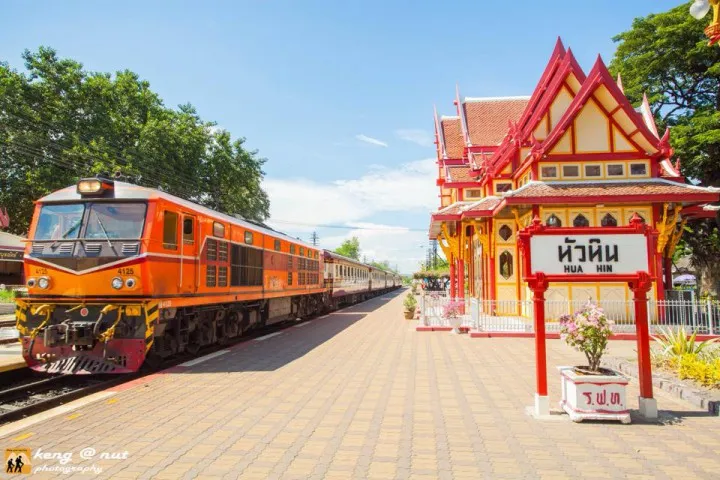
Hua Hin Railway Station is one of the most important landmarks in Hua Hin District, Prachuap Khiri Khan Province, and a place that many travelers instantly recognize from the image of its cream-and-red wooden station building standing prominently beside the railway tracks. Although Hua Hin is nationally known as a seaside resort town, its charm does not come from the sea alone. Hua Hin Railway Station is a key element that gives the town its classic character, its stories, and its historical depth in a way that clearly sets it apart from other beach destinations. This place is therefore not merely a point for boarding and leaving trains, but a gateway that connects Hua Hin’s past with the present image of a tourist town that still preserves its old-world atmosphere in an impressive way.
Hua Hin Railway Station is located on Thailand’s Southern Railway Line, one of the country’s most important railway routes for many decades, and it is considered the first station in Prachuap Khiri Khan Province for travelers arriving from Bangkok. The opening of this station on November 25, 1911 was significant not only in terms of rail transportation, but also in shaping Hua Hin’s development as a seaside resort town. Once travel from the capital to Hua Hin became more convenient, this small coastal town gradually became a destination for the elite, civil servants, members of the royal family, and travelers seeking a peaceful and elegant retreat by the sea.
From the perspective of Thai tourism history, Hua Hin Railway Station is one of the clearest examples of how transportation infrastructure can transform the identity of an entire town. Hua Hin was once a simple seaside community with a modest local way of life, but when the Southern railway line arrived, the town became more closely connected to the centers of power and the economy. The arrival of the railway did not bring only passengers; it also brought new trends, new forms of leisure, and new investment. As a result, Hua Hin gradually developed into one of Thailand’s best-known seaside resort towns.
The physical beginnings of Hua Hin Station were much simpler than the image most people know today. In its earliest period, the station consisted of a small wooden building in the style typical of stations of that era. However, as Hua Hin became increasingly popular, the station building was developed into something more elegant and more fitting for such an important seaside destination. Later, during the 1920s and 1930s, the station building that became Hua Hin’s iconic image emerged, featuring graceful wooden architecture, a cream-and-red color scheme, and decorative details that conveyed a distinctly nostalgic atmosphere. Over time, many travelers came to regard it as one of the most beautiful railway stations in Thailand.
The charm of Hua Hin Railway Station lies in the fact that the building is beautiful not only as architecture, but also as a symbol of an era when train travel represented the romance of tourism. Many people do not come here simply to board a train. They come to experience the old atmosphere of Hua Hin, to photograph the station sign, to stand and look at the long railway tracks, or to see Phra Mongkut Klao Pavilion with their own eyes. These experiences make Hua Hin Station different from an ordinary railway station, because it is a place where people come to “spend time,” not merely to “change trains.”
One of the elements that makes Hua Hin Station especially distinctive is Phra Mongkut Klao Pavilion, which stands near the station and has long been one of its defining images. This pavilion carries its own unique historical background. It was originally known as “Sanam Chan Pavilion” and once stood within Sanam Chandra Palace in Nakhon Pathom Province before being dismantled and reconstructed in Hua Hin at a later date. It was then used as a royal receiving pavilion and as a symbolic tribute to the grace of King Vajiravudh, Rama VI. The pavilion is therefore not simply a decorative structure, but a physical fragment of royal history, transportation history, and Thai tourism history gathered together in a single place.
From an architectural perspective, Phra Mongkut Klao Pavilion is an outstanding example of applied Thai architecture. Its chaturamukha form, fine craftsmanship, and colors that harmonize with the surrounding station buildings create a beautifully balanced composition. When seen together in one frame, the pavilion and the station building complement each other perfectly. This is one of the main reasons why Hua Hin Railway Station has become such a popular photography destination for both Thai and international visitors, because the images taken here communicate the identity of Hua Hin almost immediately, with very little explanation required.
Another important perspective is the relationship between Hua Hin Railway Station and the rise of major hotels and high-end tourism in Hua Hin. Once train access to Hua Hin became convenient, the town began attracting travelers with greater spending power who wanted to enjoy a refined coastal retreat. The establishment of the Hua Hin Railway Hotel, which later evolved into one of the town’s leading hotels, clearly reflected the fact that the railway played a role far beyond transportation alone. It was a major force that helped transform Hua Hin into a nationally important leisure destination. For this reason, Hua Hin Railway Station should be understood as “infrastructure that built a town,” not merely as an old structure that looks attractive in photographs.
In terms of atmosphere, Hua Hin Station is especially appealing because even though the surrounding town has developed rapidly, with shopping centers, modern hotels, and lively tourist districts, the area around the station still preserves some of old Hua Hin’s atmosphere. Visitors can easily continue on foot to Damnoen Kasem Road, the Hua Hin Night Market, Hua Hin Beach, or the old town area. This means a visit to Hua Hin Station does not need to be a standalone stop. It can be naturally connected to other important places in town. This is a major advantage for travelers who want to explore the town on foot and experience the real atmosphere of Hua Hin, rather than simply passing through quickly by car.
One thing many people should know before visiting is that present-day Hua Hin contains both the context of the old station and the new station within the same overall area. The new Hua Hin Station is an elevated station built to support a modern rail system and improve transportation efficiency, while the old station building has been preserved as a historical heritage site of both the town and Thai railways. This detail is very important, because many tourists still mistakenly believe the old station has disappeared. In reality, Hua Hin’s original charm remains, and it is still one of the main reasons why people continue to come here to check in and take photographs.
What makes Hua Hin Station interesting today is precisely this coexistence of past and present. On one side is the new station, which serves the practical needs of the modern rail system. On the other is the old station, which preserves Hua Hin’s memories for later generations to experience. Many tourist towns lose their old buildings or original atmosphere when new infrastructure is introduced, but Hua Hin has been fortunate enough to keep its most important identity alive alongside new development. This gives a visit here far more emotional and cultural weight than simply coming to see a modern railway station.
For travelers seeking a meaningful on-site experience, Hua Hin Railway Station is especially well suited to a morning or late afternoon visit. In the morning, the light is soft and the weather is not yet too hot, making it ideal for photographing the station building and Phra Mongkut Klao Pavilion. In the late afternoon, the station visit can be followed by a walk to Hua Hin Beach or nearby dining areas in town. A trip arranged in this way turns a station visit into much more than a brief photo stop. It becomes a way of connecting the station to the broader story of the town, from transportation history, architecture, and royal history to Hua Hin’s contemporary urban life.
Another reason Hua Hin Station deserves in-depth writing is its relationship to Hua Hin’s identity in the eyes of international visitors. Many seaside towns have beautiful beaches, fine hotels, and excellent restaurants, but Hua Hin has a very distinctive “visual memory”: the red station sign, the nostalgic wooden station building, and Phra Mongkut Klao Pavilion. These images make Hua Hin not just another beach town, but a beach town with history and a unique personality. Visitors therefore feel that they are not simply coming for a seaside holiday, but also to experience a place that holds a shared national memory.
Even though, in functional terms, Hua Hin Railway Station may not be the largest or busiest station on the Southern Line, in terms of cultural and tourism value it carries far more significance than an ordinary station. This station helps explain why Hua Hin developed in the way it did, how transportation once shaped people’s lifestyles, and how the beauty of a public building can remain in public memory for generations.
Getting There to Hua Hin Railway Station is convenient in several ways. If traveling by train from Bangkok, visitors can choose Southern Line services that stop at Hua Hin by checking the latest schedules from the State Railway of Thailand. If traveling by private car, visitors can take Phetkasem Road into central Hua Hin and then turn onto Damnoen Kasem Road, which is located not far from the town’s main tourist zone. Those arriving by minivan or bus can also get off in Hua Hin town and continue by local transport or by walking an appropriate distance to the station. This is easy because the station lies within the town area and is well connected to Hua Hin Beach, the Night Market, and several major hotels.
For travelers who want to organize a self-guided walking trip, Hua Hin Railway Station can be paired very naturally with nearby attractions. For example, you can begin at Hua Hin Railway Station, continue to the Hua Hin Night Market, the Hua Hin Clock Tower, Wat Hua Hin, or walk down to Hua Hin Beach and the area in front of the former Railway Hotel. Exploring in this way reveals that Hua Hin is not simply a town of resorts or shopping malls, but a place with layers of old-town character and living cultural structure that can still be felt today.
Looking at the whole picture, Hua Hin Railway Station is far more than a railway station. It is a meeting point for several major stories in Thai history, including the development of the Southern railway route, the rise of the modern seaside resort town, the role of the monarchy in Hua Hin, the preservation of architecture, and the adaptation of a historic town to a new era of transportation. For anyone who wants to understand Hua Hin beyond beaches and resorts alone, Hua Hin Railway Station is an ideal place to begin, because it opens the door to the town’s past, its identity, and its most authentic charm all in one location.
| Place Name | Hua Hin Railway Station |
| Address | Damnoen Kasem Road, Hua Hin Subdistrict, Hua Hin District, Prachuap Khiri Khan 77110, Thailand |
| Place Summary | An important historic railway station in Hua Hin and Prachuap Khiri Khan Province. It was the first station in the province on the Southern Line, opened in 1911, and remains a major architectural and tourism landmark of Hua Hin. |
| Highlights | Its iconic cream-and-red wooden station building, Phra Mongkut Klao Pavilion, its connection to Hua Hin’s growth as a resort town, and the old-town atmosphere that makes it easy to continue exploring nearby places on foot. |
| Historical Importance | Opened on November 25, 1911 during the reign of King Rama VI, it became the first railway station in Prachuap Khiri Khan Province and played a key role in helping Hua Hin develop into one of Thailand’s best-known seaside resort towns. |
| Architecture | The original station building features cream-and-red wooden architecture with a Victorian influence blended with Thai character, while Phra Mongkut Klao Pavilion is a striking chaturamukha pavilion and one of Hua Hin’s most recognizable symbols. |
| Getting There | Accessible by train, private car, minivan, and bus. The station is located near Hua Hin’s central tourist area and within easy reach of the Night Market, Hua Hin Beach, and several major hotels. |
| Open Days | Open Daily |
| Opening Hours | According to the train schedules of the State Railway of Thailand |
| Current Status | Hua Hin now has a new station for main rail operations, while the original station building has been preserved within the area and remains an important tourist attraction in the town. |
| Contact Number | 032-511-073 |
| Nearby Attractions | 1. Hua Hin Night Market – Approx. 0.4 km – Tel. 032-513-885 2. Hua Hin Beach – Approx. 0.8 km – Tel. 032-511-073 3. Wat Hua Hin – Approx. 0.8 km – Tel. 032-532-104 4. Hua Hin Artist Village – Approx. 4 km – Tel. 032-534-830, 087-167-3895 5. Hutsadin Elephant Foundation – Approx. 5 km – Tel. 032-827-100 |
| Nearby Restaurants | 1. Jek Pia Restaurant – Approx. 0.3 km – Tel. 032-511-289 2. Koti Hua Hin – Approx. 0.5 km – Tel. 032-511-252, 095-860-5364 3. Railway Restaurant – Approx. 0.9 km – Tel. 032-512-021 ext. 640 4. Railway Restaurant and Bar – Approx. 0.8 km – Tel. 090-980-8437 5. Monsoon Valley Wine Bar Hua Hin – Approx. 1.1 km – Tel. 081-904-3888, 081-904-5777 |
| Nearby Accommodations | 1. Centara Grand Beach Resort & Villas Hua Hin – Approx. 0.9 km – Tel. 032-512-021 2. Hub Hua Hin 57 Hotel – Approx. 0.6 km – Tel. 032-900-589, 082-363-8989 3. Hisea Hua Hin Hotel – Approx. 0.8 km – Tel. 032-515-655, 094-562-7555 4. Maven Stylish Hotel Hua Hin – Approx. 1 km – Tel. 032-652-999 5. Hua Hin Marriott Resort & Spa – Approx. 1.5 km – Tel. 032-904-666 6. Thipurai City Hotel – Approx. 1 km – Tel. 032-515-865, 099-241-5554 |
Frequently Asked Questions (FAQ)
Q: When was Hua Hin Railway Station first opened?
A: Hua Hin Railway Station first opened on November 25, 1911, and it was the first railway station in Prachuap Khiri Khan Province on the Southern Line.
Q: What is the most distinctive feature of Hua Hin Railway Station?
A: Its most distinctive features are the iconic cream-and-red wooden station building and Phra Mongkut Klao Pavilion, both of which are important historical and architectural symbols of Hua Hin.
Q: Is the original Hua Hin Railway Station still in use today?
A: Hua Hin now has a new station for main railway operations, while the original station building has been preserved and remains an important tourist attraction in the town.
Q: What is the best time to visit Hua Hin Railway Station?
A: Early morning and late afternoon are the best times to visit because the weather is cooler, the light is beautiful for photography, and it is easy to continue to Hua Hin Beach or the Night Market afterward.
Q: Can I visit Hua Hin Railway Station for photos even if I am not taking a train?
A: Yes. Hua Hin Railway Station is one of the town’s most popular landmarks. Many visitors come specifically to admire the architecture, take photos with the station sign, and see Phra Mongkut Klao Pavilion without using the train service.
Q: Is Hua Hin Railway Station close to other attractions in town?
A: Yes. It is close to many attractions, including Hua Hin Night Market, Hua Hin Beach, Wat Hua Hin, and the old town area, making it ideal for a walking trip through central Hua Hin.
Q: How much time should I allow for visiting Hua Hin Railway Station?
A: If you only want to take photos and walk around the station area, 30 minutes to 1 hour is usually enough. If you plan to continue to the Night Market, Hua Hin Beach, and nearby areas, you should allow at least half a day.
 Website: www.railway.co.th
 Tel: 032511073
 Hua Hin Railway Station Map
 Category:
  Group:
  Last Update: 3 DayAgo
Comment
 Nearby Attractions
| Keyword (Advance) |
 Region
|
 Muang Prachuap Khiri Khan(