
 Home
Home North(
 Chiang Mai(


Rating: 4.6/5 (5 votes)
 |
|  Map
Map 
 Have Map
  No Map
Pathum Thani attractions
Attractions in Thailand
Open Days: Depends on funeral arrangements and the schedule set by the host family
Opening Hours: Depends on the timing of the funeral chanting ceremony and the host family’s program
Mon Dance in Pathum Thani is one of the most distinctive cultural traditions associated with the Mon communities of central Thailand. In Pathum Thani, it is especially important because it is deeply tied to funeral rites, local identity, and the historical presence of Mon settlements along the Chao Phraya River. This is not simply a performance staged for entertainment. It is a meaningful ritual dance that combines grace, mourning, respect, and cultural continuity in a single tradition.
In Pathum Thani, Mon Dance is most widely recognized as a funeral performance. When someone passes away, the body is brought to a temple for merit-making and funeral chanting. During the chanting period, a Mon dance troupe may be invited to perform in front of the coffin. For outsiders, this may seem unusual at first, but within the Mon cultural framework the dance is a way of honoring the deceased, expressing respect, and helping ease sorrow through ritualized beauty and music.
The roots of Mon Dance in Pathum Thani are closely linked to the migration of Mon communities into the Sam Khok area and nearby settlements from the Ayutthaya period onward. These communities brought with them their language, clothing traditions, music, ritual practices, and performance culture. Over time, Mon Dance became embedded in local life and gradually gained recognition not only among Mon families but also among the wider Thai population in the province.
Its most important meaning lies in belief. In Pathum Thani, Mon funeral dance is understood as a respectful offering for the dead and as a merit-making act that symbolically sends the deceased to a better realm. For this reason, even though it appears in a funeral setting, the dance is not treated as inappropriate festivity. Instead, it is seen as a dignified cultural expression of farewell, remembrance, and goodwill toward the departed.
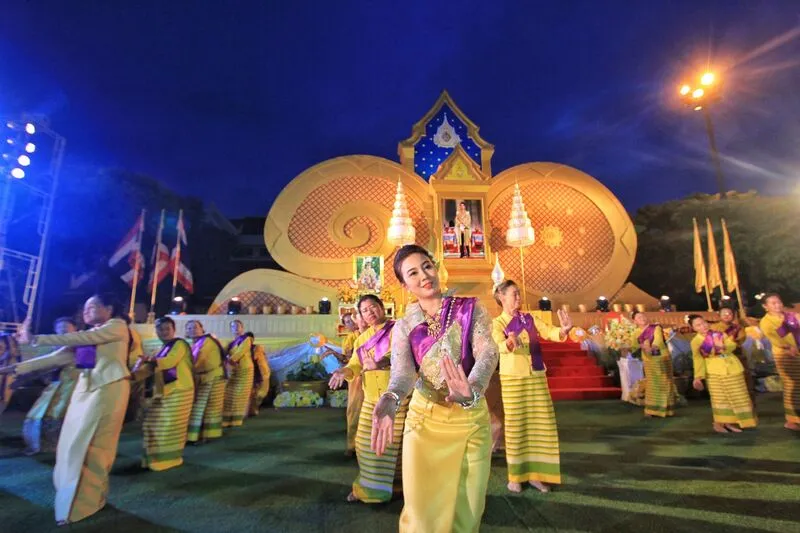
The performers are now usually women, and in many troupes several female dancers perform together as a group. Their costumes are based on Mon women’s attire, including a patterned sarong, a long-sleeved blouse, a shawl, neatly arranged hair, and floral decoration. These details are important because Mon Dance in Pathum Thani is not only about movement. It also preserves visible markers of Mon identity through dress, body posture, and presentation.
A notable aspect of the tradition is the sequence of costume colors used during funeral performances. The first set is often in black with a white shawl to show respect for the deceased. Later sets may use green, red, pink, or other colors prepared by the troupe. This progression helps shape the emotional rhythm of the performance, balancing mourning with dignity and offering a gentler atmosphere for grieving families and guests.
The music is performed by a Mon piphat ensemble. Its sound is slow, solemn, and emotionally rich, which makes it especially suitable for funeral settings. The dance movements themselves are characteristically unhurried, graceful, and controlled. Rather than emphasizing excitement or spectacle, Mon Dance creates a calm and respectful atmosphere that matches the spiritual tone of the ceremony.
In earlier times, Mon Dance in Pathum Thani could be performed across many songs and for a relatively long duration. One of the distinctive customs was the alternation between funeral chanting and dancing. After one round of chanting ended, the dancers would perform a set of Mon dance pieces before the next round began. This structure linked Buddhist ritual and cultural performance closely together and gave the funeral ceremony a clear rhythm and ceremonial flow.
Today, many troupes perform shorter programs to suit modern schedules and changing social expectations. Even so, the essential meaning of the tradition remains intact. The dance is still performed for the deceased, still accompanied by Mon musical tradition, and still recognized as an important marker of Mon cultural heritage in Pathum Thani. What has changed is mainly format and duration, not the heart of the practice.
Another important element is the teacher-honoring ritual. Before performing, dancers traditionally pay respect to their teachers, including living teachers, deceased teachers, and spiritual masters. This reflects the Thai and Mon understanding that performing arts are not merely technical skills. They are inherited disciplines that carry spiritual, ethical, and cultural weight. In funeral settings, the dancers also observe gestures of respect toward monks, the deceased, the musicians, and the audience.
For Pathum Thani as a whole, Mon Dance is one of the clearest expressions of local Mon identity. When people think of the province’s Mon heritage, they often think of temples, riverside communities, and seasonal traditions. Mon Dance belongs firmly within that heritage, but it is especially powerful because it brings together costume, music, ritual, belief, and movement in one living cultural form. It is both performance and cultural memory in motion.
In terms of transmission, Mon Dance has long relied on the teacher-disciple system. Learners observe, memorize, practice, and gradually absorb both the dance technique and the proper ritual conduct surrounding performance. This has helped preserve the tradition even as society has changed. At the same time, some adaptation has taken place, especially in costume refinement and in shortening performance time to suit present-day funerals.
Getting There Because Mon Dance is not a fixed tourist show with a permanent stage, seeing it in its original context usually depends on funeral ceremonies or important community events in Mon areas of Pathum Thani, especially around Sam Khok and older Mon temple communities. Visitors who want to study or witness the tradition should begin by learning about these Mon cultural areas and by following local cultural networks, temples, or community news. From Bangkok, Pathum Thani can be reached easily by private car, and visitors can continue into Mon community areas for further local inquiry.
What makes Mon Dance so valuable today is that it is still alive in real community life. Each performance is more than a dance. It is a continuation of Mon memory, a final gesture of honor toward the dead, and a reminder that the cultural roots of Pathum Thani remain active and meaningful in the modern world.
| Name | Mon Dance |
| Cultural Area | Mon communities in Pathum Thani, especially Sam Khok and riverside Mon settlements |
| Timing | Depends on funeral arrangements and the schedule of the host family |
| Highlights | Traditional Mon dance performed mainly in funeral rites, accompanied by a Mon piphat ensemble |
| Significance | Represents Mon identity in Pathum Thani and expresses respect, mourning, and merit for the deceased |
| Performers | Today the performance is mainly carried out by female dancers, often in group formation |
| Costume | Mon-style women’s dress with sarong, long-sleeved blouse, shawl, arranged hair, and floral decoration |
| Music | Mon piphat ensemble |
| Important Ritual Elements | Teacher-honoring rite, and gestures of respect toward monks, the deceased, musicians, and audience |
| Performance Format | Formerly longer and often alternated with funeral chanting; now often shortened to suit present-day ceremonies |
| Funeral Costume Colors | The first set is often black with a white shawl, followed by green, red, pink, or other prepared colors |
| Current Status | Still practiced and transmitted in funeral rites and selected Mon community events in Pathum Thani |
Frequently Asked Questions (FAQ)
Q: What is Mon Dance in Pathum Thani?
A: It is a traditional Mon performing art in Pathum Thani, especially associated with funeral rites and cultural identity.
Q: When is Mon Dance performed?
A: It does not follow a fixed public schedule. It is usually performed according to funeral arrangements and the host family’s chanting program.
Q: Why is Mon Dance performed at funerals?
A: It is believed to honor the deceased, express mourning, and help send the deceased to a better realm.
Q: What music accompanies the dance?
A: The performance is accompanied by a Mon piphat ensemble, known for its solemn and emotionally rich sound.
Q: What do the dancers wear?
A: They wear Mon-style costumes, including a sarong, long-sleeved blouse, shawl, arranged hair, and floral decoration.
Q: Is Mon Dance still practiced today?
A: Yes. It is still practiced in Pathum Thani, especially in funerals and important cultural activities within Mon communities.
 Category:
  Group:
  Last Update: 7 HourAgo
Comment
 Nearby Attractions
| Keyword (Advance) |
 Region
|
 Muang Pathum Thani(