
 Home
Home North(
 Chiang Mai(


Rating: 3.7/5 (9 votes)
 |
|  Map
Map 
 Have Map
  No Map
Nonthaburi attractions
Attractions in Thailand
Open Days: Daily
Opening Hours: 08.30 – 16.30
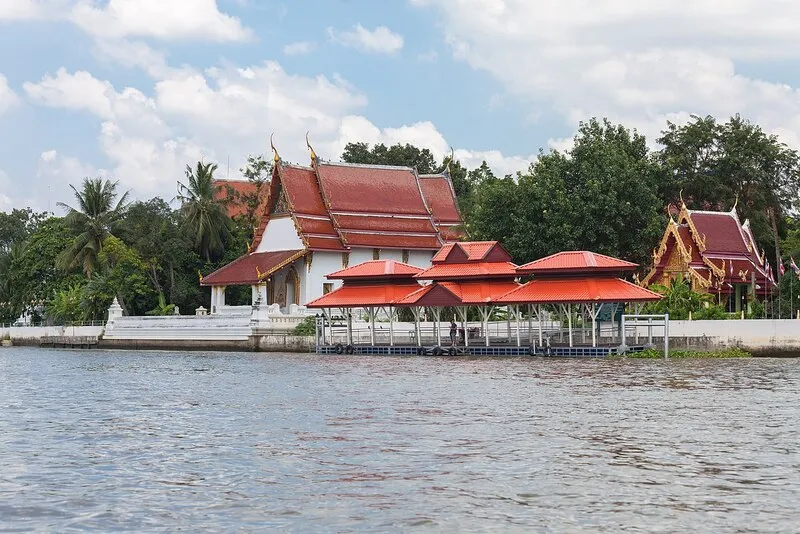
Wat Klang Kret in Bang Talat, Pak Kret District, Nonthaburi, is an old riverside temple dating back to the late Ayutthaya period. It is especially notable for its waterside setting along the Lad Kret canal, its wooden scripture hall in the middle of a pond, its old ordination hall, and its reclining Buddha image known as Luang Pho Phra Non. For travelers exploring Pak Kret beyond the usual island route, this temple offers a meaningful combination of local history, religious atmosphere, and traditional architecture.
Among the historic temples of Pak Kret, Wat Klang Kret stands out because it is deeply connected to the geography of the area. The temple sits on low-lying land beside the Lad Kret waterway and is not far from Wat Sanam Nuea. This setting matters because Pak Kret developed around waterways, ferry routes, canal communities, and river trade. A temple in this location was never only a religious site. It was also part of the social and practical life of the district.
Wat Klang Kret is a royal-recognized common temple under the Mahanikaya order and is located in Moo 1, Ban Pak Dan, Bang Talat Subdistrict, Pak Kret District, Nonthaburi. Historical references generally place its origin in the late Ayutthaya period. One long-standing interpretation suggests that the temple may have been established around the time the Lad Kret shortcut canal was dug during the Ayutthaya era. That connection is important because it places the temple within the wider historical reshaping of the Pak Kret river landscape.
The temple’s history also intersects with the turbulent period surrounding the fall of Ayutthaya. Local and historical summaries state that Burmese forces once occupied the Nonthaburi area and set up camp behind the temple in order to gather troops for the assault on Ayutthaya. After the fall of the capital in B.E. 2310, the Pak Kret checkpoint area came under enemy control, and Wat Klang Kret was left neglected for a period of time. This phase explains why the temple’s story is not only one of worship and community continuity, but also one of survival through conflict.
In the Thonburi period, the temple began to recover. King Taksin is recorded as having encouraged Mon communities to settle near Pak Kret and the checkpoint area, and these Mon residents helped care for Wat Klang Kret. Later, more Thai residents moved into Ban Pak Dan near the southern mouth of the shortcut canal and joined in restoring the temple and supporting its religious life. This shared Thai-Mon relationship gives the temple a particularly rich local identity and helps explain its long-term place in the community.
The temple later received its royal boundary charter in B.E. 2332. That milestone confirms that Wat Klang Kret had regained its recognized status and continued serving as an active Buddhist institution into the early Rattanakosin period. Its history therefore reflects a broader regional pattern: old riverside temples often depended on the resilience and cooperation of local communities in order to survive periods of war and political change.
Architecturally, one of the most remarkable features of Wat Klang Kret is its ordination hall. The gable is decorated with carved wooden swirling foliage patterns, and inside the hall sits the principal Buddha image in the Mara-Vijaya posture, measuring about three sok and one khuep across the lap. The ordination hall expresses the understated elegance of an old local temple, while the carved wood gives it visual richness without overwhelming the atmosphere of calm.
Another major highlight is the scripture hall in the middle of a pond, built by local craftsmen. A scripture hall of this type reflects both practical wisdom and architectural beauty. Traditionally, storing Buddhist scriptures above water helped protect them from insects and ground moisture. At the same time, the building’s placement over water adds a distinctly poetic quality to the temple grounds. The reflection of the structure on the pond gives the area a peaceful and memorable character, especially in the morning light.
In devotional terms, Wat Klang Kret is also known for its reclining Buddha image, called Luang Pho Phra Non. The original image once lay outdoors and was regarded as an old sacred figure of uncertain date. After severe deterioration, it was rebuilt and enshrined inside a viharn. The present image is in the lion-resting posture, with the feet and arm positioned in a way that follows traditional iconography, and the soles of the feet include wheel motifs. This gives the viharn an important role in the temple’s sacred landscape and offers visitors another focal point beyond the main ordination hall.
Because the temple includes an ordination hall, the scripture hall in the pond, and the reclining Buddha viharn in one compact but historically layered setting, it offers a very complete experience for visitors. Some come primarily for merit-making, some for heritage appreciation, and others because the temple forms part of a broader Pak Kret and Ko Kret exploration. The temple handles all of these roles naturally because it remains an active religious site rather than a purely touristic monument.
The surroundings add further charm. The temple remains closely tied to the local river community, nearby piers, and routes leading toward Ko Kret. That is one reason Wat Klang Kret is often remembered together with the larger waterside culture of Pak Kret. A visit here feels like part of a wider story about canals, crossings, old checkpoint settlements, Mon heritage, and community-based religious life.
For practical trip planning, Wat Klang Kret works very well as part of a half-day or full-day route. It can be combined with Wat Sanam Nuea, the ferry crossing to Ko Kret, local markets, and riverside restaurants in Pak Kret. Visitors who want a quieter and more historical temple stop before or after visiting the island often find this temple especially rewarding.
Getting There is straightforward. By car, visitors can reach Pak Kret via Chaeng Watthana Road or Phumwet Road and continue into the Bang Talat area and Sukhaprachasan 1 Road. Those using public transport can travel to the Pak Kret zone and continue locally by taxi or local transport. The temple is also close to the boat routes and piers used for visiting Ko Kret, which makes it convenient for travelers planning to explore several nearby attractions on the same day.
The best time to visit is from morning to late afternoon, when the temple is open and the riverside atmosphere is easiest to enjoy. Morning light is especially suitable for viewing the scripture hall in the pond and photographing the temple surroundings. As with any Thai temple, respectful dress and quiet behavior are appropriate, especially in the ordination hall and reclining Buddha viharn.
Wat Klang Kret is therefore one of the most quietly significant temples in Pak Kret. Its late-Ayutthaya roots, its connection to waterway history, its restoration through Thai and Mon community support, and its distinctive architectural features all make it far more than a simple local temple. For travelers seeking a temple in Nonthaburi with atmosphere, history, and a real sense of place, Wat Klang Kret is an excellent choice.
| Name | Wat Klang Kret |
| Location | Moo 1, Ban Pak Dan, Bang Talat Subdistrict, Pak Kret District, Nonthaburi |
| Address | No. 1, Moo 1, Sukhaprachasan 1 Road, Bang Talat, Pak Kret, Nonthaburi 11120 |
| Highlights | Scripture hall in the pond, carved wooden gable of the ordination hall, Luang Pho Phra Non reclining Buddha, riverside atmosphere near Ko Kret |
| History | Built in the late Ayutthaya period and granted its royal boundary charter in B.E. 2332 |
| Name Origin | The temple name is linked to its location in the Lad Kret and Ban Pak Dan riverside area of Pak Kret |
| Distinctive Features | Ordination hall with carved wooden swirling gable motifs, principal Buddha in Mara-Vijaya posture, scripture hall built over water by local craftsmen |
| Travel Information | Accessible by car via Chaeng Watthana or Phumwet Road into Bang Talat and Sukhaprachasan 1 Road; easy to combine with ferry routes to Ko Kret |
| Current Status | Open daily and active for worship and visits |
| Open Days | Daily |
| Opening Hours | 08.30 – 16.30 |
| Facilities | Temple grounds, worship areas, nearby pier access, local shops and eateries in the temple area |
| Main Areas / Zones | Ordination Hall, Scripture Hall in the Pond, Luang Pho Phra Non Viharn, Riverside Zone |
| Abbot / Caretaker | Phra Khru Vinayathorn Samnuek Sitthimano |
| Main Contact Number | 02-584-3556 |
| Official Website / Official Page | Facebook: Wat Klang Kret Luang Pho Phra Non |
| Nearby Tourist Attractions | 1) Wat Sanam Nuea – about 1 km 2) Ko Kret Ferry Pier – about 1 km 3) Wat Poramai Yikawat, Ko Kret – about 2 km 4) Pak Kret Market – about 3 km 5) Pak Kret Pier – about 3 km |
| Nearby Restaurants | 1) Krua Chaiyan 2 River Fish & Seafood Branch 1 – about 1 km, Tel. 02-960-8955, 02-960-9255 2) Kret Island Restaurant – about 2 km, Tel. 02-960-8788 3) Hong Seng Rim Nam – about 4 km, Tel. 02-583-8631, 02-583-7654 4) KHRUA RIM NAM – about 5 km, Tel. 089-170-3320, 082-544-2733 5) Baan Jaa Mongkut Thai Desserts, Ko Kret – about 2 km, Tel. 083-589-1890 |
| Nearby Accommodations | 1) 24@Home Hotel – about 6 km, Tel. 02-582-2255, 081-988-8544 2) KOO Hotel – about 9 km, Tel. 02-502-9830 3) Best Western Plus Wanda Grand Hotel – about 10 km, Tel. 02-582-8282, 062-594-3609 4) ibis Bangkok IMPACT – about 9 km, Tel. 02-011-7777 5) Novotel Bangkok IMPACT – about 9 km, Tel. 02-833-4888 |
Frequently Asked Questions (FAQ)
Q: Where is Wat Klang Kret located?
A: Wat Klang Kret is in Moo 1, Ban Pak Dan, Bang Talat Subdistrict, Pak Kret District, Nonthaburi, near Wat Sanam Nuea and the ferry routes to Ko Kret.
Q: When was Wat Klang Kret built?
A: The temple dates back to the late Ayutthaya period and later received its royal boundary charter in B.E. 2332.
Q: What is the main highlight of Wat Klang Kret?
A: Its main highlights are the scripture hall in the pond, the carved wooden gable of the ordination hall, and the reclining Buddha known as Luang Pho Phra Non.
Q: What are the opening hours of Wat Klang Kret?
A: The temple is open daily from 08.30 to 16.30.
Q: Can I combine a visit to Wat Klang Kret with Ko Kret?
A: Yes. The temple is close to ferry routes and is very suitable for a combined temple-and-island trip in Pak Kret.
Q: What else can I see inside the temple besides the main Buddha image?
A: You can also see the reclining Buddha viharn and the scripture hall built in the middle of a pond.
Q: What kind of trip is Wat Klang Kret best for?
A: It is ideal for merit-making, old temple visits, riverside cultural travel, and half-day or full-day exploration around Pak Kret.
 Wat Klang Kret Map
 Category:
  Group:
  Last Update: 15 HourAgo
Comment
 Nearby Attractions
| Keyword (Advance) |
 Region
|
 Muang Nonthaburi(