
 Home
Home North(
 Chiang Mai(


Rating: 4/5 (5 votes)
 |
|  Map
Map 
 Have Map
  No Map
Nakhon Pathom attractions
Attractions in Thailand
Open Days: Open Daily
Opening Hours: 07:00 – 18:00
Wat Rai Khing Royal Monastery is an important temple on the banks of the Tha Chin River, also known as the Nakhon Chai Si River, in Rai Khing Subdistrict, Sam Phran District, Nakhon Pathom Province. It belongs to the Maha Nikaya monastic order and is one of the best-known temples in Central Thailand because it enshrines “Luang Pho Wat Rai Khing,” a sacred Buddha image that has long been deeply revered by the people of Nakhon Pathom and Buddhist devotees from many parts of the country. Although the temple is not far from Bangkok and is easy to reach, the moment visitors enter the grounds they can immediately feel a marked contrast with the rush of the city, thanks to its riverside atmosphere, shaded surroundings, and the powerful sense of living faith that can be felt throughout the day.
Wat Rai Khing was originally an ordinary local temple before being elevated to the status of a third-class royal monastery on 10 July 1990. This gave the temple an important standing in terms of history, religion, and local sentiment. Its importance lies not only in being a place for religious practice, but also in serving as a long-standing spiritual center for the communities of Sam Phran District and Nakhon Pathom Province. The name of Wat Rai Khing has long been closely connected with the riverside way of life along the Nakhon Chai Si River, and it has become one of the major destinations for merit-making, paying respect to sacred images, and cultural tourism near Bangkok.
According to oral accounts passed down from older generations, Wat Rai Khing was founded in 1851 by Phra Dhammarachanurwat (Phuk), a native of Nakhon Chai Si, who was later elevated to Somdet Phra Phutthachan (Phuk). At that time, he was serving as the abbot of Wat Sala Pun Worawihan in Ayutthaya Province. He returned to build Wat Rai Khing as well as Wat Don Wai in his home area. However, the construction was not fully completed before he passed away in 1884. As a result, much of the remaining work fell to Phra Dhammarachanurwat (At Chandachoto), the sixth abbot of Wat Sala Pun and his nephew, who continued the restoration and care of the temple afterward.
The name of the temple also has an interesting story behind it. In the past, many Chinese settlers lived in this area, and they widely cultivated ginger. This gave rise to the name of the community, “Rai Khing,” meaning “ginger fields.” As the community grew more densely settled, a temple was established to serve as its spiritual center, and it naturally took the name of the community, becoming “Wat Rai Khing.” Later, around 1903, Somdet Phra Maha Samanachao Krom Phraya Vajirananavarorasa visited temples in Sam Phran District and came to this temple. He bestowed a new name, “Wat Mongkhon Chindaram,” while preserving the old name in parentheses as “(Rai Khing),” resulting in “Wat Mongkhon Chindaram (Rai Khing).” Over time, however, people continued to call it simply “Wat Rai Khing,” and that became the name used in common speech up to the present day.
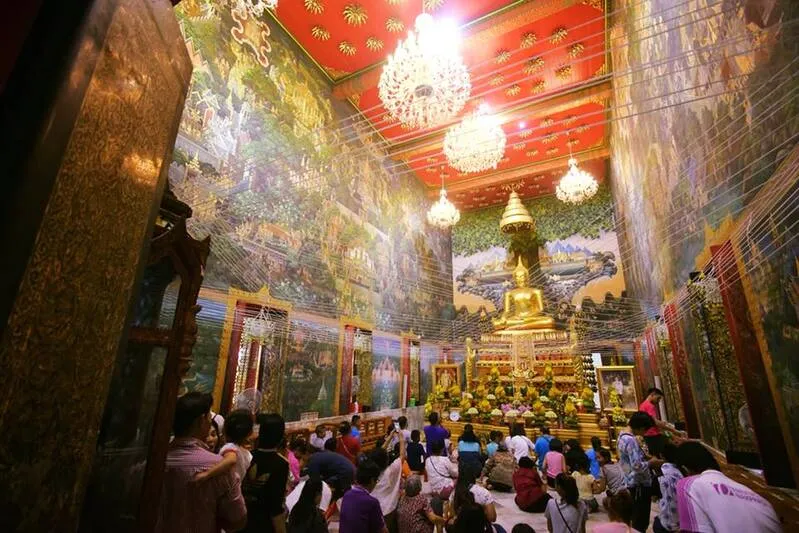
The spiritual heart of Wat Rai Khing is “Luang Pho Wat Rai Khing,” a highly revered Buddha image in the Mara-Vijaya posture. The image is cast in bronze, with a lap width of 4 sok and 2 inches, and a height of 4 sok and 16 inches. It is enshrined on a five-tiered pedestal inside the ordination hall, facing north toward the front of the temple and the Nakhon Chai Si River. The artistic features of the image are especially distinctive. Its bearing is graceful and upright like Chiang Saen art, its hands are slender and elegant in the Sukhothai style, while its face bears characteristics associated with the Rattanakosin period. This makes Luang Pho Wat Rai Khing not only a sacred object of worship, but also a Buddha image of considerable artistic distinction.
According to the historical record of the temple, Somdet Phra Phutthachan (Phuk) invited the image from Wat Sala Pun in Ayutthaya and transported it by water on a bamboo raft known as a “luk buap raft.” When the raft arrived in front of Wat Rai Khing, the image was ceremonially brought ashore and enshrined inside the ordination hall. This took place on the full moon day of the fifth lunar month, which coincided with Songkran. As the image was being moved from the raft to the ceremonial pavilion, an extraordinary event was said to have occurred. The intense heat and sunlight suddenly gave way to dark clouds, strong winds, thunder, and rainfall, bringing a cool and refreshing atmosphere. Those who attended the ceremony were filled with joy and made a shared prayer that Luang Pho would bring peace, coolness, and relief from suffering, just as rain nourishes the earth and brings fertility. Because of this, the day the image was enshrined, which fell on Songkran, became an important date, and it remains the origin of the annual Luang Pho Wat Rai Khing worship and gold-leaf offering festival.
The legends surrounding Luang Pho Wat Rai Khing exist in several versions, reflecting faith passed down through oral tradition. One legend says that Somdet Phra Phutthachan (Phuk) visited temples in Sam Phran District and, upon entering the ordination hall of Wat Rai Khing, felt that the original principal Buddha image was too small. He therefore instructed the abbot and villagers to invite an important Buddha image from Wat Sala Pun to be enshrined here. Another legend is tied to the temple’s founding in 1851, stating that after the ordination hall was completed, an important Buddha image was invited from Ayutthaya to become the principal image, but the construction was not fully completed before the founder passed away, and the remaining work was finished by Phra Dhammarachanurwat (At Chandachoto).
The most widely told legend is the story of the floating Buddha images. Some versions say there were five images, while others say there were three. In the five-image version, the sacred Buddha images floated along different rivers and eventually became the principal revered images of several provinces, including Luang Pho Sothon, Luang Pho Wat Rai Khing, Luang Pho Wat Bang Phli, Luang Pho Wat Ban Laem, and Luang Pho Wat Khao Takrao. In the Nakhon Pathom version of the legend, three Buddha images floated together, displaying miracles along the waterways and passing through several riverside communities before one finally chose to remain at Wat Rai Khing, another continued to Wat Ban Laem, and the third reached Wat Khao Takrao. Although these legends vary, they all emphasize the same essential belief: that Luang Pho Wat Rai Khing is not simply the principal Buddha image of the temple, but a miraculous and sacred image that has long served as a spiritual refuge for the people.
The ordination hall of Wat Rai Khing is another part of the temple of great artistic value. The building is a rectangular structure in early Rattanakosin style, built of brick and plaster. Its pediment is decorated with a lotus motif, while the roof is adorned with chofa finials, bai raka, and hang hong ornaments, and covered with alternating glazed roof tiles. The door frames are embellished with stucco vine motifs. The outer door panels feature gilded lacquer designs of the Four Great Heavenly Kings, while the inner panels depict fierce guardian giants. The outer window shutters are decorated with gilded lacquer images of trees and animals, while the inner side is painted with floral designs. The window frames are also adorned with stucco vine patterns. These details make Wat Rai Khing a place of remarkable completeness, both in terms of devotion and as a valuable site for the study of Thai religious art.
Surrounding the ordination hall are directional viharns on all four sides, each with pediments decorated with stucco figures of praying celestial beings and without the usual door and window frames seen in many viharns. In front of and behind the ordination hall stand two Thai-style four-gabled pavilions. Their pediments contain stucco scenes narrating the life of the Buddha from his birth to his final nirvana, including the division of the Buddha’s relics. Along the lower edges are sculpted figures of Rahu swallowing the moon, and every pillar ends with an upward-facing lotus form, adding rich artistic dimension to the area. There is also a pavilion in the middle of a pond to the west of the ordination hall, which enshrines a replica of the Buddha’s footprint and is another popular stop for worshippers.
Wat Rai Khing is not only an old temple with significant legends and sacred objects, but also a temple that remains very much alive today. Its grounds are divided into two sections: the sacred religious zone and the public-use zone. Within the overall area are a school and a hospital, with a road running through the middle. This reflects the temple’s true role as a center of community life, linking religion, education, healthcare, and everyday living. Walking through the temple, visitors do not encounter only a sacred and peaceful atmosphere, but also the daily life of people who remain closely connected to the temple.
The riverside atmosphere in front of the temple is another important reason why Wat Rai Khing differs from many other temples. The riverbank in front of the temple is a sanctuary area where thousands of large striped catfish live. Visitors can buy bread or fish food to feed them. This activity makes a temple visit feel more relaxed and welcoming for people of all ages, including the elderly, families, and children. At the same time, every Friday and Sunday morning, there is a local market in front of the temple selling food and fruit. This gives visitors a closer look at riverside community life, with local dishes, fresh produce, and a lively trading atmosphere. As a result, Wat Rai Khing is more than just a temple for paying respect; it is a destination that combines faith, relaxation, and local culture in one place.
Today, Wat Rai Khing remains one of the most important temples in Nakhon Pathom Province and in Sam Phran District. People from both the local area and other provinces continue to come to pay respect to Luang Pho Wat Rai Khing on a regular basis. The importance of the temple has not diminished over time. On the contrary, it has become even more significant as a place where the past and present are clearly connected. Visitors encounter history, legend, Buddhist art, living faith, and a vibrant riverside atmosphere all in one visit. It is therefore no surprise that Wat Rai Khing remains one of the most worthwhile destinations for pilgrims and cultural travelers alike.
Getting There Wat Rai Khing is easy to reach from Bangkok and nearby provinces. The most common route is to take Phet Kasem Road toward Sam Phran District and then follow the signs to Wat Rai Khing. The temple is located along the Tha Chin River in Rai Khing Subdistrict and is easily accessible by private car. Visitors can also travel by public transport to the Sam Phran area and then continue by local transport to the temple. Once there, they will find spacious grounds with worship areas, merit-making zones, riverside spaces, and fish-feeding points, making the site suitable for both a short temple visit and a half-day or full-day outing.
In summary, Wat Rai Khing Royal Monastery is one of the most important temples in Nakhon Pathom Province, bringing together many layers of value in one place. These include the temple’s origins under Somdet Phra Phutthachan (Phuk), the story behind its name, the legends of Luang Pho Wat Rai Khing, the beauty of its ordination hall and Thai religious art, and the lively yet peaceful atmosphere along the Tha Chin River. For those looking for a temple near Bangkok that offers serenity, devotion, beauty, and a meaningful taste of riverside community life, Wat Rai Khing is unquestionably a destination worth visiting.
| Name | Wat Rai Khing Royal Monastery |
| Summary | A royal monastery on the Tha Chin River in Sam Phran District, Nakhon Pathom Province, famous for Luang Pho Wat Rai Khing, a sacred Buddha image continuously revered by Buddhist devotees. |
| Highlights | Luang Pho Wat Rai Khing, the early Rattanakosin ordination hall, the four-gabled pavilion, the replica Buddha footprint pavilion, the riverside sanctuary zone, and the market held in front of the temple on certain days. |
| History / Period | Older generations recount that the temple was founded in 1851 by Phra Dhammarachanurwat (Phuk), who was later elevated to Somdet Phra Phutthachan (Phuk). It was originally a local temple before being elevated to a third-class royal monastery on 10 July 1990. |
| Address | 51 Moo 2, Phet Kasem Road, Rai Khing Subdistrict, Sam Phran District, Nakhon Pathom 73210, Thailand |
| Coordinates | 13.742582, 100.258624 |
| Zone | Rai Khing Subdistrict, Sam Phran District, Nakhon Pathom Province, on the Tha Chin River |
| Getting There | Travel from Bangkok via Phet Kasem Road toward Sam Phran District, then follow the signs to Wat Rai Khing. The temple is on the Tha Chin River and is easily accessible by private car. Visitors can also take public transport to Sam Phran and continue by local transport to the temple. |
| Open Days | Open Daily |
| Opening Hours | 08:00 – 16:00 |
| Entrance Fee | No admission fee information found |
| Facilities | Large temple grounds, worship areas, fish-feeding points, riverside spaces, parking, shops, and markets on certain days. |
| Latest Publicly Announced Acting Abbot | Phra Ratchawachirasutaphon, abbot of Wat Bang Chang Nuea, serving as acting abbot of Wat Rai Khing |
| Nearby Attractions | 1. Pathom Organic Village – 2 km 2. Samphran Elephant Ground and Zoo – 2.6 km 3. Sri Sawat Retro Pier – 4.1 km 4. Wat Don Wai – 4.8 km 5. Don Wai Floating Market – 7.2 km |
| Nearby Restaurants | 1. Khrua Mae Nong Rai Khing 26 Wat Rai Khing – Near the Wat Rai Khing area – Tel. 096-289-5677, 086-788-6707 2. Khrua Im Aroi (Rai Khing) – Near the Rai Khing area – Tel. 084-649-6753 3. The Three Little Pigs, Tha Talat – 1.5 km 4. O2 Kaffee & Bistro – 1.8 km 5. Cafe Saturday – 800 m |
| Nearby Accommodations | 1. Baan Phak Araya Rai Khing – 1 km – Tel. 092-674-0724, 065-568-3021 2. Baan Ruean Kaew Sampran Riverside – 1.9 km 3. Baan Suan Bang Toei Homestay – Near Wat Rai Khing / Don Wai Floating Market – Tel. 081-659-5805 4. Sampran Riverside – Near the Sam Phran area |
| Contact | Tel. 034-311-384, 034-323-056, 034-323-616 |
Frequently Asked Questions (FAQ)
Q: Where is Wat Rai Khing located?
A: Wat Rai Khing is located in Rai Khing Subdistrict, Sam Phran District, Nakhon Pathom Province, on the banks of the Tha Chin River, also known as the Nakhon Chai Si River.
Q: Who founded Wat Rai Khing?
A: According to oral tradition, Wat Rai Khing was founded by Phra Dhammarachanurwat (Phuk), who was later elevated to Somdet Phra Phutthachan (Phuk).
Q: What posture is Luang Pho Wat Rai Khing in?
A: Luang Pho Wat Rai Khing is a Buddha image in the Mara-Vijaya posture and is the principal Buddha image inside the ordination hall.
Q: What legend is associated with Luang Pho Wat Rai Khing?
A: One legend says that Luang Pho Wat Rai Khing was invited from Wat Sala Pun by water, and other traditions connect the image to the famous floating Buddha legends shared across several provinces.
Q: What are the main highlights of Wat Rai Khing?
A: The main highlights are Luang Pho Wat Rai Khing, the early Rattanakosin ordination hall, the four-gabled pavilion, the replica Buddha footprint pavilion, the riverside sanctuary zone, and the market held in front of the temple on certain days.
Q: How do I get to Wat Rai Khing?
A: You can travel from Bangkok via Phet Kasem Road toward Sam Phran District and then follow the signs to Wat Rai Khing. The temple is easily accessible by private car.
 Tel: 034311384, 034323056
 Wat Rai Khing Royal Monastery Map
 Category:
  Group:
  Last Update: 6 HourAgo
Comment
 Nearby Attractions
| Keyword (Advance) |
 Region
|
 Muang Nakhon Pathom(