
 Home
Home North(
 Chiang Mai(


Rating: 3.5/5 (17 votes)
 |
|  Map
Map 
 Have Map
  No Map
Nakhon Pathom attractions
Attractions in Thailand
Open Days: Open Daily
Opening Hours: 08:00 – 17:00
Wat Dhammapanyaram Bang Muang (Heng Seng Yi) is a Mahayana Buddhist temple in Bang Chang Subdistrict, Sam Phran District, Nakhon Pathom Province. It is distinguished by its artistic character, deep spiritual significance, and peaceful setting along the Tha Chin River, also known as the Nakhon Chai Si River. The front of the temple faces the river, which has long served as a lifeline for communities in Thailand’s central plains, while the rear connects to Thian Dat–Khlong Mai Soi and Phet Kasem Road. This gives the temple both the calm atmosphere of a riverside sanctuary and the practical convenience of accessible travel. As soon as visitors step into the grounds, they can immediately sense how different this temple feels from many typical Thai temples, because it carries a clearly defined Thai–Chinese Mahayana identity expressed through its architecture, sacred images, offerings, and ritual order.
The temple traces its roots to “Heng Seng Tua Vegetarian Hall,” which local people commonly called “Bang Muang Riverside Vegetarian Hall.” This old Chinese vegetarian hall is more than 100 years old and has been continuously restored by devoted supporters across generations. Its significance lies not only in being a place for ritual practice within the Thai-Chinese community, but also in serving as a long-standing center of cultural and spiritual attachment for people living along the Tha Chin River. Later, when the committee of the vegetarian hall recognized the importance of preserving Buddhism, they donated the building and its land to His Venerable Phra Maha Khananam Dhammapanyadhiwat, the Supreme Patriarch of the Annam Nikaya in Thailand. The site was then officially elevated to temple status on 30 December 2005 under the Annam Nikaya Sangha of Thailand.
The appeal of Wat Dhammapanyaram Bang Muang lies not only in its history, but also in the way it preserves the identity of Mahayana Buddhism in a form that remains clear and accessible to the general public. Visitors will find a temple that is peaceful, shaded, and surrounded by impressive natural scenery. The atmosphere reflects the fertile character of Sam Phran, with orchards, orchid gardens, and green landscapes contributing to a naturally refreshing environment. Walking through the temple feels noticeably different from the pace of the city. It is especially suitable for those seeking a quiet place for contemplation, merit-making, prayer, or simply spending time in a sacred environment filled with living faith.
Within the temple grounds are many important sacred sites that continue to attract worshippers. One of the most significant is the Buddha relics enshrined here after being brought from Bihar, Bodh Gaya, India. This gives the temple a deeper sense of sacredness and symbolically links it to the birthplace of Buddhism. In addition, the temple houses Phra Yulai Phaisatchayakhuru Buddha, also widely known as “Phra Yulai Phaisat” or “Phra Ngean Yai,” the principal Buddha image of the temple. This revered image is one of the temple’s most important highlights and a major focus for devotees who come here to pay their respects.
The Phra Yulai Phaisatchayakhuru Buddha of Wat Dhammapanyaram Bang Muang is especially remarkable because it was cast from silver alloy and is widely recognized as the first and largest image of its kind in Thailand. The Buddha is seated in a meditative posture, with one hand holding a bowl of holy water, symbolizing healing, protection, and auspicious blessings. It is therefore unsurprising that many visitors, especially those facing illness, emotional hardship, or those seeking blessings for health and peace of mind, make a deliberate journey to worship this principal image in person.
Beyond Phra Yulai Phaisatchayakhuru Buddha, the temple contains many other objects of worship that make a visit here far more meaningful than simply paying respect at a single shrine. Visitors can worship the Three Buddhas enshrined inside the vegetarian hall building, the set of Chinese gods of fortune known as Ngow Low Chai Xing carved from old fragrant wood from China, the divine healer Hua Tuo, Guan Yu as a symbol of loyalty and virtue, Yi Da the protector of Buddhism, and the shrine of Pae Kong, which represents an ancestral spiritual heritage of the Tha Chin river basin community. Together, these elements show how this temple is a place where Mahayana Buddhist beliefs and Thai-Chinese cultural traditions blend together harmoniously.
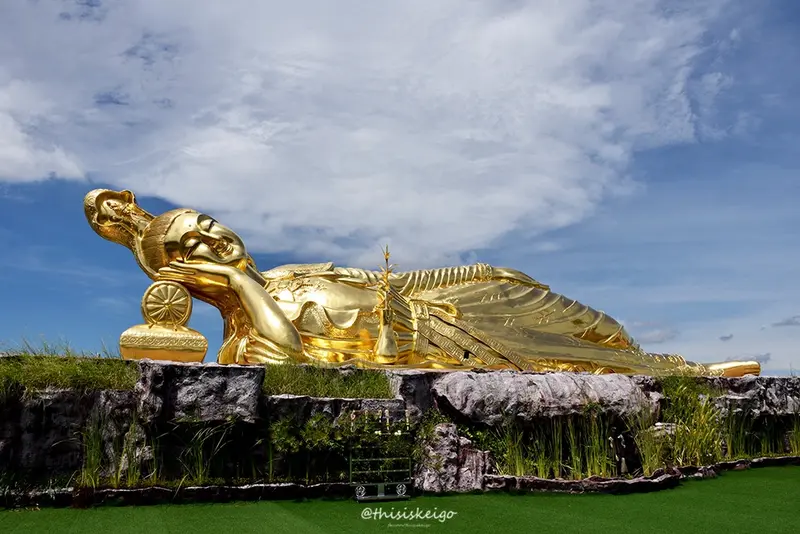
Another reason why Wat Dhammapanyaram Bang Muang is widely known is its revered Guanyin figures, especially the Thousand-Hand Guanyin and other forms of Guanyin that are deeply respected by worshippers. Of particular note is the reclining or blissful form of Guanyin, which is one of the temple’s most distinctive attractions and continues to draw both devotees and visitors who come to admire the beauty of the image. The atmosphere of worship inside the temple is therefore delicate, peaceful, and spiritually calming. People come not only to admire the artistic beauty of the sacred images, but also to pray, seek encouragement, and experience a sense of inner comfort in this holy setting.
The temple also offers elements that make a visit feel like more than a religious trip, creating a well-rounded experience for both mind and body. There are areas where visitors can feed large numbers of koi fish, adding a relaxed and pleasant atmosphere. At certain times, there are health-related activities and traditional Thai medicine services, along with monthly merit-making ceremonies based on one’s birth month and Sunday religious activities such as chanting and animal release ceremonies. These features make Wat Dhammapanyaram Bang Muang more than just a temple for a brief visit. It is a place where many people intentionally spend time so that both body and mind can rest from the pressures of daily life.
From a visitor’s perspective, Wat Dhammapanyaram Bang Muang is suitable for spiritual travelers, worshippers, and those interested in Thai-Chinese culture alike. In the morning or late morning, the view of the Tha Chin River in front of the temple makes the overall setting feel open, airy, and more peaceful than many might expect. Combined with the surrounding greenery and shade, this gives the temple a distinctive charm unlike that of urban temples. Those who enjoy photography can capture beautiful scenes of Chinese-style architecture, detailed sacred images, and the riverside temple atmosphere, while those who come specifically to pray can sense the order, devotion, and continuity of faith that remains active here every day.
Today, Wat Dhammapanyaram Bang Muang continues to play an important role in Mahayana Buddhism in Thailand. The current abbot is Ongsorapotchanasunthorn, Dr., also known as Phra Dr. Phisit Thianbao Srivicha. As a result, the temple serves not only as a place of ritual worship, but also as a center for the propagation of Buddhism, education, and community-oriented public service. This ongoing role ensures that the temple remains active, visited, and spiritually important, rather than being known merely as a beautiful temple with temporary fame.
Getting There Reaching Wat Dhammapanyaram Bang Muang is convenient by both private car and public transport. If traveling by car, one common route is to take the Pinklao–Nakhon Chai Si Road to the end, turn left for about 2 km, then at the first traffic-light intersection turn right into Khlong Mai–Thian Dat Road and continue for about 7 km. The temple will be on the left. Another common route is to use Phet Kasem Road, pass Big C Om Yai for about 2.5 km, then turn left into Thian Dat–Khlong Mai Road and continue for about 6 km. The temple will be on the right. For those using public transport, visitors can get off near Soi Thian Dat and then continue by motorcycle taxi or local taxi into the temple area. The final stretch of the journey gradually enters an old riverside community, which makes arriving at the temple feel like stepping into a calmer and more traditional atmosphere.
In summary, Wat Dhammapanyaram Bang Muang (Heng Seng Yi) is a Mahayana Buddhist temple distinguished by the history of its old vegetarian hall, Thai–Chinese artistic heritage, numerous sacred objects, and its peaceful atmosphere along the Tha Chin River. Visitors who come here can worship Phra Yulai Phaisatchayakhuru Buddha, Guanyin, and many other sacred figures while experiencing the calm environment of a religious site that continues to play a meaningful role today. For those looking for a temple in Sam Phran that offers spiritual depth, beauty, and serenity in one place, Wat Dhammapanyaram Bang Muang is unquestionably worth visiting.
| Name | Wat Dhammapanyaram Bang Muang (Heng Seng Yi) |
| Summary | A Mahayana Buddhist temple on the Tha Chin River in Sam Phran, rooted in an old Chinese vegetarian hall and known as an important Thai–Chinese spiritual destination in Nakhon Pathom. |
| Highlights | Phra Yulai Phaisatchayakhuru Buddha, Buddha relics, Guanyin, Chinese deities, riverside atmosphere, and Mahayana artistic elements. |
| History / Period | Officially established as a temple on 30 December 2005, with roots in Heng Seng Tua Vegetarian Hall, which is more than 100 years old. |
| Address | 108/8 Moo 8, Ban Bang Muang, Bang Chang Subdistrict, Sam Phran District, Nakhon Pathom 73110, Thailand |
| Zone | Sam Phran District, Nakhon Pathom, along the Tha Chin River |
| Getting There | Accessible via Pinklao–Nakhon Chai Si Road or Phet Kasem Road, then into Thian Dat–Khlong Mai Road. The temple stands along the Tha Chin River and can be reached conveniently by private car or by continuing from public transport with a short local transfer. |
| Open Days | Open Daily |
| Opening Hours | 08:00 – 17:00 |
| Entrance Fee | No entrance fee information found |
| Facilities | Multiple worship areas, fish-feeding zone, temple courtyard, merit-making points, riverside relaxation space, and parking area. |
| Current Abbot | Ongsorapotchanasunthorn, Dr. (Phra Dr. Phisit Thianbao Srivicha) |
| Nearby Attractions | 1. Don Wai Floating Market – 6 km 2. Wat Rai Khing – 8 km 3. Suan Sampran – 10 km 4. Thai Human Imagery Museum – 9 km 5. Samphran Riverside Area – 10 km |
| Nearby Restaurants | 1. Khrua Lung Loy Pla Lum Nam – 5 km – Tel. 034-321-234 2. Don Wai Riverside Restaurant – 6 km – Tel. 034-397-123 3. Sri Sawat Floating Restaurant – 7 km – Tel. 034-225-678 |
| Nearby Accommodations | 1. Sampran Riverside – 10 km – Tel. 034-322-588 2. Baan Suan Bang Toei Homestay – 8 km – Tel. 081-234-5678 3. The Palm Resort Sam Phran – 12 km – Tel. 034-111-222 |
| Contact | Tel. 085-177-9169 |
Frequently Asked Questions (FAQ)
Q: Where is Wat Dhammapanyaram Bang Muang (Heng Seng Yi) located?
A: The temple is located at 108/8 Moo 8, Ban Bang Muang, Bang Chang Subdistrict, Sam Phran District, Nakhon Pathom 73110, Thailand, along the Tha Chin River.
Q: What time is Wat Dhammapanyaram Bang Muang open?
A: The temple is open daily from 08:00 to 17:00.
Q: What is the main highlight of Wat Dhammapanyaram Bang Muang?
A: The temple is best known for its Mahayana Buddhist atmosphere, Phra Yulai Phaisatchayakhuru Buddha, Buddha relics, Guanyin, and various Thai–Chinese sacred images along the Tha Chin River.
Q: Was this temple originally a vegetarian hall?
A: Yes. The site was originally Heng Seng Tua Vegetarian Hall, also known locally as Bang Muang Riverside Vegetarian Hall, before it was officially elevated to temple status in 2005.
Q: How can I get to Wat Dhammapanyaram Bang Muang?
A: You can travel by car via Pinklao–Nakhon Chai Si Road or Phet Kasem Road, then continue into Thian Dat–Khlong Mai Road. If using public transport, get off near Soi Thian Dat and continue by local transport to the temple.
Q: What kind of visit is this temple suitable for?
A: It is suitable for worship, merit-making, spiritual travel, prayer, and for visitors interested in Thai–Chinese religious culture in a peaceful riverside setting.
 Tel: 03295341
 Mobile: 034979225
 Wat Dhammapanyaram Bang Muang (Heng Seng Yi) Map
 Category:
  Group:
  Last Update: 2 HourAgo
Comment
 Nearby Attractions
| Keyword (Advance) |
 Facebook Fanpage
 Region
 Art, Culture and Heritage
 Historical Sites and Monuments(
 Landmarks and Memorials(
 Royal Palace(
 Art, Craft Centres, Tradition(
 Museums(
 Art Gallery(
 Educational Places
 Educational Gardens, Farm(
 University
 Other religious and spiritural sites(
 Research and Development
 Royal Project(
 Suburban Living
 Village, Community(
 Local Market(
 Floating Market(
 Nature and Wildlife
 River, Canal(
 Other natural attractions(
 Entertainment and Agricultural
 Animal camps and shows(
 Stadium(
 Farm, Parks, Gardens and Ecotourism(
 Waterpark(
 Theater(
 Outdoor and Adventure Activities(
 Spas and Wellness
 Spas and Wellness(