
 Home
Home North(
 Chiang Mai(


Rating: 4.2/5 (10 votes)
 |
|  Map
Map 
 Have Map
  No Map
Chiang Mai attractions
Attractions in Thailand
Open Days: Daily
Opening Hours: 06:00–18:00 (Open-air archaeological site)
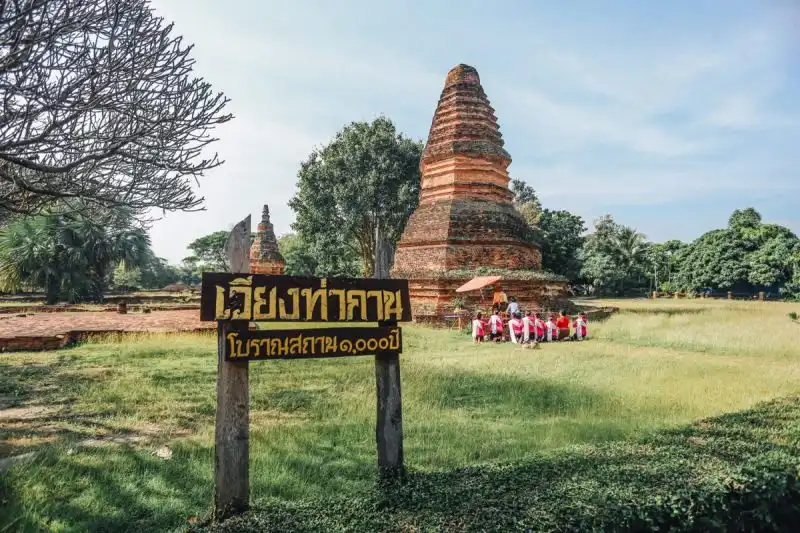
Wiang Tha Kan, an ancient city from the Hariphunchai period, lies quietly amid rice fields and the rural community of Ban Tha Kan, Ban Klang Subdistrict, San Pa Tong District, Chiang Mai. Today it is one of Northern Thailand’s most important archaeological sites. The atmosphere remains serene and rustic, allowing visitors to walk among centuries-old remnants while learning about the culture and history preserved by the local Yong community, who have safeguarded this heritage for generations.
Archaeological evidence and Chiang Mai’s historical chronicles suggest that Wiang Tha Kan was first established around the 13th Buddhist century, during the Hariphunchai Kingdom. It likely served as a frontier settlement or satellite town under Lamphun rule. When King Mangrai expanded his influence into the Ping River basin and founded the Lanna Kingdom, Wiang Tha Kan evolved into a strategic supply city, storing food and manpower to support the kingdom’s military campaigns due to its fertile surroundings.
In ancient manuscripts, Wiang Tha Kan often appears under the name “Wiang Phan Na Tha Kan”. The term “Phan Na” in Northern Thai implies a region or administrative area, suggesting that Wiang Tha Kan was once a significant city. Chronicles during the reign of King Mangrai and King Tilokarat (Phra Chao Tilokkarat) mention military movements through Wiang Phan Na Tha Kan and record that one of the sacred Bodhi trees brought from Sri Lanka was planted here, symbolizing the prosperity of Buddhism and the importance of the city at the time.
Situated on a fertile plain near the Ping River, Wiang Tha Kan was constructed as a large rectangular walled city measuring approximately 500 meters wide and 700 meters long. It was surrounded by earthen ramparts and a moat. Today, much of the city wall has transformed into earth embankments, and parts have become local roads or community spaces. Nevertheless, the outlines of the ancient city are still clearly visible. The archaeological zone spans roughly 60 rai, sitting amid a living rural community, with houses, temples, and farmland interwoven with ancient remains.
Several important archaeological structures remain within Wiang Tha Kan, including the central chedi, Wat Tha Kan, Wat Ton Kok, Wat Ubosot, Wat Ton Pho, Wat Pa Pao, Wat Phai Ruak, and Wat Ku Mai Daeng. Many display architectural features blending Hariphunchai and early Lanna styles, such as multi-tiered octagonal bases, bell-shaped stupas, and brick foundations of long-lost temples. Visitors can explore on foot via walkways maintained by the local community, with informative signs installed throughout the site.
Wiang Tha Kan is also rich in ancient artifacts. Excavations carried out from the 1950s to the 1970s uncovered sandstone Buddha images, terracotta Buddha figures, numerous votive tablets, brown-glazed funerary jars, Chinese Yuan Dynasty ceramics, metal objects, and various household artifacts. These discoveries confirm that Wiang Tha Kan was once an active religious and trading community connected to other regions through commerce and culture.
As political power shifted, Wiang Tha Kan changed hands as well. When the Burmese, led by King Bayinnaung of Hongsawadi (Pegu), conquered Chiang Mai, towns in the Ping River valley—including Wiang Tha Kan—came under Burmese rule. By the late 18th century (B.E. 2318–2339), Chiang Mai was deserted, and Wiang Tha Kan also fell into abandonment, its structures left to weather naturally for decades.
A major turning point came in B.E. 2339 when King Kawila of the Thipchakarin Dynasty reclaimed Chiang Mai from the Burmese. He relocated large groups of Yong people (Tai Lue ethnicity) from Muang Yong—now within Myanmar—to repopulate several areas of Chiang Mai. One of the resettlement sites was Wiang Tha Kan. Over 200 years later, the descendants of these Yong settlers still live around Ban Tha Kan, preserving their language, customs, and cultural identity with remarkable devotion.
The strong sense of cultural pride within the community has helped protect and revive Wiang Tha Kan. Residents work closely with the Fine Arts Department and local administrative organizations to maintain the archaeological site. They established the Wiang Tha Kan Museum, curated community guides to provide historical tours, and initiated conservation activities that earned the community a royal award from Her Royal Highness Princess Maha Chakri Sirindhorn in B.E. 2531 for outstanding heritage preservation.
For visitors, Wiang Tha Kan offers a slow-paced, contemplative travel experience. Most people wander along the moat, embankments, and ancient chedi clusters under the shade of trees, surrounded by rice fields and simple rural scenery. The museum displays artifacts and a model of the ancient city layout, while local guides share stories with warmth, humor, and genuine pride. Photographers particularly enjoy capturing the contrast between ancient ruins and green fields, especially during the rice-growing season.
Beyond history, Wiang Tha Kan provides insights into the living culture of the Yong community. Many traditions—ritual dances, annual merit-making ceremonies, and local dress—remain faithfully practiced. Visitors who arrive during community festivals may witness processions, local food preparations, and traditional performances that seamlessly connect the area’s past and present.
Getting There Wiang Tha Kan is easily accessible from Chiang Mai. Take Highway 108 (Chiang Mai–Hot Road), passing Hang Dong until reaching San Pa Tong (approx. 34 km). At Ban Thung Sieo, turn left toward Ban Tha Kan and continue for about 2 km to the archaeological entrance. Signs lead from the main road to the parking area. Travelers without private transport can take a Chiang Mai–San Pa Tong songthaew or the Chiang Mai–Hot bus, get off in San Pa Tong town, and hire a local songthaew or motorcycle taxi to reach Ban Tha Kan. For exploring multiple sites inside the ancient city, a private vehicle is most convenient.
| Name | Wiang Tha Kan Ancient City and Wiang Tha Kan Museum, Ban Tha Kan, Ban Klang Subdistrict, San Pa Tong District, Chiang Mai |
| Location | Ban Tha Kan, Village No. 5, Ban Klang Subdistrict, San Pa Tong District, Chiang Mai, approx. 34 km from Chiang Mai along Highway 108 (Chiang Mai–Hot), then turn left at Ban Thung Sieo toward Ban Tha Kan. |
| Main Features | A rectangular ancient walled city (approx. 500 × 700 m) with moat and earthen ramparts. Key archaeological groups include central chedi structures and numerous temple remains. The area is surrounded by rice fields and rural landscapes. The Wiang Tha Kan Museum displays artifacts, and community guides offer insightful tours. |
| Historical Background | Founded around the 13th Buddhist century under Hariphunchai, later incorporated into King Mangrai’s Lanna Kingdom as a frontier and supply city. Fell under Burmese control and was abandoned around B.E. 2318–2339. Reestablished in B.E. 2339 when King Kawila resettled Yong people, forming today’s Ban Tha Kan community. |
| Key Evidence / Notable Remains | Visible moat and earthen ramparts, brick foundations of ancient temples, sandstone Buddha images, terracotta figurines, Yuan Dynasty ceramics, brown-glazed burial jars, and historical displays within the Wiang Tha Kan Museum. |
| Getting There | Take Highway 108 (Chiang Mai–Hot) toward San Pa Tong (34 km). Turn left at Ban Thung Sieo and drive 2 km to Ban Tha Kan. Local signs direct visitors to the archaeological site. Public transport: take Chiang Mai–San Pa Tong songthaews or Chiang Mai–Hot buses, then hire a local taxi or motorcycle taxi to the site. |
| Nearby Attractions (Approx. Distance) | - Wat Tha Kan and main archaeological ruins < 1 km (walkable) - Temples and villages in the Tha Kan–Thung Sieo area, 1–3 km - Rong Bom Café & Kao Mai Lanna Resort, 2–3 km - Lan Long Khao Café & Resort, approx. 2 km - Hang Dong & Grand Canyon Chiang Mai area, 12–15 km along Highway 108 |
| Recommended Restaurants (Distance & Phone) | - Rong Bom Café (Kao Mai Lanna), approx. 2–3 km, Tel. 053-481-201, 086-428-7481 - Salaween Fish Restaurant (Pla Salaween), 2.5–3 km, Tel. 085-107-8557, 086-919-3851 - Anda Peka Café & Restaurant (San Pa Tong), approx. 2 km - Cafe Vintage1980, 2–3 km, Tel. 096-084-0462 - Various local food shops around San Pa Tong town center |
| Recommended Accommodations (Distance & Phone) | - Kao Mai Lanna Resort, 2–3 km, Tel. 053-266-550, 053-266-551, 053-266-552, 053-266-555 - Lan Long Khao Café & Resort, approx. 1.5–2 km, Tel. 093-571-5888 - Tai Resort, 6–8 km, Tel. 063-096-7000 - Additional small homestays and resorts in San Pa Tong within 10–15 km radius |
| Facilities | Parking area, walkways around the archaeological zone, resting pavilions, informative signage, Wiang Tha Kan Museum (Mon–Fri, office hours), and nearby restrooms in local government buildings and temples. |
| Entrance Fee | Free admission (donations welcome to support conservation activities) |
| Contact | Wiang Tha Kan Museum, Ban Tha Kan, Village No. 5, Ban Klang Subdistrict, San Pa Tong District, Chiang Mai 50120. Tel. 053-481-176, 099-522-2650 Wiang Tha Kan Subdistrict Administrative Organization (SAO), Village No. 8, Ban Klang Subdistrict, San Pa Tong District, Chiang Mai 50120. Tel. 053-481-420–1, Fax 053-481-052 |
Frequently Asked Questions (FAQ)
Q: How far is Wiang Tha Kan from Chiang Mai City, and how long does it take to travel there?
A: Wiang Tha Kan is located in San Pa Tong District, about 34 km from Chiang Mai via Highway 108. Travel time is approximately 40–50 minutes. For travelers planning to visit cafés or other attractions nearby, it is advisable to set aside at least half a day.
Q: Is Wiang Tha Kan open daily, and are there fixed opening hours?
A: The outdoor archaeological site is generally open daily from early morning until evening (recommended: 06:00–18:00). The Wiang Tha Kan Museum is usually open Monday–Friday during office hours. Visitors who want a guided tour should contact the museum or the Subdistrict Administrative Organization in advance.
Q: Are guided tours available? Is the site suitable for school groups or families?
A: Yes. Local community guides provide tours explaining the history of the ancient city and the Yong culture. It is ideal for families, students, and small tour groups. Booking in advance is recommended if a group requires a dedicated guide.
Q: Is Wiang Tha Kan suitable for seniors or young children? Is there a lot of walking?
A: The site consists of open-air paths and earthen walkways. To see all structures, some walking is required, but key attractions near the parking area—such as the central chedi group and the museum—are easy to visit. Comfortable walking shoes, hats, and water are recommended.
Q: What nearby attractions can be combined with a visit to Wiang Tha Kan?
A: Popular options include visiting Wiang Tha Kan in the morning, then stopping at Rong Bom Café or Lan Long Khao Café & Resort for lunch or coffee. In the afternoon, travelers can continue to Hang Dong, Grand Canyon Chiang Mai, or the Kad Farang community area—making for a well-rounded day trip combining history, culture, and leisure.
 Wiang Tha Kan Map
 Category:
  Group:
  Last Update: 3 MonthAgo
Comment
 Nearby Attractions
| Keyword (Advance) |
 Facebook Fanpage
 Region
 Landmarks and Memorials(
 Royal Palace(
 Art, Craft Centres, Tradition(
 Museums(
 Educational Places
 Museum for Study(
 Educational Gardens, Farm(
 Training Center(
 University
 Places of Worship
 Temple(
 Mosque(
 Other religious and spiritural sites(
 Research and Development
 Royal Project(
 Suburban Living
 Village, Community(
 Local Market(
 Nature and Wildlife
 National Parks and Marine Reserves(
 Mountain (Doi)(
 Dam, Reservoir, Lake(
 Waterfalls(
 Hot Springs(
 Caves(
 River, Canal(
 Other natural attractions(
 Entertainment and Agricultural
 Zoos and Aquariums(
 Animal camps and shows(
 Stadium(
 Farm, Parks, Gardens and Ecotourism(
 Waterpark(
 Theater(
 Outdoor and Adventure Activities(
 Shopping
 Shopping and Night Market(
 Restaurant
 Michelin Star(
 Michelin Guide(
 Call Customer Service in Tourism
 Call Customer Service in Tourism(
 Travel Articles, Recipes
 Travel Review, Food Review(
 Food Menu, North Recipes(
 Thai Desserts, North Recipes(