
 Home
Home North(
 Chiang Mai(


Rating: 3.8/5 (5 votes)
 |
|  Map
Map 
 Have Map
  No Map
Chiang Mai attractions
Attractions in Thailand
Open Days: Daily
Opening Hours: 24 hours
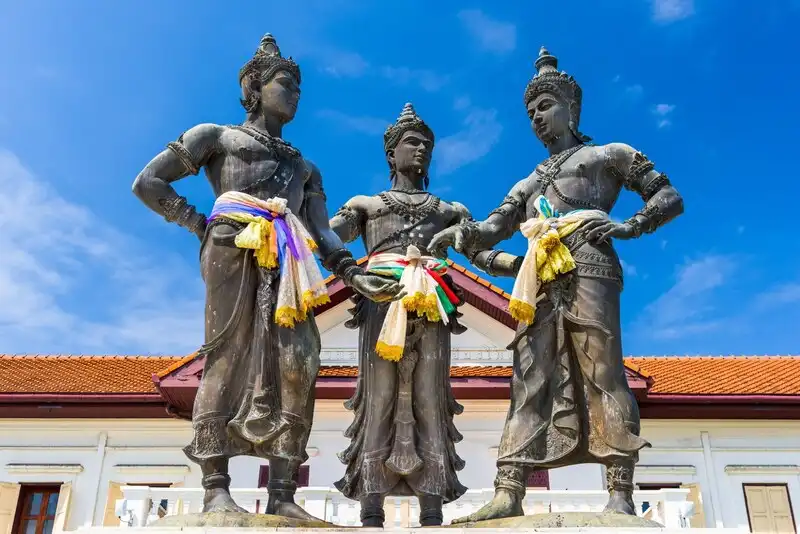
Three Kings Monument is one of Chiang Mai’s most iconic landmarks, located in front of the Old Provincial Hall on Prapokklao Road within the ancient walled city. This monument commemorates three influential kings whose alliance and vision laid the foundation for the establishment of Chiang Mai: King Mangrai of the Lanna Kingdom, King Ramkhamhaeng of Sukhothai, and King Ngam Muang of Phayao. The site is both a historic and cultural center, attracting visitors who wish to learn about the origins of the Lanna capital.
The bronze and copper statues of the three kings were crafted slightly larger than life-size, standing approximately 2.7 meters tall. The monument was designed and sculpted by Khai Muk Chuto, a renowned Thai sculptor, and took around 10 months to complete. The statues were ceremonially transported from Bangkok and installed at the current site on September 23, 1983, at 11:49 AM. Since then, the monument has become a symbol of unity, leadership, and friendship among three great monarchs.
The spacious plaza surrounding the Three Kings Monument is a popular gathering point for both locals and visitors. The area is surrounded by museums, cultural centers, cafés, and historical buildings, including the Chiang Mai City Arts & Cultural Centre. On Sundays, the plaza becomes part of the famous Sunday Walking Street, filled with people exploring local handicrafts, performances, and food stalls. This makes the monument not only historically significant but also a living cultural space at the heart of Chiang Mai.
The monument also symbolizes the legendary alliance between the three monarchs. According to historical accounts, King Mangrai, King Ramkhamhaeng, and King Ngam Muang once met on the banks of the Ing River in Phayao. There, they performed a ritual oath—drinking sacred water mixed with blood from their fingertips—to pledge eternal friendship and mutual support. This alliance played a crucial role in creating stability among northern states and ultimately led to the establishment of Chiang Mai as the new capital of the Lanna Kingdom.
King Mangrai, the founder of the Lanna Kingdom, was born in 1239 (B.E. 1782). He ascended the throne of Ngoenyang (Chiang Saen) in 1259 and ruled with exceptional intelligence and military strength. He unified various northern states, strengthened political structures, and introduced the Mangrai Law as a governing code. His most celebrated accomplishment was the founding of Chiang Mai in 1296 (B.E. 1839), which became the flourishing cultural and political capital of Lanna. King Mangrai passed away in 1317 (B.E. 1860) at the age of 79.
King Ramkhamhaeng the Great of the Sukhothai Kingdom was the third son of King Si Inthrathit. His reputation for bravery began at age 19 when he defeated Khun Sam Chon, the ruler of Chot, in single combat. King Ramkhamhaeng is renowned not only as a warrior but also as the creator of the Thai alphabet in 1283 (B.E. 1826), which forms the basis of the Thai writing system used today. His reign was marked by prosperity, openness in governance, and a flourishing society. He ruled around 1279–1298 (B.E. 1822–1842) and remains one of Thailand’s most revered monarchs.
King Ngam Muang, ruler of Phayao, was born in 1238 (B.E. 1781) and succeeded his father, King Mueang, in 1258 (B.E. 1801). He studied alongside King Mangrai under the same teacher, forging a lifelong friendship between the two. King Ngam Muang was known for his wisdom and diplomatic strategies. Rather than relying on military force, he strengthened alliances with neighboring kingdoms, enabling Phayao to maintain stability and peace throughout his reign.
The close alliance among the three kings eventually led to cooperative political planning and territorial organization in the northern region. A significant outcome of their partnership was the establishment and structuring of Chiang Mai as the capital of the Lanna Kingdom. The Three Kings Monument stands today as a tribute to their friendship, leadership, and collective vision that shaped northern Thailand.
Today, the monument remains a vibrant public space used for cultural events, city ceremonies, and major celebrations in Chiang Mai. Morning and evening hours provide a peaceful atmosphere for photography or relaxation, while festival periods fill the area with lively performances and processions. Its central location also makes it an excellent starting point for exploring temples, museums, and historic streets within the Old City.
Getting There: The monument is centrally located within Chiang Mai’s Old City. From Tha Phae Gate, it takes around 10–15 minutes on foot along Ratchadamnoen Road. Red Songthaews, tuk-tuks, and local taxis can also be hired easily. Visitors arriving from Chiang Mai International Airport, the train station, or Arcade Bus Terminal can simply tell the driver “Three Kings Monument,” a well-known destination for all local transport services.
| Name | Three Kings Monument, Chiang Mai |
| Location | In front of the Old Provincial Hall, Prapokklao Road, Si Phum Subdistrict, Mueang Chiang Mai District, within the Old City moat area |
| Key Features | Bronze monument honoring King Mangrai, King Ramkhamhaeng, and King Ngam Muang; symbol of unity and cooperation; important cultural plaza and photo landmark in central Chiang Mai |
| Period | Installed in 1983 (B.E. 2526); commemorates monarchs from the late 13th century to early 14th century during the founding era of the Lanna Kingdom |
| Historical Evidence | Statues, inscriptions, and records describing the roles of the three kings in city planning, the founding of Chiang Mai, and their political alliance |
| Name Origin | Named after King Mangrai, King Ramkhamhaeng the Great, and King Ngam Muang—three allied monarchs influential in shaping northern Thailand |
| Travel | 10–15 minutes on foot from Tha Phae Gate; easily accessible by red Songthaew, tuk-tuk, or taxi from anywhere in Chiang Mai |
| Nearby Attractions | Chiang Mai City Arts & Cultural Centre (~50 m), Lanna Folklife Museum (~100 m), Wat Chedi Luang (~500 m), Tha Phae Gate & Sunday Walking Street (~800–900 m), Wat Phra Singh (~900 m) |
| Popular Restaurants Nearby | Kiat Ocha Chicken Rice (~0.2 km, Tel. 053-327-263), Ponganes Coffee Roasters (~0.7 km, Tel. 087-727-2980), Woo Café & Art Gallery (~1.8 km, Tel. 052-003-717) |
| Popular Accommodations Nearby | Cozytel Chiang Mai (~0.3 km, Tel. 097-998-8199), Chala Number 6 (~0.3 km, Tel. 052-010-466), U Nimman Chiang Mai (~2.5 km, Tel. 052-005-111) |
| Current Status | A major historical landmark and cultural plaza open 24 hours; serves as a venue for city ceremonies, public events, and cultural festivals |
Frequently Asked Questions (FAQ)
Q: Who are the three kings represented by the monument?
A: The monument honors King Mangrai of Lanna, King Ramkhamhaeng the Great of Sukhothai, and King Ngam Muang of Phayao—three allied monarchs who played significant roles in founding and shaping Chiang Mai.
Q: Is the Three Kings Monument open to visitors all day?
A: Yes. The plaza is a public open space accessible 24 hours a day. Mornings and evenings are peaceful, while Sunday nights are lively due to the Sunday Walking Street Market.
Q: What is the atmosphere like around the monument?
A: The area is vibrant with cultural activities, city ceremonies, and local gatherings. Visitors often relax, take photos, or explore nearby temples and museums within walking distance.
Q: Is it easy to reach the monument from Tha Phae Gate?
A: Very easy. It’s a 10–15 minute walk along Ratchadamnoen Road inside the Old City. The route is safe and lined with cafés, shops, and temples—ideal for a leisurely city walk.
 Three Kings Monument Map
 Category:
  Group:
  Last Update: 4 MonthAgo
Comment
 Nearby Attractions
| Keyword (Advance) |
 Region
|
 Muang Chiang Mai(