
 Home
Home North(
 Chiang Mai(


Rating: 4.6/5 (5 votes)
 |
|  Map
Map 
 Have Map
  No Map
Chiang Mai attractions
Attractions in Thailand
Open Days: Every day
Opening Hours: 08.00–17.00
Lanna Cultural Preservation Center, Nam Phrae (Ban Klawng Sabad Chai) is a small but meaningful community learning space in Moo 3, Ban Phae Khwang, Nam Phrae Subdistrict, Hang Dong District, Chiang Mai. It was created so that local people, especially children and youth, could learn Lanna performing arts in a living environment rather than only seeing them in books or museums. The center offers free training and runs entirely on community spirit, focusing on passing down traditions rather than making profit.
The center stands in a rural neighborhood surrounded by houses, fields, and local temples. Everyday life in Nam Phrae still carries traces of traditional Lanna culture. While Chiang Mai city continues to grow and modernize, this center quietly holds on to the roots of the community, reminding everyone that culture survives through practice. It has become a living memory space for elders and a classroom for younger generations who want to understand where they come from.
What makes the center truly unique is its simple but powerful philosophy: free learning with no hidden costs. Activities are designed for children, students, and anyone interested, without charging tuition fees. The physical space may be modest, but the content is rich. Lanna performing arts that once appeared only in temple fairs and village processions are now used as tools for personal growth, discipline, and connection to heritage.
The story of the center is closely connected to the legacy of Pho Khru Kham Kawai, a National Artist in performing arts. For many years, his home was a gathering place for Sabad Chai drumming and traditional dance. After his passing, his descendants and local leaders did not want his life’s work to fade away. With the support of people such as Phor Luang Pairin Kawai, village headman of Moo 3 and direct descendant of Pho Khru Kham, the family home was renovated and transformed into a cultural learning center known as Ban Klawng Sabad Chai.
At first, the idea was simple: keep teaching the arts that Pho Khru Kham had spent his life developing. Over time, however, the center also became an answer to broader social problems. As in many communities, some local youth were drifting toward unproductive or risky activities. Community leaders and the Nam Phrae Subdistrict Administrative Organization realized that traditional arts could give young people structure, pride, and a sense of belonging. Supporting the center was therefore not only about culture, but also about social development and youth empowerment.
As the center continued to grow, it received more attention and support. Learning equipment was improved, more drums and props were added, and additional cultural teachers joined to help with training. New generations of students kept arriving, and skills such as Sabad Chai drumming and sword dancing were kept alive. Whenever the community holds a major festival or ceremony, performers from the center are often invited to lead the procession or open the event, making the center an integral part of local cultural life.
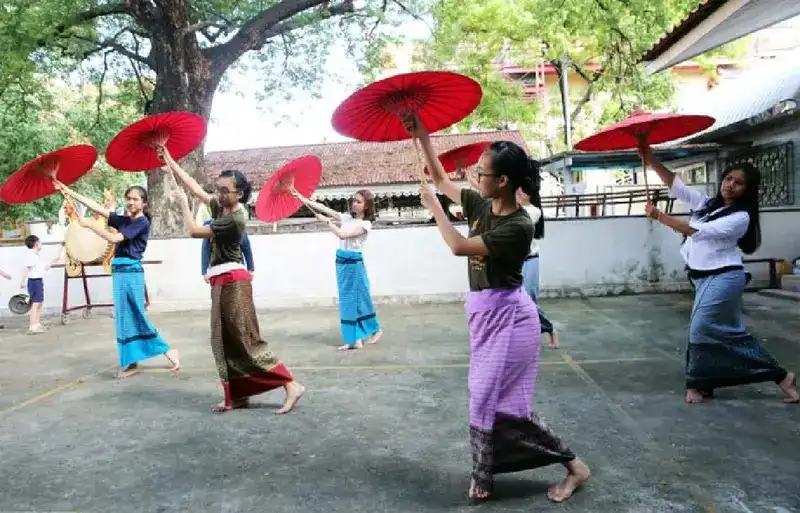
The core of the center’s work lies in teaching Lanna performing arts. These include drumming, dancing, and ritual performance that have deep roots in Lanna history. Students do not simply learn movements or beats for the stage; they also learn the stories and meanings behind each tradition.
Sabad Chai drumming is one of the center’s most energetic and recognizable activities. Traditionally used to declare victory or raise morale, the Sabad Chai drum is now commonly heard in parades, temple festivals, and auspicious events. At the center, children start by learning posture, basic strokes, and simple rhythms before moving on to full performance sequences. Through this process, they develop physical strength, coordination, concentration, and teamwork. The drum becomes not just an instrument, but a teacher of confidence and discipline.
The sword dance, or fon dab, is another key tradition taught at the center. It blends grace and controlled power, reflecting the legacy of Lanna warriors. Students learn how to hold the sword safely, position their feet, rotate their bodies, and align each move with traditional music. Every turn, step, and cut is meant to be purposeful rather than simply decorative. Learning the sword dance teaches students to respect their teachers, handle strength responsibly, and maintain inner calm even while performing powerful movements.
The Choeing dance emphasizes softness, flowing lines, and a deep connection between body, music, and spirit. Often associated with rituals of respect and blessing, it expresses the gentle side of Lanna culture. Many learners describe the experience of practicing the Choeing dance as meditative. As they move slowly and deliberately, they find themselves breathing more calmly and feeling more grounded. In this way, the dance becomes not only a performance skill but also a form of inner training.
Auspicious victory drumming, or klong chai mongkhon, is typically used in housewarming ceremonies, ordinations, weddings, and other blessings. Each rhythm symbolizes good wishes for the hosts and participants. At the center, students learn the basic patterns of auspicious drumming and then gradually practice playing in ensemble with other drums. Along the way, they come to understand how rhythm, belief, and ceremony are woven together in community life.
The learning atmosphere at the center is warm and informal. Children often arrive together with neighbors or family members. During practice, the teacher leads by demonstration, and students follow by watching, listening, and repeating. There is little emphasis on theory or written notation; instead, knowledge is passed down through shared rhythm and movement. Over time, the skills are absorbed into the body and memory in a natural way, just as they were in past generations.
One particularly beautiful aspect of the center is its openness to all ages. Adults and elders are welcome to join practices, whether to learn new skills, refresh what they once knew, or simply support the younger learners. This intergenerational space allows stories to be passed on verbally. Children talk about school and their daily lives, while elders share memories of temple fairs, community parades, and the famous teachers of their youth. As a result, the center functions not only as a training ground for arts, but also as a meeting place for shared history.
The center plays an active role in many local festivals and official events. Students often perform Sabad Chai drumming, sword dance, and other Lanna performances during Yi Peng, Songkran, Loy Krathong, community merit-making ceremonies, and government-organized events in Hang Dong and surrounding districts. Through these performances, they see their training come to life in real situations, and the community sees living proof that its traditions are still carried by the younger generation.
In terms of long-term impact, the Lanna Cultural Preservation Center in Nam Phrae helps shape personal and collective identity. Children who grow up with the sound of drums and the movements of traditional dance have a clearer sense of cultural belonging. Parents are reassured that their children are spending time in a constructive environment rather than being drawn only to screens or risky activities. The community benefits from having a shared space where positive, creative, and culturally rooted activities take place on a regular basis.
From an organizational perspective, the center is supported by community committees and the Nam Phrae Subdistrict Administrative Organization. Together, they coordinate activities, maintain the space, and connect the center with broader networks in culture and education. This structure helps ensure that the center is not just a temporary project, but a sustainable part of the community’s development and cultural preservation efforts.
Getting There: Reaching the Lanna Cultural Preservation Center is fairly straightforward. From Chiang Mai city, travelers can take the Chiang Mai–Hang Dong Road (Highway 108) toward Hang Dong. After passing the Kad Farang area, they turn into Nam Phrae Subdistrict and follow local village roads toward Moo 3, Ban Phae Khwang. The center is located in a residential area near local temples and community facilities. Those using public transport can take a red shared taxi (songthaew) along Hang Dong Road and then transfer to a motorcycle taxi or local transport into Nam Phrae village.
The surrounding area offers a variety of attractions and activities. Grand Canyon Water Park provides swimming and water-based fun, Chiang Mai Night Safari offers evening wildlife experiences, and nearby temples such as Wat Nam Phrae and Wat Ton Kwen showcase Lanna religious architecture. Golfers can visit North Hill Golf Club, while travelers looking for a quiet stay can choose from several homestays and boutique resorts in Hang Dong. This makes it easy to design a day trip that combines cultural learning at the center with recreation and sightseeing.
When all of these elements are viewed together, the Lanna Cultural Preservation Center in Nam Phrae is far more than a venue for drumming or dancing. It is a beating heart of the community. Each drumbeat, each swing of the sword, and each dance step signals that Lanna culture is still alive here – not as a relic, but as a living, evolving part of everyday life. For anyone interested in culture, community, or education, a visit to this center offers a clear and inspiring answer to the question of how traditions can survive in a changing world.
| Name | Lanna Cultural Preservation Center, Nam Phrae (Ban Klawng Sabad Chai) |
| Location | 125 Moo 3, Ban Phae Khwang, Nam Phrae Subdistrict, Hang Dong District, Chiang Mai 50230, Thailand |
| Characteristics | Community-based cultural learning center offering free training in Lanna performing arts, including Sabad Chai drumming, sword dance, Choeing dance, auspicious victory drumming, and other Lanna cultural activities for children, youth, and the general public. |
| Period | Contemporary development following the work and legacy of National Artist Pho Khru Kham Kawai, continuing his mission to preserve and transmit Lanna performing arts in the Nam Phrae community. |
| Key Evidence | The original house of Pho Khru Kham Kawai converted into a learning center, Sabad Chai drums and performance sets, documentation of community cultural projects, and records of performances in local festivals and ceremonies. |
| Name Origin | Named for its role in preserving Lanna arts and culture in Nam Phrae and commonly known as “Ban Klawng Sabad Chai” due to its strong focus on Sabad Chai drumming. |
| Travel | From Chiang Mai city, take Chiang Mai–Hang Dong Road (Highway 108) toward Hang Dong, continue past Kad Farang, then turn into Nam Phrae Subdistrict and follow local roads to Moo 3, Ban Phae Khwang. The center is located inside the village near local temples. By public transport, take a red songthaew along Hang Dong Road and transfer to a motorcycle taxi into Nam Phrae. |
| Current Status | An active community learning center used for regular practice of drumming, dancing, and cultural activities, as well as for preparing performances in local festivals and ceremonies in Nam Phrae and Hang Dong. |
| Contact Number | Verified as of 2025-12-11: 083-5825046, 081-3666905 (center coordinators); 053-296600-1 (Nam Phrae Subdistrict Administrative Organization for further information). |
| Nearby Tourist Attractions with Distance | Grand Canyon Water Park (approx. 3–4 km); Wat Nam Phrae (approx. 2 km); Chiang Mai Night Safari (approx. 8–10 km); North Hill Golf Club (approx. 8 km); Wat Ton Kwen (Wat Intharawat), Hang Dong (approx. 10 km). |
| Popular Restaurants Nearby | Restaurants and cafes in the Nam Phrae and Grand Canyon area, such as Tuang Thong Canyon View (approx. 3–4 km), Phufinn Doi and related cafes (approx. 3–5 km), along with other local eateries around Grand Canyon and Hang Dong. |
| Popular Accommodations Nearby | Homestays and boutique accommodations in Hang Dong such as Hoshihana Village, Rice Barn and Rooms, The Heritage House & Garden, and The Luna Compass, generally within 5–12 km of Nam Phrae, depending on the specific property. |
| Facilities | Open activity space for drumming and dance practice, indoor or sheltered practice areas, and an outdoor yard that can be used for community events and traditional performances. |
| Fees | No fees are charged for regular learning activities; participation is free as part of the community learning initiative. Voluntary donations may occasionally be accepted during special events. |
Frequently Asked Questions
Q: What activities does the Lanna Cultural Preservation Center in Nam Phrae offer?
A: The center offers training in Sabad Chai drumming, Lanna sword dance, Choeing dance, auspicious victory drumming, and other Lanna cultural activities, depending on the season and community events.
Q: Is there any fee to join the classes at the center?
A: No. All classes and activities at the center are free of charge, as it operates as a non-profit community learning space.
Q: Can children and seniors participate in the activities?
A: Yes. The center welcomes participants of all ages, including children, youth, adults, and elders, encouraging a family-like and intergenerational learning atmosphere.
Q: How can visitors or study groups arrange a visit to the center?
A: Individual visitors can come during opening hours (08.00–17.00). For school groups or organized study visits, it is recommended to contact the center coordinators or the Nam Phrae Subdistrict Administrative Organization in advance to discuss schedules and possible demonstrations.
Q: What role does the center play in local festivals and ceremonies?
A: The center plays a key role in preparing performance groups for local festivals such as Yi Peng, Songkran, Loy Krathong, and various merit-making ceremonies. Students often lead parades, perform drumming, and present traditional Lanna dances for both community and official events.
Q: Are there other tourist attractions near the center?
A: Yes. Nearby attractions include Grand Canyon Water Park, Wat Nam Phrae, Chiang Mai Night Safari, North Hill Golf Club, and Wat Ton Kwen in Hang Dong. These make it easy to combine a cultural visit to the center with leisure and sightseeing in the same area.
 Website: www.namphrae.go.th
 Tel: 053296600-1
 Fax: 053296600-1
 Cultural Heritage Center of Lanna Map
 Category:
  Group:
  Last Update: 3 MonthAgo
Comment
 Nearby Attractions
| Keyword (Advance) |
 Region
|
 Muang Chiang Mai(