
 Home
Home North(
 Chiang Mai(


Rating: 3.5/5 (12 votes)
 |
|  Map
Map 
 Have Map
  No Map
Chiang Mai attractions
Attractions in Thailand
Open Days: Daily
Opening Hours: 24 hours (open public plaza)
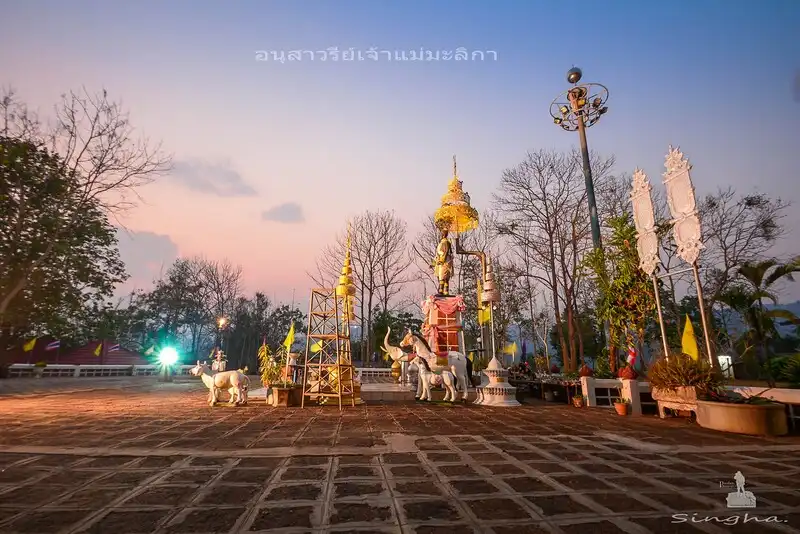
Chao Mae Malika Monument in Mae Ai District, Chiang Mai, is one of the key symbols of this small border town along the Kok River. Many people know the name through the legend of “Phra Nang Malika” and the stories that became the origin of the name “Mae Ai” District today. The monument is located not far from the main community area of Mae Ai, in an open plaza used by local residents for worship ceremonies and traditional events, especially during Songkran when the ritual bathing of Chao Mae Malika is held in a lively atmosphere.
According to local legend, Phra Nang Malika was the daughter of Phra Chao Fang (some versions call him Phra Chao Udom Sin), ruler of the ancient city of Fang, and his consort Phra Nang Samphiw, famed for her beautiful skin likened to three kinds of flowers: jasmine, lotus, and rose. Their daughter was therefore named “Malika.” She inherited her mother’s radiant beauty, but had a cleft lip, which caused her great insecurity about meeting others, no matter how widely her beauty and grace were praised across the land.
When the princess reached about 18 years of age, her beauty became renowned throughout the region. Many princes from other cities came to ask for her hand in marriage. However, she avoided all suitors and refused to meet any men, fearful that they would see the imperfection at her lips. Phra Chao Fang, her father, then ordered the construction of a new city to the north of Fang around 1607 CE (B.E. 2150), named Wiang Malika after his daughter. Within this city were royal gardens, a royal residence, a moat, and earthen ramparts with fortified gates on all four sides. Though small, it was a strong and beautiful city.
What made Wiang Malika truly unique was that there were no men inside the city at all. Everyone was a woman. Most were strong and physically fit women whom Phra Nang Malika personally trained as warriors, especially in archery. Wiang Malika thus became famous for its elite archers, reputed to shoot with perfect accuracy. The fame of both Wiang Malika and Phra Nang Malika spread far and wide throughout Lanna and neighboring states.
The legend continues that news of her beauty and martial skill eventually reached the ears of the prince of Wiang Phu Kam in the Tai Yai kingdom. Eager to meet the famed princess, he disguised himself as a merchant and traveled to Wiang Malika, bringing precious gems as tribute to request an audience. When news of this mysterious merchant’s arrival reached Phra Nang Malika, she felt deeply embarrassed and refused to meet him, not yet ready for any man to see her face.
On the day the prince, disguised as a trader, came to present his gifts, the princess slipped away to bathe in a stream outside the city walls, leaving her nursemaid to receive him instead. When the merchant requested an audience, the nursemaid honestly replied that the princess did not wish to see any man and that he could not meet her. Disappointed and heartbroken, the Tai Yai prince had no choice but to return to Wiang Phu Kam. Meanwhile, as Phra Nang Malika was bathing in the stream, she felt profound shame and sorrow about her fate. Villagers later called that stream “Mae Nam Ai” (the river of shame), which gradually became “Mae Ai,” and the name was eventually adopted for the district.
Another version of the story says that the prince did, in fact, see the princess’s face up close and, upon noticing the cleft at her lip, was shocked and recoiled. This deeply wounded her feelings. After that, she secluded herself, no longer meeting outsiders and living only within Wiang Malika. People passed down the story of “Mae Ai” as a mother who had to endure shame and sorrow because of her appearance. The name “Mae Ai” thus became linked with the feelings of embarrassment and sadness in the legend and was later used officially for the district.
Although the legend blends romance and tragedy, in the historical imagination Phra Nang Malika appears as a heroic woman of Fang and Wiang Malika. Her most famous heroic act is said to have taken place around B.E. 2172, when Burmese forces invaded Fang. Phra Nang Malika led a corps of brave women warriors from Wiang Malika to assist her father in defending the city. Despite being greatly outnumbered, their courage and unity allowed them to hold out against the Burmese army for as long as three years.
In the end, however, the defenders grew exhausted, and Fang could no longer withstand the pressure of the Burmese forces. Phra Chao Fang and his consort died, and Phra Nang Malika withdrew with the surviving people back to Wiang Malika. She rebuilt and ruled the city for another 40 years until her death around B.E. 2190, at the age of about 58. Over time, Wiang Malika gradually faded under the weight of history, leaving behind only traces of moats, earthen walls, and stories passed down through the generations.
As time moved into the modern era, the people of Mae Ai District continued to remember the kindness and bravery of Phra Nang Malika, whom they honor as Chao Mae Malika. To show their gratitude and recognition, they joined together to build the Chao Mae Malika Monument near the Mae Ai city pillar shrine, in an area believed to have once been part of ancient Wiang Malika. The monument depicts her as a standing bronze-colored figure, left hand holding a bow and right hand holding a sword, symbolizing both her beauty and her warrior spirit in a single form.
Today, the plaza around the Chao Mae Malika Monument serves as both a sacred site and a community gathering space. Locals of Mae Ai often come to pay respects and seek blessings before traveling or taking important steps in their lives. People believe that paying homage to Chao Mae Malika helps grant protection from harm and brings peace and stability to their families. Women and mothers in particular pray for strength, the ability to protect their loved ones, and happiness in love and family life.
During Songkran each year, a grand worship and bathing ceremony for Chao Mae Malika is held. Locals dress in traditional clothing and bring offerings such as flowers, incense, candles, and bai sri arrangements. Processions form from various parts of the district and converge at the monument plaza. Drums, flutes, and traditional music fill the air, creating a vibrant and reverent atmosphere that reflects both deep faith and pride in their ancestral roots.
Venturing outwards from the Chao Mae Malika Monument, visitors can still find traces of ancient Wiang Malika in Village No. 8, Mae Ai Subdistrict—moats that remain clearly visible and old earthen walls considered sacred archaeological remnants by locals. From there, travelers can continue on to Wat Thaton, enjoy rafting along the Kok River, or soak in mineral waters at Muang Ngam Hot Springs in neighboring Fang District. It is an ideal area for a small trip combining legend, local faith, and northern Thai nature.
Getting There From Chiang Mai City, take Highway 107 (Chiang Mai–Fang Road), passing Mae Rim, Mae Taeng, and Chiang Dao, heading toward Fang District. Then continue on the Fang–Thaton Highway (Route 1089) to Mae Ai District. The total distance from Chiang Mai to Mae Ai is about 170 kilometers, taking roughly three hours. Once in Mae Ai town, you can ask locals for directions to the city pillar shrine and Chao Mae Malika Monument, or follow local signage. The most convenient way to travel is by private car or rental. If using public transport, take a Chiang Mai–Thaton or Chiang Mai–Fang bus, get off at Mae Ai, then hire a motorcycle taxi or small songthaew to reach the monument.
| Name | Chao Mae Malika Monument and Ancient Wiang Malika Site, Mae Ai District, Chiang Mai |
| Location | Around the Mae Ai city pillar shrine and surrounding areas in Mae Ai town, Chiang Mai, near the Fang–Thaton Road, and not far from the ancient Wiang Malika site in Village No. 8, Mae Ai Subdistrict. |
| Main Features | A bronze–brown monument depicting Chao Mae Malika standing, left hand holding a bow and right hand holding a sword, mounted on a high base. It is a focal point of local faith and the main site for annual worship and bathing rituals, surrounded by the ambiance of a small northern town. |
| Historical Background | Based on the legend of Wiang Malika, built around B.E. 2150, which existed for about 40–41 years during the reign of Phra Nang Malika, before the region entered a period of warfare with Burma in the mid-Ayutthaya era. In later times, the Mae Ai community erected the Chao Mae Malika Monument to tangibly commemorate her heroic deeds and virtues. |
| Key Evidence / Notable Remains | Visible traces of the moat and earthen walls of Wiang Malika in Village No. 8, Mae Ai Subdistrict, regarded as sacred archaeological remains by locals, and sections within Mae Ai Witthayakhom School believed to be part of the old city. The district’s slogan also explicitly refers to “the city of Chao Mae Malika,” reinforcing her role as a local symbol. |
| Origin of the Name “Mae Ai” | Derived from the legend that Phra Nang Malika hid herself to bathe in a stream out of embarrassment, unable to face the visiting prince from Wiang Phu Kam. Villagers called the stream “Mae Nam Ai” (river of shame), which evolved into “Mae Ai.” Another interpretation links the name to the inner shame and sorrow she felt when a young man recoiled at her appearance, making “Mae Ai” a place name rooted in emotional memory. |
| Getting There | From Chiang Mai, take Highway 107 (Chiang Mai–Fang), then continue on Route 1089 (Fang–Thaton Road) into Mae Ai District. The total distance is about 170 km, taking around 3 hours. From the Mae Ai District Office, follow local signs or ask residents for directions to the city pillar shrine and Chao Mae Malika Monument. Travel is most convenient by private car or rental; if using public buses, get off in Mae Ai town and hire a local songthaew or motorcycle taxi to reach the site. |
| Nearby Attractions (Approx. Distance) | - Ancient Wiang Malika site, Village No. 8, Mae Ai Subdistrict (moats and earthen walls), approx. 2–3 km - Wat Thaton and Kok River viewpoint, Thaton Subdistrict, approx. 15–20 km - Rafting along the Kok River from Thaton downstream, approx. 15–20 km from Mae Ai town - Muang Ngam Hot Springs (Fang District), approx. 25–30 km from Mae Ai - Tea plantation viewpoints and mountain scenery along Mae Ai–Thaton and Mae Ai–Mae Sao routes, within a 10–25 km radius |
| Recommended Restaurants (Distance & Phone) | - Tonmai Rak Café (De'lovetreecafe), café and simple dishes along Thaton–Fang Road, Malika Subdistrict, approx. 8–10 km, Tel. 061-419-5835 - Boss Sa Cafe, café and made-to-order dishes near PTT Mae Ai, approx. 2–3 km, Tel. 095-675-4545 - Fulfill Coffee Roasters, minimalist-style café in Mae Ai town, approx. 1–2 km, Tel. 091-688-8462 - Various local restaurants and noodle shops around the Mae Ai market area (options vary by time of day) |
| Recommended Accommodations (Distance & Phone) | - Saranya River House, riverside accommodation on the Kok River, Thaton Subdistrict, approx. 15–20 km, Tel. 089-851-7072, 053-053-672 - Maihom Resort, Mae Ai District, approx. 5–8 km from the town center, Tel. 088-260-5811 - Areeya Phuree Resort, Thaton area, approx. 15–20 km (it is recommended to check the latest details and phone numbers via booking platforms before traveling) - Other small resorts and homestays around Mae Ai and Thaton, which can be chosen based on budget and recent reviews |
| Facilities | Open space for parking near the monument, walkways around the plaza, and areas for worship and community events. Restrooms and shops are available in nearby market areas, schools, and government offices as appropriate. |
| Entrance Fee | Free admission as it is an open public space; visitors are encouraged to make donations or join community activities as they wish. |
| Contact | Mae Ai District Office, Fang–Thaton Road, Mae Ai Subdistrict, Mae Ai District, Chiang Mai. Tel. 053-870-994, 053-459-612 (for local information and annual festival schedules). |
Frequently Asked Questions (FAQ)
Q: Where exactly is the Chao Mae Malika Monument located in Mae Ai?
A: The monument is located near the city pillar shrine in the center of Mae Ai District, Chiang Mai, close to the Fang–Thaton Road. It is easily accessible from the town market area and is not far from the ancient Wiang Malika site in Village No. 8, Mae Ai Subdistrict.
Q: How is the legend of Phra Nang Malika connected to the name “Mae Ai”?
A: The legend tells that Phra Nang Malika hid herself to bathe in a stream out of embarrassment and refused to face the visiting prince from Wiang Phu Kam. Villagers called the stream “Mae Nam Ai” (river of shame), which later became “Mae Ai.” The name was adopted for the town and district, connecting the place to the image of a woman who was both deeply shy and a courageous heroine who fought for her homeland.
Q: When is the best time of year to visit the Chao Mae Malika Monument?
A: The monument can be visited year-round. However, to experience the most vibrant atmosphere, it is recommended to visit during Songkran, when official worship and bathing ceremonies are held, along with processions and a variety of community events.
Q: Are there parking and restrooms available near the monument?
A: There is an open area around the monument where vehicles can be parked. Restrooms are available at nearby government offices, shops, temples, and schools in Mae Ai town. Visitors can ask locals or follow signs for the most convenient facilities.
Q: How can I get to the Chao Mae Malika Monument if I don’t have a private car?
A: You can take a bus from Chiang Mai to Fang or Thaton and get off in Mae Ai town. From there, hire a local songthaew, motorcycle taxi, or taxi to the city pillar shrine and Chao Mae Malika Monument. It is recommended to agree on the fare and pick-up time in advance.
 Chao Mae Malika Monument Map
 Category:
  Group:
  Last Update: 3 MonthAgo
Comment
 Nearby Attractions
| Keyword (Advance) |
 Region
|
 Muang Chiang Mai(