
 Home
Home North(
 Chiang Mai(


Rating: 3.9/5 (7 votes)
 |
|  Map
Map 
 Have Map
  No Map
Kanchanaburi attractions
Attractions in Thailand
Open Days: Daily (recommended to contact/coordinate before visiting, especially if you want community-led activities)
Opening Hours: 08.00 – 17.00 (approximate; depends on the specific area and community activities)
Karen Villages in Kanchanaburi Province have become a search term that reflects a growing interest among culture-focused travelers who want to step away from standard tourist routes and experience the everyday reality of an ethnic community in the mountainous, forest-rich landscapes of western Thailand. Kanchanaburi’s terrain is diverse and complex, shaped by mountain ranges, dense forests, and major watersheds, which is why Karen communities have settled here for generations. They have preserved their language, customs, and a worldview closely tied to nature in ways that remain clearly visible today. Visiting a Karen village in Kanchanaburi is therefore not just about “going sightseeing” but about learning the meaning of a way of life that respects resources, uses them with moderation, and relies on strong kinship-based community bonds.
From a cultural perspective, the Karen are an ethnic group with distinctive identity markers in language, dress, foodways, and traditions that align with seasonal cycles and livelihoods. Much of this knowledge is passed down through practice and communal living rather than written manuals, which is why visitors often notice small details that reveal the texture of community life: how homes are arranged, how food is shared, the local terms used to address one another, or even the slower rhythm of daily life shaped by daylight and forest sounds. These are the qualities that make “Karen villages in Kanchanaburi” a meaningful destination for travelers who want to see Thailand through a lens that is unhurried and not overly staged.
Within Kanchanaburi, Karen communities are spread across multiple districts, especially in mountainous areas and near protected forests such as Sangkhlaburi, Thong Pha Phum, Sai Yok, and Si Sawat. These zones are defined by important waterways and winding mountain roads that make them less immediately accessible than large towns. Yet this very geography has functioned as a natural buffer, helping some communities maintain strong cultural continuity – particularly in language and ceremonial traditions still practiced in everyday life, rather than being reduced to performances solely for tourism.
What many travelers seek when they think about Karen villages in Kanchanaburi is “cultural heritage worth studying” – and this usually includes several shared elements: a living spoken language used at home, folk games or music that appear during merit-making events and community gatherings, craftsmanship and weaving that reflect patience and precision, and belief systems that connect people to nature and ancestors. In many communities, you may still see natural dyeing, the use of local herbs, and seasonal subsistence practices such as foraging, rotating crops, or land use that considers soil recovery. These features make the learning experience in a Karen village more than simply “watching”; it becomes an attempt to understand why the community has chosen these practices and how they remain relevant today.
In terms of language, many Karen villages still use Karen languages as the primary language within households, while Thai functions as a shared language when outsiders arrive. Visitors may hear greetings or kinship terms that feel unfamiliar, which can become a natural starting point for conversation and trust-building. For many ethnic communities, language is not merely a tool for communication but a space of memory connecting people to ancestors and local narratives. When you listen respectfully and show genuine curiosity, communities are often more willing to share deeper knowledge – from word meanings and daily work rhythms to the background of rituals and practices that urban visitors may have never encountered.
As for “folk play” and community singing, these activities often connect to merit-making, celebrations, or seasonal gatherings. In some areas, there may be local songs performed in call-and-response patterns, accompanied by simple percussion or instruments made from local materials. These traditions are not only for entertainment; they help strengthen social cohesion, carry collective memory, and give younger generations a space to stay connected to their cultural roots. Visitors who enter with respect often gain more than photo opportunities – they gain an understanding of how culture functions as a living part of everyday life.
When it comes to traditions, many communities hold rituals connected to rice, cultivation, and gratitude to nature around harvest time, as well as wrist-tying ceremonies that symbolize blessings and the strengthening of spirit. For visitors, the key is to participate with humility, listen to the hosts’ explanations, and respect boundaries set by the community – such as sacred areas where photography is discouraged or specific taboos linked to belief systems. These guidelines are not meant to create inconvenience; they help protect the meaning and integrity of ceremonies as something that truly belongs to the community.
To make the picture more concrete, this article references a well-known area in Kanchanaburi: Karen communities in Sangkhlaburi District, especially the Lai Wo subdistrict, which includes multiple Karen villages and is often associated with learning about forests, waterways, and borderland geography. Communities in this zone can require careful planning because access may depend on time, road conditions, and seasonal factors. Yet what you gain is an experience unlike typical tourism: you see how people and resources still “work together” in daily life – from farming and food-sharing to the protection of upstream forests that are central to community survival.
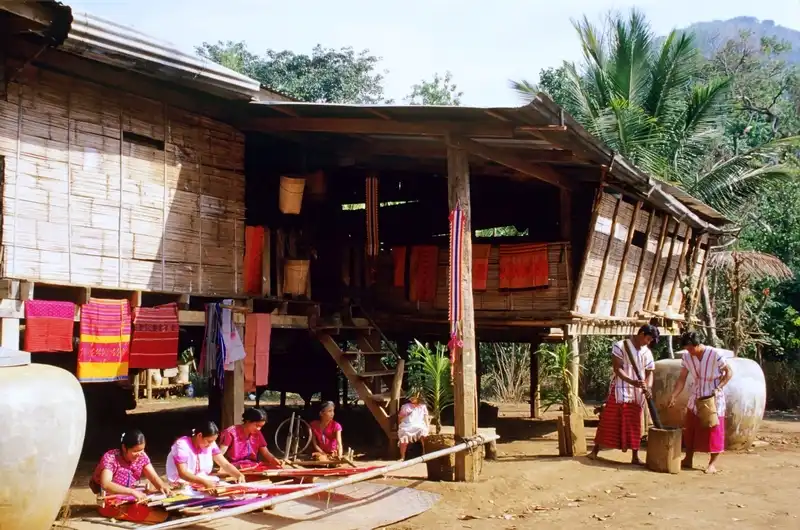
The distinctive value of visiting Karen villages in Kanchanaburi is the opportunity to learn across multiple layers. You might begin with a quiet walk through the village, observing stilted wooden houses, the organization of kitchen spaces, and the placement of tools and household items shaped by local terrain and livelihoods. From there, you may learn about weaving, natural dyeing, or seasonal cooking practices. If the community organizes activities, you might try simple steps yourself, such as preparing thread, learning a basic pattern, or wrapping food in leaves in a traditional style. These hands-on moments help you understand that “local wisdom” is not something frozen in a museum, but practical knowledge that helps communities thrive where time and resources are precious.
Another dimension that is often overlooked is “quietness.” Many Karen villages are far from urban noise and nightlife. In mountain landscapes, the main sounds you notice are wind, water, birds, and soft conversation that is not rushed. This atmosphere naturally supports rest and reflection, giving visitors a mental spaciousness that can be difficult to find in everyday urban life. For many people, a Karen village visit offers not only cultural learning, but also a renewed sense of appreciation for simplicity.
That said, visiting an ethnic community should follow principles of responsible travel. The most basic rules include respecting the community’s privacy, keeping noise low, leaving no trash behind, avoiding photographing people without permission, and not reducing culture to content-making material. If you want to take photos, begin by greeting politely, asking for consent, and accepting a refusal without pressure. Some places have beliefs related to rituals or sacred locations where photography is not appropriate. Respecting these boundaries communicates that you are a guest, and that the community has the right to define its own limits.
Supporting the local economy is also part of responsible travel. If there are community-made products such as woven textiles, natural dyes, basketry, or local food, buying directly from the source helps circulate income and can encourage younger generations to value local livelihoods. At the same time, visitors should buy mindfully, avoid bargaining in ways that feel disrespectful, and ask about origins and production methods with genuine interest. These conversations often become the bridge that builds mutual understanding between visitors and hosts.
If you only have one day, a practical plan is to choose an accessible zone – such as areas near the Sangkhlaburi district center or the Sai Yok zone – and keep the schedule light. Start in the morning by taking in the community atmosphere and learning cultural context, have a local lunch at midday, and return in the afternoon to avoid driving mountain roads at night. If you want deeper learning, staying overnight usually offers a clearer view of real rhythms of life, because evenings and mornings are key times when daily routines become most visible: meal preparation, household management, family conversations, and the kind of quiet where you can hear nature in detail.
Many travelers prefer the late rainy season into the cool season because the weather is comfortable and the landscape is lush, with mountain views at their best. If you travel during the rainy season, allow extra time and prepare for slippery roads, fog, and sudden rain, especially on routes that include unpaved sections or steep curves. Non-slip shoes, a rain jacket, and waterproof bags for important devices can make the trip safer and more enjoyable.
Getting There If you want to plan a Karen village visit in Kanchanaburi in a straightforward way, begin from Kanchanaburi town and choose a district known for Karen communities and nature-based travel, such as Sangkhlaburi, Thong Pha Phum, Sai Yok, or Si Sawat. Driving your own car is the most flexible option, because some areas require transfers or involve side roads without frequent public transport. If you travel by public transport, you generally need to reach the province’s transport hub first, then continue to your target district, and finally use local transport or coordinate with the community for activity-based visits. In all cases, plan extra time – mountain routes often include many curves, and traveling after dark may be less convenient than daytime travel.
In summary, “Karen villages in Kanchanaburi Province” are well suited for travelers who want meaningful experiences that combine nature and culture – learning language, daily life, folk traditions, and the relationship between people and resources in ways that standard travel guides rarely capture in full. If you visit with politeness and a genuine intention to learn, you will gain more than photographs. You will leave with a renewed perspective on simplicity and a clearer understanding of why many traditions remain resilient when communities still live them as part of everyday life.
| Place Summary | A cultural travel concept for learning about Karen communities in Kanchanaburi Province, with a focus on language, daily life, folk play, and local wisdom. |
| Location | Kanchanaburi Province (Karen communities can be found across several districts such as Sangkhlaburi, Thong Pha Phum, Sai Yok, and Si Sawat) |
| Address For Navigation | Sangkhlaburi zone, Nong Lu Subdistrict / Lai Wo Subdistrict, Kanchanaburi (reference area for travel planning) |
| Key Highlights | Living Karen culture, spoken community language, nature-based livelihoods, folk play and music, crafts/textiles, and responsible community travel |
| Nearby Tourist Attractions | 1) Mon Bridge – approx. 2 km 2) Wat Wang Wiwekaram – approx. 2 km 3) Phutthakhaya Pagoda (Sangkhlaburi) – approx. 3 km 4) Three Pagodas Pass – approx. 22 km 5) Vajiralongkorn Dam Viewpoint (Sangkhlaburi zone) – approx. 35 km |
| Nearby Restaurants | 1) Pa Yin Restaurant (Mon-style breakfast) – approx. 2 km. Tel. 089-808-3002 2) Krua Somchai by Somchai Coffee – approx. 2 km. Tel. 089-529-1675 3) Highlight Sangkhlaburi (Thai BBQ) – approx. 3 km. Tel. 092-570-2256 4) Jok Nang Yong (rice porridge) – approx. 2 km. Tel. 085-702-2152 5) Mit Sampan Floating Rafts (Nong Lu riverside zone) – approx. 6 km. Tel. 034-595-261 |
| Nearby Accommodations | 1) Sam Prasob Resort – approx. 2 km. Tel. 034-595-050, 089-137-4831 2) Coffee Berry – approx. 2 km. Tel. 062-483-2873 3) Must Tawan – approx. 2 km. Tel. 082-292-5139 4) Cheun Jai House – approx. 2 km. Tel. 081-402-8960, 081-300-9376 5) P Guesthouse – approx. 2 km. Tel. 034-595-061, 081-450-2783 |
| Facilities | Basic shops and services are concentrated around the district center/market. Prepare cash, mosquito repellent, a rain jacket, and waterproof protection for key devices, especially during the rainy season. |
| Current Status | A cultural travel concept where prior coordination and respect for community guidelines are important, especially for deeper learning activities and village-based experiences. |
Frequently Asked Questions (FAQ)
Q: Who are Karen village visits in Kanchanaburi suitable for?
A: They are ideal for travelers interested in ethnic culture, nature, community life, and slower-paced learning-based travel, including families and student groups doing field study.
Q: How should I prepare before visiting a Karen community?
A: Dress respectfully, bring mosquito repellent, drinking water, a rain jacket, and waterproof protection for your phone/camera, and be ready to follow community etiquette such as asking permission before photographing people.
Q: What cultural elements are most worth learning about?
A: Everyday spoken language and greetings, annual traditions, crafts/textiles, local food practices, and folk play or music that strengthens community bonds.
Q: How many days should I plan for a deeper experience?
A: At least 2 days and 1 night is recommended, because staying overnight reveals morning and evening rhythms that are central to real daily life.
Q: What is the best season to visit?
A: Late rainy season into the cool season is comfortable and scenic. In the rainy season, allow extra time and take care on slippery mountain roads.
Q: Why is responsible travel especially important in ethnic communities?
A: Because communities have cultural integrity and privacy. Respecting guidelines, minimizing disruption, and supporting local livelihoods appropriately helps keep tourism sustainable and beneficial for everyone.
 Karen Villages Map
 Category:
  Group:
  Last Update: 2 MonthAgo
Comment
 Nearby Attractions
| Keyword (Advance) |
 Region
|
 Muang Kanchanaburi(