
 Home
Home North(
 Chiang Mai(


Rating: 3.1/5 (7 votes)
 |
|  Map
Map 
 Have Map
  No Map
Kanchanaburi attractions
Attractions in Thailand
Open Days: Open Daily
Opening Hours: 07:00 – 18:00
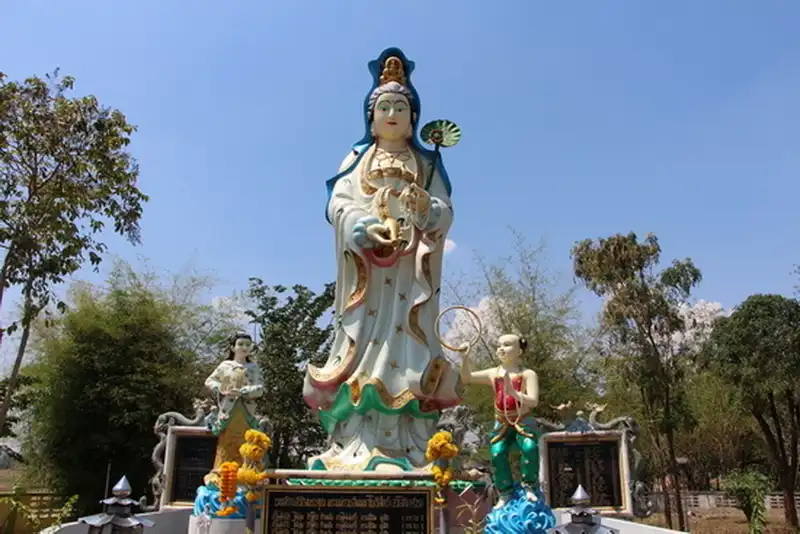
Guanyin Bodhisattva at Wat Thung Samo in Kanchanaburi is a faith-based destination that many visitors travel to specifically to pay respects to a large Guanyin statue, guided by beliefs in compassion, protection, and the wish for a calm, smooth path in life. The dignified presence of the Bodhisattva makes this place a well-known stop for temple visits in Kanchanaburi, and it continues to welcome both Thai visitors and international travelers throughout the year. The temple is not far from Kanchanaburi town; you can drive east along Highway 324 for roughly 15–16 kilometers, which makes it suitable both for those who want to make merit with full intention and for anyone planning a relaxed half-day temple trip without rushing.
For first-time visitors, the charm of Wat Thung Samo often begins with a simple feeling: it is easy to get here, yet your mind naturally slows down and settles. Once you leave the busy rhythm of town and enter the local community and open fields, the road itself seems to soften your pace. When the Guanyin statue comes into view as the clear symbol of the place, a quiet sense of reverence can arise without needing much explanation. Paying respects to Guanyin within the setting of a Thai temple also offers a gentle cultural harmony, where East Asian devotional imagery and Thai Buddhist practice coexist naturally in one space. It does not feel out of place, because the heart of the visit remains the same: to cultivate kindness, compassion, and a mindful return to what is good within oneself.
Many people come primarily to pay respects to Guanyin, but once they arrive, they often discover that the temple also offers other important points of worship. Tourism descriptions note that visitors can also pay respects to Phra Sangkajjai and to the principal Buddha image inside the ubosot (ordination hall) of Wat Thung Samo. This means one visit does not end with the Guanyin statue alone; it can become a more complete merit-making experience, combining a calm and focused prayer, simple offerings according to one’s faith, and a respectful visit into the ubosot to pay homage to the principal Buddha image, which is central to the identity of a Thai temple. A polite and meaningful order that many visitors follow is to begin by setting the mind and paying respects to Guanyin, then enter the ubosot to pay homage to the principal Buddha image, and finally offer respects to Phra Sangkajjai or make merit as appropriate. Many people describe this flow as feeling “complete” in both devotion and peace of mind.
In terms of background, Wat Thung Samo is located in Phanom Thuan District, Kanchanaburi, and there is information indicating the temple’s establishment year as well as visungkhamsima details, which help confirm its formal standing within Thai Buddhism. This kind of information matters in a travel article because it supports trust: the temple has a clear religious foundation rather than being only a temporary attraction. In the broader picture, Wat Thung Samo functions primarily as a community temple that supports local faith and religious life, while the prominence of the Guanyin statue has expanded its recognition beyond the immediate area and encouraged visitors from elsewhere to come with intention. This growth does not mean the temple becomes only a tourist spot; rather, it reflects a wider circle of devotion, while the temple’s quiet Thai-temple atmosphere remains the core.
What many visitors remember most about paying respects to Guanyin at Wat Thung Samo is a sense of fulfillment without pressure. The space does not push anyone to move quickly from one activity to another; instead, it allows each person to choose their own rhythm. Some people bow and then sit quietly for a moment, some make merit through offerings or donations according to their means, and others take time to walk around and let their thoughts settle. Because Guanyin symbolizes compassion, many visitors naturally use this time to reflect gently, not only to ask for blessings, but also to regain emotional balance and lighten the mind. This is a kind of value many people seek from temple visits today, especially in an era where daily life can feel fast and demanding.
When it comes to “making wishes” in the way people commonly associate with Guanyin, a grounded approach that fits a place like this is to pray for peace, compassion, safety, and steadiness of heart. The most meaningful prayer is often paired with the intention to do good, because a temple is ultimately a space that reminds people to reduce harm and strengthen kindness. Any vow or request should be made respectfully, without exaggeration, and with emphasis on merit-making and personal effort alongside prayer. Presenting this perspective in a cultural travel article helps the content remain responsible, balanced, and valuable to readers.
Many people recommend visiting in the morning not long after opening or in the late afternoon before closing, when the weather is usually more comfortable and the atmosphere tends to be calmer, especially outside long holiday periods. If you want cleaner photos with fewer people in the background, weekdays are often a good choice. If you prefer a livelier merit-making atmosphere, weekends or important Buddhist days can feel more communal and active. Both styles have their own appeal. The key is to dress modestly, keep your voice low, and take photos in a way that respects those who are praying, especially when elders or families with children are present.
Temple etiquette helps create a good experience for both visitors and the local community. Modest clothing is the baseline, and it is best to avoid overly short or tight outfits. Keep conversations quiet around worship areas, and if you take photos, do so discreetly without blocking others or posing inappropriately in sacred spaces. You can make merit according to your means, and if you wish to offer items, it is considerate to ask temple staff or monks what is appropriate. These small actions support respectful cultural travel, which aligns well with Kanchanaburi’s broader identity as a province rich in nature, history, and religious sites spread across many areas.
Getting There To visit the Guanyin Bodhisattva at Wat Thung Samo, you can start from Kanchanaburi town and drive east along Highway 324 for approximately 15–16 kilometers, then follow the local access road into the Thung Samo community area. Using a navigation map alongside your drive is recommended for accuracy. The route is generally convenient and suitable for most vehicles, and it is easy to combine this visit with other nearby points of interest around town within the same day.
| Place Summary | A well-known worship spot for a large Guanyin Bodhisattva statue at Wat Thung Samo (Phanom Thuan District), with convenient access from Kanchanaburi town and a calm, culture-rich temple atmosphere. |
| Place Name | Guanyin Bodhisattva at Wat Thung Samo |
| Location | Thung Samo Subdistrict, Phanom Thuan District, Kanchanaburi |
| Address | Thung Samo Subdistrict, Phanom Thuan District, Kanchanaburi (along Highway 324, east of Kanchanaburi town) |
| Highlights | A prominent large Guanyin statue as a faith landmark, with additional worship points including Phra Sangkajjai and the principal Buddha image inside the ubosot in the same visit. |
| Abbot / Caretaker (Latest) | Phra Khru Worathammaprabhas (Sutjai Mahisaro) |
| Current Status | Open to visitors and worshippers daily during the temple’s opening hours. |
| Contact Numbers | 034-659-276, 034-659-277, 034-659-278 |
| Nearby Tourist Attractions With Distance | 1) Wat Tham Suea (approx. 18 km) 2) Wat Ban Tham (approx. 22 km) 3) Mallika R.S. 124 (approx. 28 km) 4) Kanchanaburi Skywalk (approx. 18 km) 5) Bridge Over the River Kwai (approx. 20 km) |
| Popular Restaurants Nearby With Distance + Phone | 1) Kaew Ruen Kwan Restaurant (approx. 19 km) Tel. 034-513-855 2) Keeree Tara (approx. 21 km) Tel. 034-512-888 3) On’s Thai Issan (approx. 20 km) Tel. 034-514-555 4) Loft Restaurant and Bar (approx. 20 km) Tel. 034-511-222 5) H2 Rivercafe (approx. 21 km) Tel. 034-512-777 |
| Popular Accommodations Nearby With Distance + Phone | 1) Felix River Kwai Resort (approx. 21 km) Tel. 034-551-000 2) Dheva Mantra Resort (approx. 22 km) Tel. 034-615-999 3) The Bridge Residence Hotel (approx. 20 km) Tel. 034-512-888 4) U Inchantree Kanchanaburi (approx. 21 km) Tel. 034-514-222 5) Royal River Kwai Resort & Spa (approx. 24 km) Tel. 034-525-888 |
Frequently Asked Questions (FAQ)
Q: What are the opening hours for the Guanyin Bodhisattva at Wat Thung Samo?
A: The site is generally open daily from 07:00 – 18:00, and it is recommended to allow enough time to pray and walk around respectfully.
Q: How far is Wat Thung Samo from Kanchanaburi town?
A: It is approximately 15–16 kilometers east of Kanchanaburi town along Highway 324.
Q: What do people usually pray for when visiting Guanyin here?
A: Many visitors pray for compassion, peace of mind, safety, and a calm, steady life, while also focusing on doing good alongside prayer.
Q: Are there other worship points inside the temple besides Guanyin?
A: Travel information notes that visitors can also pay respects to Phra Sangkajjai and to the principal Buddha image inside the ubosot of Wat Thung Samo.
Q: When is the best time to visit for a calmer atmosphere?
A: Early morning after opening or late afternoon before closing is often more comfortable and tends to be quieter than long holiday periods.
Q: Is there a contact phone number for Wat Thung Samo?
A: Yes. Available contact numbers include 034-659-276, 034-659-277, and 034-659-278.
 Guanyin Bodhisattva Wat Thung Samo Map
 Category:
  Group:
  Last Update: 2 MonthAgo
Comment
 Nearby Attractions
| Keyword (Advance) |
 Region
|
 Muang Kanchanaburi(