

 Home
Home Chiang Mai(




Rating: 3.3/5 (8 votes)
 |
|  Map
Map 
 Have Map
  No Map
Chai Nat attractions
Attractions in Thailand
Open Days: Open Daily
Opening Hours: 08:00 – 17:00
Wat Don Tum Kamolawas, Chainat is a Dhammayut temple of considerable importance in Chainat Province. It is located in Ban Don Tum, Village No. 5, Nong Bua Subdistrict, Wat Sing District. This temple serves as a center of faith for the local community and also reflects the collective devotion of Buddhist laypeople who joined together to establish it as a place for Buddhist ceremonies, meditation practice, and spiritual peace amid the tranquil atmosphere of a forested setting.
Wat Don Tum Kamolawas has a founding history closely connected with the faith of both the monastic community and local residents. Between 1968 and 1974, Mr. Thawan Thakingsri, who served as the Provincial Education Officer of Chainat at the time, together with Uncle Sangwan and Aunt Chala Suraruet, owners of Suk Saeng Dao Shop, as well as devoted lay followers in Wat Sing District, offered land to Chao Khun Phra Rajamuni (Hom Sophano) of Wat Pathum Tharam in Pathum Wan, Bangkok, for the establishment of a Dhammayut temple in Chainat Province.
The establishment of a Dhammayut temple in Chainat during that period was significant because, in earlier times, there were relatively few Dhammayut temples in some central provinces. The creation of another Dhammayut temple therefore expanded opportunities for monks and Buddhist devotees who followed the Dhammayut tradition to study the Dhamma and practice properly in accordance with Buddhist monastic discipline.
After the land was offered, Chao Khun Phra Rajamuni assigned Phra Khru Panyathuratron, the abbot of Wat Khao Chai Thong Woraram in Tak Fa District, Nakhon Sawan Province, to arrange for a monk to oversee the temple’s construction. Later, Bhikkhu Thongyot Santikaro came to take responsibility for supervising the construction and led local devotees in continuously developing the temple.
During the early stage, the construction of the temple progressed through the united efforts of villagers in the community. The temple was not built through abundant resources, but through the faith and sacrifice of Buddhist laypeople who wished to have a temple serving as the spiritual center of their community. Eventually, Wat Don Tum Kamolawas was officially recognized as a temple on 22 October 1970.
Then, on 5 April 1974, Wat Don Tum Kamolawas received royal bestowal of Wisungkhamasima, an important step in the formal establishment of a Buddhist temple. Wisungkhamasima refers to the officially designated boundary for the monastic acts of the Sangha, such as ordination, recitation of the monastic code, and other important ecclesiastical ceremonies.
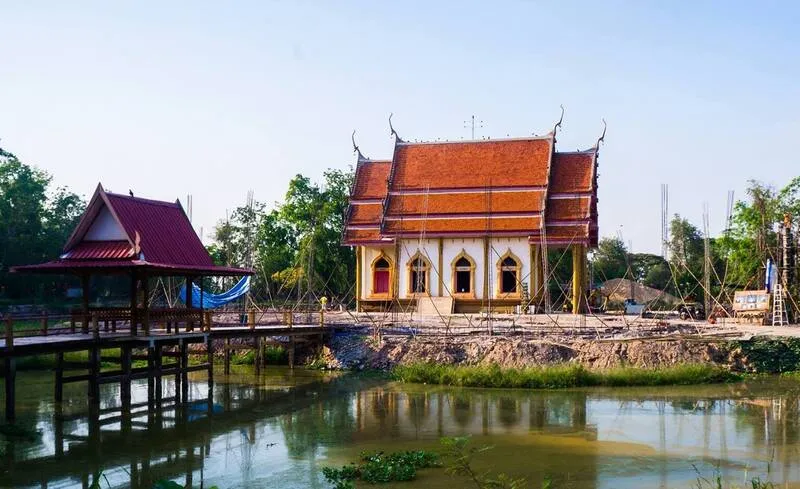
The feature that makes Wat Don Tum Kamolawas especially unique among temples in Chainat is its ordination hall surrounded by water, known as a “water sima.” This is a special type of ordination hall not commonly found in ordinary temples. A water sima is defined by a consecrated boundary established with water surrounding the ordination hall, creating an atmosphere of greater calm and sacredness.
The water-sima ordination hall of Wat Don Tum Kamolawas is also regarded as the only one of its kind in Chainat Province. This makes the temple stand out both in terms of religious architecture and Buddhist significance. Visitors can see the image of the ordination hall set amidst the water, reflecting both beauty and serenity in a remarkable way.
In 1975, the temple’s foundation stone was laid by Somdet Phra Nyanasamvara, who later became the Supreme Patriarch of Thailand. This event was considered highly auspicious for Wat Don Tum Kamolawas, as the laying of the foundation stone by a senior ecclesiastical figure marked a blessed beginning and enhanced the sacred character of the site.
Later, in 1978, there was a casting ceremony for the principal Buddha image presided over by Somdet Phra Sangharat (Wasana Maha Thera), who was the head of the Thai monastic order at the time. Because Wat Don Tum Kamolawas became connected with two Supreme Patriarchs, it has been regarded as a temple enjoying the great blessing of “two Somdets, two heads of the Sangha.”
Beyond its historical importance, the atmosphere inside Wat Don Tum Kamolawas is peaceful and shaded, as the surrounding area is filled with large trees and natural woodland. Once visitors walk into the temple grounds, they can immediately feel the coolness and calm that make the temple well suited for meditation practice and mental rest.
Wat Don Tum Kamolawas is also a meditation retreat that attracts those who wish to cultivate concentration and study the teachings of Buddhism. Its meditation areas are designed to blend with nature, resembling small cottages set among the trees, allowing practitioners to live simply and peacefully in accordance with Buddhist principles.
Phra Khru Supanyakosol, who served as the abbot of Wat Don Tum Kamolawas during one period, played an important role in improving the temple grounds to make them beautiful and suitable for meditation practice. He initiated the construction of various features inside the temple, such as an artificial waterfall, a reception pavilion, and several shrine halls housing sacred images.
One of the attractions that draws the attention of visitors is the shrine housing images of Luang Pu Suk, Somdet Toh, and Luang Pu Thuat. This shrine was designed in a cave-like style that blends naturally with the surrounding forest garden, giving those who come to pay respect a sense of tranquility and sacredness.
Today, Wat Don Tum Kamolawas continues to serve as a religious and cultural center for the people of Ban Don Tum and nearby communities. Local residents often come here to make merit, listen to sermons, and take part in religious activities on important Buddhist holy days. The temple therefore continues to play a significant role in connecting the people of the community together.
Getting There Reaching Wat Don Tum Kamolawas can be done by starting from Chainat town and heading toward Wat Sing District, which is about 20 kilometers away. Once you enter Wat Sing District, it is not difficult to continue to Nong Bua Subdistrict and Ban Don Tum, as the road leading to the temple is convenient and signposted clearly.
For those traveling from Bangkok, you can take the Asian Highway (Highway No. 32) toward Chainat Province, then enter Chainat town and continue to Wat Sing District. The journey takes about 3 hours. You can also search for “Wat Don Tum Kamolawas” on Google Maps for convenient navigation.
A visit to Wat Don Tum Kamolawas can also be combined with other major attractions in Chainat Province, such as Wat Pak Khlong Makham Thao, Wat Song Sawoei, Chao Phraya Dam, and Chainat Bird Park, all of which are well-known destinations in the province.
| Name | Wat Don Tum Kamolawas |
| Location | Ban Don Tum, Village No. 5, Nong Bua Subdistrict, Wat Sing District, Chainat Province |
| Brief History | A Dhammayut temple established during 1968–1974, officially recognized as a temple on 22 October 1970, and granted royal Wisungkhamasima on 5 April 1974. |
| Highlights | The only water-sima ordination hall in Chainat Province, and a meditation temple set amid a natural forest garden. |
| Caretaker / Abbot | Phra Khru Supanyakosol |
| Nearby Tourist Attractions | 1. Wat Pak Khlong Makham Thao – 10 km. 2. Wat Song Sawoei – 12 km. 3. Chao Phraya Dam – 18 km. 4. Chainat Bird Park – 20 km. 5. Wat Sing Satit – 8 km. |
| Nearby Restaurants | 1. Baan Suan Wat Sing Restaurant – 6 km. Tel. 056-401-889 2. Krua Wat Sing – 5 km. Tel. 056-401-221 3. Krua Rim Nam Chainat – 18 km. Tel. 056-411-888 4. Baan Imsuk Restaurant – 20 km. Tel. 056-410-229 5. Chainat Garden Restaurant – 21 km. Tel. 056-411-201 |
| Nearby Accommodations | 1. Chainat Thani Hotel – 20 km. Tel. 056-411-403 2. 111 Resort Chainat – 19 km. Tel. 056-414-229 3. Chainat Park Resort – 21 km. Tel. 056-417-777 4. Chao Phraya Resort – 22 km. Tel. 056-415-909 5. Chainat Resort – 23 km. Tel. 056-411-566 |
Frequently Asked Questions (FAQ)
Q: Where is Wat Don Tum Kamolawas located?
A: Wat Don Tum Kamolawas is located in Ban Don Tum, Village No. 5, Nong Bua Subdistrict, Wat Sing District, Chainat Province. It is a Dhammayut temple of importance to the local community.
Q: What is the highlight of Wat Don Tum Kamolawas?
A: Its main highlight is the ordination hall surrounded by water, or water sima, which is the only one of its kind in Chainat Province.
Q: When was Wat Don Tum Kamolawas established?
A: The temple began to be established during 1968–1974 and was officially recognized as a temple on 22 October 1970.
Q: What sacred objects can be worshipped inside the temple?
A: Inside the temple there are shrine halls for Luang Pu Suk, Somdet Toh, and Luang Pu Thuat, as well as the principal Buddha image in the ordination hall, all of which are highly revered by devotees.
Q: Is Wat Don Tum Kamolawas suitable for meditation practice?
A: Yes. The temple has a peaceful atmosphere and meditation areas designed to blend with nature, making it suitable for those who want to practice meditation and study the Dhamma.
 Wat Don Tum Kamolawas Map
 Category:
  Group:
  Last Update: 3 HourAgo
Comment
 Nearby Attractions
| Keyword (Advance) |
 Facebook Fanpage
 Region
 Art, Culture and Heritage
 Historical Sites and Monuments(
 Landmarks and Memorials(
 Art, Craft Centres, Tradition(
 Museums(
 Educational Places
 Museum for Study(
 Other religious and spiritural sites(
 Nature and Wildlife
 Mountain (Doi)(
 Dam, Reservoir, Lake(
 River, Canal(
 Other natural attractions(
 Entertainment and Agricultural
 Zoos and Aquariums(
 Animal camps and shows(
 Waterpark(