

 Home
Home Chiang Mai(




Rating: 3.6/5 (5 votes)
 |
|  Map
Map 
 Have Map
  No Map
Chai Nat attractions
Attractions in Thailand
Open Days: Every Day
Opening Hours: 06:00 – 18:00
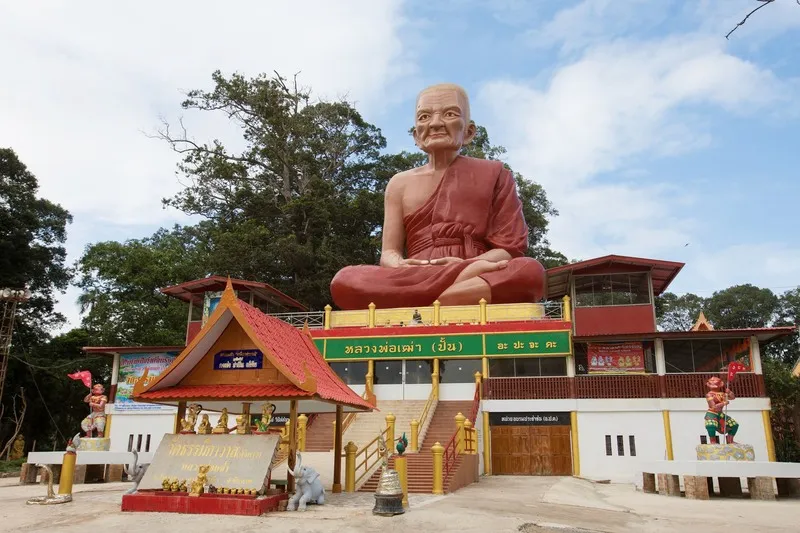
Wat Thammikawat, commonly known among local residents as “Wat Suan Ling” or the Monkey Garden Temple, is one of the important temples in Chai Nat Province. Located in Phongam Subdistrict, Sankhaburi District, this temple has long served as a spiritual center for local people. It also clearly reflects the deep bond between religion, nature, and the traditional way of life of the surrounding community.
In the past, the area where Wat Thammikawat now stands was woodland and farmland used by villagers. The Noi River flowed nearby and was an important water source for the community. The people living in this area had a way of life closely connected to the river and the natural environment. As the settlement gradually became more permanent, villagers joined together to establish a monastic residence in the area to serve as a place for Buddhist ceremonies and as a dwelling for monks practicing the Dhamma.
This monastic residence was later developed and officially established as a temple, receiving the name “Wat Thammikawat,” which means a place where those who practice righteousness reside. From then on, the temple became a religious and cultural center for people in Phongam Subdistrict and nearby communities.
Inside Wat Thammikawat are sacred Buddha images that are deeply revered by local people, namely Luang Pho Wat and Luang Pho Thao. These Buddha images are regarded as spiritual guardians of the community. Villagers often come to pay respect and pray for blessings, asking for prosperity in life, success in their work, and happiness and well-being for their families.
Over time, Wat Thammikawat became more widely known because of one distinctive feature: a large troop of monkeys living within the temple grounds. These monkeys have inhabited the area since long ago because the temple is filled with large trees that provide both shelter and natural food sources. As the monkey population continued to grow, villagers began calling the temple “Wat Suan Ling,” meaning Monkey Garden Temple, and that name remains widely recognized today.
The monkeys living at Wat Thammikawat are mostly long-tailed macaques, a species commonly found in central Thailand. They are known for their greyish-brown fur and their strong ability to adapt to the environment. These monkeys usually live in large trees and along the temple walls, and their lives have long been closely connected with the local community and the monks living at the temple.
People in the area believe that these monkeys are like guardians of the temple and are part of nature that should be cared for and protected. As a result, the monkeys are fed regularly by monks, villagers, and visitors who come to the temple. Many visitors bring bananas, corn, or fruit to feed them, and this has become a familiar sight around Wat Suan Ling.
Although monkeys are wild animals that can adapt well to living near humans, the temple and the community still emphasize the importance of proper coexistence. Visitors are often advised to be careful when feeding the monkeys and not to get too close in order to prevent possible accidents.
In addition to the large monkey population, the riverside area of Wat Thammikawat along the Noi River is also a place where various freshwater fish species are protected. Local residents and visitors often come here to release fish and feed them, making the riverside area a gathering place for many freshwater fish.
Another distinctive feature of Wat Thammikawat is the many large Yang trees within the temple grounds. These trees are several decades old and provide shade throughout the area, creating a calm and cool atmosphere suitable for relaxation and meditation for monks and visitors alike.
Local residents of Phongam Subdistrict say that Wat Thammikawat has long been closely connected to the life of the community, from the time of their grandparents to the present day. The temple has not only been a place for religious ceremonies but also a center for many community activities.
In the past, during important Buddhist holy days, villagers would gather at the temple to make merit, listen to sermons, and take part in religious activities together. The atmosphere within the temple was therefore filled with liveliness and strong faith.
Some villagers recall that when they were children, they often followed adults to the temple to feed the monkeys and watch them climb the large trees throughout the grounds. These scenes became beautiful memories shared by many people in the community.
Many people also believe that Luang Pho Wat and Luang Pho Thao, the sacred Buddha images enshrined at Wat Thammikawat, protect the community and bring peace and well-being. Villagers often come to make vows and return to offer thanks when their wishes are fulfilled.
Even as time has passed, Wat Thammikawat remains an important place that connects faith, nature, and the community’s way of life in a harmonious way. Those who wish to ask for more information about the temple may contact local offices at the following phone numbers: 056481234, 056411234, 056487321, 056451567, and 056412890.
Among the sacred objects enshrined within Wat Thammikawat, Luang Pho Wat is regarded as one of the most revered Buddha images by people in Phongam Subdistrict and nearby areas. Many villagers recount events they believe to be miracles of Luang Pho Wat experienced by those who came to pray with sincere faith. Stories commonly shared in the community often involve vows for success in business, examinations, or work. When their wishes come true, people usually return to fulfill their vows by offering flower garlands, incense, candles, and other offerings at the shrine.
Local elders tell the story of a villager who once worked as a trader and came to pray to Luang Pho Wat for better business fortune. Not long afterward, his business improved significantly, allowing him to expand his shop and improve his financial situation. The man later returned to the temple to hold a large merit-making ceremony in fulfillment of his vow, and that story became one of the best-known accounts passed down among villagers to this day.
In addition to business-related stories, there are also stories about safe travel. Some villagers who need to travel long distances often come to pay respect to Luang Pho Wat before departure, believing that the sacred Buddha image will protect them on their journey. These stories reflect the deep faith that local people have in this revered image and show how Luang Pho Wat has become a spiritual symbol of profound importance.
Today, Wat Thammikawat is cared for by the monks and the temple committee, who play an important role in maintaining the temple grounds and preserving its peaceful atmosphere as a place of worship for the community. The abbot of Wat Thammikawat is highly respected by local people because of his role in developing the temple both religiously and socially, such as organizing merit-making activities on important Buddhist holy days, promoting Dhamma education, and working together with the community to conserve the natural environment around the temple.
Many villagers say that the abbot is compassionate and closely connected to the community. He often gives guidance on living according to Buddhist teachings and continually supports community activities, whether local traditions, village merit-making events, or assistance for the underprivileged in the area. His role therefore extends beyond the temple itself, as he also serves as a spiritual leader for the wider community.
When speaking of Wat Suan Ling, stories about the monkeys living there are another subject often shared among villagers. Elderly residents of Phongam recall that in the past the number of monkeys at the temple was not very large. The earliest groups of monkeys lived in the large trees along the Noi River, where natural food sources were abundant.
Over time, the monkey population increased until a large troop came to live permanently in the temple grounds. Some villagers say that the monkeys in earlier times were gentle and familiar with local people. Children would often bring fruit to feed them, and the monkeys would come down to take the food without fear. Images of monkeys running around the temple courtyard and climbing the large trees became a familiar sight for many decades.
One story that villagers still remember well concerns a monkey that often sat near the shrine of Luang Pho Wat. People believed that this monkey was like a guardian of the temple because it appeared in the same place every day and rarely moved far from the shrine. Although this may only be local folklore, it reflects the long-standing bond between people, monkeys, and the temple.
The location of Wat Thammikawat is also important in terms of the geography of the community, as it stands near the Noi River, a waterway that has sustained the lives of people in Phongam Subdistrict for a very long time. In the past, the Noi River served as a transportation route used by villagers for travel and for moving goods, with boats being the main means of transport between villages.
The Noi River was also an important food source for the community because it was home to many species of freshwater fish. Villagers often fished there for household consumption or to sell at local markets. The presence of the river near the temple made the surrounding area fertile and suitable for settlement.
Today, the Noi River remains an essential part of life in Phongam Subdistrict, and the riverside area of Wat Thammikawat has become a place where people often come to release fish, feed them, and enjoy the peaceful scenery along the water.
Getting There Wat Thammikawat can be reached by car from Chai Nat town by taking the route toward Sankhaburi District and then continuing to Phongam Subdistrict, where the temple is located. The journey from Chai Nat town to Wat Thammikawat takes around 30 to 40 minutes, and most of the route is along paved roads that are easy to travel.
Visitors using navigation systems can search for the destination using the names “Wat Suan Ling Chai Nat” or “Wat Thammikawat Sankhaburi” to reach the temple conveniently. Upon arrival, visitors will find a peaceful setting shaded by large trees and will be able to see the troop of monkeys living in the trees and along the temple walls.
Traveling to Wat Thammikawat is not only a cultural visit, but also an opportunity to experience the local way of life, admire the natural beauty of the Noi River, and learn about the story of Wat Suan Ling, a place that beautifully reflects the close relationship between religion, nature, and community.
| Name | Wat Thammikawat (Wat Suan Ling) |
| Address | Phongam Subdistrict, Sankhaburi District, Chai Nat Province |
| Key Characteristics | An old temple of the Phongam community located near the Noi River, with a large troop of monkeys living in the area, which is the origin of the name Wat Suan Ling. |
| Highlights | Home to Luang Pho Wat and Luang Pho Thao, a large monkey population, a fish conservation area along the Noi River, and many large Yang trees. |
| Abbot or Caretaker | Phra Khru Prasit Chai Nat (information may change according to monastic administrative terms) |
| Getting There | Travel from Chai Nat town to Sankhaburi District, then continue toward Phongam Subdistrict. The trip takes about 30–40 minutes. |
| Current Status | A community temple and a cultural tourism attraction in Chai Nat Province |
| Nearby Attractions | 1. Chao Phraya Dam (about 22 km) 2. Wat Pak Khlong Makham Thao (about 15 km) 3. Chainat Bird Park (about 20 km) 4. Wat Mahathat Chai Nat (about 21 km) 5. Sankhaburi Market (about 8 km) |
| Nearby Restaurants | 1. Khrua Lum Nam Chao Phraya Restaurant (about 20 km) Tel. 056-405123 2. Sankhaburi Boat Noodle Shop (about 8 km) Tel. 056-451234 3. Khrua Chai Nat Restaurant (about 21 km) Tel. 056-411567 4. Riverside Chao Phraya Restaurant (about 22 km) Tel. 056-412345 5. Baan Suan Chai Nat Restaurant (about 19 km) Tel. 056-413789 |
| Nearby Accommodations | 1. Chainat Thani Hotel (about 20 km) Tel. 056-411222 2. Riverside Resort Chai Nat (about 22 km) Tel. 056-413333 3. Sankhaburi Resort (about 9 km) Tel. 056-451999 4. Baan Suan Resort Chai Nat (about 18 km) Tel. 056-412444 5. Chai Nat Resort (about 21 km) Tel. 056-410555 |
Frequently Asked Questions (FAQ)
Q: Where is Wat Suan Ling located?
A: Wat Thammikawat, also known as Wat Suan Ling, is located in Phongam Subdistrict, Sankhaburi District, Chai Nat Province. It is an old community temple with a large troop of monkeys living within the temple grounds.
Q: Why is it called Wat Suan Ling?
A: The temple is called Wat Suan Ling because a large number of monkeys have lived among the large trees and throughout the temple grounds for many decades.
Q: Who is Luang Pho Wat?
A: Luang Pho Wat is a sacred Buddha image enshrined inside Wat Thammikawat. Local people deeply respect and worship this image and often come to pray for blessings and good fortune.
Q: Can visitors feed the monkeys?
A: Yes, visitors can feed the monkeys, but they should do so carefully and avoid getting too close in order to ensure the safety of both people and animals.
Q: What time is Wat Thammikawat open to visitors?
A: In general, the temple is open to visitors every day from morning until evening.
 Wat Thammikawat Map
 Category:
  Group:
  Last Update: 2 MinuteAgo
Comment
 Nearby Attractions
| Keyword (Advance) |
 Facebook Fanpage
 Region
 Art, Culture and Heritage
 Historical Sites and Monuments(
 Landmarks and Memorials(
 Art, Craft Centres, Tradition(
 Museums(
 Educational Places
 Museum for Study(
 Other religious and spiritural sites(
 Nature and Wildlife
 Mountain (Doi)(
 Dam, Reservoir, Lake(
 River, Canal(
 Other natural attractions(
 Entertainment and Agricultural
 Zoos and Aquariums(
 Animal camps and shows(
 Waterpark(