

 Home
Home Chiang Mai(


























Rating: 4.5/5 (4 votes)
 |
|  Map
Map 
 Have Map
  No Map
Ratchaburi attractions
Attractions in Thailand
Open Days: Open daily
Opening Hours: 08:00 – 17:00
Sarika Cave, or Wat Tham Sarika, is one of the most interesting historical and religious attractions in Ratchaburi Province. It is located in Village No. 8, Thammasen Subdistrict, Photharam District, surrounded by a peaceful hillside setting that feels quiet, shaded, and especially suitable for visitors who want to pay respect at a temple, explore a cave, and experience traces of Thai history in the same place. Although Sarika Cave is not mentioned as widely as some of the more famous caves in Ratchaburi, its historical importance, religious role, and natural beauty make it a highly worthwhile destination, especially for travelers who appreciate places with stories, historical evidence, and an active spiritual presence that continues to this day.
The appeal of Sarika Cave goes well beyond being a limestone cave with a cool and quiet atmosphere. What makes the site distinctive is the way nature, faith, and history overlap so clearly here. On one level, it is a natural cave with stalactites, stalagmites, and cave chambers that visitors can walk through and observe. On another, the surrounding area has been developed into a temple complex with stairways leading up to the cave, Buddha images, and sacred objects for worship. At the same time, Sarika Cave is also tied to stories connected with King Taksin the Great and with royal visits by Thai monarchs in the Rattanakosin period. Because of this, visiting the site is not simply about entering a cave, but about stepping into a landscape layered with memory, devotion, and historical meaning.
In terms of physical setting, Sarika Cave stands in a hilly area where rocky slopes form a natural backdrop to the temple grounds. Trees grow densely throughout the compound, giving the place a clean, peaceful, and cool character. Visitors often sense immediately that this is different from a hurried tourist stop. Even though there are scenic points for photographs and notable sacred images within the grounds, the core identity of the place remains that of a living religious site. The overall mood encourages calm movement, quiet observation, and respect rather than fast-paced sightseeing.
The more recent history of Sarika Cave becomes clearer around B.E. 2490, when an unidentified wandering monk came to live inside the cave in meditation retreat. Local people recalled that he stayed in the area for roughly ten years before moving away. Later, around B.E. 2511, the area began to be organized as a monastic residence, with the cave continuing to serve as a center for religious practice for another decade. This stage was important because it marked the transformation of Sarika Cave from a natural cave known locally into a more clearly developed religious site with a sustained role in the spiritual life of the community.
According to local accounts, one of the key figures in the development of the site was Mae Chi Salika, together with faithful donors who contributed funds to build two monk residences on the hill for monks staying during the rains retreat. They also supported the creation of two important sacred images, Phra Sangkrachai and Phra Sivali, and donated money for the construction of the stairway leading up to the cave. That stairway became one of the most important improvements to the site because it made access far easier and is still used by visitors today. Seen from this perspective, Sarika Cave is not simply a natural site later managed by authorities, but a place that grew through the devotion and effort of local believers.
On 15 January B.E. 2525, the site was formally established as a temple. The process was carried out by Mr. Thong-oeb and Mrs. Somchuea Yaiphimon from Bangkok, who handled the formal request for the creation of the temple. This step gave the area a more defined role as a community temple and a place for Buddhist education and training. After that, more religious structures were gradually added, including the ordination hall, monks’ quarters, bell tower, chedi, and various Buddha images. These developments strengthened Wat Tham Sarika as both a functioning temple and a destination of religious and cultural interest.
What gives Sarika Cave a special place among cave temples is its connection to Thai national history. One important local tradition tells that during the final period of Ayutthaya, when King Taksin the Great broke through enemy lines and escaped from the fallen capital with around 500 followers, he stayed overnight in this cave. After resting here, he is said to have gathered additional volunteers and supplies before continuing along the coast toward Chanthaburi. This story adds substantial historical weight to the site, because it turns Sarika Cave from a local religious retreat into a place remembered as part of one of the defining turning points in Thai history.
This story is also connected with Thong Duang, who later became King Rama I. Local memory holds that he had previously served as a legal official in Ratchaburi and therefore knew the routes in the area well, making him one of the guides in that journey. While some details remain subjects for further historical interpretation, for many local people this association is one of the reasons Sarika Cave is respected as a historical cave rather than simply another natural tourist cave.
Beyond its association with King Taksin the Great, Sarika Cave is also linked with Thai monarchs in the Rattanakosin era. Local information states that King Mongkut, Rama IV, visited the area in B.E. 2399 to study the cave and its surroundings. Later, in B.E. 2433, King Chulalongkorn, Rama V, made a royal visit to Sarika Cave based on earlier records and route references. The account describes how he came ashore at Ko Phlapphla Pier in Thung Thammasen and then rode an elephant with his entourage to the cave entrance. A royal inscription left at the cave entrance later became one of the most significant traces confirming the site’s status as an important royal excursion point in Ratchaburi.
For modern visitors, the royal connection has a strong effect on the experience of the place. Walking up toward the cave does not feel like a simple climb to view natural scenery, but rather like following a route that once held meaning in royal travel and historical memory. Knowing that the cave was recorded and recognized in the sightline of Thai monarchs adds depth to the visit and gives the site a stronger cultural presence than an ordinary cave destination.
The name Sarika Cave itself is also surrounded by several strands of local explanation. Some accounts say that the area was once known as a blacksmithing cave because villagers used it for metalwork in the past. Later, it became known as Sarika Cave because myna birds were found living in and around the cave. Another layer of local memory places more emphasis on the role of Rama V in the naming and recognition of the cave entrance. Regardless of which explanation is emphasized, what becomes clear is that the name of the cave is not merely a geographic label. It reflects how people have understood the place through nature, memory, and royal association.
As visitors begin the climb to Sarika Cave, one of the first impressions is that the ascent feels measured rather than rushed. The staircase built to reach the cave has made access much more convenient than in earlier times. Although the climb still requires some physical effort, there are moments along the way to pause, rest, and take in the green surroundings. This gradual ascent helps visitors shift mentally from the outside world into the quieter religious atmosphere of the cave and temple, which suits the character of the site remarkably well.
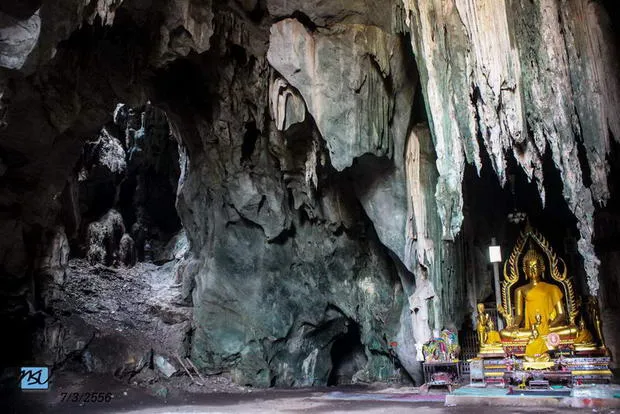
Inside, the cave contains a large main chamber and sections that are distinguished by differences in air and internal conditions, leading some parts to be referred to as the hot cave and the cool cave. This contrast gives Sarika Cave a special character because it makes the visit more varied and allows visitors to experience different natural conditions within the same cave system. Stalactites and stalagmites can still be seen throughout, with some resembling curtains of stone and others forming long descending rock shapes from the ceiling or rising from the floor. These features preserve the cave’s identity as a natural formation even though it has long been used as part of a temple.
Another feature that sets Sarika Cave apart from a purely natural cave is the presence of Buddha images enshrined inside. The relationship between rock surfaces, natural darkness, filtered light, and sacred images creates an atmosphere of unusual quiet and solemnity. People who enter the cave do not only search for scenic viewpoints or photographs. Many also pause to pay respect, sit quietly, or absorb the silence of the cave for a moment. That experience gives Sarika Cave a spiritual value that extends beyond visual beauty alone.
At the foot of the hill and around the temple grounds are important sacred objects including Phra Sangkrachai and Phra Sivali, both associated with the period when the site developed from a monastic residence into a formal temple. Many visitors choose to pay respect to these images before or after climbing to the cave, which creates a complete circulation within the compound: first experiencing the temple atmosphere on the lower grounds, then ascending toward the quieter cave space above. In addition, the ordination hall, chedi, bell tower, and monks’ quarters make the temple feel complete as a living religious center rather than a tourist site with a cave as its backdrop.
Wat Tham Sarika covers a little over 22 rai of land and is bordered by private property, mountain terrain, and public access routes. The ordination hall, built in B.E. 2543, is a reinforced concrete structure of relatively substantial size compared with many rural cave temples. There are also several monks’ residences in both wooden and half-concrete styles. These elements allow the temple to function continuously as a place of worship, religious training, and Buddhist education. That continued use is one of the reasons the site remains orderly, maintained, and alive rather than becoming only a quiet relic of the past.
From a visitor’s perspective, Sarika Cave is especially suitable for those who prefer a slower pace of travel. Most people can spend around one to two hours exploring the main temple grounds, climbing to the cave, paying respect, taking photographs, and enjoying the atmosphere. Those who want to turn the trip into a fuller day can combine it with nearby attractions in the Photharam area, such as Wat Khao Chong Phran, the old market of Photharam, Wat Khanon and its shadow puppetry heritage, or local cafés and small accommodations in the district. This makes Sarika Cave suitable both as a single-destination stop and as part of a wider eastern Ratchaburi route.
The best times to visit are in the morning or late afternoon, when the weather is more comfortable for climbing the stairs. Visitors should wear shoes with good grip, bring drinking water, and dress respectfully because the site remains an active temple. Elderly visitors or those with knee problems may need to take the climb slowly, but overall Sarika Cave is still considered more accessible than many other hill caves in the region.
Getting There If traveling by private car from Bangkok, take Highway No. 4, Phetkasem Road, through Nakhon Pathom toward Ratchaburi. At Bang Phae, keep left and turn right toward Photharam via Highway No. 3080. Continue for about 5.4 kilometers, cross the Mae Klong River bridge, and then at the junction where the road branches toward Wat Khao Chong Phran and Wat Khanon, turn left onto Highway No. 3089. Drive for about 11.6 kilometers, pass Wat Khao Chong Phran, continue for another 8 kilometers, and then turn left at the junction leading to Wat Tham Sarika. From there, continue about 2 kilometers to reach the temple.
For those using public transportation, there were formerly buses operated by Photharam Tour from Bangkok Southern Bus Terminal to Photharam every day, after which travelers could continue by local transport toward Thammasen. However, bus schedules and fares may change over time, so it is best to confirm with the operator before departure.
In summary, Sarika Cave brings together three clear dimensions of value. It is a natural cave with distinctive geological charm, a living temple with a peaceful and shaded atmosphere, and a historical site remembered through stories connected with King Taksin the Great, Rama IV, and Rama V. For anyone looking for a place in Ratchaburi that offers more than surface beauty alone, and instead provides history, reflection, and genuine atmosphere, Sarika Cave deserves a place on the itinerary.
| Name | Wat Tham Sarika / Sarika Cave |
| Type | Cave Temple, Historical Attraction, Buddhist Practice Site |
| Location | Village No. 8, Thammasen Subdistrict, Photharam District, Ratchaburi 70120 |
| Opening Hours | Open Daily 08:00 – 17:00 |
| Entrance Fee | Free |
| Highlights | Historical cave associated with King Taksin the Great, traces of a royal visit by Rama V, stalactites and stalagmites, cave chambers, hot and cool cave sections, Phra Sangkrachai, Phra Sivali, and a peaceful setting suitable for Buddhist practice |
| Abbot / Temple Caretaker | Phra Maha Jadet Khositthammo |
| Getting There | From central Photharam, take Highway 3089 past Wat Khao Chong Phran, then turn toward Wat Tham Sarika for about 2 km. From Bangkok, use Phetkasem Road toward Ratchaburi and continue via the local Photharam route. |
| Current Status | Still active as a temple and religious attraction, open for visits and worship during operating hours |
| Nearby Attractions | 1. Wat Khao Chong Phran – Approx. 10 km – Thammasen / Photharam Zone 2. Wat Khanon Shadow Puppet Temple – Approx. 14 km – Sroi Fa / Photharam Zone 3. Photharam Old Market – Approx. 20 km – Central Photharam Zone 4. Tao Hong Tai Ceramics, Ratchaburi – Approx. 36 km – Ratchaburi Town Zone 5. Na Satta Thai Park – Approx. 34 km – Bang Phae Zone |
| Nearby Restaurants | 1. Lim Cafe’ Photharam – Approx. 19 km – Central Photharam Zone – Tel. 062-614-9365 2. DoNom Photharam – Approx. 20 km – Photharam Old Market Zone – Tel. 062-494-6424 3. Junction Cafe & Coffee Roaster – Approx. 20 km – Central Photharam Zone – Tel. 095-232-2359 4. LooksaoKamnan Cafe – Approx. 18 km – Photharam Zone – Tel. 095-490-4606 5. Cafe De La Mon – Approx. 17 km – Tha Chumphon / Photharam Zone – Tel. 097-945-4619 |
| Nearby Accommodations | 1. Photharam 126 Resort – Approx. 17 km – Riverside Photharam Zone – Tel. 064-539-0574, 062-184-9666 2. The Resort Hotel at Photharam – Approx. 18 km – Photharam Zone – Tel. 097-373-8811 3. Plaina Hut Resort – Approx. 17 km – Tha Chumphon / Photharam Zone – Tel. 097-945-4619 4. Ping-Pe-La Photharam – Approx. 17 km – Tha Chumphon / Photharam Zone – Tel. 099-236-9495, 062-614-9365 5. Prakai Resort – Approx. 24 km – Ban Lueak / Photharam Zone – Tel. 089-153-8554, 084-122-7448 |
Frequently Asked Questions (FAQ)
Q: Where is Sarika Cave located?
A: Sarika Cave is located in Village No. 8, Thammasen Subdistrict, Photharam District, Ratchaburi Province. It is a cave temple in a hillside area that can be reached by car.
Q: What time is Sarika Cave open?
A: Public tourism information states that Sarika Cave is open daily from 08:00 to 17:00.
Q: Is there an entrance fee for Sarika Cave?
A: Publicly available information indicates that admission is free. Visitors can enter to pay respect, explore the cave, and enjoy the temple grounds without an entrance fee.
Q: What makes Sarika Cave special?
A: Sarika Cave is special because it is both a temple and a historical cave. It is associated with stories of King Taksin the Great, contains traces linked to the royal visit of Rama V, and features stalactites, cave chambers, and sacred Buddha images inside.
Q: Who is Sarika Cave suitable for?
A: It is suitable for visitors interested in temples, caves, Thai history, and peaceful destinations for worship or quiet reflection while traveling in Ratchaburi.
Q: How do I get to Sarika Cave?
A: If traveling by car, take the route from Photharam toward Wat Khao Chong Phran, then turn toward Wat Tham Sarika and continue for about 2 kilometers. Public transport users should first travel to Photharam and then continue locally toward Thammasen.
 Sarika Cave Map
 Category:
  Group:
  Last Update: 1 DayAgo
Comment
 Nearby Attractions
| Keyword (Advance) |
 Region
|
 Muang Ratchaburi(