

 Home
Home Chiang Mai(


























Rating: 4.3/5 (4 votes)
 |
|  Map
Map 
 Have Map
  No Map
Ratchaburi attractions
Attractions in Thailand
Open Days: Every Day
Opening Hours: Approximately 07:00 – 17:00
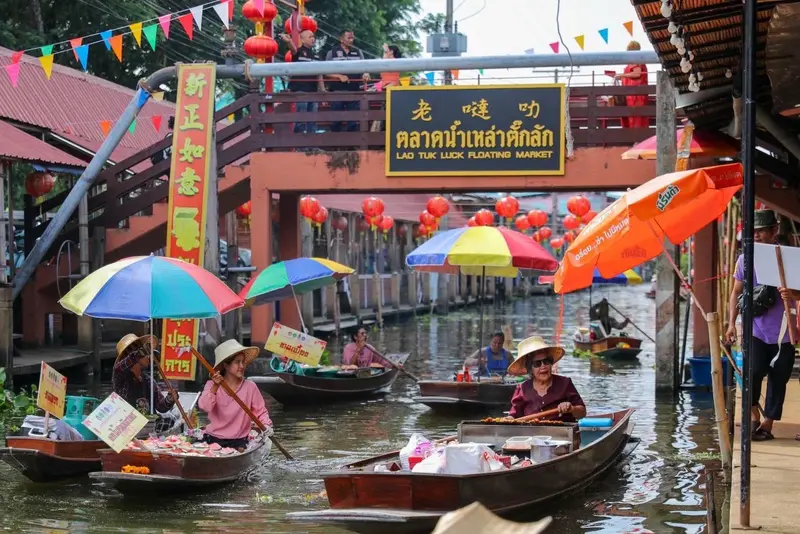
Lao Tak Lak Floating Market is one of the most valuable cultural attractions in Damnoen Saduak District, Ratchaburi Province. Although Damnoen Saduak Floating Market is world-famous, for those who want to look deeper into the original roots of the floating market lifestyle in this area, Lao Tak Lak Floating Market is a destination that should not be overlooked. This place is not merely an old floating market. It is also a living space that tells the story of the Thai-Chinese canal community, the transformation of transportation routes, and the memories of the people of Damnoen Saduak.
This market is located at the mouth of Khlong Lat Phli, an important area of the original canal-side community in Damnoen Saduak. As soon as visitors walk into the market, they can immediately sense that its atmosphere is different from that of large tourism-oriented floating markets. The movement of local life still blends naturally with everyday routines. Old wooden houses, shrines, traditional coffee shops, and riverside walkways make a visit here feel like stepping back into a scene from local history rather than simply visiting a place set up only for tourists.
The name “Lao Tak Lak” comes from the Teochew Chinese language and means “old market,” which perfectly matches the historical status of this place. Lao Tak Lak Floating Market is considered one of the earliest original floating markets in the Damnoen Saduak area, and it reflects the roots of the floating market before the area now widely recognized as Damnoen Saduak Floating Market expanded and became more commercialized. The presence of this Chinese name also reflects the identity of the Thai-Chinese community that has long been rooted in this area.
Looking back to the period when Damnoen Saduak Canal was first excavated during the reign of King Rama IV, around 1866 to 1868, this area began to develop as a settlement for Chinese laborers who played a major role in digging the canal. These people were extremely important to the development of the area, because they not only helped build the canal but also gradually transformed the land into an agricultural and water-based trading community. Once the canal opened, canal-side communities naturally flourished, and floating markets emerged out of the necessity of exchanging goods in daily life.
Lao Tak Lak Floating Market was therefore not a market created from a modern tourism promotion concept. It grew out of the real lives of people along the canal. Farmers paddled boats carrying vegetables, fruits, coconuts, coconut sugar, and local food to sell in the morning. At the same time, the market served as a gathering place for people in the community, where they met, talked, traded, exchanged news, and participated in religious and cultural activities. It can be said that this market once functioned as a center of daily life just as much as it was a place for buying and selling goods.
Later, when photographs of the floating market at the mouth of Khlong Lat Phli were published and introduced to international tourists around 1967, the area began to gain wider recognition as the original Damnoen Saduak Floating Market. Images of paddle boats lined up in the canal, brightly colored tropical fruits, and the lifestyle of the Thai-Chinese canal community became scenes that inspired travelers to come and experience the place for themselves. The fame of the market grew along with Thailand’s tourism boom during the period when cultural tourism began receiving serious attention from foreign visitors.
However, as road transportation became increasingly important and the more accessible section of Damnoen Saduak Floating Market began to develop to accommodate large numbers of tourists, the flow of people gradually shifted from this old market to the newer and busier area. As a result, Lao Tak Lak Floating Market, which had once been the heart of the community, became noticeably quieter. Even so, while the density of commercial activity declined, the cultural beauty of the place remained intact, including the old Chinese wooden houses, the peaceful lifestyle, and the image of a canal-side community that had not been rushed to the point of losing its original character.
What makes Lao Tak Lak Floating Market especially charming today is its true sense of being an “old floating market.” This place does not compete in terms of spectacle, boat numbers, or crowds of tourists. Instead, it stands out through its gentle and deeply evocative atmosphere. Those who enjoy slow travel, seek the memory of old towns, or want to see the appearance of a floating market that still retains a clear community character often feel more connected to Lao Tak Lak than to larger floating markets with a faster pace.
In the morning, Lao Tak Lak Floating Market has a unique atmosphere that is difficult to find elsewhere. The sight of monks going on alms rounds beside the canal, orchard farmers paddling their produce to market, and traditional coffee shops sending their soft aroma into the air creates an image that feels both warm and classic. It is this simplicity that makes many visitors return again and again, because what they receive is not just shopping or photography, but the chance to absorb the real life of the community.
One of the market’s most talked-about charms is the chance to sit and sip “kopi,” or traditional Chinese-style coffee, which still preserves the original spirit of the community very well. Sitting by the canal, drinking coffee, and watching paddle boats slowly pass in front of old wooden houses is an experience that makes many people feel that time moves more slowly here. And if the visit ends with a local specialty such as “khao haeng” or “koi pung,” traditional dishes of the Chinese floating market community, the experience of visiting Lao Tak Lak Floating Market becomes even more complete.
Khao haeng is a dish that expresses the identity of the community very clearly. It is not merely an ordinary local food, but a dish that carries flavors and memories passed down from generation to generation in this neighborhood. Eating khao haeng in the setting of Lao Tak Lak Floating Market is therefore not like ordering just another plate of food in a regular restaurant. It becomes a connection to the stories, lifestyle, and tastes of a community with strong Teochew Chinese roots. Travelers who are genuinely interested in authentic local food often give special importance to this market for that reason.
Beyond the food, Lao Tak Lak Floating Market is also visually distinctive. The old Chinese-style wooden houses along the canal, many of which still preserve their original proportions and forms, provide the market with a perfect backdrop for slow exploration. Wooden buildings, narrow walkways beside the canal, shrines, and the small details of daily community life create a naturally nostalgic mood. Photographers and those who appreciate community architecture are often drawn to this market because there is much more to observe here than simply the busy scene of boats selling goods.
Another important charm of Lao Tak Lak Floating Market is the relationship between the market and the sacred places of the community, such as Ti Liu Yi Shrine and Wat Rat Charoen Tham in the surrounding area. This means that walking through the market is not separate from the world of local belief. Visitors can stop to pay respects at the shrine, visit the temple, and then continue into the market along the same route. This kind of connection makes Lao Tak Lak Floating Market more than just a tourist destination. It is a “living cultural space” that still serves the real lives of people in the area.
Compared with the main zone of Damnoen Saduak Floating Market, the difference in atmosphere at Lao Tak Lak is immediately clear. Damnoen Saduak Floating Market is internationally famous, filled with many boats, and highly energetic. Lao Tak Lak Floating Market, by contrast, feels quieter, older, and more delicate. It is ideal for those who want to see the Thai-Chinese community dimension more seriously, want to walk without rushing, and want to read history through real places instead of simply looking at the most familiar iconic image of a Thai floating market.
Because it is located close to Damnoen Saduak Floating Market and Khlong Lat Phli Floating Market, visitors can easily plan a route linking several places in a single day. A common itinerary is to start with the lively main floating market in the morning, then continue to Lao Tak Lak to experience the mood of the old market and the Chinese canal-side community. Traveling in this way gives a much fuller understanding of the Damnoen Saduak area as a whole, because visitors can see both the internationally known floating market economy and the deeper traditional community that lies behind it.
For travelers who value experience more than simple check-ins, Lao Tak Lak Floating Market is a place that offers a particularly strong sense of feeling. Here there are memories of the old floating market, intersections of Thai and Chinese culture, the aroma of traditional coffee, local food, and the sounds of the community that can still truly be heard. Even though the market is no longer as crowded as it once was and is not as large as the main market, its beauty lies in its authenticity, its quietness, and the memories that have never entirely disappeared.
From the perspective of tourism in Ratchaburi, Lao Tak Lak Floating Market is a good example of a place whose value is greater than the number of its visitors. It helps people understand that Ratchaburi is not only about famous check-in attractions, but also about old communities that continue to preserve the stories of the town through waterways and architecture. If Damnoen Saduak Floating Market is the image the world remembers, Lao Tak Lak is the cultural background that gives that image its roots and deeper meaning.
In practical terms, this market is best explored over at least 1-2 hours. That allows enough time to walk among the wooden houses, take photographs, sample local food, stop for coffee, and sit quietly watching canal life. If there is more time, visitors can continue by boat to explore the atmosphere of Damnoen Saduak Canal or move on to nearby attractions in the same area. Taking the market slowly reveals its charm far more clearly than simply passing through in a hurry.
The most suitable time to visit is from early morning to late morning, because this is when the community still feels most alive, the weather is not yet too hot, and it is still possible to see monks on alms rounds, farmers, and paddle boats clearly. Although the market can generally be visited throughout the day, if the goal is to experience the true atmosphere of an old floating market, the morning offers the best experience in terms of mood, light for photography, and the rhythm of life along the canal.
Getting There From Bangkok, visitors can take Phetkasem Road toward Ratchaburi and then turn into Damnoen Saduak District before heading toward the market area near the mouth of Khlong Lat Phli. If traveling from Samut Songkhram town, drive toward Damnoen Saduak, pass the entrance to Damnoen Saduak Floating Market, cross the bridge, and then look for the small road on the left marked with a sign for Khlong Lat Phli Floating Market. Follow the signs toward the Ti Liu Yi Shrine area and continue until reaching the parking area of Pak Khlong Lat Phli Floating Market, or Lao Tak Lak Floating Market. Overall, the route is convenient and suitable for a day trip from either Bangkok or Samut Songkhram.
Another reason why Lao Tak Lak Floating Market remains highly interesting in the long term is its potential as a place of value-based tourism. It is ideal for newer generations of travelers who are searching for authentic experiences rather than spaces designed mainly for photographs. Whether they are interested in local food, fascinated by community architecture, enjoy historical narratives, or simply seek peace in their travels, this market can meet those needs fully within a relatively compact area while offering remarkable cultural depth.
In summary, Lao Tak Lak Floating Market is one of the key hearts of the Damnoen Saduak floating market story and is a Ratchaburi destination well worth visiting for anyone who wants to understand Damnoen Saduak more deeply. Its age, quietness, Thai-Chinese community character, and canal-side way of life that can still genuinely be seen give the market a unique charm. If you want to see a floating market that is not defined only by fame, but also by cultural roots, stories, and the memories of local people hidden in every corner, Lao Tak Lak is a destination not to be missed on your Ratchaburi trip.
| Place Name | Lao Tak Lak Floating Market |
| Location | At the mouth of Khlong Lat Phli, Damnoen Saduak District, Ratchaburi Province, near Ti Liu Yi Shrine and the Wat Rat Charoen Tham area |
| Open Days | Every Day |
| Opening Hours | Approximately 07:00 – 17:00 |
| Place Summary | A traditional Thai-Chinese floating market in the Damnoen Saduak area. Its name means “old market,” reflecting the original roots of the floating market before the expansion of the present-day Damnoen Saduak Floating Market. It is ideal for cultural tourism, local food tasting, and appreciating old wooden canal-side houses. |
| Highlights | Old Thai-Chinese community, Chinese-style wooden canal-side houses, a more peaceful atmosphere than the main floating market, traditional coffee and local khao haeng, ideal for photography and for those interested in history and cultural stories. |
| History | It originated from a Chinese community whose members were important laborers during the excavation of Damnoen Saduak Canal between 1866 and 1868. It later developed into a Thai-Chinese floating market community at the mouth of Khlong Lat Phli and became the original floating market of the area before activity expanded to what is now Damnoen Saduak Floating Market. |
| Zones | 1. Chinese-style wooden canal-side house zone 2. Traditional kopi and local khao haeng food zone 3. Paddle boat pier and canal lifestyle viewing zone 4. Ti Liu Yi Shrine and surrounding community zone |
| Getting There | From Bangkok, take Phetkasem Road and head into Damnoen Saduak. From Samut Songkhram town, turn into the side road following the signs to Khlong Lat Phli Floating Market, then continue toward Ti Liu Yi Shrine and the market parking area. |
| Current Status | It remains a cultural tourism destination that clearly preserves the atmosphere of the old floating market and the Thai-Chinese community, making it ideal for visitors seeking ambiance and historical storytelling more than commercial bustle. |
| Nearby Attractions | 1. Khlong Lat Phli Floating Market – approximately 500 m 2. Damnoen Saduak Floating Market – approximately 1 km 3. Wat Rat Charoen Tham (Wat Sun) – approximately 1 km 4. Ti Liu Yi Shrine – next to the market 5. Maikaew Pier – approximately 2 km |
| Nearby Restaurants | 1. Jay Ree Khao Tom Khao Haeng, Damnoen Saduak – approximately 2 km. Tel. 085-862-7983 2. Puea Khun Restaurant, Damnoen Saduak – approximately 4 km. Tel. 032-253-087 3. Hom Mai Somtam, Damnoen Saduak – approximately 7 km. Tel. 093-513-5622 4. Krua Ta Luang, Damnoen Saduak – approximately 6 km. Tel. 086-751-7448 5. Hok Lee Café, Lao Tak Lak Floating Market – next to the market. Tel. 081-255-5909 |
| Nearby Accommodations | 1. Loyd Stay – next to the market. Tel. 096-892-3000 2. Maikaew Damnoen Resort – approximately 2 km. Tel. 081-527-9033, 032-245-120 3. Khum Damnoen Resort – approximately 5 km. Tel. 032-241-444 4. Baan Thai Damnoen Canal House – approximately 9 km. Tel. 081-713-3320 5. Rachabhura Hotel – approximately 35 km. Tel. 032-919-999 |
| Contact Numbers | Lao Tak Lak Floating Market 081-921-7030 Damnoen Saduak Community Tourism Volunteer 081-684-6383 Damnoen Saduak District Office 032-241-204 Damnoen Saduak District Registration Office 032-241-275 TAT Ratchaburi Office 032-919-176 |
Frequently Asked Questions (FAQ)
Q: Where is Lao Tak Lak Floating Market located?
A: Lao Tak Lak Floating Market is located at the mouth of Khlong Lat Phli in Damnoen Saduak District, Ratchaburi Province, near Ti Liu Yi Shrine and the Wat Rat Charoen Tham area.
Q: What time does Lao Tak Lak Floating Market open?
A: In general, visitors can come every day, and the best time to visit is approximately 07:00 - 12:00, because that is when the canal-side community atmosphere can be experienced most clearly.
Q: What does the name “Lao Tak Lak” mean?
A: “Lao Tak Lak” is a Teochew Chinese term meaning “old market,” which reflects the role of this place as the original floating market of the Damnoen Saduak area.
Q: How is Lao Tak Lak Floating Market different from Damnoen Saduak Floating Market?
A: Lao Tak Lak Floating Market has a quieter and more peaceful atmosphere. It emphasizes the charm of the old Thai-Chinese community, canal-side wooden houses, and traditional life more than the commercial bustle of the main Damnoen Saduak Floating Market zone.
Q: What should visitors eat at Lao Tak Lak Floating Market?
A: The must-try items are kopi, or traditional Chinese-style coffee, and khao haeng, or koi pung, which are traditional local dishes of the Chinese floating market community in this area.
Q: Who is Lao Tak Lak Floating Market suitable for?
A: It is suitable for travelers who enjoy places with stories, like photographing old wooden houses, appreciate Thai-Chinese communities, and want to see Damnoen Saduak from a deeper perspective beyond the famous mainstream floating market.
Q: Can Lao Tak Lak Floating Market be visited together with other attractions?
A: Yes. The market is close to Damnoen Saduak Floating Market, Khlong Lat Phli Floating Market, and Wat Rat Charoen Tham, making it suitable for a half-day or full-day trip in the Damnoen Saduak area.
 Website: www.facebook.com/laotukluck
 Lao Tak Lak Floating Market Map
 Category:
  Group:
  Last Update: 33 MinuteAgo
Comment
 Nearby Attractions
| Keyword (Advance) |
 Region
|
 Muang Ratchaburi(