

 Home
Home Chiang Mai(










Rating: 2.4/5 (44 votes)
 |
|  Map
Map 
 Have Map
  No Map
Chiang Mai attractions
Attractions in Thailand
Open Days: Daily (recommended to reconfirm before visiting)
Opening Hours: Approximately 08.00–17.00 (daytime is best for visibility)
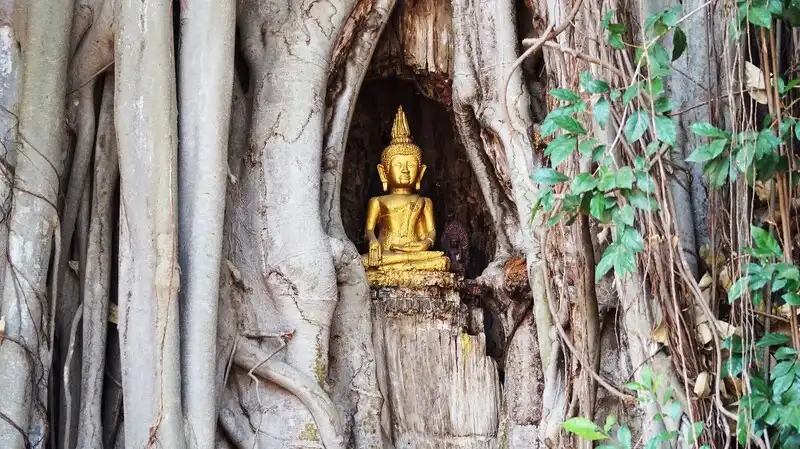
Phra Chao Nang Kon (Dong Phra Chao Nang Kon) is a culturally and spiritually significant landmark in Chiang Mai Province, Northern Thailand. The site is best known for its extraordinary wooden Buddha image seated inside a natural tree hollow, a form rarely found elsewhere. Rather than being defined by architectural grandeur, its value lies in the way Buddhist faith, Lanna craftsmanship, and nature coexist in a single living monument.
In Lanna tradition, the term Phra Chao refers respectfully to a Buddha image, while Kon in the local dialect means a hollow or cavity. The name Phra Chao Nang Kon therefore literally translates to “the Buddha seated in a hollow.” The image is a wooden Buddha in the Maravijaya posture, carved in classic Lanna style. Originally sculpted into a teak tree, it was later enveloped by a banyan tree whose roots gradually wrapped around the teak trunk, forming the iconic “banyan embracing teak” appearance that defines the site today.
According to local chronicles and oral tradition, the carving of Phra Chao Nang Kon began on the 15th waning day of the 12th lunar month in 1782 CE. The work was initiated during the reign of King Kawila, ruler of Chiang Mai, who is said to have personally participated in the carving. Historical accounts describe how King Kawila and his retinue rested in a forest near the Mae Tha Chang River while returning from worship at Phra Borommathat Si Chom Thong. Impressed by the tranquility of the area, the king decided to create Buddha images for travelers to venerate.
The carving effort involved royal attendants, craftsmen, and commoners. In total, 27 Buddha images were carved into various trees in the forest: 21 by royal followers and 5 by skilled artisans, together with the image carved by King Kawila himself. Over time, due to logging concessions, natural decay, and environmental change, all of these images disappeared except for Phra Chao Nang Kon, which remains preserved within the intertwined teak and banyan trees.
After the carving was completed, monks from nearby temples were invited to conduct a consecration ceremony, and the image was originally named Phra Mahasirinagawila in honor of the king. As teak forests in the area were later felled during logging operations, only the tree containing Phra Chao Nang Kon survived. The banyan roots that grew around the teak protected the image, leaving it visible within a natural hollow formed by the roots.
Today, Phra Chao Nang Kon stands as a rare surviving example of sacred Lanna wood carving integrated with living nature. In 2019 (B.E. 2562), the Thai government officially registered the banyan-embraced teak tree at Dong Phra Chao Nang Kon as a Heritage Tree, recognizing its historical, cultural, and environmental significance and ensuring its protection for future generations.
The site remains deeply woven into daily community life. Local residents regularly stop to pay respect, offer flowers, or light incense. Visitors are encouraged to maintain a respectful demeanor, avoid touching the carving or climbing the tree, and keep noise to a minimum. Photography is permitted, but flash should be avoided, and worshippers should not be disturbed.
Getting There From Chiang Mai city, take the Chiang Mai–Hang Dong Road. Make a U-turn near the PTT gas station, then enter the irrigation canal road leading toward the Mae Tha Chang Subdistrict Municipality Office. Phra Chao Nang Kon is located directly opposite the municipal office. Using GPS navigation is recommended, especially along the canal road.
| Name | Phra Chao Nang Kon (Dong Phra Chao Nang Kon) |
| Location | Ban Dong Noi, Mae Tha Chang Subdistrict, Hang Dong District, Chiang Mai |
| Key Characteristics | Wooden Buddha carved into a teak tree, later embraced by banyan roots; Maravijaya posture, Lanna style |
| Historical Period | Founded in 1782 CE (over 220 years old) |
| Historical Significance | Only surviving image among 27 tree-carved Buddhas created during King Kawila’s era |
| Heritage Status | Registered as a Heritage Tree by the Thai government in 2019 |
| Entrance Fee | Free (donations welcome) |
| Facilities | Small worship area; facilities depend on current site conditions |
Frequently Asked Questions (FAQ)
Q: What does the name “Phra Chao Nang Kon” mean?
A: It means “the Buddha seated in a hollow,” referring to the image carved inside a tree cavity.
Q: Who created Phra Chao Nang Kon?
A: According to tradition, it was carved during the reign of King Kawila, with the king himself participating in the carving.
Q: Why is this Buddha image unique?
A: It is carved directly into a teak tree and later embraced by banyan roots, making it a rare fusion of sculpture and living nature.
Q: Is Phra Chao Nang Kon the only one of its kind?
A: It is the only surviving image among 27 tree-carved Buddhas created in the same forest during the same period.
Q: Is the site officially protected?
A: Yes, the banyan-embraced teak tree was registered as a Heritage Tree in 2019.
 Phra Chao Nang Kon (Dong Phra Chao Nang Kon) Map
 Category:
  Group:
  Last Update: 15 HourAgo
Comment
 Nearby Attractions
| Keyword (Advance) |
 Region
|
 Muang Chiang Mai(