
 Home
Home North(
 Chiang Mai(


Rating: 3.8/5 (5 votes)
 |
|  Map
Map 
 Have Map
  No Map
Nakhon Pathom attractions
Attractions in Thailand
Open Days: Daily
Opening Hours: The exterior area can be visited at any time
Nakhon Pathom Palace, also found in some historical documents under the name “Phra Ratchawang Pathom Nakhon,” is an important historical site in Nakhon Pathom. Although no palace buildings remain today in the way that Sanam Chandra Palace still does, this area continues to hold major significance as evidence of the revival of Nakhon Pathom during the reign of King Mongkut, Rama IV. It also represents an important point of connection between royal authority, Buddhism, and the development of transportation routes in the early Rattanakosin period.
The site of Nakhon Pathom Palace was located to the east of Phra Pathom Chedi, around the present-day line of Chedi Bucha Canal and Thetsa Road. This area has long been one of the important parts of Nakhon Pathom because it stands close to Phra Pathom Chedi, the spiritual and historical center of the province. Establishing the palace not far from the great stupa was therefore not simply a matter of convenience for royal visits. It also clearly reflected the relationship between the monarch and one of the kingdom’s most important Buddhist sites.
The main reason for the construction of Nakhon Pathom Palace was directly connected to the restoration of Phra Pathom Chedi during the reign of Rama IV. At that time, travel from Bangkok to Nakhon Pathom was far less convenient than it is today. Journeys took much longer, and in many cases an overnight stop was necessary along the way. Once King Mongkut ordered the serious restoration of Phra Pathom Chedi, a royal residence became necessary for use during visits to oversee royal duties and to pay homage to the great stupa on different occasions.
Prince Damrong Rajanubhab explained in his book Tamnan Wang Kao that the palace was built because travel between Bangkok and Nakhon Pathom was still inconvenient, making it necessary to have a royal stopping place near Phra Pathom Chedi. King Mongkut therefore ordered the construction of a palace in a manner similar to the old royal custom of the Ayutthaya period, when kings built palaces near important Buddhist pilgrimage sites such as Phra Phutthabat in Saraburi. He then bestowed upon this palace the name “Phra Nakhon Pathom.” This concept gave Nakhon Pathom Palace cultural importance beyond that of an ordinary temporary royal residence, because it represented the continuation of older royal traditions into the Rattanakosin era.
Historical evidence suggests that Nakhon Pathom Palace was designed as a royal compound intended for actual use during royal journeys and temporary residence, rather than as a large palace serving as a permanent royal capital or administrative center. Some documents describe the palace complex as having a 2-storey royal hall, royal residences, supporting buildings, horse stables, elephant quarters, and areas for officials attached to the royal visit. This shows that the palace was once developed to a substantial degree and was able to support the royal duties required in that period.
The significance of Nakhon Pathom Palace was not limited to the palace structures themselves. It was also closely connected with the development of the city’s infrastructure. During the same period, King Mongkut ordered the excavation of Khlong Mahasawat and Khlong Chedi Bucha in order to make travel between Bangkok and Nakhon Pathom easier. These 2 canals played a very important role in transportation, the movement of materials, and communication with the capital. In that sense, Nakhon Pathom Palace formed part of the broader effort to restore Nakhon Pathom as an important city once again during the Rattanakosin period.
When viewed through the lens of urban history, Nakhon Pathom Palace stands as a symbol of the city’s “return to life.” Nakhon Pathom had been important since ancient times, but in some periods its importance faded. Once Phra Pathom Chedi was rediscovered and seriously restored during the reign of Rama IV, Nakhon Pathom came back into the view of the royal court. The construction of a palace near the stupa clearly declared the meaning of this place: the city was not just a stopping point, but an important urban center worthy of care and of systematic connection with the capital.
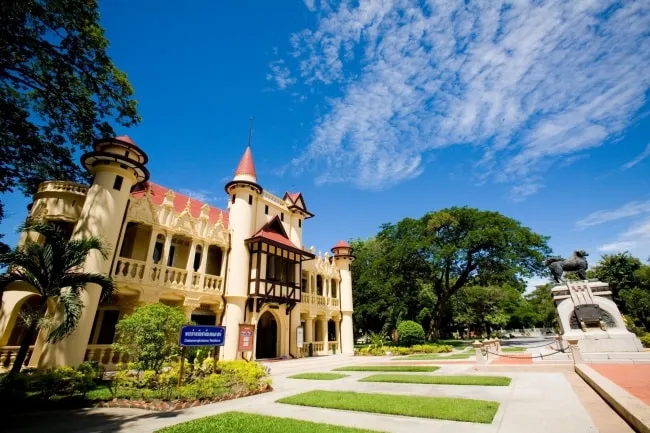
When compared with Sanam Chandra Palace, which was built in the reign of Rama VI and still preserves an impressive group of palace buildings, Nakhon Pathom Palace presents a different kind of significance. Its historical importance is stronger than the surviving architectural evidence. Visiting this site today is therefore not an experience of viewing a beautifully preserved palace in the usual sense, but rather an exercise in reading history through the site itself and through the memory embedded in the landscape. Those interested in the history of Nakhon Pathom will recognize that the eastern side of Phra Pathom Chedi reflects the movement and transformation of the city during the reign of Rama IV with remarkable clarity.
Although time has passed and the original palace was demolished until no visible structures remain, the name of Nakhon Pathom Palace continues to appear in historical documents and local studies. This is precisely why the site should still be discussed in contemporary travel and history writing. Without Nakhon Pathom Palace, our understanding of Nakhon Pathom’s development during the reign of Rama IV would remain incomplete, especially in relation to the restoration of Buddhist monuments, water-based travel, and the planning of a more modern urban landscape.
In terms of its present atmosphere, the eastern side of Phra Pathom Chedi feels like a living old-city district. There is traffic, commerce, major roads, and the daily activity of urban life all around it. This is different from a historic monument that stands isolated from its surroundings. Here, history is layered directly into the everyday life of the people of Nakhon Pathom. Travelers walking around the area near Phra Pathom Chedi who understand the background of Nakhon Pathom Palace will see the space differently. What may at first appear to be just city streets and ordinary buildings begins to reveal hidden layers of the past within the modern townscape.
Another aspect that makes Nakhon Pathom Palace especially interesting is that it serves as an example of an upcountry royal palace in the early Rattanakosin period. There were not many such palaces, and each one was built for its own specific reason. This palace shows that King Mongkut placed importance on traveling to major sites outside the capital and regarded the establishment of royal residences as one element in linking royal power with the provincial cities. The presence of a palace close to Phra Pathom Chedi therefore carried simultaneous religious, political, and cultural meaning.
For travelers interested in historical routes in Nakhon Pathom, Nakhon Pathom Palace should be understood as part of the wider group of important places surrounding Phra Pathom Chedi rather than as a completely separate destination. Once these stories are connected, the broader picture becomes clearer: why Phra Pathom Chedi received major restoration, why Khlong Chedi Bucha was dug, and why a royal palace was built nearby. All of these developments were closely related within the context of Rama IV’s reign.
From a tourism perspective, Nakhon Pathom Palace is best suited to visitors who enjoy reading the city through its landscape rather than searching for a typical check-in point with a striking surviving building. If you are interested in the history of old towns, changes in the urban landscape, or the background of Nakhon Pathom’s revival in the modern period, visiting this area will add a great deal to your understanding of the city. This is especially true if you combine the visit with Phra Pathom Chedi, Phra Pathom Chedi National Museum, and the historic district around the monument.
Another key feature of Nakhon Pathom Palace is that it stands as evidence of a transitional age in transportation. Before roads and railways took on their full role, water transport was still central to contact with provincial cities. The excavation of Khlong Mahasawat and Khlong Chedi Bucha was therefore not merely a public works project, but a strategic infrastructure plan designed to create a direct connection between the capital and Nakhon Pathom. Nakhon Pathom Palace became one of the destinations within this new transportation system and can be seen as a direct marker of urban development.
From a cultural point of view, Nakhon Pathom Palace also confirms that Phra Pathom Chedi was not simply an important local monument, but a Buddhist site of national importance that received serious attention from the royal court. The fact that Rama IV ordered a palace to be built near the great stupa is concrete evidence of how sacred and meaningful this area was in the eyes of the monarchy. Thus, even though the buildings themselves have disappeared, the symbolic meaning of the palace remains and continues to give the eastern side of Phra Pathom Chedi a significance beyond that of an ordinary urban area.
Getting There to the former site of Nakhon Pathom Palace today is easiest if you use Phra Pathom Chedi as your main reference point. If traveling from Bangkok by private car, take Phetkasem Road into Nakhon Pathom city center, then continue toward Phra Pathom Chedi. From there, look toward the eastern side of the monument, especially around the line of Thetsa Road and Khlong Chedi Bucha, which historical records identify as the former palace area. If traveling by public transport, you can arrive in central Nakhon Pathom first, then walk or take a local vehicle to the area around Phra Pathom Chedi, as it remains the city’s main center and is easily connected by local routes.
For those who want to understand the site more clearly, the best approach is to begin by visiting Phra Pathom Chedi itself and then continue exploring the eastern side of the surrounding area while paying attention to the relationship between the roads, the canal, and the later urban development. This method helps visitors understand how well positioned Nakhon Pathom Palace once was in terms of royal residence, transportation, and connection with one of the city’s most important sacred places.
In conclusion, Nakhon Pathom Palace may not be a tourist site with monumental structures still standing in the way that other palaces are, but the value of this place lies in its concentrated historical meaning. It is evidence of the revival of Nakhon Pathom in the reign of Rama IV, a point of connection between Phra Pathom Chedi and the development of transportation routes, and a trace of an upcountry royal residence that clearly reflects the thinking of the Thai royal court during a period of transition. If you want to understand Nakhon Pathom more deeply than simply visiting temples or taking photographs of famous landmarks, Nakhon Pathom Palace is one of the key stories that should not be overlooked.
| Name | Nakhon Pathom Palace |
| Place Summary | A former royal palace from the reign of Rama IV built near Phra Pathom Chedi for royal residence during visits connected with worship and the restoration of the great stupa. |
| Highlights | Important as historical evidence of the revival of Nakhon Pathom during the reign of Rama IV, with direct links to Phra Pathom Chedi, Khlong Mahasawat, and Khlong Chedi Bucha. |
| History / Period | Reign of King Mongkut, Rama IV; some historical sources suggest construction around 1853. |
| Address | The eastern side of Phra Pathom Chedi, near Thetsa Road and Khlong Chedi Bucha, Phra Pathom Chedi Subdistrict, Mueang Nakhon Pathom District, Nakhon Pathom Province |
| Getting There | Travel into central Nakhon Pathom and head toward Phra Pathom Chedi, then explore the eastern side of the monument around Thetsa Road and Khlong Chedi Bucha, which historical sources identify as the former palace site. |
| Open Days / Opening Hours | The exterior area can be viewed daily at any time. |
| Facilities | Located within the city area, close to main roads, shops, public areas, and major attractions around Phra Pathom Chedi. |
| Zones | Eastern side of Phra Pathom Chedi, Khlong Chedi Bucha corridor, Thetsa Road corridor, and the old-town district around the great stupa |
| Nearby Tourist Attractions with Distance | 1. Phra Pathom Chedi Ratchaworamahawihan – about 0.2 km 2. Phra Pathom Chedi National Museum – about 0.4 km 3. Sanam Chandra Palace – about 1.8 km 4. Phra Ruang Rojanarit – about 0.3 km 5. Phra Pathom Chedi Walking Street – about 0.5 km |
| Popular Restaurants Nearby with Distance and Phone Number | 1. Nai Chua Moo Daeng Rice Restaurant – about 0.8 km – 034-242-533 2. Lung Loi Pa Lan Restaurant – about 0.9 km – 034-251-510 3. Baan Baibua – about 1.6 km – 034-255-011 4. M Salad Cafe & Food for Life – about 1.8 km – 062-195-4924 5. TAMA Japanese Restaurant Nakhon Pathom – about 2.0 km – 080-456-7775 |
| Popular Accommodations Nearby with Distance and Phone Number | 1. Xen Hotel Nakhon Pathom – about 1.7 km – 034-900-500 2. The Proud Exclusive Hotel – about 2.1 km – 034-255-555 3. Diary Suite Hotel – about 2.0 km – 081-849-9650 4. Ratchaphruek Pavilion – about 2.2 km – 034-280-299 5. Mida Grande Hotel Dhavaravati Nakhon Pathom – about 3.4 km – 034-966-700 |
Frequently Asked Questions (FAQ)
Q: Where was Nakhon Pathom Palace located?
A: Nakhon Pathom Palace originally stood on the eastern side of Phra Pathom Chedi, near Thetsa Road and Khlong Chedi Bucha in Mueang Nakhon Pathom District.
Q: During which reign was Nakhon Pathom Palace built?
A: Nakhon Pathom Palace was built during the reign of King Mongkut, Rama IV, for royal residence during visits to Phra Pathom Chedi and in connection with the restoration of the great stupa.
Q: Is the original palace still standing today?
A: No. The original palace buildings no longer survive, but the area remains historically important as the former site of the royal residence.
Q: Why is Nakhon Pathom Palace important to the history of Nakhon Pathom?
A: The site is closely connected with the restoration of Phra Pathom Chedi, the development of transportation routes through Khlong Mahasawat and Khlong Chedi Bucha, and the revival of Nakhon Pathom during the reign of Rama IV.
Q: Can I visit Nakhon Pathom Palace together with other attractions?
A: Yes. The former palace area is close to Phra Pathom Chedi, Phra Pathom Chedi National Museum, and can easily be included in the same trip as Sanam Chandra Palace.
Q: How is Nakhon Pathom Palace different from Sanam Chandra Palace?
A: Nakhon Pathom Palace was a royal palace from the reign of Rama IV built for temporary royal residence near Phra Pathom Chedi, while Sanam Chandra Palace was built in the reign of Rama VI and still preserves its major palace buildings.
Q: Who would most enjoy visiting this area?
A: It is especially suitable for visitors interested in the history of Nakhon Pathom, the reign of Rama IV, the development of the area around Phra Pathom Chedi, and travelers who enjoy reading layers of history through the urban landscape.
 Nakhon Pathom Palace Map
 Category:
  Group:
  Last Update: 8 HourAgo
Comment
 Nearby Attractions
| Keyword (Advance) |
 Region
|
 Muang Nakhon Pathom(