
 Home
Home North(
 Chiang Mai(


Rating: 3.1/5 (7 votes)
 |
|  Map
Map 
 Have Map
  No Map
Nakhon Nayok attractions
Attractions in Thailand
Open Days: Daily
Opening Hours: 08.00 - 17.00
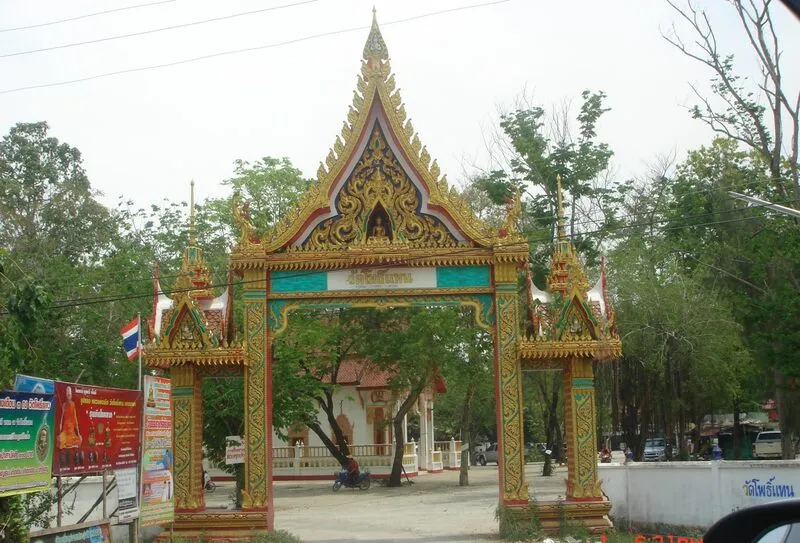
Wat Pho Thaen, Nakhon Nayok Province, is an old temple in Ongkharak District that has long been important to the community of Pho Thaen Subdistrict. Although the temple today remains an active community temple, a closer look at the historical layers of the site reveals a story that stretches much further back than the present appearance suggests. The site preserves evidence of an old ordination hall, local memories of a period when the temple became abandoned, and the later restoration that brought it back as a center of faith for local people once again.
The special charm of Wat Pho Thaen lies in the fact that it is not merely old in terms of age, but that it contains multiple “layers of time” within the same space. In other words, traces of an earlier temple survive in the form of an old ordination hall, there was a period when the community remembered the temple as abandoned, and later there was a phase of restoration that returned it to active religious use. This makes Wat Pho Thaen different from many ordinary temples, because visitors do not encounter only the buildings of the present, but can also sense the continuity of the past that still remains connected to the community.
Official state information on cultural heritage confirms the existence of the “old ordination hall of Wat Pho Thaen” in Pho Thaen Subdistrict, Ongkharak District, and classifies it under temples, abandoned temples, and religious sites. This is highly significant because it confirms that the area of Wat Pho Thaen is not known only through local oral tradition, but also contains remains acknowledged by the state as a site of artistic and cultural value worthy of conservation. This gives much greater weight to the history of the former temple and to the historical layers of the site.
As for the temple’s own history, official tourism sources describe Wat Pho Thaen as an old temple of Ongkharak District and note that it was important enough for the name of the temple to later become the name of Pho Thaen Subdistrict itself. This reflects that the relationship between the temple and the community is much deeper than that of a place used only for ceremonies, because the temple became both a geographic reference point and part of the local identity of the people in the area.
An especially important local account about Wat Pho Thaen says that the original temple was an old temple that later became abandoned, and that in 2475 BE Phra Ajarn Phae restored it and gave it the name “Wat Pho Thaen.” This account is quite plausible when considered together with the evidence of the old ordination hall and the record of an abandoned temple in the area. Although in the current round of verification no official document was found that names Phra Ajarn Phae directly, the overall narrative is highly consistent with the history of the site: there was an earlier temple, it passed through a period of abandonment, and it later returned to active use after restoration.
In terms of meaning, the name “Wat Pho Thaen” also carries cultural weight in itself. Local tourism information explains that there was a large bodhi tree in the temple area, so villagers used the temple’s name to refer to the surrounding area as well. In the context of Thai temples, a bodhi tree is not just an ordinary tree. It has deep Buddhist associations with enlightenment, shade, calmness, and sacred presence. This gives the name Wat Pho Thaen a meaning that goes far beyond an ordinary place name.
Another layer that makes Wat Pho Thaen especially interesting is the role of respected monks who once resided here and led the temple in later periods, especially Luang Pho Koet Parimutto, a former abbot who became widely known among devotees and in the line of famous monks of Ongkharak District. The name of Luang Pho Koet means that Wat Pho Thaen is important not only as an old temple that was restored, but also as a temple that played a role in the history of renowned monks in Nakhon Nayok Province.
Luang Pho Koet played an important role in shaping the temple’s image in the modern era, because he was not only the monk in charge of the temple, but also a center of faith for lay devotees and local residents. The fact that his name continues to be mentioned in public information and in accounts about the temple gives Wat Pho Thaen a dimension of “shared memory” that clearly links earlier generations with the present.
In terms of monastic leadership, the most recently verified information identifies Phra Khru Photithammanukit as the abbot of Wat Pho Thaen, and he also plays a role in the monastic administration of the Ongkharak area. His name is therefore important information because it confirms that the temple continues to be actively cared for and remains a genuine religious center for the community today.
From the point of view of the community, Wat Pho Thaen does not function only as a religious site, but also as a public space closely tied to everyday life. This is clear because Wat Pho Thaen School is located on the same grounds, and there is also information about a local community market held at the temple. All of this clearly shows that the temple still functions as living social infrastructure, rather than being only an old temple remembered for its history.
This identity as a community temple gives Wat Pho Thaen a very different atmosphere from larger temples developed fully as tourist attractions. Visitors who come here often feel its simplicity, calmness, and natural atmosphere. The temple has not been shaped into a check-in destination, but instead preserves the character of a temple that is still actively used by villagers, the school, and the monks. It is therefore especially suitable for people who want to see Thai temple life as it exists within a real community, rather than in a purely tourism-oriented setting.
For those interested in art history and religious heritage, the point of greatest interest is the old ordination hall of Wat Pho Thaen, because its presence clearly confirms that the temple has a past extending much further back than the present appearance suggests. The old ordination hall is not simply a surviving structure, but evidence of a period when the original temple once flourished, later fell into abandonment, and was eventually restored. Having the old ordination hall alongside the present temple makes Wat Pho Thaen a place where “the past and the present exist together” in a particularly compelling way.
As a place to visit, Wat Pho Thaen is ideal for those who want to worship, make merit, and learn about local community history at the same time. There is no need to rush, because the appeal of the temple lies in slowly absorbing the atmosphere, walking around the grounds, and understanding why this place means so much to the people of Pho Thaen Subdistrict. Visitors who are interested in the temple’s restoration, its period as an abandoned temple, and the name of Luang Pho Koet will gain a much deeper understanding of the temple than those who come only for a brief act of worship.
Visitors should dress modestly, behave respectfully, and show proper regard for the site, because the temple includes sacred areas, school grounds, and community activities that continue side by side in daily life. Good manners are therefore especially important, particularly on days when there is a market or community event at the temple, when visitors should allow extra time and act appropriately within the setting.
Getting There Wat Pho Thaen is most conveniently reached by private car. The temple is located in Moo 4, Pho Thaen Subdistrict, Ongkharak District, Nakhon Nayok Province, and the coordinates 14.2090879328, 100.944359973 can be used as a navigation reference. From Bangkok, travelers can follow the Rangsit–Nakhon Nayok route into Ongkharak District and then continue into Pho Thaen Subdistrict. This makes the temple suitable for both a half-day pilgrimage and a full-day trip combined with other places in Ongkharak.
In summary, Wat Pho Thaen has great value in terms of community history and religion because it contains traces of the original temple and old ordination hall, local memories of a period of abandonment, accounts of later restoration, the role of Luang Pho Koet in the era when the temple became widely known, and its present status as a living community temple. Anyone interested in old temples, community temples, and the historical stories of the Ongkharak area should not overlook this temple.
| Place Summary | Wat Pho Thaen is an old temple in Ongkharak District, Nakhon Nayok Province, with multiple historical layers including an original temple, an abandoned phase, an old ordination hall, and the present community temple. |
| Highlights | The old ordination hall of Wat Pho Thaen, its identity as an old community temple, the fact that the subdistrict takes its name from the temple, and its connection to Luang Pho Koet Parimutto. |
| History / Period | The temple has a history as an old temple with the remains of an old ordination hall on site. Local accounts say it once became abandoned and was restored in 2475 BE. |
| Latest Caretaker or Abbot | Phra Khru Photithammanukit |
| Address | Moo 4, Pho Thaen Subdistrict, Ongkharak District, Nakhon Nayok Province 26120 |
| Coordinates | 14.2090879328, 100.944359973 |
| Getting There | Best reached by private car. Travel into Ongkharak District and then continue into Pho Thaen Subdistrict using the Moo 4 reference point and the coordinates provided. |
| Facilities | Temple grounds, Wat Pho Thaen School, and community activity areas connected with the temple. |
| Zones | The present temple zone, Wat Pho Thaen School zone, and the reference area of the old ordination hall of Wat Pho Thaen. |
| Nearby Tourist Attractions | 1. Wat Pho Thaen, Ongkharak District, Nakhon Nayok Province (main reference site) 2. Wat Pho Thaen Community Market 3. Ongkharak Morning Market 4. Ongkharak Flower and Ornamental Plant Village 5. Wat Sunthornphichitaram (Wat Bueng Phra Ajarn) |
| Nearby Restaurants | 1. Krua Lung Dam Ongkharak Tel. 098-547-4465 2. Ban Khun Yai Ongkharak Tel. 082-711-3356, 065-549-1561, 085-092-7363 3. Sureeporn Pochana, Duck Basil Ongkharak Tel. 086-058-5682 4. Chanchala Twenty-two cafe' Tel. 063-536-6289 5. Montreux Cafe & Farm Tel. 087-979-7341 |
| Nearby Accommodations | 1. Rueanporn Resort Tel. 037-349853, 064-845-8459, 094-685-6585 2. Tonrak Resort Khlong 15 Tel. 088-570-7938, 037-333042-3 3. Imrak Resort Tel. 083-887-7344 4. S. Kanyanee Ongkharak Tel. 097-268-5230 5. Daily rental rooms in the Ongkharak area (verified community listing phone number 037-392835) |
| Main Contact Number | 089-544-4209 |
Frequently Asked Questions (FAQ)
Q: Where is Wat Pho Thaen located?
A: Wat Pho Thaen is located in Moo 4, Pho Thaen Subdistrict, Ongkharak District, Nakhon Nayok Province 26120, and it is an important temple of the area to the extent that the subdistrict itself takes its name from the temple.
Q: Is Wat Pho Thaen really an old temple?
A: Yes. Wat Pho Thaen is an old temple of Ongkharak District, and there is also official information about the old ordination hall of the temple as a state-recognized artistic heritage site.
Q: Was Wat Pho Thaen once abandoned?
A: Local accounts say that the original temple once became abandoned, and in 2475 BE it was restored. State information also confirms that the area of the old ordination hall is classified under abandoned temple and religious site categories.
Q: How is Phra Ajarn Phae connected to Wat Pho Thaen?
A: According to local tradition, Phra Ajarn Phae was the monk who restored the temple in 2475 BE and gave it the name Wat Pho Thaen.
Q: How is Luang Pho Koet connected to Wat Pho Thaen?
A: Luang Pho Koet Parimutto was a former abbot of Wat Pho Thaen and a famous monk whose reputation helped make the temple much more widely known.
Q: Is it convenient to travel to Wat Pho Thaen?
A: Yes. It is most convenient to travel there by private car, using the coordinates 14.2090879328, 100.944359973 as a navigation reference.
 Wat Pho Thaen Map
 Category:
  Group:
  Last Update: 1 DayAgo
Comment
 Nearby Attractions
| Keyword (Advance) |
 Facebook Fanpage
 Region
 Art, Culture and Heritage
 Historical Sites and Monuments(
 Landmarks and Memorials(
 Art, Craft Centres, Tradition(
 Museums(
 Educational Places
 Educational Gardens, Farm(
 University
 Church(
 Mosque(
 Other religious and spiritural sites(
 Suburban Living
 Village, Community(
 Local Market(
 Nature and Wildlife
 Dam, Reservoir, Lake(
 Waterfalls(
 Other natural attractions(
 Entertainment and Agricultural
 Farm, Parks, Gardens and Ecotourism(
 Outdoor and Adventure Activities(