
 Home
Home North(
 Chiang Mai(


Rating: 3.6/5 (5 votes)
 |
|  Map
Map 
 Have Map
  No Map
Nakhon Nayok attractions
Attractions in Thailand
Open Days: Every day
Opening Hours: 08.00 - 17.00
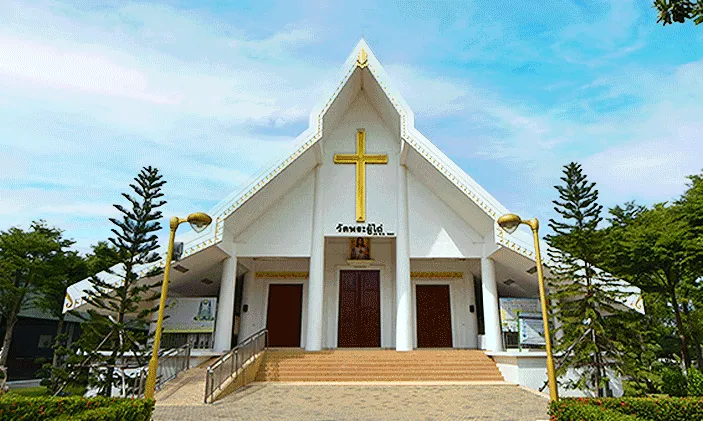
Phra Maha Thai Saopha Church, Nakhon Nayok Province, also known within the Catholic community as Holy Redeemer Church, Saopha, is a Roman Catholic church in Ongkharak District that continues to hold Mass and religious activities on a regular basis. The church building seen today was rebuilt around 1992, but the faith community here has much deeper roots. It is therefore both an important religious site for local Christians and an interesting destination for those who want to see another side of Nakhon Nayok beyond nature, including community history, faith, architecture, and contemporary local life.
Phra Maha Thai Saopha Church is located in Ongkharak District, Nakhon Nayok Province, along the Rangsit–Nakhon Nayok Road, an important route linking the Bangkok outskirts with older communities and agricultural areas of Ongkharak. Most travel websites refer to it as “Phra Maha Thai Saopha Church,” while in Catholic circles it is known as “Holy Redeemer Church, Saopha.” Both names refer to the same place, and both reflect the Christian meaning of Jesus Christ as the Redeemer of humankind.
The charm of this place does not lie in the grandeur or luxury often associated with large churches in major cities, but rather in its quietness, the continuity of its faith community, and the atmosphere that makes visitors feel they are stepping into a living place where worship is truly practiced. It continues to serve as a spiritual center for Christians in Ongkharak in a very real sense. For this reason, the church is especially suitable for a cultural travel article, as it offers local history, religious significance, and easy access from Bangkok.
This church was rebuilt around 1992, but a closer look shows that the importance of Holy Redeemer Church, Saopha, did not begin only in the year the current building was completed. The Catholic community of Saopha in Ongkharak has a long memory, with annual celebrations of the faith community and religious ceremonies continuing over time. There are also old photographs of Marian processions in the Ongkharak market community that are connected with Holy Redeemer Church, Saopha, showing that this church has played a role in the area for much longer than the current building itself.
The word “Saopha” in the church’s name also gives the place a distinctive identity. It is not simply a general Holy Redeemer church, but one closely tied to the Saopha community in Ongkharak. It therefore stands as both a religious site and a cultural marker of the local Catholic community. This significance makes Phra Maha Thai Saopha Church more than just a photo stop. It is a place that deserves to be approached with respect and with an understanding of the people whose lives are deeply connected to it.
Architecturally, the present church building reflects the style of modern Thai Catholic churches that emphasize simplicity, practicality, and suitability for the community rather than elaborate decoration in the manner of large European cathedrals. Its most notable feature is the proportion of the building, which conveys a sense of stability, calmness, and order. This form is well aligned with its function as a venue for Mass and daily religious activities without diminishing the sacred character of the interior space.
From the outside, visitors can sense the image of a Christian religious building that is clean, uncluttered, and welcoming. Its atmosphere differs from that of Thai Buddhist temples or other sacred places that many people in Thailand are more familiar with. This makes it especially interesting for travelers who want to experience the country’s religious diversity, particularly in a province like Nakhon Nayok, which is more commonly remembered for waterfalls, reservoirs, and lush natural scenery than for Christian religious landmarks.
Inside the church, in accordance with Catholic tradition, there are important spaces such as the altar, pews for the congregation, and religious elements designed primarily for prayer and liturgical use rather than for display. The beauty of this type of church lies in its stillness, orderliness, and the interplay of light and shadow within the building, which helps create a naturally peaceful atmosphere. Those accustomed to fast-paced travel may find that this is a place that encourages them to slow down and look more carefully at the space before them.
Another reason Phra Maha Thai Saopha Church is so interesting is its role as a religious center that remains genuinely active. There are still Sunday and weekday Mass schedules, and the community continues to show activity through its official page and through religious events held in cooperation with nearby institutions. This means the church is not merely a destination listed in travel brochures or on a map, but a real place of daily use for Christians in the area.
The Holy Redeemer Church, Saopha community continues to hold Masses, faith community celebrations, cemetery-related activities, and joint religious events with St. Theresa International University. This clearly confirms that the church has not been permanently closed, has not been abandoned, and still plays an important role within the Catholic network of Ongkharak and the related diocese.
For those interested in community history, one particularly notable point is that the name of Holy Redeemer Church, Saopha appears in local memory and in old documents and photographs related to Marian processions in Ongkharak market. This shows that although the present building was reconstructed in 1992, the original faith community is much older. The church should therefore be viewed as a continuation of an older community rather than as something whose story began only in 1992.
In religious terms, this church has a straightforward role as a place for celebrating Mass, receiving the sacraments, and gathering for prayer. In social terms, however, Holy Redeemer Church, Saopha also serves as a meeting point for people of different generations, from long-established local families to students and staff members who are connected to Catholic activities in Ongkharak. The continued presence of such a church shows how religions coexist in Thai society in a way that may not be dramatic, but is steady and deeply rooted.
From the perspective of cultural tourism, Phra Maha Thai Saopha Church is especially suitable for those who want to make a day trip from Bangkok and include a stop with a different atmosphere from cafes or plant markets. Visiting a Christian church in Ongkharak adds a cultural layer to a Nakhon Nayok itinerary, because it expands the trip beyond nature and connects it with community history, faith, and local stories.
The overall atmosphere of the church is ideal for people who enjoy quiet, peaceful places and do not want the crowds often found at major tourist attractions. The surrounding area feels more like a community space than a commercial site, making it suitable for a respectful short visit that still leaves a meaningful impression. Those who enjoy photographing architecture will find images that are simple, classic, and softened by natural light, especially in the morning or late afternoon when the sunlight is less harsh.
Another strong point is its accessibility. The church is located in Ongkharak District, which is easy to reach from Bangkok via the Rangsit–Nakhon Nayok route. It is also not far from the university area, medical facilities, and popular cafes around Khlong 14–15, making it easy to include as one destination in a wider trip. For example, visitors can stop by the church in the morning and then continue on to a cafe or agricultural tourism site in Ongkharak later in the day.
As for the current community leader, the latest verifiable information points to Father Joseph Pinan Pornprasith, who presided over certain Masses and activities related to Holy Redeemer Church, Saopha in 2025. There is also information from the church’s page about welcoming a new parish priest in an earlier period. His name is therefore the latest community leadership information that can be reliably cited at this time, although internal administrative details may change in the future according to diocesan assignments.
Visitors should understand that a Catholic church is an active place of worship. They should dress modestly, speak quietly, and avoid walking inside to take photographs during Mass or prayer services. If they wish to photograph the interior, they should ask permission first. Showing respect to a place like this is not only basic etiquette, but also helps ensure that cultural tourism is meaningful and does not disturb the local community.
Those who want to experience a special atmosphere may choose to visit near a Sunday service or during major Christian festivals such as Christmas, the month of Mary, or the celebration of the faith community, because these are the times when the role of the church is most visible in terms of decoration, community gatherings, and religious atmosphere. However, for those who want mainly to enjoy the quietness and photograph the building, weekdays provide a calmer and more private setting.
From the perspective of local history, the presence of Phra Maha Thai Saopha Church in Nakhon Nayok also reinforces the fact that the central region around Bangkok is not shaped only by Buddhist temples, floating markets, or agricultural communities. It also includes the history of Catholic communities that have genuinely taken root and are connected to migration, settlement, and community-building during different periods of modern Thai history. The church therefore has value far beyond its immediate visual appeal.
Travelers who enjoy reading a place through its stories will find this church particularly interesting because of the overlap between the long past of the community and the building that was reconstructed in the late 20th century. This overlap makes Phra Maha Thai Saopha Church more than a religious structure. It becomes a symbol of faith carried forward from one generation to the next and evidence that the Catholic community in Ongkharak continues to live on actively to this day.
If asked who Phra Maha Thai Saopha Church is best suited for, the answer would be 3 main groups. The first is those interested in religion and Christian architecture. The second is travelers looking for a cultural destination in Nakhon Nayok that differs from the usual tourist route. The third is those who want a peaceful stop on the way to Ongkharak, Khlong 15, or the university zone, and who are looking for a place to rest both their eyes and their minds rather than merely ticking off another photo stop.
Getting There The most convenient way to reach Phra Maha Thai Saopha Church is by private car via the Rangsit–Nakhon Nayok Road toward Ongkharak District, then turning into the Ongkharak area according to the location coordinates. Travelers coming from Bangkok can easily plan this as a half-day or full-day trip. If you do not have a car, you can take public transport to Ongkharak first and then continue by local hired transport to the church. This is possible, but less convenient than driving, especially if you want to visit several places in the same area.
The church’s location also works well for a mixed itinerary. You can begin with a calm and respectful visit in the morning, continue to a cafe or agricultural tourism site around Khlong 14–15, and then finish by stopping in Ongkharak town or driving on to other attractions in Nakhon Nayok. This kind of route gives the trip both quiet moments and more relaxed leisure time without requiring a rushed schedule.
For first-time visitors, the main thing to prepare is the understanding that this is not a commercial check-in point, but a religious site that should be visited respectfully. If you arrive while a ceremony is taking place, observe the atmosphere first. If clergy or worshippers are in the middle of a service, it is better to wait or to view only the exterior. Paying attention to such etiquette helps ensure that the experience remains harmonious for both visitors and the community.
In conclusion, Phra Maha Thai Saopha Church in Nakhon Nayok Province is a place of value on several levels at once: religious, communal, and cultural-tourism related. The present building may have been rebuilt around 1992, but the identity of the Saopha faith community is much older and has continued into the present day. If you are looking for a place in Nakhon Nayok that offers more than surface beauty, this is one destination truly worth visiting.
| Place Summary | A Roman Catholic church in Ongkharak District, Nakhon Nayok Province, known within the Catholic community as Holy Redeemer Church, Saopha, and still actively used for religious services. |
| Highlights | A peaceful Christian church that is easy to reach from Bangkok, reflecting the history of the Catholic community in Ongkharak and well suited to religious and cultural tourism. |
| History / Period | The present church building was rebuilt around 1992, but the faith community of Holy Redeemer Church, Saopha is older and has long been mentioned in Ongkharak community activities. |
| Latest Community Leader | Father Joseph Pinan Pornprasith (latest verifiable information from 2025 activities) |
| Address | 184 Moo 2, Ongkharak Subdistrict, Ongkharak District, Nakhon Nayok 26120 |
| Coordinates | 14.118730, 100.993092 |
| Getting There | Best reached by private car via the Rangsit–Nakhon Nayok Road, then entering Ongkharak according to the coordinates. If using public transport, travel to Ongkharak first and continue by local hired transport. |
| Open Days / Opening Hours | Every day / 08.00 – 17.00 |
| Facilities | Church grounds, worship space, and community religious activity areas |
| Current Status | Still active and continuously used for religious activities |
| Nearby Attractions | 1. Farm de Lek, Khlong 15, about 6 km. 2. Wat Pa Khlong 15, about 6 km. 3. Uthayan Mai Yai, Khlong 14, about 8 km. 4. Kiatipat Plant Garden, Khlong 15, about 9 km. 5. St. Theresa International University, about 10 km. |
| Popular Restaurants Nearby | 1. Montreux Cafe and Farm, about 8 km. Tel. 087-979-7341 2. Phuan Farm Cafe and Restaurant, about 7 km. Tel. 094-964-1461, 064-569-4636 3. Pa In Garden Coffee Shop, about 8 km. Tel. 097-359-3937 4. RATI CHA, about 9 km. Tel. 091-860-2009 5. Darin’s Day Cafe, about 10 km. Tel. 090-282-4919 |
| Popular Accommodations Nearby | 1. Area 15 Hotel & Apartment, about 4.79 km. 2. Hong Phak Lang Mor, about 5 km. Tel. 090-549-3665, 098-302-9934 3. Suan Supachok Dormitory, Ongkharak Khlong 16, about 5.69 km. 4. Mescape, about 6.72 km. Tel. 093-539-9997 5. Tara Cholapruek Resort, about 20 km. Tel. 037-614-444, 037-307-567, 080-630-3331 |
| Main Contact Numbers | 084-654-3518, 037-391-087, 037-391-718 |
Frequently Asked Questions (FAQ)
Q: Where is Phra Maha Thai Saopha Church located?
A: Phra Maha Thai Saopha Church, or Holy Redeemer Church, Saopha, is located at 184 Moo 2, Ongkharak Subdistrict, Ongkharak District, Nakhon Nayok Province.
Q: When was Phra Maha Thai Saopha Church built?
A: The present church building was rebuilt around 1992, but the Catholic community in this area is older than the current structure.
Q: Is Phra Maha Thai Saopha Church open to visitors?
A: There is information indicating that it is open every day from 08.00 to 17.00. However, if you wish to enter during Mass or religious activities, you should respect the site and avoid disturbing ceremonies.
Q: How do I get to Phra Maha Thai Saopha Church?
A: The most convenient way is by private car along the Rangsit–Nakhon Nayok Road, then continuing into Ongkharak according to the location coordinates. If using public transport, travel to Ongkharak first and continue by local hired transport.
Q: Is Phra Maha Thai Saopha Church still active?
A: Yes. It is still active and there is ongoing evidence of religious ceremonies and church community activities.
Q: What should I wear when visiting Phra Maha Thai Saopha Church?
A: Visitors should dress modestly, as it is an active place of worship. They should also avoid making loud noise or taking photographs during ceremonies without permission.
 Phramahathai Church Map
 Category:
  Group:
  Last Update: 23 HourAgo
 Nearby Attractions
 Region
 Muang Nakhon Nayok(