
 Home
Home North(
 Chiang Mai(


Rating: 3.1/5 (8 votes)
 |
|  Map
Map 
 Have Map
  No Map
Nakhon Nayok attractions
Attractions in Thailand
Open Days: Daily
Opening Hours: 08.00 – 17.00
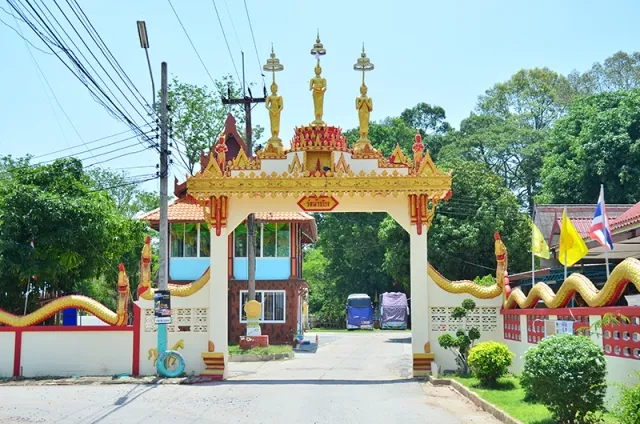
Wat Huai Rong, Nakhon Nayok, is an old temple in Ko Pho Subdistrict, Pak Phli District, with deep roots in the local community. It is one of the temples that clearly reflects the character of a traditional Thai rural monastery, both in terms of local history, community faith, and artistic heritage that can still be seen today. Although this temple is not a large monastery or a nationally famous tourist landmark, when viewed through the lens of local history, Wat Huai Rong remains a spiritual center of profound importance for the people of the area.
Local information states that Wat Huai Rong was established around 2390 BE, which places its origins in the early Rattanakosin period and gives it a history stretching back more than one and a half centuries. In the context of the old community, the temple was not merely a place for religious ceremonies. It also served as a space for learning, gathering, and the transmission of local culture. Wat Huai Rong therefore appears to have played the role of a community center from the early period of settlement in this area.
Phra Pae was the first abbot of Wat Huai Rong, reflecting that the temple was formally established and cared for from an early stage. The fact that the name of the first abbot remains in local memory is an important sign that this temple was not simply an old religious structure standing in place, but an active Buddhist institution with which the people felt a lasting connection. Over time, Wat Huai Rong gradually grew alongside the community and became a sacred place that has supported local life for generations.
What makes Wat Huai Rong especially distinctive is that it has preserved several old symbols of faith, most notably the ancient Buddha image revered by the local people under the name “Luang Pho Phuttha Sukho.” This Buddha image is not only an object of religious art in a formal sense, but also the spiritual heart of the community. Many families in the area know Luang Pho Phuttha Sukho as a revered Buddha image closely tied to village life, an image before which people come to pay respect, pray for blessings, and seek spiritual support during important moments in their lives.
In cultural terms, the importance of Luang Pho Phuttha Sukho lies in its role as a symbol of continuity in local belief. A Buddha image that has been venerated by a community across many generations carries value not only in artistic terms, but also as a vessel of shared memory, a link between the people and their temple, and a focal point for religious practices that have continued across different periods. The devotion people hold toward Luang Pho Phuttha Sukho is therefore a key factor that keeps Wat Huai Rong alive as a true center of the community, rather than merely an old temple marked only by physical remains.
Another highly valuable highlight of Wat Huai Rong is its teakwood pulpit decorated entirely with traditional Thai motifs and believed to be several hundred years old. The pulpit is an important element of a Thai temple, used as the seat from which monks deliver sermons, preach the Vessantara Jataka, or give teachings on important occasions. The fact that Wat Huai Rong still preserves this ancient teak pulpit in a condition worthy of mention shows that the temple possesses heritage of notable artistic and craftsmanship value. Such pulpits are not found in every temple, and when one is described as being fully made of teak and adorned with Thai motifs, it reflects both the quality of the workmanship and the refinement of traditional Thai decorative art.
From the perspective of art history, an ancient teak pulpit means far more than visual beauty. It is evidence that tells us about the aesthetic taste, faith, and social standing of the community in the past. The creation of a fully carved Thai-style pulpit required quality materials, highly skilled craftsmen, and a sincere intention to offer the best to Buddhism. The pulpit at Wat Huai Rong is therefore an important cultural legacy and one of the main reasons why this temple stands out from an ordinary community temple.
When entering Wat Huai Rong, visitors often notice the simple and peaceful atmosphere of a rural Thai temple. The quiet surroundings, the shade, and the welcoming character of the place make it ideal for making merit, paying respect to Buddha images, and calming the mind away from the rush of daily life. The appeal of the temple does not lie in grand architecture, but in the charm of an old monastery that grew together with its village and has preserved its identity very well.
Wat Huai Rong is also important as a social center for the community, because temple activities are closely linked with merit-making, traditional events, and local Buddhist ceremonies. The fact that the grounds are still used for religious merit-making, listening to sermons, and participating in shared community activities confirms that the role of the temple has not faded with time. On the contrary, the temple continues to be a place that strengthens the sense of unity among the people, both on major Buddhist holy days and during annual local occasions.
From a tourism perspective, Wat Huai Rong is suitable for those interested in old temples, local history, and the atmosphere of traditional Thai community life. Travelers coming to Pak Phli District or Nakhon Nayok Province who wish to stop at a temple that offers more than a brief visit for worship will find Wat Huai Rong worthwhile. It combines spiritual value, artistic heritage, and historical significance closely tied to the way of life of the people in the area.
In addition, Wat Huai Rong is well suited for visitors interested in studying the relationship between temples and communities in Thai society. Several key elements of the temple, whether the sacred Buddha image, the ancient pulpit, or the memory of the first abbot, all show that the temple does not exist separately from the community, but is part of a cultural structure that has shaped local people for a very long time.
For those who come specifically to pay respect to Luang Pho Phuttha Sukho, a visit to Wat Huai Rong is not only a journey to pray for blessings or make merit. It is also an opportunity to experience a continuity of faith passed down from the past into the present. The sacred presence of the Buddha image in the eyes of local people gives the act of worship a deeper spiritual meaning than simply viewing an old religious object, because it connects the visitor with the living stories and beliefs of the community.
Visitors should dress modestly, behave respectfully, and honor the sacred space of the temple, especially around the area where the Buddha image is enshrined and in sections associated with antique objects such as the ancient teak pulpit. These should not be touched or approached in ways that may cause damage. If you wish to take photographs, it should be done appropriately and without disturbing monks or those who are practicing meditation within the temple grounds.
Getting There Wat Huai Rong is most conveniently reached by private car. Travel into Pak Phli District, Nakhon Nayok Province, and continue toward Ko Pho Subdistrict. The temple is located in Ban Huai Rong, an area closely connected to the surrounding community. This kind of journey is well suited to a half-day or full-day itinerary, and Wat Huai Rong can be combined with other attractions in Nakhon Nayok such as Khun Dan Prakan Chon Dam, Nang Rong Waterfall, Sarika Waterfall, or other old temples nearby. This makes a visit to the temple suitable both as a merit-making trip and as a local cultural exploration in the same day.
Although the overall appearance of Wat Huai Rong may seem simple, the true value of this temple lies in the small but meaningful details preserved within it, from the history of its foundation, the memory of Phra Pae as the first abbot, the devotion toward Luang Pho Phuttha Sukho, and the beauty of its carved teak pulpit. These elements make Wat Huai Rong more than just another old temple in Nakhon Nayok. It is a place that deeply and clearly reflects the meaning of a “community temple.”
For those seeking a place that offers peace, historical value, and a close connection to local life, Wat Huai Rong is a destination well worth visiting. It offers not only the experience of paying respect at a temple, but also the chance to see the beauty of Thai cultural roots that continue to live on in the everyday life of the community.
| Place Summary | An old temple in Ban Huai Rong, Ko Pho Subdistrict, Pak Phli District, Nakhon Nayok Province. It is a Mahanikaya royal-supported local temple with a history dating back to around 2390 BE and remains a center of faith for the community. |
| Highlights | Luang Pho Phuttha Sukho, an ancient Buddha image revered by local people; a fully carved teakwood pulpit with traditional Thai motifs believed to be several hundred years old; and the peaceful atmosphere of a rural temple |
| History / Period | Established around 2390 BE and registered as a temple in the same year according to Thai temple records |
| First Abbot | Phra Pae |
| Address | Ban Huai Rong, Moo 1, Ko Pho Subdistrict, Pak Phli District, Nakhon Nayok 26130 |
| Getting There | Best reached by private car. Travel into Pak Phli District and continue to Ko Pho Subdistrict. The temple is located within the Ban Huai Rong community and can be included in a one-day temple and nature itinerary in Nakhon Nayok |
| Open Days / Opening Hours | Daily / 08.00 – 17.00 |
| Facilities | Parking area, spaces for religious activities, sermon hall, ordination hall, and the usual sacred and monastic zones found in a community temple |
| Zones | Area of Luang Pho Phuttha Sukho, ordination hall, sermon hall, monks’ living quarters, and community merit-making spaces |
| Nearby Tourist Attractions | 1. Wat Jindaram (Wat Dong Kha), about 4 km 2. Wat Sakae Sueng, about 6 km 3. Huai Prue Reservoir, about 18 km 4. Khun Dan Prakan Chon Dam, about 26 km 5. Nang Rong Waterfall, about 27 km |
| Nearby Restaurants | 1. Srisunee Restaurant, about 17 km, Tel. 037-311529 2. Daeng Kaeng Pa Nakhon Nayok, about 18 km, Tel. 089-073-4516 3. Krua Hydro Nakhon Nayok, about 19 km, Tel. 037-615-469, 081-864-2995 4. Krua Manao, about 28 km, Tel. 037-328327, 037-328313 5. Baan Boonamnuay Garden Restaurant, about 30 km, Tel. 092-557-2745 |
| Nearby Accommodations | 1. Baan Suan Khun Yai Resort, about 16 km, Tel. 098-347-6289 2. At Rice Resort, about 24 km, Tel. 037-385-013, 095-548-8601 3. Phumontra Resort Nakhon Nayok, about 27 km, Tel. 037-349-258, 093-616-3561 4. The Forest Home Resort, about 30 km, Tel. 037-385086, 037-385087, 087-554-5150 5. Rimthan Resort Nakhon Nayok, about 31 km, Tel. 092-772-8888, 092-772-9999, 063-958-8380 |
| Main Contact Number | 086-102-9691 |
Frequently Asked Questions (FAQ)
Q: Where is Wat Huai Rong located?
A: Wat Huai Rong is located in Ban Huai Rong, Moo 1, Ko Pho Subdistrict, Pak Phli District, Nakhon Nayok 26130. It is an old community temple in the Pak Phli area.
Q: When was Wat Huai Rong established?
A: Local information states that Wat Huai Rong was established around 2390 BE, making it a temple with a very long history in the community of Nakhon Nayok.
Q: What is the main highlight of Wat Huai Rong?
A: The temple’s most important highlights are Luang Pho Phuttha Sukho, an ancient Buddha image revered by local people, and the fully carved teakwood pulpit with traditional Thai motifs that is believed to be several hundred years old.
Q: What kind of visit is Wat Huai Rong suitable for?
A: It is ideal for paying respect to Buddha images, making merit, learning about local history, and enjoying the peaceful atmosphere of a rural temple. It can also be combined with a nature trip in Nakhon Nayok on the same day.
Q: Is it convenient to visit Wat Huai Rong by private car?
A: Yes. It is the most convenient option because the temple is located within the community area of Ko Pho Subdistrict. Driving into Pak Phli District and then using a map for the final approach is easier than relying on public transportation.
Q: How should visitors behave when visiting Wat Huai Rong?
A: Visitors should dress modestly, behave respectfully, honor the sacred space, avoid touching antique objects unnecessarily, and take photographs appropriately without disturbing monks or those practicing meditation.
 Wat Huai Rong Map
 Category:
  Group:
  Last Update: 1 DayAgo
Comment
 Nearby Attractions
| Keyword (Advance) |
 Facebook Fanpage
 Region
 Art, Culture and Heritage
 Historical Sites and Monuments(
 Landmarks and Memorials(
 Art, Craft Centres, Tradition(
 Museums(
 Educational Places
 Educational Gardens, Farm(
 University
 Church(
 Mosque(
 Other religious and spiritural sites(
 Suburban Living
 Village, Community(
 Local Market(
 Nature and Wildlife
 Dam, Reservoir, Lake(
 Waterfalls(
 Other natural attractions(
 Entertainment and Agricultural
 Farm, Parks, Gardens and Ecotourism(
 Outdoor and Adventure Activities(