
 Home
Home North(
 Chiang Mai(


Rating: 3.6/5 (5 votes)
 |
|  Map
Map 
 Have Map
  No Map
Bangkok attractions
Attractions in Thailand
Open Days: Not specified (please contact the mosque in advance)
Opening Hours: Not specified (please contact the mosque in advance)
Nurul Islam Mosque (Ban Pa) is one of Bangkok’s long-established Muslim cultural sites—somewhere many people might simply “drive past” without realizing that, tucked inside Pattanakarn 20 Alley 7, there is a deep story of settlement, community growth, and generations of collective effort that shaped a spiritual center quietly holding its meaning in place.
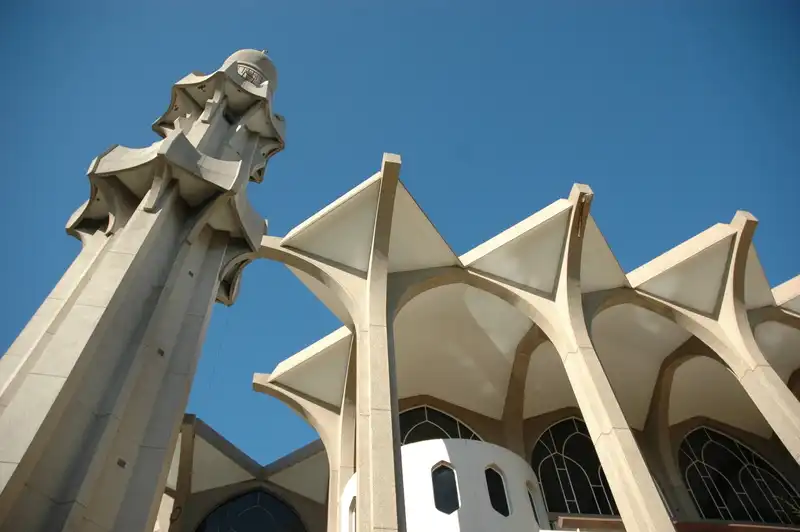
What makes this place different from a typical visit to a religious site is the living “community narrative” you can still trace today: the earlier name “Surao Ban Pa,” the story of Khlong Ban Pa connecting out to Khlong Phra Khanong, and the way the mosque itself was rebuilt as the number of worshippers increased—eventually becoming the current building with a prominent minaret and expanded space to support community activities.
About 182 years ago, a group of Muslim brothers and sisters migrated from the city of Fatoni, or today’s Pattani province. Led by Chama and Chanuramdah, they settled and formed a small village deep inside a forest filled with trees large and small. This is why the village came to be known as “Ban Pa” (“Forest Village”). The area also had a small canal flowing out to a larger waterway, Khlong Phra Khanong; that smaller canal was called “Khlong Ban Pa.”
As the small group grew into a larger community, a mosque was built in the lower part of the forest—an area later known as Ban Lang (the lower village). A cemetery (kubor) was also established and called Kubor Ban Lang. Later, as the number of worshippers increased, the original mosque was moved and rebuilt on the site of the present mosque. This second mosque was a teak wooden house with a clay-tile roof and plank walls, and the community even purchased logs and sawed the timber themselves.
Later, in 2475 B.E. (1932), the congregation increased significantly and the older building deteriorated. The worshippers then joined together to build the third mosque: a two-story wooden structure with a hip roof and tiled roofing. The walls were teak, and the lower floor was entirely teak. The upper floor was half teak and half Ta-bak (a local hardwood). The building was approximately 9 meters wide and 21 meters long. This third mosque was considered one of the larger mosques in Bangkok at the time.
After the Islamic Mosque Act was introduced, the mosque was registered as a legal entity under the Act on 4 April 2429 B.E., Registration No. 22, Moo 9, Khlong Tan Subdistrict, Phra Khanong District, Bangkok. Today it is known as “Nurul Islam Mosque,” located at No. 22, Moo 19, Suan Luang Subdistrict, Phra Khanong District, Bangkok. As the congregation continued to grow without stopping, the third mosque—though already quite large—soon became cramped. The worshippers endured these limitations for many years. Later, on 23 January 2513 B.E., the committee and worshippers discussed what should be done and how. In the end, the meeting unanimously resolved to proceed.
Mr. Paijit Pongparuerk was assigned as the designer of the new mosque building. On Monday, 30 April 2516 B.E., the old mosque was dismantled. On Monday, 7 May 2516 B.E. (H. 1393), piling work and surveying began by Ajarn Muhammad Mahmad and Abdullatif Boonrod. Then, on Monday, 14 May 2516 B.E. (H. 1393), the committee and worshippers held the foundation-laying ceremony for the large new mosque building, with the Chularatchamontri presiding as chairman. Alhamdulillah, construction proceeded steadily with strong cooperation from the worshippers of Nurul Islam Mosque as well as Muslims in general.
The fourth mosque building has the following dimensions: 42 meters long and 34 meters wide, with a minaret 42 meters high. It is a two-story reinforced-concrete structure. The ground floor uses polished stone flooring; the interior walls are finished with marble and mosaic, and the interior columns are clad in marble. The upper floor is parquet (unfinished with shellac). The exterior largely uses exposed aggregate finishes (washed gravel and stone). Facilities include a reception room, meeting room, sound-and-light room, and storage. There are 14 ablution stations. Construction began on 14 May 2516 B.E. (H. 1393) and was completed on 29 April 2519 B.E. (H. 1396), taking nearly 3 years. The total budget was 6,009,053 baht. No one was sent out to solicit donations anywhere; all funding came directly from the people.
After reading this story, it becomes clear that “Nurul Islam Mosque (Ban Pa)” did not emerge from a desire to build something merely beautiful. It grew from faith—faith that expanded with the community and with the practical needs of each era, from a wooden mosque built by the community’s own hands to a reinforced-concrete building that supports a wide range of uses: prayer space, committee gatherings, community events, and an organized system for ablution.
Architecturally, what many people notice first is the “large scale of the building” and the “minaret” that anchors the eye. Equally worth paying attention to are the functional details inside—such as the recorded interior finishes (marble and mosaic) and the way space is organized around real community use. These elements reflect a design shaped by lived function, not aesthetics alone.
Getting There If you are coming specifically to visit, pin the location to Pattanakarn 20 Alley 7 in Suan Luang area, then take a moment to observe the surrounding neighborhood—this makes it easier to connect the story to the place. For public transport, you can use bus routes passing through the area and walk a short distance from nearby stops.
If you visit as a guest (not as a worshipper attending religious observance), a simple approach works best: dress respectfully, be mindful of the prayer area, avoid disturbing religious times, and if you wish to take photos or walk inside, ask permission from the caretakers first so the visit feels comfortable “for both sides.”
| Name | Nurul Islam Mosque (Ban Pa) |
| Location | Pattanakarn 20 Alley 7, Suan Luang Subdistrict, Suan Luang District, Bangkok 10250 |
| Mosque Highlights | A long-established “Ban Pa” community with a settlement story linked to Fatoni/Pattani; a 4-era mosque-building history; the current building is large (42 m long, 34 m wide) with a 42 m minaret; a community hub for religious life and local activities. |
| Mosque Caretakers | Registration applicants’ information (Imam/Khatib/Bilal) appears in the Bangkok Islamic Committee’s mosque registration system. |
| Contact Number | 086-620-8826 |
| Nearby Attractions (Approx. Distance) | Thanya Park Srinakarin ~ 2.2 km Seacon Square Srinakarin ~ 3.9 km, Tel. 02-721-8888 Paradise Park ~ 4.9 km Big C On Nut ~ 5.1 km The Nine Center Rama 9 ~ 5.6 km, Tel. 1285 |
| Nearby Restaurants (Approx. Distance) | Fantuan (Seacon Square Srinakarin branch) ~ 3.9 km, Tel. 084-170-9170 (Tip: If you need “100% halal,” it’s best to call and confirm directly with the restaurant for peace of mind.) |
| Nearby Accommodations (Approx. Distance) | The Grand Fourwings Convention Hotel Bangkok (Srinakarin–Hua Mak area), Tel. 02-378-8000 |
Frequently Asked Questions (FAQ)
Q: Which district of Bangkok is Nurul Islam Mosque (Ban Pa) located in?
A: It is located in Pattanakarn 20 Alley 7, Suan Luang Subdistrict, Suan Luang District, Bangkok.
Q: Why is the community here called “Ban Pa”?
A: According to the settlement story, the area was originally a forest with dense trees, and there was a small canal called “Khlong Ban Pa” connecting out to Khlong Phra Khanong—hence the name “Ban Pa.”
Q: How many times has the mosque been built or rebuilt?
A: The community narrative describes four major eras of building/moving/rebuilding, culminating in the current structure.
Q: If I want to visit, what is the appropriate etiquette?
A: Dress respectfully, be mindful of the prayer space, avoid disturbing religious observance times, and if you wish to take photos or go inside, ask permission from the caretakers first.
Q: What is the contact number for the mosque?
A: 086-620-8826.
Q: Where can I go after visiting the mosque?
A: Nearby stops include Thanya Park, Seacon Square Srinakarin, Paradise Park, and The Nine Center Rama 9—each within a short distance based on the reference distances listed.
 Mobile: 0866208826
 Nurul Islam Mosque (Ban Pa) Map
 Category:
  Group:
  Last Update: 2 MonthAgo
Comment
 Nearby Attractions
| Keyword (Advance) |
 Region
|
 Phra Nakhon(